_2768.jpg)
A crustacean wearing a shell it was never entitled to
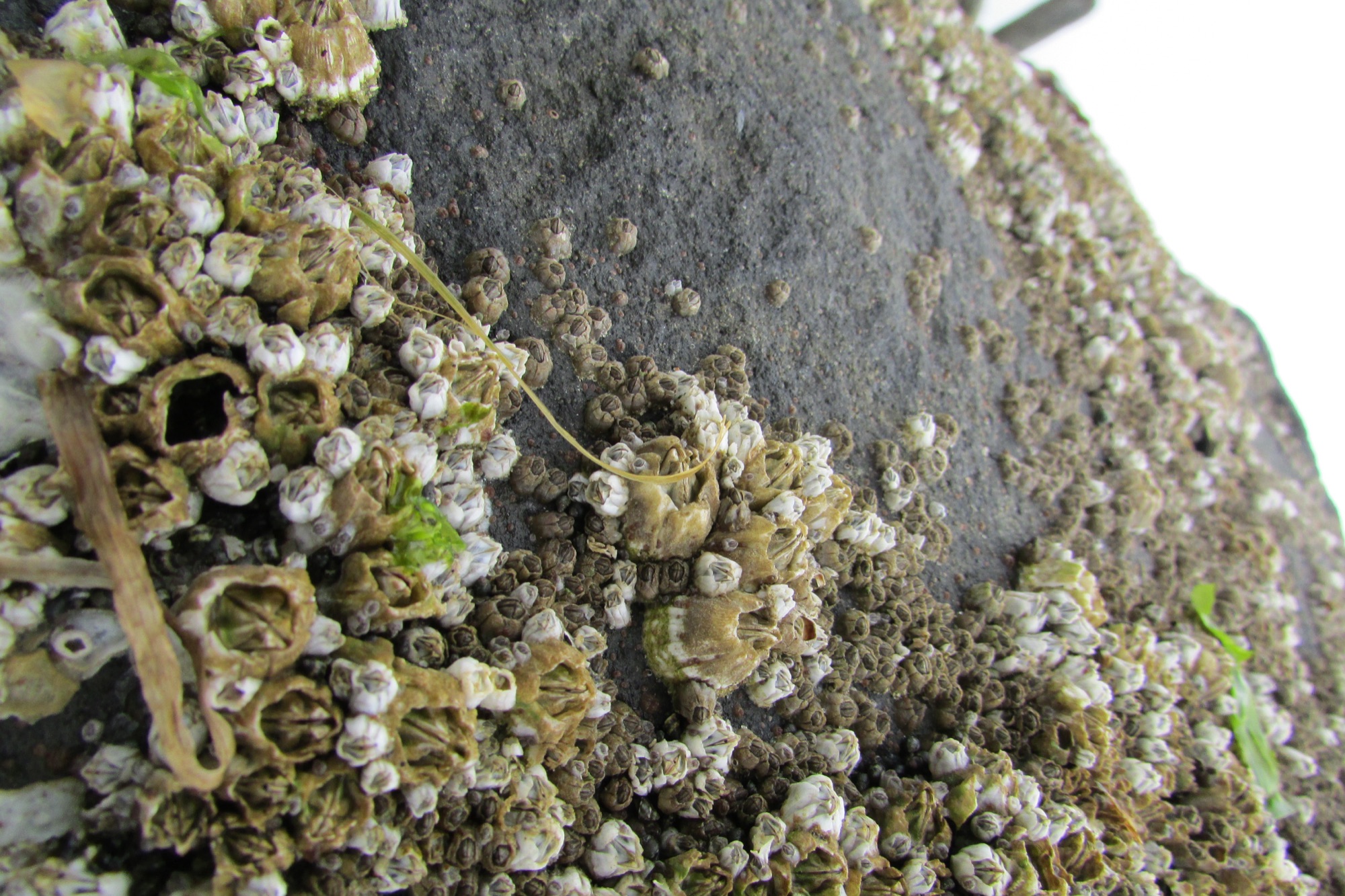
For most of recorded natural history, barnacles were classified as mollusks, grouped with limpets and mussels because of the chalky plates covering their bodies. Georges Cuvier still listed them that way in the early 1800s. It took J. Vaughan Thompson's 1830 discovery of the barnacle's free-swimming larval stage, a nauplius nearly identical to other crustacean larvae, to establish that barnacles are crustaceans, cousins of crabs, shrimp, and land giants like the coconut crab. Where evolution pushed the coconut crab toward becoming the largest land invertebrate alive, it pushed barnacles toward giving up movement entirely.
That surrender happens in a second larval stage called the cyprid, which does not feed. Its only job is to find a permanent home: it swims along a surface using paired antennules tipped with sensory organs, testing chemical cues and texture, and once it settles on a spot, it cements itself head-first with a permanent glue and metamorphoses into the adult form. From that point on, the animal cannot relocate even a few centimeters, a fact reflected in the group's formal name, Cirripedia, Latin for "curl-footed," after the feathery, leg-derived structures called cirri that adults sweep rhythmically through the water to catch food particles. The same intertidal rocks where barnacles cement themselves for life are often grazed by sea urchins, animals that retain the ability to move. Studies of three urchin species with different lifespans found little sign of cellular senescence, a narrower finding than negligible aging across the entire group.
The glue biomedical researchers cannot yet replicate
Because an adult barnacle can never crawl away from a bad decision, the cement it uses to attach has to work permanently, underwater, on surfaces ranging from bare rock to living whale skin. An early study on the ivory barnacle, Balanus eburneus, calculated its cement's tensile strength at more than 50,000 pounds per square inch, a figure still cited in barnacle-adhesion research today even though the original measurement used crude 1960s-era methods. Modern biochemistry has identified what makes the bond work: cement proteins that are highly hydrophobic and cross-linked through cysteine residues, self-assembling into a hardened layer that resists both water and the microbial biofilms that would otherwise dissolve most glues.
That resistance to wet, dirty, biologically active conditions is exactly what surgeons need and synthetic adhesives generally lack, which is why barnacle cement has become an active biomedical research target. A 2019 review in Frontiers in Marine Science laid out the biochemistry researchers are trying to reverse-engineer, and follow-up work, including a study on a recombinant version of the cement protein cp19k from Balanus albicostatus, has produced lab-made aggregates with adhesion strength comparable to several commercial glues. None of it has yet reached an operating room. What barnacles solved by evolutionary trial and error over millions of years, biomedical engineers are still working to copy on a lab bench.
Darwin's eight-year obsession, and the penis that turned out not to be mandatory
Charles Darwin spent eight years, from 1846 to 1854, dissecting barnacles almost exclusively, publishing a four-volume monograph on the group before he ever published On the Origin of Species. He was startled by their reproductive anatomy: barnacles are simultaneous hermaphrodites but almost always fertilize a neighbor, not themselves, and since neither partner can move, one has to physically reach the other. Writing about the barnacle genus Cryptophialus, Darwin recorded that "the probosciformed penis is wonderfully developed, so that... when fully extended, it must equal between eight and nine times the entire length of the animal." Relative to body size, it remains the longest penis documented in the animal kingdom.
That organ is not a fixed trait. Neufeld and Palmer's 2008 study of the acorn barnacle Balanus glandula found that individuals from wave-battered outer coasts grow penises that are shorter, stouter, and more than twice as massive for their length as those from sheltered bays nearby, a difference the maximum velocity of breaking waves at each site predicted closely. To rule out the possibility that this was simply which barnacles survived at which site, the researchers transplanted animals between a wave-exposed shore and a protected harbor; the transplants grew new penises matching their new environment within one reproductive season, proof the shape is plastic rather than genetically fixed. Then, in 2013, Marjan Barazandeh and colleagues found something that undercut the entire premise that a long penis is required at all: genetic paternity testing on gooseneck barnacles (Pollicipes polymerus) that lived well outside any neighbor's physical reach still turned up fertilized eggs carrying another individual's DNA. The barnacles had captured sperm released into open water, a strategy called spermcast mating that overturned an assumption biologists had held, largely unquestioned, since Darwin's own monograph.

A parasitic relative that castrates crabs, and shells that record where whales have been
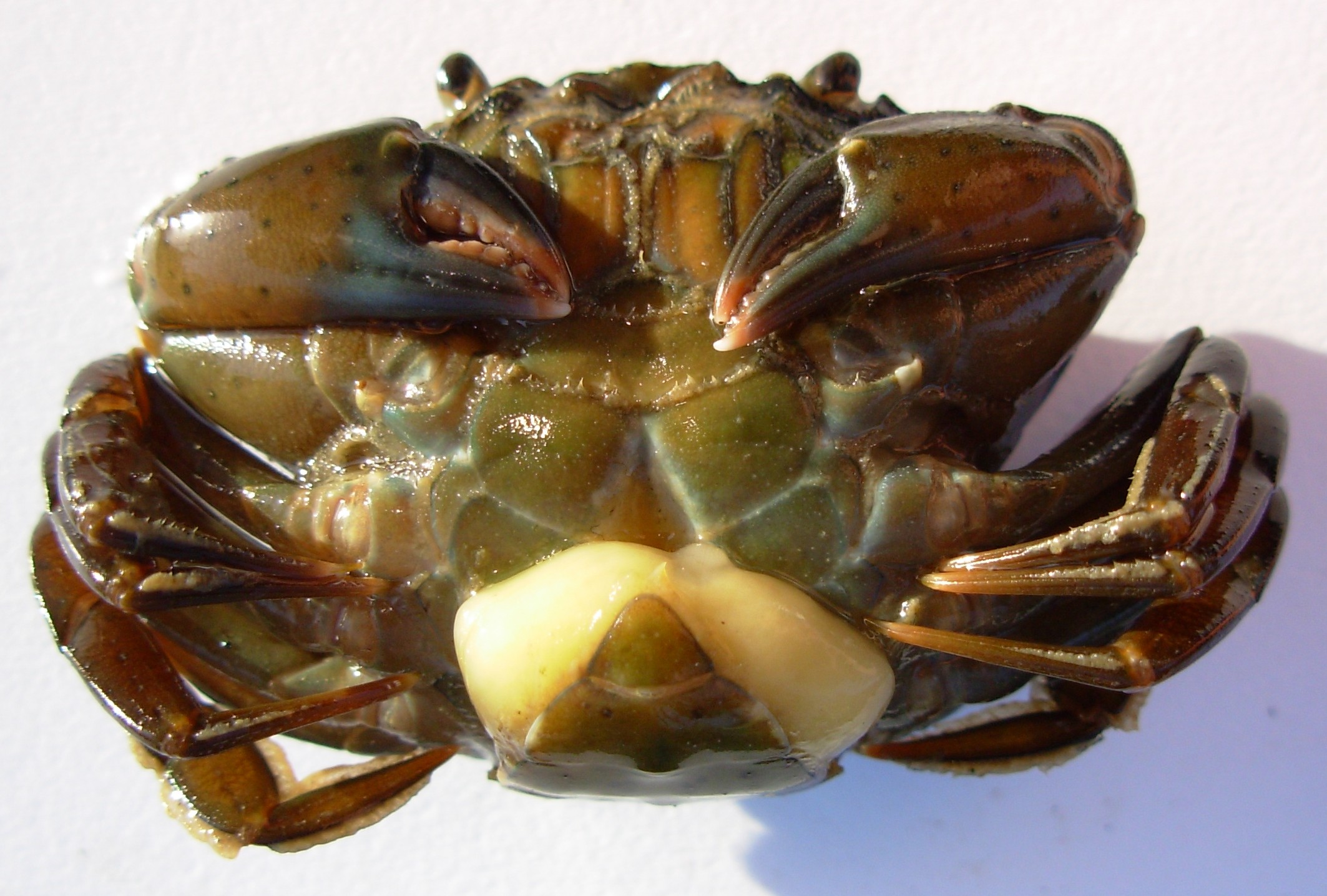
Not every barnacle filters food from the water. The order Rhizocephala gave up feeding and mobility for a second time, evolving into internal parasites of crabs and other decapods. A Sacculina larva lands on a crab, injects a small mass of cells through the shell, and grows into a root-like network called the interna that spreads through the host's body, drawing nutrients directly from its blood. The visible sign of infection is the externa, a soft sac that erupts from under the crab's abdomen and takes over the position where the crab would normally brood its own eggs. The host is sterilized in a process called parasitic castration, and in infected males, Sacculina goes further: it triggers a broadened, feminized abdomen and shifts behavior toward the maternal care patterns of an egg-brooding female, so the crab tends the parasite's brood as though it were its own. A 2023 study of the shore crab Pachygrapsus crassipes along the coast of Japan documented this same feminization pattern in a species not previously studied for it, evidence the mechanism is widespread across crab hosts, not limited to one relationship.
A far less invasive barnacle relationship has turned out to be useful to scientists rather than harmful to a host: species in the family Coronulidae attach to the skin of humpback and gray whales and grow a new, thin layer of shell every month, incorporating oxygen isotopes from the surrounding seawater as they do. Because the ratio of oxygen-18 to oxygen-16 in seawater shifts with temperature, each layer works like a dated entry in a travel log of the whale's migration between cold feeding grounds and warm breeding grounds. Larry Taylor and colleagues, publishing in the Proceedings of the National Academy of Sciences in 2019, showed that this record survives even after the barnacle falls off a dead whale and fossilizes, and used isotope readings from fossil coronulid shells to reconstruct migration patterns in whale populations that lived during the Pleistocene, finding that the coast of Panama has served as a meeting ground for separate humpback whale subpopulations for at least 270,000 years. An animal that gives up the ability to move even a body length after settling has, twice over, ended up reshaping the lives of far larger creatures around it: hijacking a crab's body to raise its young, and, purely as a side effect of growing a shell one month at a time, leaving behind the clearest record scientists have of where whales traveled hundreds of thousands of years before anyone was around to watch. Other marine animals use different defenses: some aeolid nudibranchs store stinging cells taken from their prey, while adults in the order lack shells. Crustaceans don't need the ocean at all to keep surprising biologists: a woodlouse runs its blood on copper instead of iron, a terrestrial relative that made it all the way onto dry land while barnacles went the opposite direction and gave up motion entirely.