.jpg)
What "nudibranch" actually means, and what it doesn't
Nudibranchia is a single taxonomic order of marine gastropods within the larger group Heterobranchia, and its name comes from Latin nudus ("naked") plus Greek brankhia ("gills"): most species carry an exposed, feathery cluster of gills on their back instead of tucking them under a shell. The World Register of Marine Species lists roughly 3,000 described species. Every adult nudibranch has lost the small coiled shell it carried briefly as a larva, and every nudibranch species, without exception, is a carnivorous predator. That last point matters because "sea slug" is not a taxonomic term. It is an informal umbrella that also covers unrelated, algae-grazing groups such as sacoglossans and sea hares, and popular coverage routinely calls any shell-less marine slug a "nudibranch" even when the animal belongs to one of those other groups, a mix-up this article comes back to later.
Diet splits the order into two broad strategies. Dorid nudibranchs mostly graze on sponges and bryozoans, absorbing the prey's own defensive chemicals into their skin as a byproduct. Aeolid nudibranchs specialize in cnidarians, meaning hydroids, anemones, jellyfish and siphonophores, and they are the group responsible for the strategy at the center of this article: eating an animal that can sting, and keeping the sting. Venom delivery among marine invertebrates takes stranger forms than a spiny silhouette suggests; the most dangerous documented sea urchin species delivers its venom through small pincer-like organs called pedicellariae, not its spines. Nudibranchs are unusual for skipping a step even earlier than delivery: they don't make their own venom to begin with. They take someone else's. Not every cnidarian relative is worth the trouble of stealing from: a moon jellyfish's own sting is weak enough to barely register on human skin at all, its nematocyst tubules too short to penetrate the epidermis.
Kleptocnidy: how to eat a jellyfish relative and keep its weapon
Swallowing an animal that stings should be dangerous. Aeolid nudibranchs that prey on cnidarians manage it through a process researchers call kleptocnidy, from the Greek for stolen stinging cells; the stolen cells themselves, once incorporated into the nudibranch, are called kleptocnidae. Nematocysts, the coiled, harpoon-like capsules cnidarians use to sting, pass through the nudibranch's gut undischarged, travel through branching extensions of the digestive gland into the finger-like projections on the animal's back called cerata, and collect in a specialized storage pouch at each ceras's tip known as a cnidosac. From there they are held in reserve and deployed against the nudibranch's own predators, effectively turning the animal into a walking magazine of someone else's weapons.
The mechanism has been worked out in stages, by researchers who kept returning to it. In 1984, Paul Greenwood and Richard Mariscal, publishing in Marine Biology, found that in the aeolid Spurilla neapolitana, the nematocysts arriving in the cnidosac are often still immature and incapable of firing, and simply finish developing safely inside the nudibranch's own tissue: a passive solution to an active problem. Twenty years later, Greenwood and three colleagues published a second piece of the puzzle in the Biological Bulletin: the mucus coating a different aeolid, Aeolidia papillosa, actively inhibits nematocyst discharge, and the inhibitory chemistry of that mucus shifts within about two weeks of the animal switching to a new anemone species, tuning itself to whatever prey the nudibranch is currently eating rather than working as one fixed defense. A broader 2017 review in Invertebrate Biology by Jessica Goodheart and Alexandra Bely surveyed nematocyst sequestration across the animal kingdom and found it has evolved independently an estimated 9 to 17 times across four phyla, including flatworms and even ctenophores, the unrelated comb jellies that only superficially resemble cnidarians, which makes nudibranchs the best-studied example of a strategy other lineages separately reinvented, not the only group that uses it.
Glaucus atlanticus: a sting worse than the animal it was stolen from
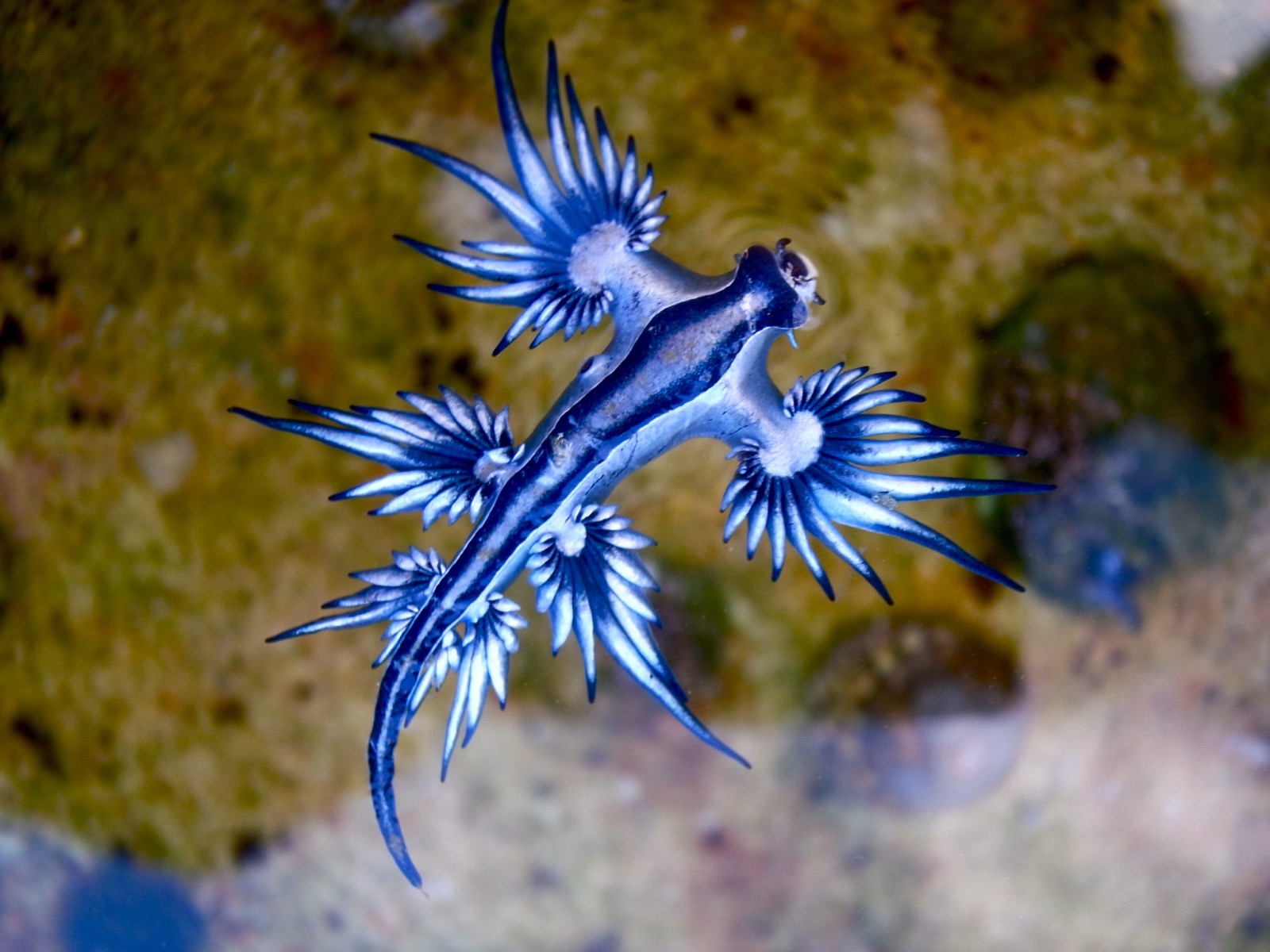
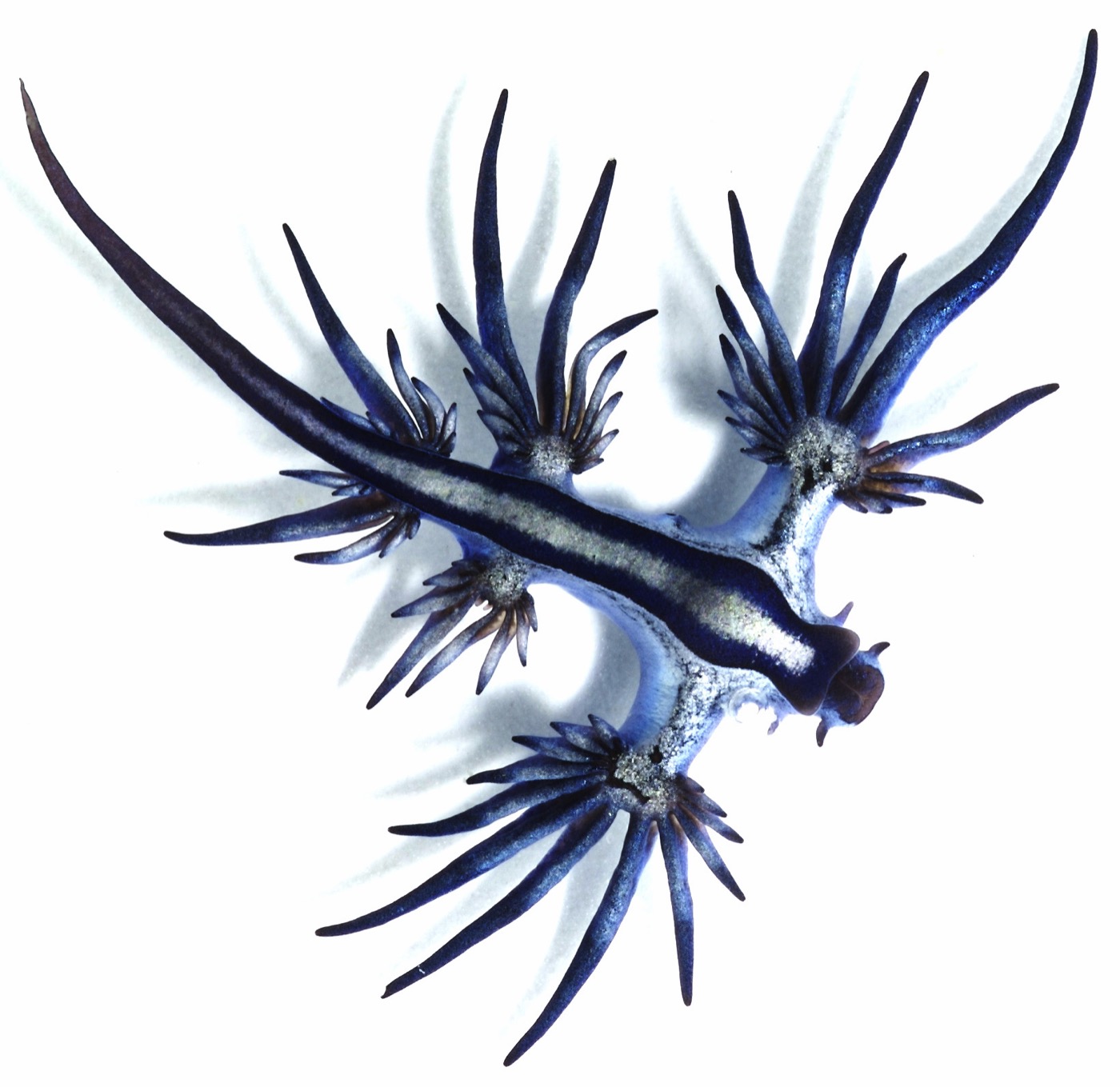
The clearest demonstration of kleptocnidy belongs to Glaucus atlanticus, the "blue dragon," an aeolid a few centimeters long that spends its life floating upside down at the ocean's surface, kept buoyant by a gas bubble it swallows and holds in its stomach. It feeds almost exclusively on the Portuguese man o'war (Physalia physalis) and related siphonophores, animals whose stings can be dangerous to humans. In a 1969 paper in Science, Tom Thompson and Isobel Bennett reported that Glaucus, and its close relative Glaucilla marginata, don't just tolerate the man o'war's nematocysts, they appear to selectively favor the most venomous ones for their own use, storing them in cnidosacs at the cerata tips exactly as the mechanism above describes. Because those cells arrive concentrated rather than spread across a full-sized man o'war, a sting from the tiny slug can be more painful than a sting from the animal it fed on. Documented cases from Australia, where onshore winds strand both species on beaches together, include children stung badly during a "bluebottle fight" game, throwing what they assumed were harmless stranded man o'war and picking up an unnoticed Glaucus instead.
Glaucus atlanticus is also a textbook case of countershading, and the reason is its upside-down lifestyle. Because it floats foot-up, the side that would normally be its underside faces the sky: that surface is blue or blue-and-white, which camouflages it from seabirds looking down. Its true dorsal surface faces the water below and is silvery grey, camouflaging it from fish looking up. The animal is also a useful contrast case for how documented danger and public reputation don't always move in the same direction. A camel spider carries no venom glands and no structure capable of injecting venom at all, despite decades of forwarded-email claims to the contrary. And in a decade of US poison-center data, only 3.4 percent of reported black widow spider bites led to antivenom treatment, evidence that even a genuinely venomous, well-studied species can carry a reputation well ahead of what happens after most real encounters. Glaucus atlanticus sits at the far end from both: by selectively concentrating someone else's most potent weapon, it becomes an animal whose real risk is easy to underestimate rather than overstate.

The self-decapitating, solar-powered "sea slug" isn't a nudibranch
Two viral animal stories of the last several years, that a sea slug can run its body on stolen chloroplasts like a plant, and that a sea slug can cut off its own head and grow a new body, both got shortened in headlines and social posts to "sea slug" or, incorrectly, "nudibranch." Neither belongs to Nudibranchia. Both belong to Sacoglossa, a separate order within Heterobranchia that, unlike every nudibranch, contains species that graze on algae, not animals. The chloroplast-stealing ability, called kleptoplasty, lets certain sacoglossans such as Elysia retain functional chloroplasts from the algae they eat and draw on the sugars those chloroplasts continue producing, in some species for months without additional feeding. No nudibranch is known to do this: nudibranchs don't eat algae in the first place, so there is no chloroplast source to steal from.
The self-decapitation story is a genuine 2021 discovery, and it too is specifically about Sacoglossa. Sayaka Mitoh, a PhD candidate at Nara Women's University, and her supervisor Yoichi Yusa published the finding in Current Biology after Mitoh noticed a sacoglossan individual in the lab moving around without the rest of its body; one individual was observed doing it twice. Working with two species, Elysia marginata and Elysia atroviridis, whose shed body typically accounts for more than 80 percent of the animal's total weight, they documented individuals severing their own head at the neck: the wound closed within about a day, heads of relatively young slugs resumed feeding on algae within hours and began regenerating a heart within a week, and the whole body was complete again in about three weeks. Heads from older individuals fared worse, stopping feeding and dying within about ten days. In every case the discarded body kept moving and reacting to touch for days or months, but never grew a new head. Mitoh and Yusa's leading hypothesis is that the behavior helps the animal shed internal parasites that block reproduction, and that kleptoplasty, the same chloroplast-retention trick described above, may be what keeps a head or a heart-less body alive long enough for regeneration to finish. Neither the ability nor the apparent motive has been documented in any true nudibranch.
A nudibranch that lives a kilometer down and glows in the dark
For as long as Nudibranchia has been studied, the order was understood to live almost entirely on the seafloor in shallow coastal habitats: tide pools, kelp forests, coral reefs, with a small number of species reaching the abyssal floor and a few pelagic species drifting near the surface. That changed in November 2024, when researchers at the Monterey Bay Aquarium Research Institute (MBARI) published a formal description of Bathydevius caudactylus in Deep-Sea Research Part I, the first nudibranch confirmed to live suspended in open deep-sea water, not down on the bottom. MBARI's remotely operated vehicles first filmed the animal in February 2000, at 2,614 meters off Monterey Bay, but its identity stayed unresolved for two decades. Researchers nicknamed it the "mystery mollusc": it had a foot like a snail, a voluminous hooded structure at one end, a flat tail fringed with finger-like projections at the other, and no obvious place in any known group. After reviewing more than 150 ROV sightings and examining a collected specimen's anatomy and genetics in the lab, the MBARI team confirmed it as a nudibranch distinct enough to warrant an entirely new family, Bathydeviidae.
Bathydevius caudactylus lives in the midnight zone, the bathypelagic layer 1,000 to 4,000 meters down, with observations ranging from 1,013 to 4,009 meters and confirmed sightings from Oregon to Southern California. It does not graze prey off the seafloor with the raspy feeding organ typical of most nudibranchs; it snaps its cavernous oral hood shut on drifting crustaceans, a trap-style strategy also used by unrelated deep-sea jellies and anemones and, in shallow water, by other nudibranchs such as Melibe and Tethys. It swims by flexing its transparent, gelatinous body, or simply drifts with the current, and when threatened it can light up with bioluminescence and, on at least one filmed occasion, detach a still-glowing finger-like tail projection as a decoy, the same principle as a lizard dropping its tail. "When we first filmed it glowing with the ROV, everyone in the control room let out a loud 'Oooooh!' at the same time," MBARI senior scientist Steven Haddock said of the discovery. Senior scientist Bruce Robison, who led the effort to formally describe the animal, called it "a new piece of the puzzle that can help better understand the largest habitat on Earth," a habitat MBARI's technology has already used to document more than 250 previously unknown deep-sea species. Eyeless vision turns up elsewhere on the seafloor, too: a brittle star can sense light and its surroundings with no eyes at all, using photoreceptor cells spread across its skin instead.