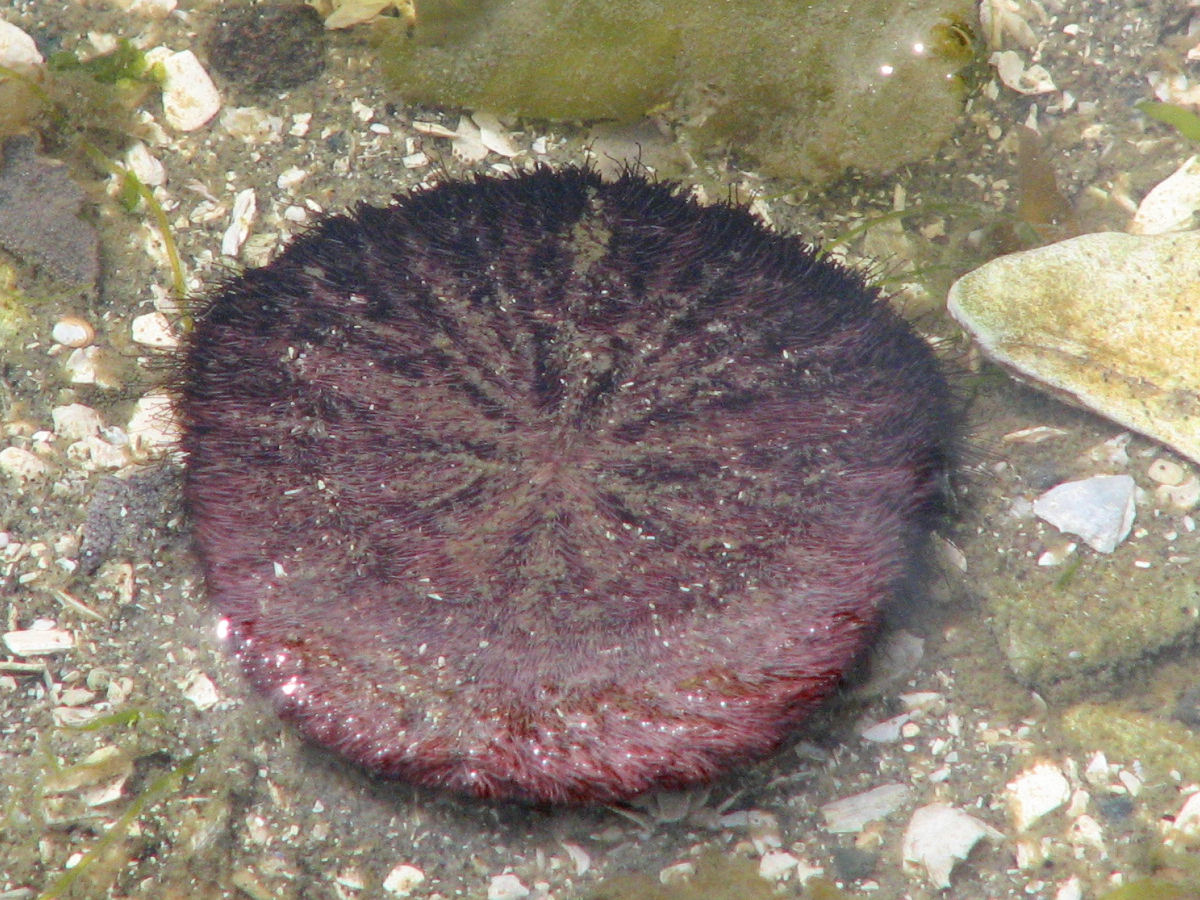

The white disc on the beach is not what the animal looked like alive
Sand dollars belong to the order Clypeasteroida, within the same class, Echinoidea, as sea urchins, and the same phylum, Echinodermata, as sea cucumbers and sea stars. Several species show up under the name: Dendraster excentricus along the Pacific coast of North America, Echinarachnius parma in the North Atlantic and North Pacific, and Mellita quinquiesperforata, the keyhole sand dollar, in the Gulf of Mexico and along the U.S. Atlantic coast, named for the lobed perforations through its test. What almost everyone who has walked a beach has actually handled is not the living animal at all. A live sand dollar is covered in thousands of short, dense spines that move in coordinated waves and give the animal a purple, brown, or gray color; once it dies, that layer of spines and skin is quickly stripped away and the bare calcium-carbonate test underneath bleaches white in the sun, which is the flat, coin-like disc that gives the animal its common name and washes up by the thousands after storms.
That gap between the living animal and its washed-up skeleton is wide enough that most people who find a white disc on dry sand have never seen a live sand dollar, since the living animals mostly stay submerged, partly buried in sand at the edge of the low-tide line or in shallow subtidal water. Where that low-tide line actually sits is not fixed, either: a spring tide pulls the water back a foot or more further than a neap tide does, so a sand dollar buried safely at a neap low tide can end up under noticeably less cover when the next spring low tide arrives about a week later. The Monterey Bay Aquarium and similar public aquariums advise beachcombers who find a sand dollar still showing spine movement or color to leave it in the water and not take it home, since what looks like a durable shell is, while alive, a functioning animal. Inside its mouth, on the underside of the test, sits a five-part jaw structure called Aristotle's lantern, the same basic apparatus that lets sea urchins scrape algae off rock, but repurposed here: no longer used for gripping and scraping, a sand dollar's lantern works as a grinding mill, crushing mouthfuls of ingested sand and sediment to break loose the organic material coating each grain. Sand dollars and their close relatives the sea biscuits are among the few irregular echinoids that keep a working lantern into adulthood at all; in most other irregular echinoid lineages, the structure atrophies before the animal reaches maturity.
A weight belt hidden in its gut, and a 2024 study that finally looked inside it
Staying in one place in loose, current-swept sand is a mechanical problem for a small, flat animal, and juvenile sand dollars solve it by making themselves heavier on purpose. In a 1973 paper in Science, F.S. Chia reported that young Dendraster excentricus selectively pick out the densest mineral grains from the surrounding sand and swallow them, packing them into a pouch off the digestive tract called Gregory's diverticulum. Chia proposed this served as a weight belt, adding mass that keeps the lightweight juvenile from being swept away by currents strong enough to dislodge a less ballasted animal, a threshold researchers call the critical velocity, the current speed at which drag force overcomes the combined pull of the animal's weight and its friction against the seafloor. For decades that remained a plausible but largely untested interpretation of what the packed grains were actually doing.
A 2024 study in PeerJ by Louis Zachos and Alexander Ziegler went back to the diverticulum with modern mineralogical analysis across thirteen sand dollar species in nine genera, and found the organ is doing something more specific than simply grabbing whatever is heavy. It selectively concentrates a narrow set of heavy minerals, chiefly magnetite, hematite, ilmenite, rutile, and zircon, at densities the study measured as roughly an order of magnitude greater than their concentration in the surrounding substrate, meaning the animal is not just picking up heavy sand but actively sorting for specific mineral grains. The ballast is temporary: sand disappears from the diverticulum once the animal reaches roughly 30 millimeters across, at which point its own body weight and surface area are enough to resist the currents it lives in. That size threshold lines up with how sand dollar posture itself changes with conditions: in calm water, animals commonly stand nearly on end, partly buried with only the upper edge of the test exposed, while in rough water many species instead lie flat or burrow further under the sand, trading the vertical, current-catching posture that helps them feed for one that keeps them from being rolled or dislodged.

When a fish gets close, the larva splits itself in two
Before it ever grows a test or a weight belt, a sand dollar spends its first weeks as a free-swimming larva, and that stage carries its own, stranger defense. In a 2008 study published in Science, Dennis Vaughn and his doctoral adviser Richard Strathmann, both at the University of Washington, placed four-day-old Dendraster excentricus larvae individually into shot glasses of seawater along with algae for food and, in the test group, mucus collected from a Dover sole, a flatfish known to prey on sand dollar larvae. Checking back roughly 24 hours later, the researchers found that larvae exposed to the fish mucus had responded by cloning themselves: some split cleanly into two, while more commonly a larva grew a bud that detached and developed into a second, smaller larva. Control larvae kept in plain seawater showed nothing like this response.
The point of splitting is size, not just numbers. A single sand dollar larva is only barely large enough for a predatory fish to see and target, at around 300 microns, roughly a hundredth of an inch. When a larva clones itself in response to the predator cue, the original animal shrinks to about half its prior size and the newly budded clone is smaller still, and Vaughn told the University of Washington at the time, "We think that by reducing their size they also reduce their visibility to predators," an interpretation that turns cloning from a numbers game into a camouflage strategy, trading one larger target for two smaller ones the fish is less likely to notice. It was the first documented case of a marine invertebrate larva cloning itself specifically in response to a chemical cue signaling predation risk, rather than as part of normal development.
Why they crowd together by the hundreds, and what the five petals are actually for
Sand dollars rarely live alone. A 2007 study in the Journal of Experimental Marine Biology and Ecology by F. Joel Fodrie and colleagues found that Dendraster excentricus adjusts both its posture and its feeding behavior based on how crowded its immediate neighborhood is, with animals in denser patches more likely to lie flat and switch feeding modes than animals with more room around them, a density-dependent trade-off distinct from the current-driven posture changes described above. Sand dollar beds documented in other clypeasteroid species have been recorded at densities exceeding 300 individuals per square meter, dense enough that the animals functionally carpet the seafloor in a given patch rather than scattering across it.
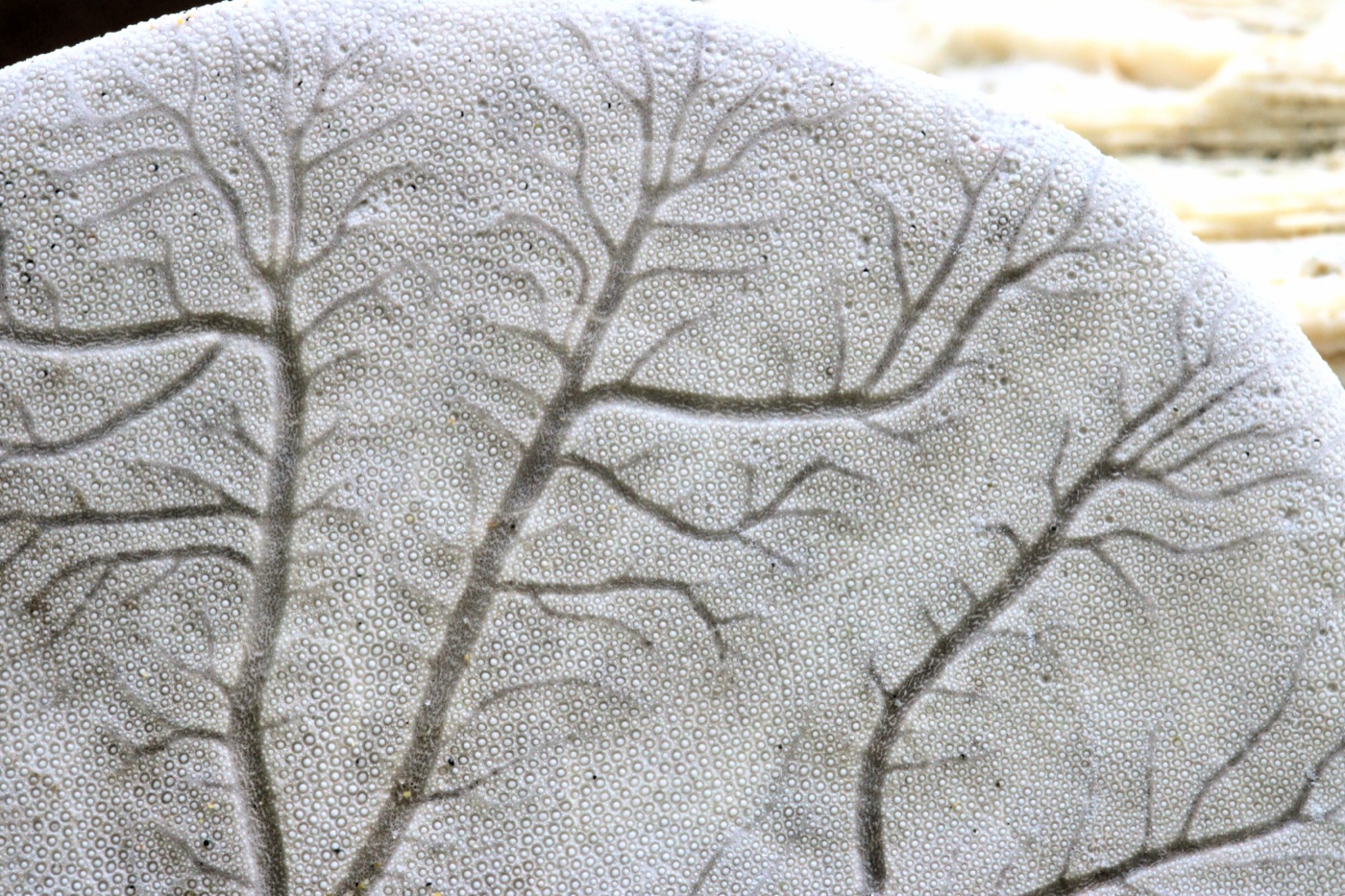
The five-petaled pattern etched into every sand dollar test, visible on both living animals and bleached skeletons, is not decorative. Each petal, called a petaloid, marks a row of paired pores where specialized tube feet emerge; unlike the tube feet sea urchins and sea stars use to grip and crawl, these petaloid tube feet are flattened and largely immobile, and per anatomical descriptions from the University of Puget Sound's Slater Museum of Natural History, they function as the animal's gills, handling gas exchange between the surrounding seawater and its internal water vascular system while the rest of the body stays buried. A widely circulated piece of American beach folklore, generally called the Legend of the Sand Dollar, assigns Christian symbolism to those same markings, describing the five slits as the wounds of Christ and five doves said to be released when a dried test is broken open; the story has no documented historical source and is treated by folklorists as a modern invention, not an inherited religious text, which makes it a case where the real biological explanation for the pattern, respiration, is better supported than the story built on top of it. Nearby marine habitats also contain shell-less nudibranchs, some aeolids storing stinging cells taken from prey, and a barnacle attaching permanently as it becomes an adult.