
What Actually Separates a Spring Tide From a Neap Tide
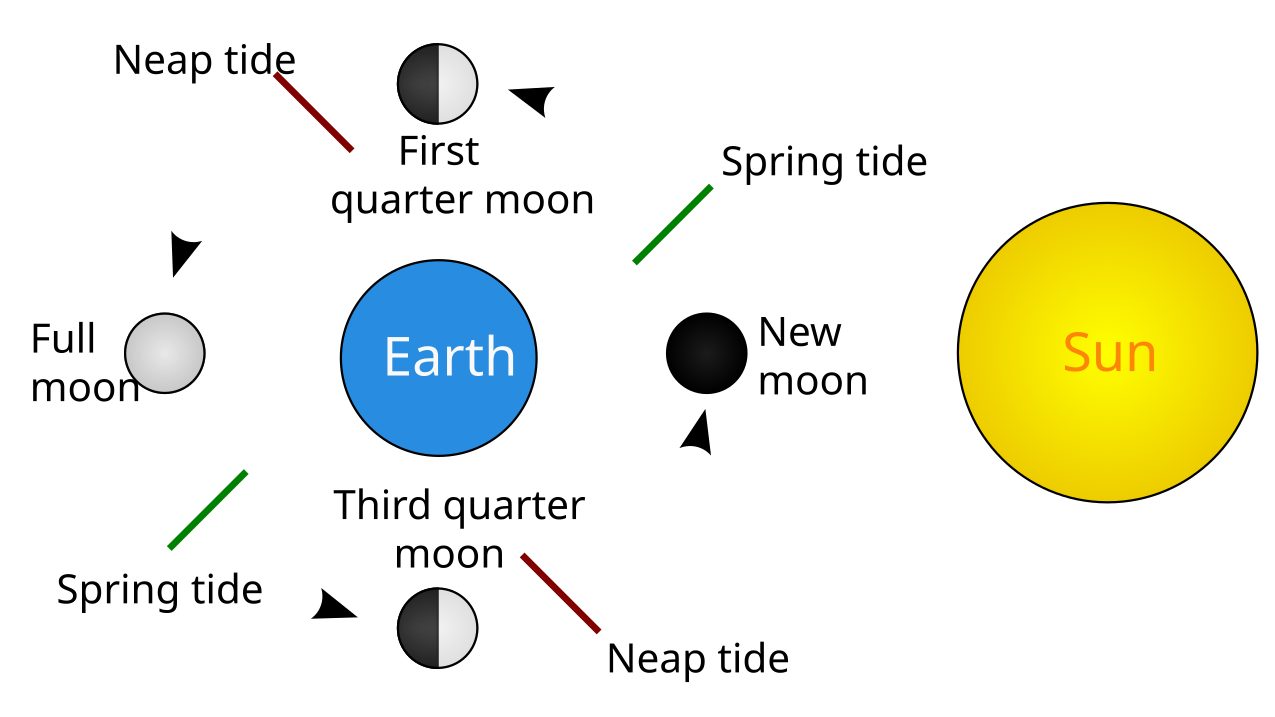
A spring tide and a neap tide are two ends of the same monthly cycle, not two different kinds of tide. According to NOAA's National Ocean Service, a spring tide happens at the new moon and the full moon, when the Sun, Moon, and Earth are roughly in a straight line and the Sun's gravitational pull adds to the Moon's, stretching the ocean's bulge a little further. High tides run a little higher than average and low tides run a little lower, producing the month's widest tidal range. About a week later, the Sun and Moon sit at a right angle to each other as seen from Earth, and the Sun's pull works against the Moon's instead of adding to it. The result is a neap tide, a period of moderate tides when high water is a little lower than average and low water is a little higher, narrowing the range rather than widening it.
The Moon does most of the work either way. Its tide-generating force is roughly twice the Sun's, according to NOAA, so the Sun mostly amplifies or dampens a lunar pattern instead of driving the tide on its own. Because the Moon takes about 29.5 days to cycle through its phases, spring tides and neap tides each occur twice a month: once around the new moon and once around the full moon for spring tides, and once around the first quarter and once around the third quarter for neap tides.
Why 'Spring' Has Nothing to Do With the Season
The name is one of the more commonly mismatched terms in ocean science. NOAA states plainly that a spring tide "has nothing to do with the season of spring"; the word instead comes from the old idea of the tide "springing forth," meaning it surges further than usual in both directions. Spring tides show up in every month of the year, including the dead of winter, through the lunar phase cycle. NOAA also uses the popular name King Tide, especially for unusually high spring tides; it is not a formal category for every spring tide.
Neap has a murkier history than that. Etymonline dates the adjective neap to the late 15th century and traces it to the older Old English compound nepflod, but the dictionary is upfront that the word's deeper origin is unsettled: it lists neap as of unknown origin with no confirmed relatives in other languages, and offers "without power" only as a guess at what the original sense might have been. What is settled is the meaning the word landed on: low, lowest, applied specifically to tides with the smallest difference between high and low water, which is exactly what a neap tide is.
How Many Feet That Actually Adds Up To
The difference is not a rounding error. NOAA's Center for Operational Oceanographic Products and Services publishes free daily tide predictions for hundreds of stations, and three real dates from a single station in September 2026 show the swing in feet, not just in principle.
| Moon phase (2026) | Date of widest daily range | Predicted low | Predicted high | Range |
|---|---|---|---|---|
| New moon, Sept 11 | Sept 9 | -0.47 ft | 6.29 ft | 6.75 ft (spring) |
| First quarter, Sept 18 | Sept 17 | 0.86 ft | 5.38 ft | 4.52 ft (neap) |
| Full moon, Sept 26 | Sept 29 | -0.22 ft | 6.31 ft | 6.53 ft (spring) |
At this one station, San Francisco's Presidio tide gauge (NOAA Station 9414290), the predicted range around the September 18 first-quarter neap tide was about 4.5 feet, while the surrounding new- and full-moon examples reached about 6.8 and 6.5 feet respectively, a swing of roughly 2.3 feet within a single lunar month. How large that swing runs varies enormously by coastline and isn't the point here; this is one prediction example that makes the monthly cycle concrete. The ranges use NOAA values before rounding the displayed high and low levels, in feet relative to MLLW. It is also not just an abstraction for the animals living in that zone: barnacles cemented permanently to a rock face and sand dollars buried just under the sand can be exposed by a lower spring tide if they occupy the intertidal zone. Exposure depends on their position; subtidal sand dollars remain underwater.
Why the Highest Water Doesn't Land Exactly on the Full Moon
Tides do not respond to the Moon instantly. Water has inertia and drags against the seafloor and coastlines as it moves, so the ocean's actual response lags behind the astronomical trigger, typically by a day or two and sometimes longer depending on the coastline. Oceanographers call this delay the age of the tide, formally the age of phase inequality, defined in NOAA's tide and current glossary as the time interval between a new or full moon and the maximum effect that phase has on the tidal range.
The San Francisco data above shows the same lag in practice. The 2026 full moon fell on September 26, but the largest predicted range in that stretch of the month, about 6.5 feet, landed three days later on September 29. Other coastlines lag by different amounts because local bathymetry and coastline shape both slow or speed up the water's response, and phase lag is not a universal one-day rule. The table also includes a large range before the September new moon, so local predictions are more useful than assuming every maximum follows the phase date.
Perigean Spring Tides: The Real 'King Tide' Events
Not all spring tides are equal, because the Moon's orbit is an ellipse, not a circle. NOAA's tidal-variations tutorial puts the distance between the Moon and Earth as varying by roughly 31,000 miles over the course of a single month, and NOAA explains separately that when a new or full moon happens to coincide closely with perigee, the Moon's closest approach, the combined pull produces a perigean spring tide, sometimes shortened to King Tide. NOAA puts this coincidence at roughly six to eight times a year, and the resulting high tides can run noticeably higher than an ordinary spring tide.
A similar, weaker effect comes from Earth's own orbit around the Sun. Tidal ranges run slightly larger in early January, near perihelion when Earth sits closest to the Sun, and slightly smaller in early July, near aphelion, according to NOAA's tidal-variations tutorial, which credits the pattern to oceanography textbooks by Sumich (1996) and Thurman (1994). Neither distance effect changes the underlying spring-neap pattern; both just make some spring tides bigger than others.
The 'Four Types of Tides' Question, Untangled
People searching for the four types of tides are usually mixing up two separate classification systems, and most explainers don't say so directly. The first system describes how many high and low tides a coastline gets each lunar day. NOAA's tidal-cycles tutorial names three patterns: a diurnal tide has one high and one low, common along the Gulf of Mexico; a semidiurnal tide has two highs and two lows of roughly equal size, typical of the U.S. East Coast; and a mixed semidiurnal tide has two highs and two lows of noticeably different sizes, the usual pattern on the West Coast, while composite volcanoes around the Pacific are commonly associated with subduction. This tectonic setting is a separate subject and does not explain the tidal pattern. NOAA credits the three-way tidal classification to the oceanography textbooks of Sumich, Thurman, and Ross.
Spring and neap tides sit on a different axis entirely: they describe how the size of those daily highs and lows changes across the month, not how many of them happen each day. A stretch of West Coast, mixed-semidiurnal coastline still gets two unequal highs and two unequal lows every lunar day, but the actual height of those highs and lows grows during a spring tide and shrinks during a neap tide. Line the two systems up and a coast can be, for example, mixed semidiurnal and in a neap phase at the same time, which is probably the honest answer whenever someone tries to force spring and neap into a four-types list alongside diurnal, semidiurnal, and mixed.