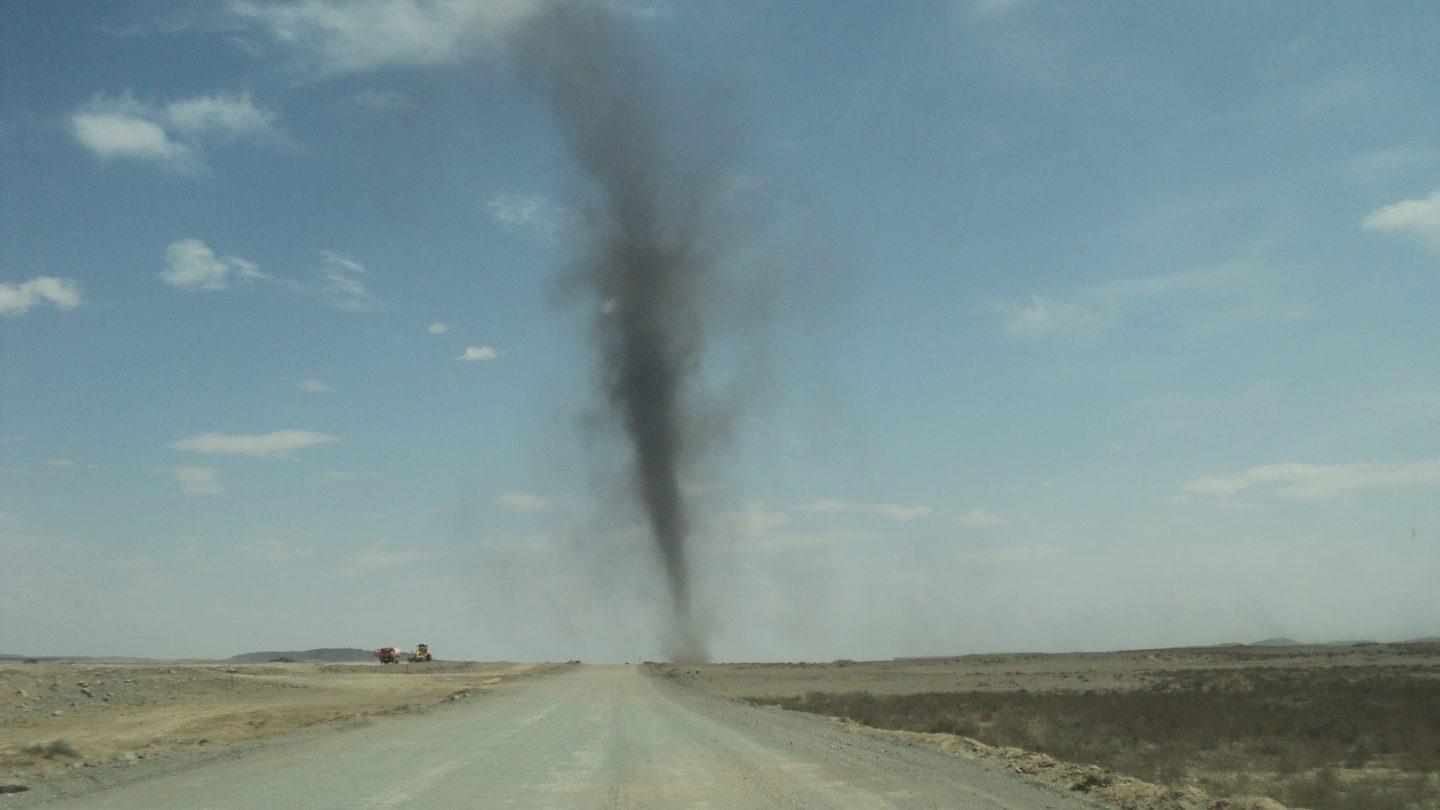

Why most dust devils are harmless
A dust devil is a rotating column of air that begins at the ground on a hot, clear day. The National Weather Service office in Flagstaff explains that strong surface heating makes a pocket of air rise quickly, pulling surrounding air inward and setting the column spinning. The energy comes from a warm surface and no storm is needed, which is why a dust devil can form under a clear sky. The difference between a dust devil and a tornado comes down to that missing storm.
The same mechanism limits how long one lasts. When the rising air cools and the surface stops feeding heat into the base, the column loses its supply and collapses. The Met Office notes that most last only a few minutes for this reason, and KGUN9 reports that most stay under 100 feet tall with winds below 45 mph, though the largest can top 3,000 feet and reach 80 mph. Dry air near the ground also allows virga to evaporate before it lands.
That is why the ordinary answer to whether dust devils are dangerous is no. The Met Office describes them as far less powerful than the tornadoes they resemble. Strong vortices can move light structures, and even an unmarked vortex can endanger aircraft.
The recorded deaths
Several reported ground fatalities involved a light structure. A strong vortex meets a light structure, and the structure fails or moves in a way that traps someone.
In May 2003, a dust devil lifted the roof off a two-story building in Lebanon, Maine, and the collapse killed a man inside. Both the Austin American-Statesman and the hazards section of Wikipedia's dust devil article list this as a fatality.
On 18 June 2008, near Casper, Wyoming, a woman died when a dust devil flipped a small scorer's shed at a youth baseball field onto her. She had stepped behind the shed for shelter. The Insurance Journal reported that a Wyoming jury later found the youth baseball league not liable for her death, while the company that built the shed settled with her family.
On 31 March 2019, at a festival in Tianmiao Township, Yucheng County, Henan province, China, a dust devil lifted an inflatable bouncy castle with children inside. China Daily reported that two children died and about 20 people were injured. The local meteorological bureau classified the whirlwind as a dust devil, not a tornado.
Skydivers face a different kind of risk. The Wikipedia hazards section records a case on 1 June 1996 in which a dust devil collapsed a skydiver's parachute about 9 metres (30 feet) above the ground, and he later died from his injuries.
Why inflatable structures keep appearing
Two of the most serious cases involve the same object: a large inflatable. In 2010 in east El Paso, Texas, a dust devil lifted a jump house with three children inside, carried it over a fence and dropped it in a backyard three houses away. Texas Parks & Wildlife Magazine reported that the children survived mostly unscathed.
The 2019 case in China ended differently, with two children killed. The size of the whirlwind was not the only difference. Reports after the Yucheng incident noted that the bouncy castle had not been properly secured to the ground.
A bounce house is a large sail with very little weight, so even a moderate vortex can lift it. The same logic covers the shed in Wyoming and the roof in Maine. A dust devil does not need tornado strength to become deadly; a light object in its path is enough.
How strong a dust devil can get
The strongest dust devils reach tornado strength. The National Transportation Safety Board writes that they "can be as strong as tornadoes and waterspouts," and the National Weather Service notes that a large one can produce winds of 60 mph or more.
A documented example is the dust devil that struck the Coconino County Fairgrounds in Flagstaff, Arizona, on 14 September 2000. It damaged tents, stands and booths and injured several people, with no fatalities, and the National Weather Service estimated its winds at up to 75 mph. The tornado wind scale shows where that figure sits.
The Met Office's description of dust devils as far less powerful than tornadoes refers to the typical case. The two statements fit together: most dust devils are weak, and the rare strong ones can reach the bottom of the tornado scale.
The aviation hazard is larger than the death toll suggests
The risk also extends to aircraft. The NTSB records a fatal 2018 hang-glider encounter near Mountain Home, Idaho, involving a loss of control while approaching a landing area. The National Transportation Safety Board issued a safety alert in December 2023 stating that dust devils have been present in more than 170 accidents it has investigated since 1982. That figure is higher than the figure of around 100 that older summaries repeat.
The alert says the danger comes from sudden, unexpected turbulence. A dust devil's updrafts can disrupt a small aircraft at low altitude, producing a rapid loss of lift or an uncommanded roll. The board's examples include a crop-dusting aircraft that flew through a dust devil after takeoff from a dirt airstrip in Saffell, Arkansas, and lost lift before hitting a field, and a Cessna in Elko, Nevada, that entered an aggressive left roll just after takeoff.
A dust devil can also be invisible. Without dust or debris to mark it, the vortex still moves air, and the NTSB advises pilots to look for a shadow on the ground or tracks in the dirt as indirect signs. The board notes that Federal Aviation Administration handbooks say little about dust devils, so a pilot may not be watching for one.
What to do when one is heading for you
A dust devil that carries dust is visible, which is the main reason encounters on foot are rarely serious. The Austin American-Statesman calls most of them harmless and short-lived.
The practical response is to step out of its path. The National Weather Service notes that dust devils usually collapse within minutes, so a column heading toward you is likely to fall apart on its own. Do not assume a vortex is safe because it is small or short-lived; flying debris, temporary structures and low-altitude flight add hazards.
Anyone setting up a temporary structure on open ground should anchor it. The 2010 jump house in El Paso and the 2019 bouncy castle in Henan illustrate the hazard when a vortex lifts an inflatable; the reports do not establish identical anchoring conditions in both cases.
Different in kind is ball lightning, which has killed people too but is a problem in atmospheric electricity rather than a rotating vortex.