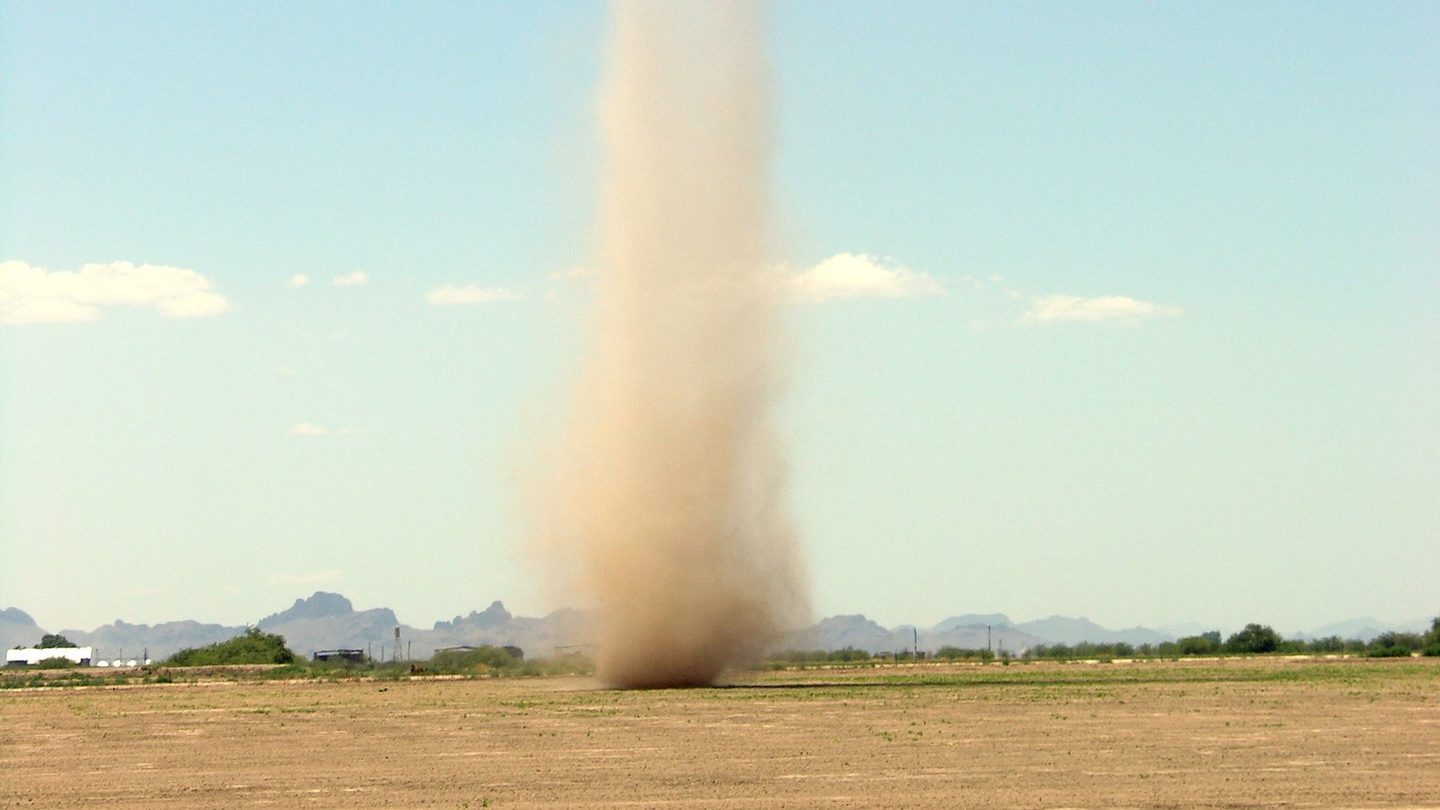

The one-line test: is a storm cloud attached?
Meteorologists do not sort these two by how scary they look. The Storm Prediction Center's tornado FAQ quotes the American Meteorological Society's definition of a tornado as "a violently rotating column of air, in contact with the ground, pendant from a cumuliform cloud or underneath a cumuliform cloud", then adds the key condition: a tornado must be in contact with the ground and a convective cloud at the same time. A dust devil fails the second half by design. The National Weather Service glossary describes it as a small, rapidly rotating wind made visible by the dust, dirt or debris it picks up, one that develops best on clear, dry, hot afternoons.
So a dust devil is not a weak tornado. The two are different categories that share a spinning shape. Guinness World Records contrasts supercell tornadoes with dust devils that form from the ground upward in sunny conditions. That comparison does not cover every tornado: landspouts form beneath growing convective clouds without a rotating supercell. NOAA's National Severe Storms Laboratory describes a tornado as a narrow, violently rotating column of air that extends from a thunderstorm to the ground, and that thunderstorm is the piece a dust devil never has.
Dust devil, landspout and supercell tornado side by side
The table adds a third case, the landspout, and lines up all three, using figures from the National Weather Service, the Storm Prediction Center and NOAA's National Severe Storms Laboratory.
| Dust devil | Landspout | Supercell tornado | |
|---|---|---|---|
| Attached to a storm cloud? | No, forms from the ground up | Yes, sits under a growing cumulus or thunderstorm | Yes, hangs from a rotating supercell |
| Sky when it forms | Clear, hot, light wind | Building cumulus or thunderstorm overhead | Organized thunderstorm |
| Width or size | 10 to 300 ft wide, 500 to 1,000 ft tall on average (NWS Flagstaff) | Typically small and weak next to the strongest tornadoes | One example: about a mile wide (Abell, Oklahoma, May 3, 1999) |
| Usual time of day | About 11 a.m. to 2 p.m. | Follows the parent storm | Most tornadoes between 4 and 9 p.m. |
| Counts as a tornado? | No | Yes, by definition | Yes |
| Gets an EF rating? | No, the scale rates tornadoes | Yes, as a tornado | Yes, EF0 to EF5 |
The dust devil column comes from the NWS Flagstaff office. Wikipedia's dust devil article (checked 13 October 2026) gives a much smaller typical figure, often under three feet wide and gone in under a minute, with the 300-foot cases called rare, so the two sources disagree on what is typical. The tornado column is easier to pin down: NSSL says most tornadoes occur between 4 and 9 p.m., a window that starts later than the dust devil's early-afternoon peak, and the Storm Prediction Center describes the Abell, Oklahoma, tornado of May 3, 1999 as a violent wedge about a mile wide.
The landspout, a tornado in a dust devil's clothes
A landspout is the case that makes the dust devil vs tornado argument genuinely hard. MPR News explains that a landspout is technically a real tornado, but it forms differently from the large tornadoes of severe weather outbreaks. Instead of coming out of a rotating supercell, it starts when spinning air already near the ground gets stretched upward into a growing thunderstorm. Because of that, MPR notes, landspouts can appear quickly and with little warning, and they are often thinner, weaker and shorter-lived than classic tornadoes while still strong enough to knock down trees and damage roofs.
The National Weather Service glossary says landspouts are usually seen beneath towering cumulus or thunderstorm clouds, often as no more than a dust whirl, and calls them the land-based equivalent of waterspouts. That last detail explains why photos cause arguments: a thin column of lofted dust can be a harmless dust devil or a landspout, and the only reliable tell is what the sky looks like above it. The Storm Prediction Center says landspouts are tornadoes by definition and capable of significant damage and of killing people. MPR's summary of the difference is short: dust devils form under sunny, fair-weather skies with little to no cloud cover, while landspouts develop beneath growing thunderstorms.
How strong can a dust devil get?
The NWS Flagstaff office says winds in larger dust devils can reach 60 mph or more and that, in the deserts of northern Arizona, they can climb several thousand feet and last an hour or more. It also documents a real case: on September 14, 2000, a large, well-defined dust devil hit the Coconino County Fairgrounds, blew tents down, knocked over a ticket booth and split a large wooden beam in one of the pavilions. From that damage the office estimated winds may have reached up to 75 mph.
Compare that number with the Enhanced Fujita Scale. The NWS lists EF0 as 65 to 85 mph, measured as a three-second gust estimated from damage, so the Flagstaff estimate lands inside the weakest tornado category. That is a rough comparison of two estimates, not a rating, because the EF scale exists to grade tornado damage and a dust devil never gets an official one. It does show that the wind in a big dust devil is not trivial. EF5, the top of the scale, starts above 200 mph.
Why a dust devil doesn't grow into a tornado
The two vortices have different engines. The National Weather Service explains that dust devils form where strong surface heating, often along the boundary between two kinds of ground such as asphalt and dirt, lets a pocket of hot air rush upward through cooler air, under clear skies and light winds. Stretching that rising column makes it spin faster, much as an ice skater speeds up by pulling in their arms. When the supply of hot, unstable air runs out, the dust devil breaks down. Nothing in that recipe involves a storm.
Tornado formation runs on storm-scale processes. NSSL says the most destructive tornadoes come from supercells, rotating thunderstorms with a well-defined radar circulation called a mesocyclone, and that tornado development is believed to be dictated mainly by what happens in and around that mesocyclone. NSSL also says scientists do not fully understand how tornadoes form. So a dust devil does not simply keep growing until it qualifies, because the thing that would make it a tornado is a parent storm overhead. If a growing thunderstorm does arrive above a spinning column of air, the result is a landspout, which is a different event from a dust devil getting stronger.
Rain that evaporates before it lands, called virga, is also a familiar sight over the Southwest desert.
Can a dust devil kill you?
Rarely, and usually through a light object. Guinness World Records lists two fatal dust devil events in the United States: one on May 19, 2003, in Lebanon, Maine, when a building collapsed and a man died, and one on June 18, 2008, near Casper, Wyoming, when a shed collapsed and a woman died. The Guinness entry says there are only two recorded fatal incidents, but news coverage shows that count is not complete. CNN reported that on March 31, 2019, a dust devil lifted an inflatable playhouse at a scenic spot in China's Henan province, killing two children and injuring 20 people. Henan's chief meteorologist said the dust devil was about 10 meters (32 feet) across and lasted three to four minutes.
That pattern shows up in research too. A University of Georgia study led by John Knox and Thomas Gill counted at least 479 injuries and 28 deaths worldwide in 132 weather-related bounce house accidents since 2000. More than 80 of the 132 events were tied to cold fronts or post-front conditions, dust devils, and overhead or distant thunderstorms, so dust devils are one cause among several and the study does not isolate them. The finding that matters for a dust devil is how little wind it took: more than a third of the accidents happened at observed wind speeds between 0 and 20 mph, and the UGA release lists a hot but calm day that triggers a dust devil among the days that looked safe. Gill has said the problem caught his attention in April 2010, when he saw a series of huge dust devils around El Paso, Texas, and then a news report about a flying bounce house.
The danger question on its own, including the aviation hazard, is covered in are dust devils dangerous.
Rotating wind is not the only small weather event with a death record. Ball lightning is not a vortex at all, and the accounts of it killing people are older still.