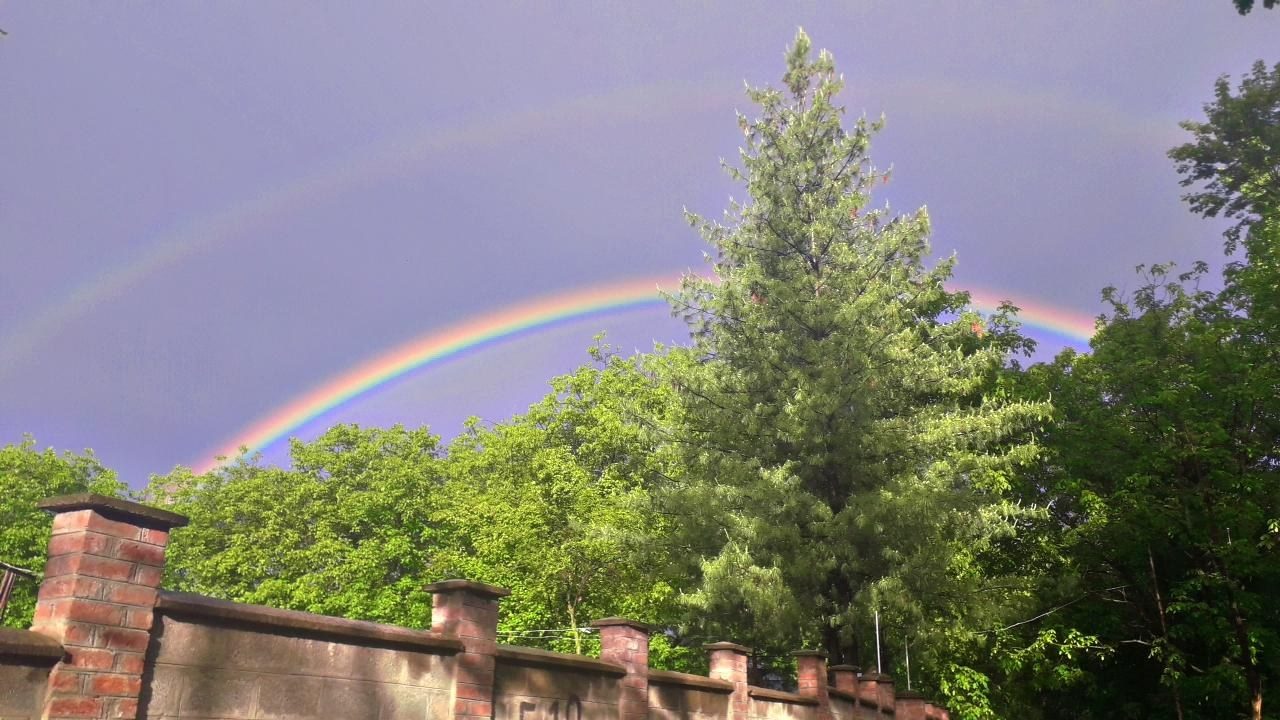

Rainbows are a cone of raindrops, and you are at the tip
The short answer to why rainbows are curved is that a rainbow is not an object in the sky. It is a collection of raindrops that happen to be in the right place. Wikipedia's rainbow article (checked 13 October 2026) states that the rainbow is curved because the set of all the raindrops with the right angle between the observer, the drop and the Sun lies on a cone pointing at the Sun with the observer at the tip. The base of that cone is a circle.
Les Cowley, of the Atmospheric Optics website, told EarthSky: "Rainbows don’t exist! They are nowhere in space." He added that all the drops glinting rainbow colors are on the surface of a cone with its point at your eye, and that other drops outside the cone also glint sunlight but their rays do not reach you. So the arc you see is not sitting at one distance like a painted stripe. The drops can be near and far, and the shape is only the outline of which ones line up with your eye.
How much of the circle you see depends on the Sun
The centre of the circle is the antisolar point, the spot directly opposite the Sun, which sits as far below your horizon as the Sun is above it. A lower Sun pushes the centre up toward the horizon and exposes more of the circle. The table below is a geometric model on a flat, unobstructed horizon with a fixed 42° radius, not a measurement, so treat the numbers as estimates. Real hills, trees and the roughly half-degree offset for red light shift them a little.
| Sun's height above the horizon | Top of the bow above the horizon | Share of the full circle above a flat horizon | Width of the arc along the horizon |
|---|---|---|---|
| 0° (sunrise or sunset) | 42° | 50% | about 84° |
| 10° | 32° | 44% | about 82° |
| 20° | 22° | 37% | about 76° |
| 30° | 12° | 28% | about 62° |
| 40° | 2° | 12% | about 28° |
| 42° or higher | 0° | 0% | none |
The pattern lines up with the sources. Wikipedia notes (checked 13 October 2026) that the largest section normally seen is about 50% at sunrise or sunset, and that when the Sun's elevation exceeds 42° a rainbow will not be visible against the sky. Atmospheric Optics gives the same 42° figure for when only the tip of the bow shows. This is also why summer rainbows cluster in the early morning and late afternoon: a high midday Sun leaves the bow below your feet.
Why the angle is 42 degrees
Sunlight enters a spherical raindrop, bends, reflects once off the back, and bends again on the way out. Wikipedia explains (checked 13 October 2026) that the returned light spreads over a range of 0° to 42°, and is most intense at 42°, because that is a turning point: light entering near the drop's edge and light entering near its centre both come back at less than 42°. The angle does not depend on the size of the drop, but it does depend on the refractive index of the liquid, which is why sea spray makes a smaller bow than rain. In Wikipedia's derivation (checked 13 October 2026) the 42° comes from the refractive index of water, about 1.33.
Color comes from dispersion: water bends each wavelength by a slightly different amount. Wikipedia gives (checked 13 October 2026) a radius angle of 42.5° for red light (refractive index 1.330) and 40.6° for blue (1.343), so each color traces its own circle and the red band sits on the outside. That is a spread of under two degrees across the whole band. Wikipedia is the only source cited here that gives the red and blue figures, so treat the exact decimals as one source's numbers.
Why we usually see only half
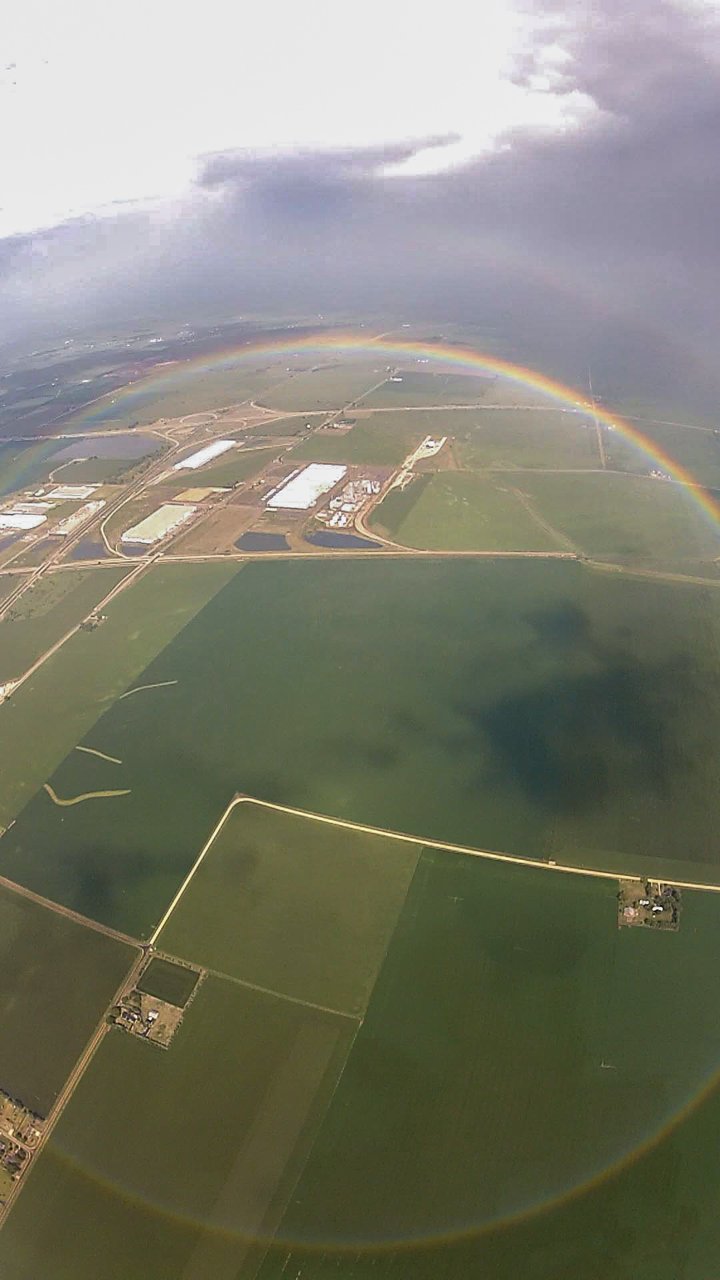
In theory every rainbow is a circle, but the ground gets in the way. Wikipedia says (checked 13 October 2026) 50% or more of the circle lies below the horizon unless the observer is high enough to see all of it, and that the lower half would need water droplets and sunlight below your horizon, which a ground-level viewer rarely has. The Met Office makes the same point: from a mountain or airplane you might see the full circle.
The photo below was captured on video while skydiving, according to its Wikimedia Commons description, which describes it as a circular rainbow with a faint double rainbow. The upper arc is the familiar part, and the rest of the ring continues faintly across the fields below, the half a ground-level viewer never gets.

Where to stand to see one
To see a rainbow you need the Sun at your back and raindrops falling in front of you, EarthSky says, and Wikipedia adds (checked 13 October 2026) that the Sun must be at a low angle, which is why rainbows show up in the western sky in the morning and the eastern sky in the early evening. The most striking ones appear when half the sky is still dark with rain clouds and you stand in clear air toward the Sun. Rain is the raw material, and the wettest place on Earth has the most of it. Rain, snow or ice that evaporates before it lands is called virga.
Two guesses that do not explain the curve
A natural guess is that rainbows curve because the Earth does. The cone geometry never uses the planet's shape. As Wikipedia describes (checked 13 October 2026) it, the same full circle can be made with a garden hose mist while standing on the ground, and at that scale of a few metres the planet's curvature cannot matter.
Another guess is that the light itself travels along a curve. Light changes direction only inside individual drops, and the arc is just the set of drops positioned to send light to you.
As for why a rainbow looks flat, EarthSky says we see rainbows as flat for the same reason we see the Sun and Moon as flat disks: the sky offers no visual cues to tell us otherwise. Wikipedia adds (checked 13 October 2026) that each person sees a slightly different rainbow, because each eye intercepts light from a different set of droplets, and the observer perceives one single rainbow at an infinite distance.
A second bow outside the first
When a double rainbow forms, Wikipedia says (checked 13 October 2026) the second arc appears about 10° outside the primary one with its colors in reverse order, because the light reflects twice inside each drop. The dark strip between the two bows is called Alexander's band, after Alexander of Aphrodisias, who first described it. Each bow is a circle of its own and is cut by the horizon in the same way. The secondary bow is fainter, Wikipedia says (checked 13 October 2026), because more light escapes after two reflections and because the bow is spread over a greater area of the sky.