
Most sightings end with a fright and nothing else
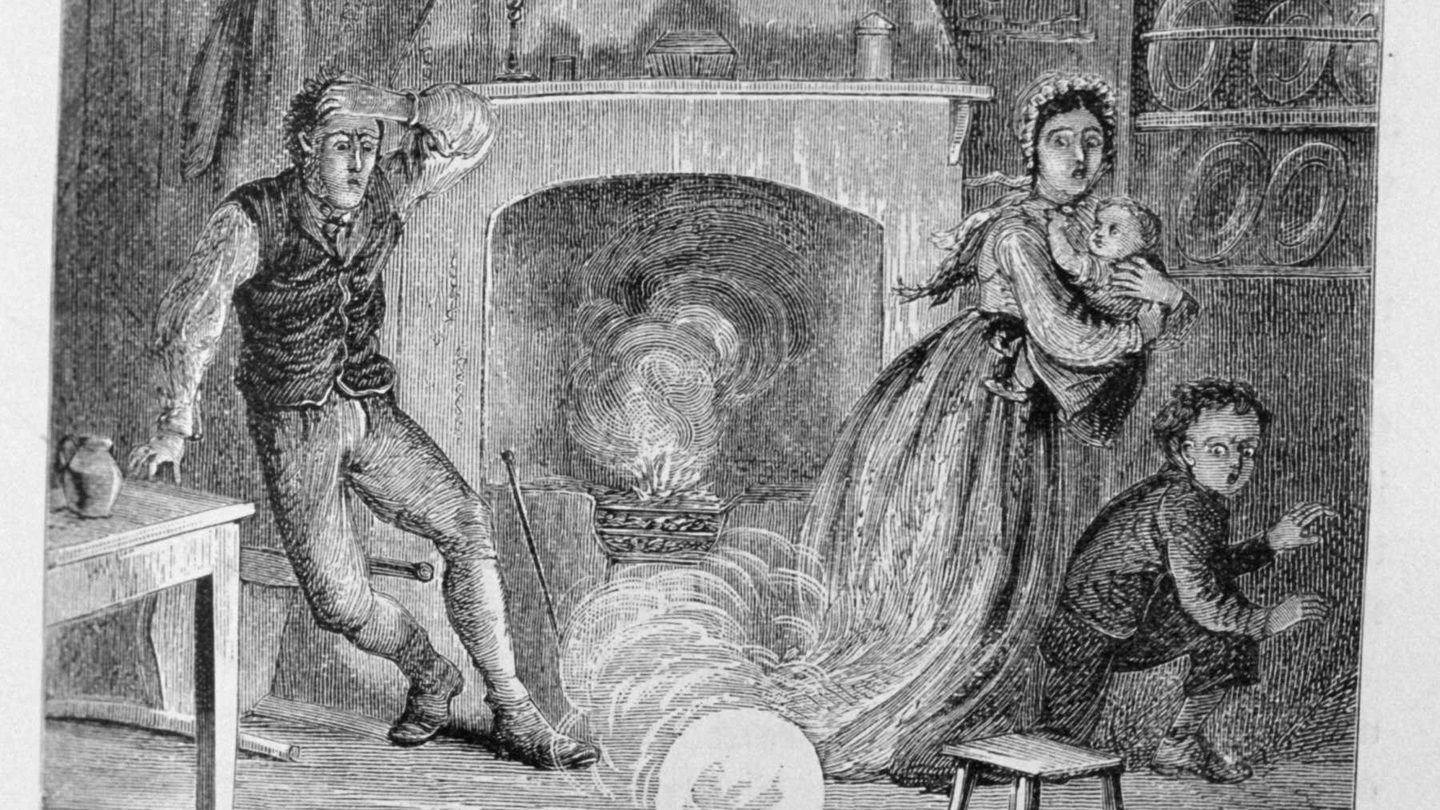
Ball lightning is rare, brief and unpredictable. A 1972 review by Neil Charman in New Scientist set out what a typical report looks like: a sphere or pear shape with fuzzy edges, usually 10 to 20 centimetres across, roughly as bright as a domestic lamp, drifting a few metres per second and lasting anywhere from one second to more than a minute. Charman also warned against leaning too hard on eyewitnesses, since almost everything known about the phenomenon comes from people describing something that vanished in seconds.
John Lowke, writing in The Conversation in 2012, gave a plainer version of the same picture: about the size of a grapefruit, about as bright as a 40-watt bulb, moving at walking speed roughly a metre above the ground, and gone in around ten seconds.
Most encounters stop there. The hazard record is real but thin, and the compiled account of sightings is blunt about the uncertainty: reports "vary on their alleged danger to humans, from lethal to harmless." That line comes from Wikipedia's ball lightning article, checked on 13 October 2026, and it is a fair summary of a literature that has never managed a controlled experiment on the phenomenon itself.
One reason the danger is hard to pin down is that a ball lightning is not simply a small tornado or a stray bolt. It is a separate problem in atmospheric electricity, which is why the comparison pages that try to separate look-alike weather, such as the difference between a dust devil and a tornado, end up describing a completely different mechanism.
The 1638 church storm
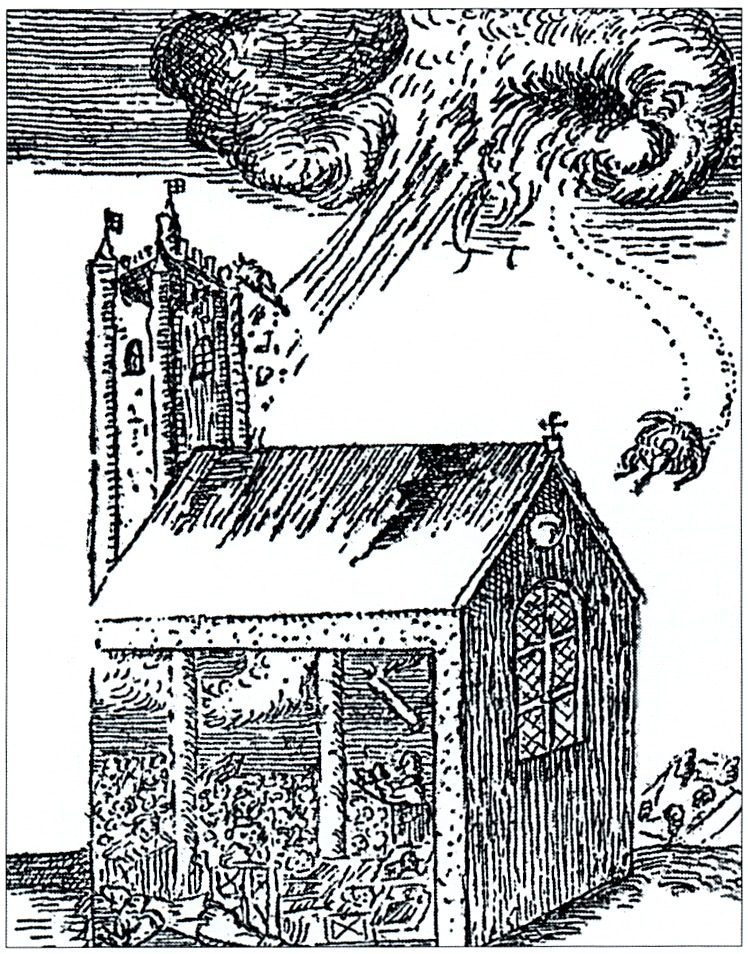
The earliest event usually cited happened on 21 October 1638, when a violent storm struck the parish church at Widecombe-in-the-Moor on Dartmoor in Devon. Witnesses described an eight-foot ball of fire that entered the church, smashed pews and windows, and filled the building with a foul sulphur smell and thick smoke. Four people died and around sixty were hurt, though the contemporary accounts do not agree on the exact tally.
The woodcut below was made at the time and shows the damage as contemporaries understood it. Whether the ball the witnesses described was ball lightning is a later reading of their account rather than something the 1638 report itself claims, and it belongs in the record with that caveat attached.

The deaths that were written down
The deaths that survive in the record cluster in the century before anyone understood what lightning was, when observers wrote down what they saw without a theory to fit it into. A 1726 report from the Gulf of Florida describes a ball of fire that split a ship's mast, killed one man and took another's hand.
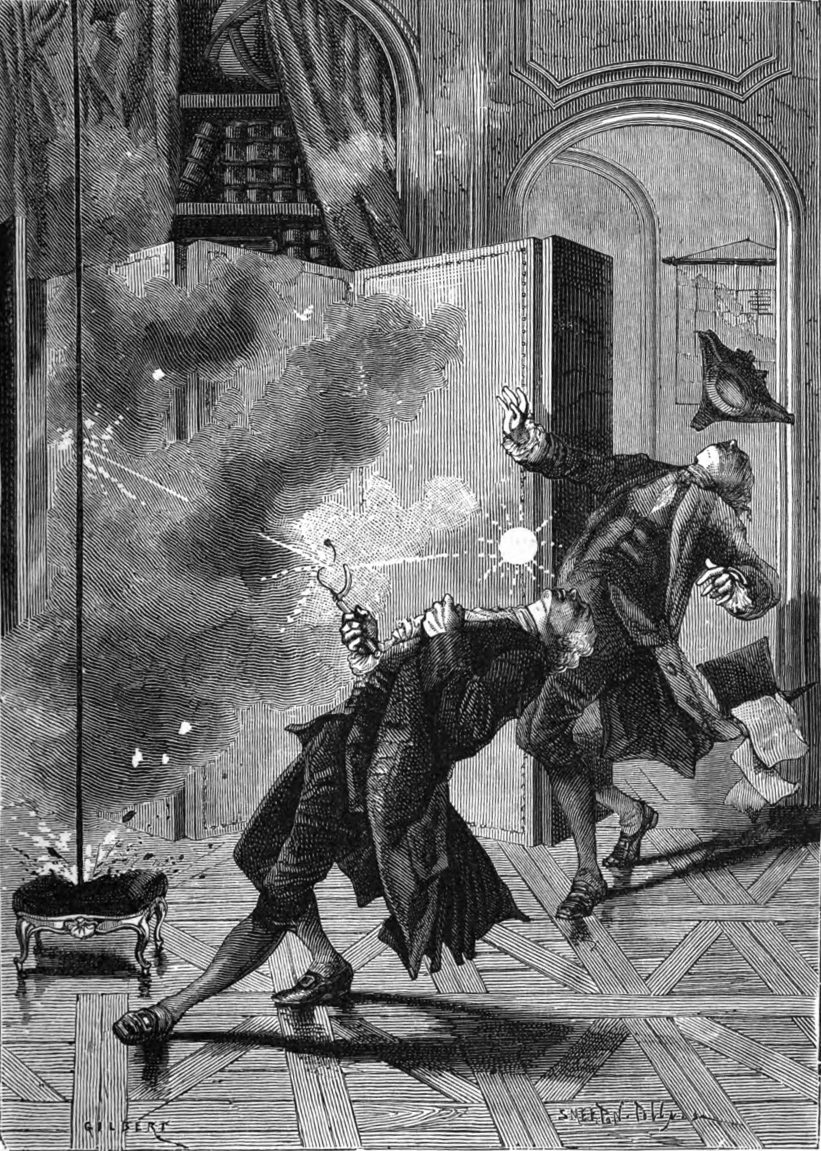
The best-documented early death is Georg Wilhelm Richmann, a physicist at the St Petersburg Academy of Sciences. On 6 August 1753 he was repeating Benjamin Franklin's experiment with an iron rod and an electrometer when a small ball of lightning jumped from the apparatus to his forehead and killed him. A second discharge knocked his engraver unconscious, split the door frame and tore the door off its hinges. Richmann was found with a red spot on his forehead, his shoes blown open and his clothing singed, and he is usually described as the first person killed while conducting electrical experiments.
In 1809, according to an English journal account, three balls of fire appeared during a storm on the warship HMS Warren Hastings. One killed a man on deck and set the main mast alight, a second struck the sailor who had gone to retrieve the body, and a third killed another man. The accounts disagree on how badly the second man was hurt, describing anything from mild burns to an arm shattered badly enough that amputation was expected. A French account from 10 September 1845 describes a ball that rolled past three people in a kitchen at Salagnac without touching them, then entered a stable and exploded, killing a pig.
| Date | Place | Outcome |
|---|---|---|
| 21 Oct 1638 | Widecombe-in-the-Moor, Devon | 4 dead, about 60 injured |
| 29 Aug 1726 | Gulf of Florida | 1 dead, 1 hand lost |
| 6 Aug 1753 | St Petersburg | 1 dead (Georg Richmann) |
| 1809 | HMS Warren Hastings | 2 dead, 1 injured |
| 10 Sep 1845 | Salagnac, France | 3 people unharmed, 1 pig killed |

The modern medical record
The most recent injuries in the clinical literature were reported in 2003 in Annals of Plastic Surgery by a Belgian burns team led by G. Selvaggi. During a severe storm, ball lightning came down a chimney into a house and burned a 28-year-old man and his 5-year-old daughter.
The father lost consciousness and sustained superficial second-degree burns across both cheekbones and deep second-degree burns on his right hand, about 4% of his total body surface area. His daughter was burned across the left side of her face and, more seriously, took deep second-degree and third-degree burns to the left side of her neck, both upper arms and her back, around 30% of her body surface area.
The authors describe the injuries as carrying the marks of both fire and electricity, and note that these were the first two reported cases of ball lightning burns sustained indoors. That last detail is the one worth holding on to. Four of the six dated events above happened indoors, and the other two took place aboard ships, which is a reminder that a wall is not something ball lightning reliably stays behind.
The one time anyone measured one
In July 2012 a research group from Northwest Normal University in Lanzhou was filming ordinary cloud-to-ground lightning on the Tibetan Plateau when a ball formed after a strike. The team published the results in January 2014, and it remains the only spectrum of natural ball lightning published in a peer-reviewed journal.
The instruments were 900 metres away, which is far for a phenomenon this small. The ball was about five metres across, far larger than the 10 to 20 centimetres of a typical report, and it travelled roughly 15 metres at an average 8.6 metres per second. Its spectrum showed emission lines of neutral silicon, calcium, iron, nitrogen and oxygen, in contrast to the mainly ionised nitrogen that ordinary lightning produces. The brightness pulsed at 100 hertz, which the authors attribute to a 50-hertz high-voltage power line nearby, and the ball's temperature came out lower than the parent lightning's, which runs somewhere between 15,000 and 30,000 kelvin.
| Measurement | Value |
|---|---|
| Distance recorded | 900 m |
| Video captured | 1.64 s |
| Ball diameter | 5 m |
| Distance travelled | about 15 m |
| Average speed | 8.6 m/s |
| High-speed capture | last 0.78 s at 3,000 frames per second |
| Emission lines | neutral silicon, calcium, iron, nitrogen, oxygen |
| Brightness oscillation | 100 Hz |
Why the danger is still an open question
Nobody can say in advance how dangerous a given ball is because nobody agrees on what it is. The hypotheses on offer include vaporised soil silicon burning as it recombines with oxygen, a microwave cavity, a soliton, Rydberg matter, a charged aerosol held together by its own field, and several others, and the article compiling them runs to a long list of proposals with no consensus pick.
The vaporised-silicon idea, published by John Abrahamson and James Dinniss in Nature in 2000, got its first real support from the 2012 spectrum, which showed neutral silicon lines. In 2007 a Brazilian team led by Gerson Paiva reported producing luminous balls lasting seconds by discharging electricity into pure silicon, which at least shows that the mechanism is not impossible.
None of this settles the danger question, and the honest version of the answer is that a ball lightning is a rare event with a documented but small capacity to injure and kill. It is not the only hazard whose record is thin in proportion to how seriously it can end: a composite volcano can kill more than 20,000 people in a single small eruption, and the same question about whether a dust devil is actually dangerous turns on the same mismatch between how often something is seen and how badly it can go. For ball lightning the mismatch is wider still, because the phenomenon has been measured exactly once.