.jpg)
What actually separates a brittle star from a starfish
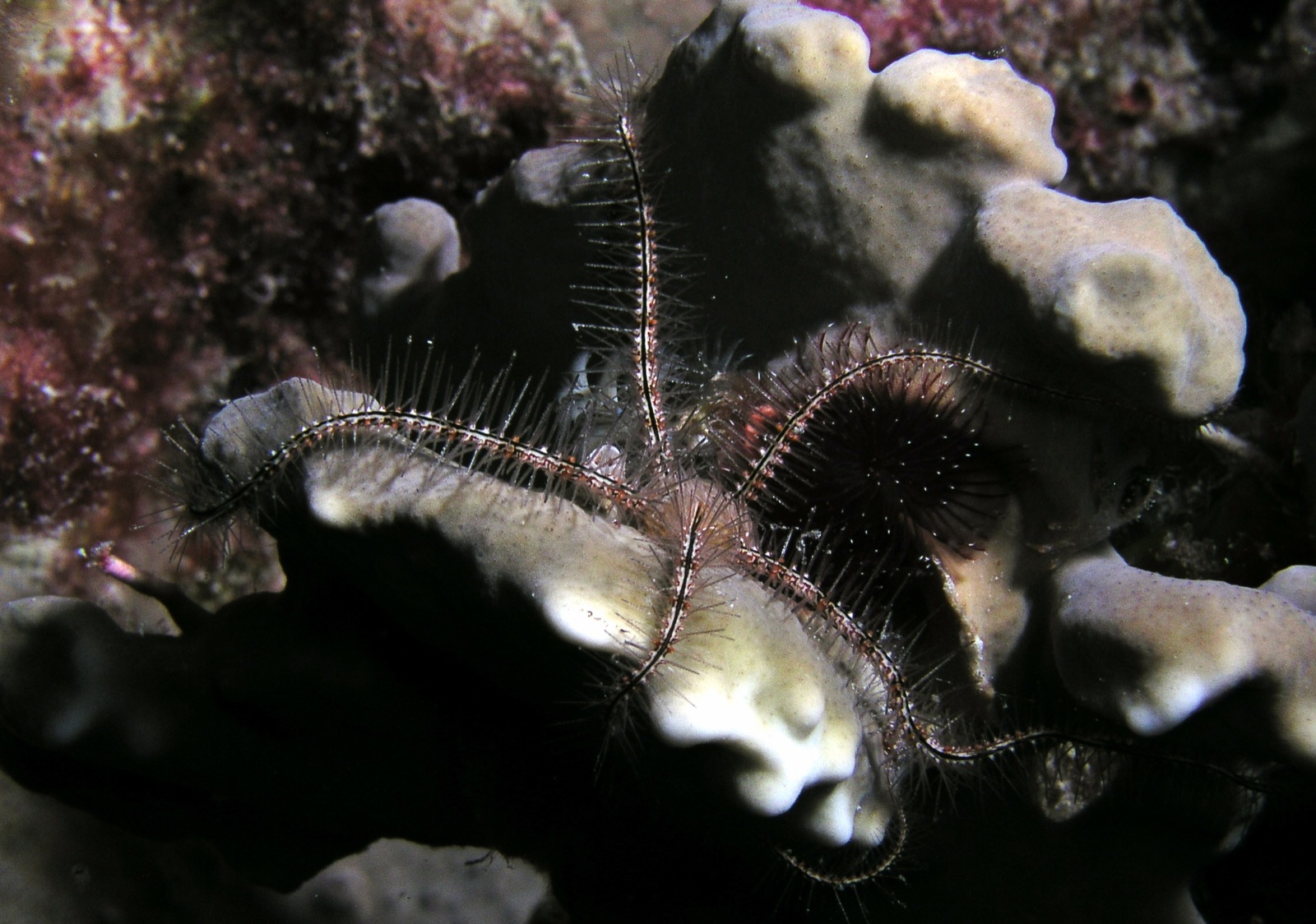
Brittle stars belong to their own echinoderm class, Ophiuroidea, distinct from the sea stars (Asteroidea) people often mistake them for at a glance. The giveaway is the central disc: on a brittle star it's small and sharply set apart from five long, thin, whip-like arms that can reach up to 60 centimeters on the largest species. Sea stars, by contrast, have arms that blend directly into a thicker body and crawl using rows of tube feet on the underside of each arm. Brittle stars move differently: they row and flex their arms to push across the seafloor, not walk on tube feet, a faster, more snake-like style of locomotion that gives the group its other common name, serpent stars.
A comprehensive 2012 taxonomic review in PLoS ONE by Sabine Stöhr, Timothy O'Hara, and Ben Thuy, built on the World Register of Marine Species, put the number of formally described living species at 2,064, the largest class within the echinoderms, and that count has likely grown some since as more species get described. The review recorded nearly identical numbers of species in shallow shelf waters and in the deeper bathyal zone beyond the shelf edge, 1,313 versus 1,297, evidence that global brittle star diversity isn't concentrated near the surface the way a lot of casual reef-watching would suggest. The single largest family, Amphiuridae, accounts for 467 of those species on its own, including Amphiura filiformis, the species researchers keep returning to below for its glow and its genome.
Why grabbing one usually costs you the arm
The name is literal. Grab a brittle star, or startle one badly enough, and it will voluntarily snap off the arm you're holding rather than let a predator drag the rest of it away, a defense called autotomy. The severed arm sometimes keeps twitching on its own afterward, a distraction that buys the rest of the animal time to retreat into a crevice. Other marine animals can also survive the loss of body structures: some sea cucumbers eject defensive tubules or internal organs and regenerate them. Those responses involve different structures from a brittle star's arm.
Losing the arm isn't the end of it, and researchers have started using the regrowth process itself as a research tool. A 2023 study in the journal Marine Drugs took tissue samples from Ophiocoma cynthiae arms at 7 and 14 days into regeneration and found extracts from both timepoints measurably sped wound closure and cell migration in lab tests, with the 7-day extract performing best once the same extracts were tested on live rat skin wounds. GC-MS analysis behind that study identified 42 distinct compounds across the different regeneration-stage extracts, evidence that whatever drives the regrowth chemically is an active, shifting process rather than one static substance the animal simply switches on.
The compound eye that later research took apart
Brittle stars have no eyes and no brain, just a decentralized nerve ring with radial nerves running down each arm, which is what made a 2001 study in Nature, by Joanna Aizenberg and colleagues at Bell Laboratories and the Weizmann Institute of Science, so striking. In light-sensitive species like Ophiocoma wendtii, they found that the calcite crystals making up the arm's skeletal plates form a regular array of spherical microlenses, arranged in a double-lens design that minimizes the distortion ordinary calcite normally introduces into light passing through it. Photolithography tests supported the idea that the array actually focuses light: shining light through an isolated section produced sharp points of exposure directly beneath each lens center, at an estimated focal distance of 4 to 7 micrometers, which happened to line up with where the underlying nerve bundles sat. The paper proposed those lenses and nerves together might work something like a compound eye spread across the animal's own skeleton, and the idea stuck for years, inspiring biomimetic-optics research and getting cited as a landmark example of a visual system built out of bone.
A 2018 study in Proceedings of the Royal Society B, led by Lauren Sumner-Rooney at the University of Oxford, went back and tested that model directly with synchrotron X-ray tomography and immunostaining for light-sensing opsin proteins, and it didn't hold up. The team found opsin-reactive photoreceptor cells scattered across almost the entire body surface, not clustered at the lenses' predicted focal points; the nerve bundles once proposed as the primary receptors actually projected past the lenses, all the way to the skin surface, never stopping beneath them. Just as damaging to the original model, a related species, Ophiocoma pumila, previously reported to lack the lens structures entirely and used as the light-indifferent control, turned out to have its own version of them, with the same dense photoreceptor network as O. wendtii. A 2020 follow-up study by the same lab, in Current Biology, confirmed O. wendtii genuinely can detect shapes in a way O. pumila can't, but traced that ability to something else: mobile pigment cells called chromatophores that expand and contract around the photoreceptors, screening incoming light the way an aperture does in a pinhole camera. The skeleton's crystal lenses turned out to be real, just not for seeing; the researchers describe them as a likely case of exaptation, a structure whose optical properties are a side effect of something else, not the reason the animal can sense light and dark.
It glows, but the fuel isn't its own
A different brittle star does something else with light: it makes its own. Amphiura filiformis, a burrowing species common off European coasts, produces blue flashes at 472 nanometers through a Renilla-type luciferase enzyme, concentrated in photocyte cells packed into its arm spines. A 2024 study in Scientific Reports, led by Constance Coubris and colleagues at Belgium's Université catholique de Louvain, ran the first long-term seasonal monitoring of that ability and found something the animal can't get around on its own: it has no internal storage form for coelenterazine, the light-producing compound its luciferase needs to react with.
That means every flash has to come from what the animal recently ate. The researchers found luciferase gene expression stayed steady across seasons, so the enzyme itself is always ready to work, but the animal's actual glowing capacity tracked the availability of coelenterazine-containing prey in its diet, not the calendar. In their study area there was no meaningful seasonal dip, because small crustaceans carrying the compound were present year-round, but the underlying mechanism means an A. filiformis population in a food-poorer patch of seafloor could, in principle, lose the ability to glow even with every biochemical piece needed to do it still switched on inside it.
What a regrowing arm might teach human medicine
Regeneration researchers have started paying closer attention to brittle stars for a practical reason: humans are bad at regrowing lost body parts, and echinoderms are exceptionally good at it. A 2024 study in Nature Ecology & Evolution, led by Elise Parey at University College London, sequenced the first chromosome-scale genome for Amphiura filiformis and found it to be the most rearranged genome among all echinoderms sequenced so far, including a reshuffled Hox gene cluster, the same family of genes that pattern body segments in essentially every bilaterally symmetric animal. Profiling gene activity across the stages of arm regrowth, from wound closure through proliferation to differentiation, the team found genes with expression patterns conserved between the brittle star's arm regeneration and appendage regeneration in vertebrate models, evidence that at least part of the genetic toolkit for regrowing a limb has persisted across an enormous evolutionary distance.
Brittle stars aren't the only echinoderms rewriting assumptions about what a body can withstand. A close relative, the red sea urchin, shows close to no measurable decline in survival or reproduction even past its hundredth year, and outside the phylum entirely, some ribbon worms can regrow an entire animal from a fragment as small as a quarter of the original body. None of these are the same mechanism, and none hand human medicine a shortcut on their own, but they're exactly the kind of comparative data the field is short on: species that solved the same basic problem, staying functional after major bodily damage, in different ways, and the brittle star's newly sequenced genome now gives researchers an actual list of genes to check against.