_Luc_Viatour.jpg)
What actually makes a jellyfish a "moon" jellyfish
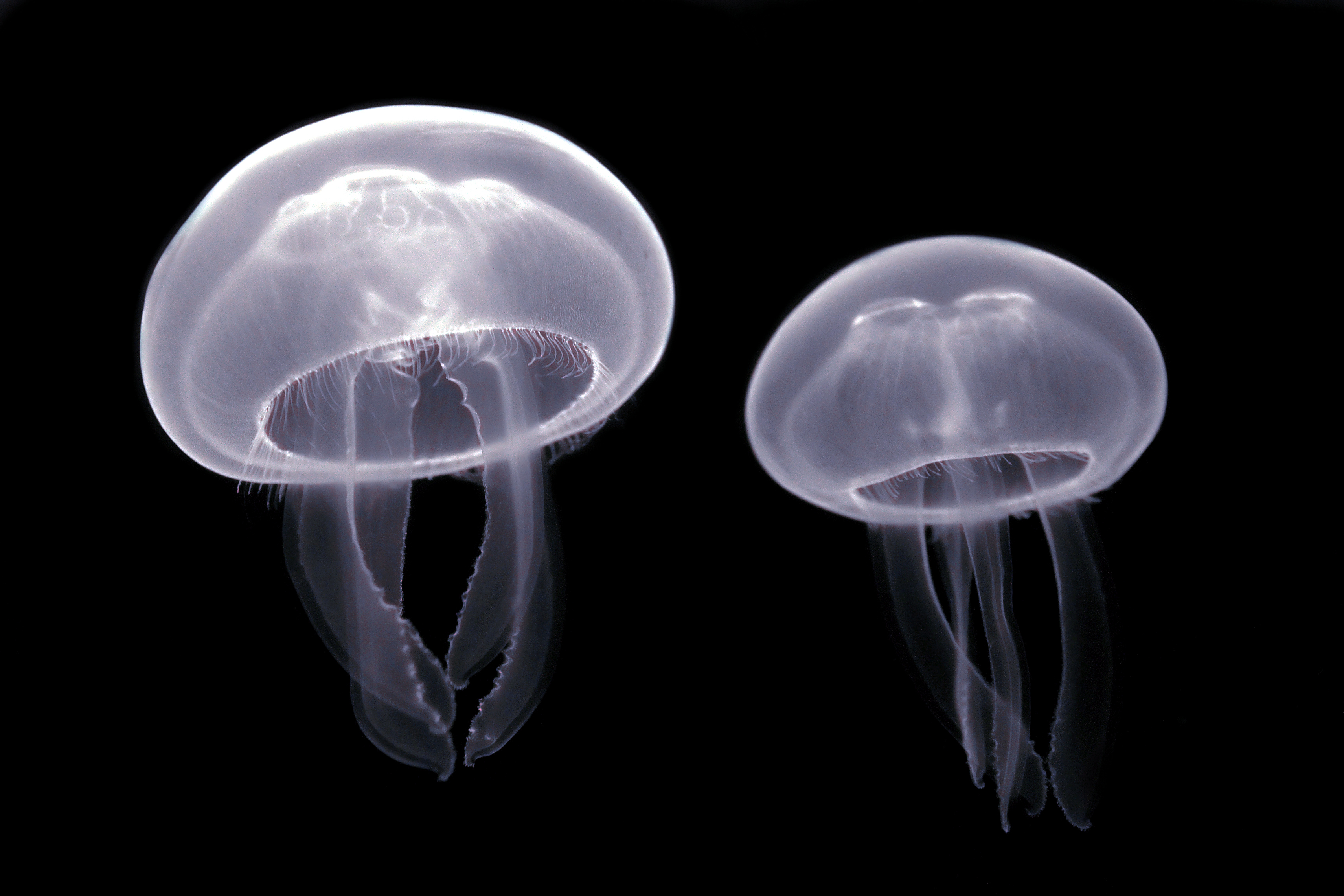
The name comes from the animal's pale, translucent bell, which glows faintly like a small moon when light catches it underwater. The surest way to identify one isn't color or size, which both vary, but the four horseshoe- or clover-shaped structures visible through the top of the bell: these are the gonads, and in a healthy adult there are exactly four, arranged in a ring around the center. Bell diameter typically runs from about 25 to 40 centimeters, and unlike jellyfish built around a few long, trailing stinging arms, a moon jellyfish carries a dense fringe of short, fine tentacles around the entire rim, more like short bristles than the whips associated with box jellyfish or the Portuguese man o'war. It has no brain, heart, or blood, and its body is upward of 95 percent water; movement and orientation instead run through a diffuse nerve net paired with eight sensory structures called rhopalia spaced around the bell margin, each one carrying a light-sensing eyespot and the gravity-sensing statolith organ that becomes relevant later in this article. Not every invertebrate built this way is so delicate: limpet teeth, measured in a 2015 study, are the toughest biological material ever recorded, tougher than spider silk and on par with Kevlar.
The swimming jellyfish most people picture is also only half the story, and the shorter half. That drifting medusa stage typically lives a matter of months in the wild before dying, but it began as a bud released from a sessile polyp, a small stalked animal anchored to a rock, piling, or shell that can live for up to 25 years, according to a life-history summary from the University of Michigan's Animal Diversity Web. Each spring, a temperature shift triggers the polyp to undergo strobilation, segmenting itself like a stack of coins and releasing each segment as a free-swimming juvenile called an ephyra, which grows into the adult medusa over the following months. The polyp keeps doing this year after year. The part of the life cycle most people never see is also the part built to last. A different seafloor invertebrate relies on an even stranger survival trick at the larval stage: a sand dollar larva can clone itself the moment it senses a predator nearby.
Aurelia aurita isn't one species. It's at least 28.
When Linnaeus formally described Aurelia aurita in 1758, working from specimens collected in Sweden, naturalists had no way to tell one population of nearly identical, translucent, four-gonad jellyfish from another short of looking at them, and for the next two and a half centuries "moon jellyfish" and "Aurelia aurita" were treated as interchangeable, a single species drifting through every ocean on Earth. Genetic sequencing eventually told a different story. In a 2021 paper in PeerJ, Jonathan Lawley, Edgar Gamero-Mora, Maximiliano Maronna, Luciano Chiaverano, Sérgio Stampar, Russell Hopcroft, Allen Collins, and André Morandini used molecular characters to work around a genus where morphology alone routinely fails to separate distinct lineages, and recognized 28 species of Aurelia in total: seven already described before their study, ten formally described for the first time in the paper itself, four resurrected from older names that had been folded into A. aurita, and seven more flagged as genetically distinct but still awaiting a formal description.
The revision also shrank the map. True Aurelia aurita, the population Linnaeus actually described, is now considered restricted to the North Atlantic and waters off Argentina rather than global. A lot of what gets photographed and labeled "moon jellyfish" elsewhere in the world is a separate species, commonly Aurelia coerulea, native to the northwest Pacific and now established in San Francisco Bay, the Atlantic and Mediterranean coasts of France, Wales, and parts of Australia, having spread through ballast water and shellfish transport, not by natural range expansion. The animal in a touch tank on one coast and the animal actually named by Linnaeus may not be the same species at all. The count keeps moving, too: in 2025, Alexandra Frolova, Ann Mammone, and Maria Pia Miglietta described Aurelia profunda in the journal Marine Biodiversity, a new species pulled from deep, cool water roughly 80 miles off the Louisiana coast in the Gulf of Mexico, its entire life cycle documented from a single fertile female a graduate student happened to net in 2017.
NASA sent 2,478 jellyfish into orbit to study human vertigo
STS-40 launched aboard Space Shuttle Columbia on June 5, 1991, as Spacelab Life Sciences-1, the first Spacelab mission dedicated entirely to biology. Among its subjects, alongside the human crew and 30 rodents, were 2,478 moon jellyfish polyps, sent up by researcher Dorothy Spangenberg of Eastern Virginia Medical School to study a specific structural overlap: the rhopalia described in the first section of this article each contain a statolith, a small mass of calcium sulfate crystals that shifts under gravity and tells the jellyfish which way is down, using essentially the same physical principle as the calcium-carbonate otolith organs in the human inner ear that give people their own sense of balance. "At the cellular level, there are structures in the jellyfish that are analogous to structures in the inner ear of humans," Spangenberg told The Virginian-Pilot in a 1997 interview about the research. "Jellies have tiny crystals on their armlike projections that help them determine which way is up."
Over the nine days before Columbia landed on June 14, the jellyfish population aboard grew from the original 2,478 polyps to nearly 60,000 juvenile ephyrae. Spangenberg and three colleagues published the detailed results in Advances in Space Research in 1994: the space-grown ephyrae built rhopalia that looked structurally normal under the microscope, but statolith loss from those rhopalia was significantly higher in the ephyrae raised in orbit than in ground-based ephyrae that never left Earth, and some of the space-developed animals showed pulsing abnormalities once they were back in Earth's gravity, struggling to swim the way healthy jellyfish normally do. A sensor that looks fine but still misfires under real gravity is a small-scale version of the same mismatch behind why astronauts stumble and feel disoriented for their first days back on the ground.
A sting most people never feel
A moon jellyfish is armed the same way every jellyfish is, with nematocysts, coiled harpoon-like capsules that fire a hollow tubule into anything that brushes past. The reason its sting is famous mainly for not hurting comes down to that tubule's length. In a 2015 PLOS ONE study, Ryuju Kitatani, Mayu Yamada, Michiya Kamio, and Hiroshi Nagai at Tokyo University of Marine Science and Technology measured nematocyst tubules across several jellyfish species and found that ones capable of causing real pain, including Chrysaora pacifica, Carybdea brevipedalia, and Chironex yamaguchii, fire tubules longer than 200 micrometers, long enough to physically punch through the human epidermis and reach the pain-sensing nerve fibers underneath. Aurelia aurita's tubules fall short of that threshold, mechanically incapable of breaking skin in most cases, which is why brushing against one in the water typically produces no sensation at all, and at most a brief tingle or mild redness that clears up within an hour or two.
Not every stinging-cell story in the ocean runs the same direction. A sea urchin delivers venom through an entirely different structure, with the most dangerous documented species stinging through small pincer-shaped organs called pedicellariae rather than through its spines at all, and some marine slugs skip building venom of their own entirely: certain nudibranchs that prey on jellyfish relatives swallow their victim's stinging cells undischarged and fire the stolen weapon back as their own defense. A moon jellyfish, by contrast, has the standard equipment; it just doesn't have enough of it, at the wrong length, to matter to something built like a human. Sensory surprises run just as deep elsewhere on the seafloor: a brittle star can sense its surroundings without any eyes, using light-sensitive cells spread across its skin instead.
Are jellyfish blooms actually increasing?
Reports of surging jellyfish swarms clogging beaches and fishing nets circulate regularly, usually pinned on warming oceans and overfishing thinning out the predators and plankton competitors that would otherwise keep numbers in check, with Aurelia often cited as a bloom-forming genus. In 2013, Robert Condon and roughly 30 co-authors working as the Global Jellyfish Group compiled abundance records from 37 locations around the world spanning 1790 to 2011 and published their analysis in PNAS. Rather than confirming a runaway global increase, they found jellyfish abundance rises and falls in decades-long oscillations that have repeated for more than a century, patterns strong enough to explain a meaningful share of the variance in the raw data on their own.
The study's authors also flagged a likely source of the public perception gap: a rising phase in the oscillation ran from roughly 1993 to 2004, and that stretch lines up closely with when headlines about a global jellyfish takeover became common, timing that may have shaped the narrative more than the full historical record supports. None of this rules out that a warmer bay or an overfished coastline can produce a real local bloom; it means the long-term global picture Condon's team assembled doesn't show a steady, one-directional surge, and that any single spike is more likely a swing within a recurring cycle than proof the oceans are being permanently overrun.