_-_(living_animal),_%C3%89tretat,_France.jpg)
One shell shape, three unrelated animal families
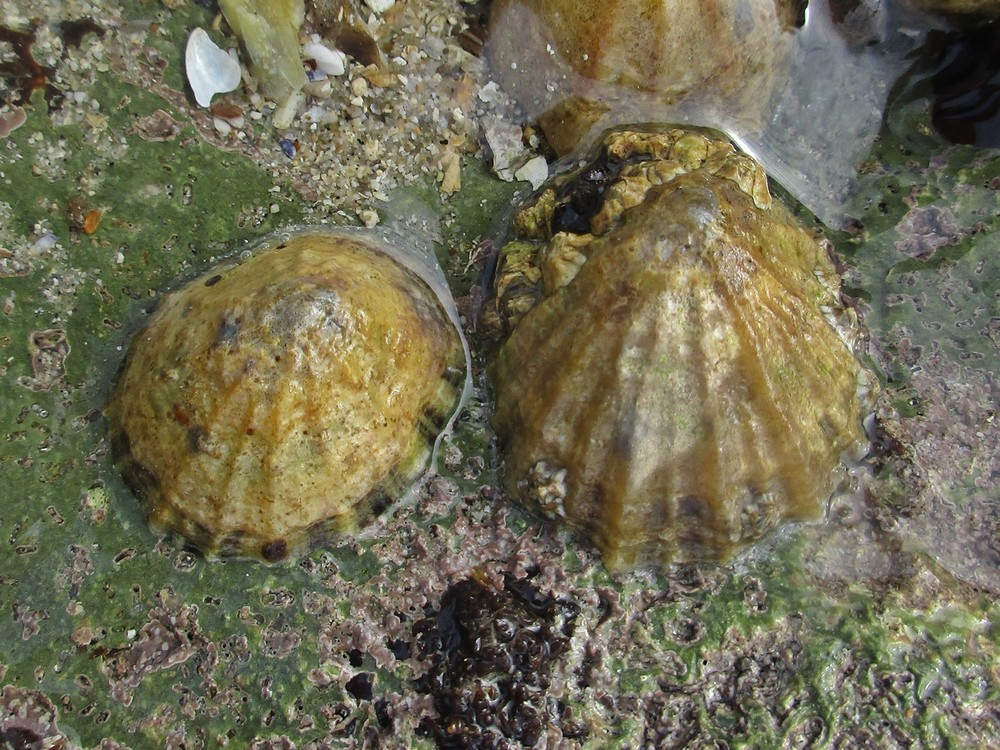
"Limpet" describes a body plan, not a single lineage. The University of California Museum of Paleontology groups true limpets (Patellidae, in the order Patellogastropoda), keyhole limpets (family Fissurellidae), and false or pulmonate limpets (family Siphonariidae) together only because all three independently converged on the same low, cap-shaped shell, a shape that spreads wave force evenly and lets the animal clamp down against a rock with almost no leverage for a predator or a breaking wave to exploit. They are otherwise only distantly related within the gastropods, roughly the same way a shark and a dolphin share a body shape without sharing a recent ancestor.
Keyhole limpets carry the clearest evidence that the shape is a solution, not a shared inheritance: their shell has a small hole at the apex, called the foramen, that most true limpets lack. According to Britannica, water flows in under the shell's edge and exits through that opening, carrying waste and reproductive cells out of the mantle cavity while the animal stays sealed flat against the rock, which means a keyhole limpet gets the respiratory plumbing other snails manage with an open shell aperture without ever having to break its seal. True limpets, including the common limpet featured in most of the research below, solved the same wave-exposure problem differently: they lift the shell's edge just enough to draw water in around the whole rim rather than through a dedicated vent. Barnacles, which settle on the same rocks and were long mistaken for mollusks themselves because of their own hard plates, took the opposite path and gave up moving entirely, while nudibranchs, fellow gastropods, abandoned the shell altogether, and the aeolid ones among them defend themselves with stolen stinging cells instead.
Teeth stronger than spider silk, discovered by pulling them apart one at a time
Every limpet feeds by dragging a ribbon of microscopic teeth, the radula, across bare rock to rasp off a film of algae too thin to see. In the common limpet, Patella vulgata, that ribbon turned out to hide the strongest biological material scientists have ever measured. Asa Barber's team at the University of Portsmouth, working with Nicola Pugno at the University of Trento in Italy, used atomic force microscopy in 2015 to grip individual limpet teeth, no more than a couple of millimeters long, and pull them apart under controlled load. The tensile strength they recorded, published in the Journal of the Royal Society Interface, ranged from 3.0 to 6.5 gigapascals, which beat spider silk, the previous record holder among natural materials, and put limpet teeth in the range of Kevlar and high-grade carbon fiber.
The strength comes from composition and geometry together. Limpet teeth are reinforced with goethite, an iron-oxide mineral, arranged as nanofibers inside a softer protein matrix, but the fibers themselves are the key: Barber's team found their diameter sits below a defect-controlled critical size, meaning they are too thin to contain the microscopic flaws that normally weaken a material as its sample size grows. Seven years later, a University of Portsmouth team led by Robin Rumney and Alex Ford took the discovery a step further, publishing a 2022 study in Nature Communications describing how they grew a synthetic version of the same chitin-and-goethite composite in a laboratory rather than harvesting it from a live animal. The team framed the achievement as a potential path toward a manufactured fiber for cars, boats, or aircraft that could rival synthetic composites in strength while breaking down without the waste problem those synthetics create, though the process has not yet been scaled beyond lab quantities.
A keystone grazer: remove the limpets and the rock turns green
Those teeth do more than make headlines. Patellid limpets are widely described in the ecological literature as a keystone species on temperate rocky shores, meaning their effect on the wider community is disproportionate to how much space or biomass they take up. Left ungrazed, a rock face develops a thin film of diatoms and cyanobacteria within days, then a bloom of fast-growing ephemeral seaweeds such as Ulva, a succession pattern that shows up consistently in limpet-removal experiments across the UK and Europe. A limpet population grazes that film down before it can establish, keeping the rock face clear, the same kind of bare surface a barnacle larva tests for a spot before cementing itself down for life.
How strong that control is turns out to depend on where the shore sits. Ross Coleman, Tony Underwood, Stephen Hawkins, and an international team ran a manipulative field experiment at five sites spanning 17 degrees of latitude, from southern Portugal to the Isle of Man, removing limpets and tracking how the algae responded. Published in Oecologia in 2006, the results showed grazing exerted strong, consistent control over algal cover at the northern sites but a far weaker, patchier effect toward the warmer south, evidence that a single species can act as a keystone grazer in one region and a minor player a few hundred kilometers away. The same logic that makes sea urchins capable of turning a kelp forest into a barren gives limpets an outsized ecological footprint for an animal that spends its life within a few meters of one spot.
_attachment_depressions_on_sandstone,_Seamill,_North_Ayrshire.jpg)
A home scar ground into the rock, and a sex that isn't fixed for life
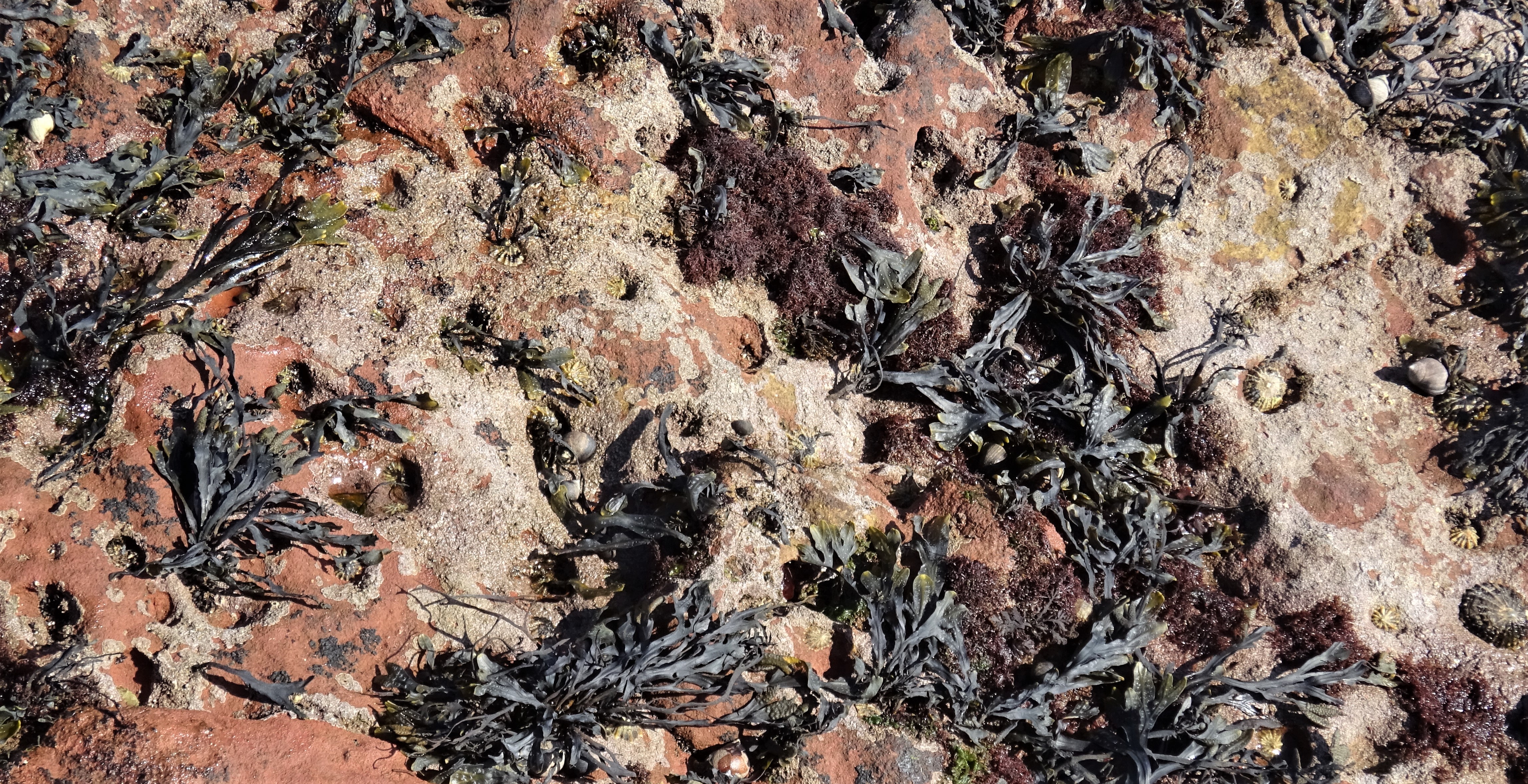
A limpet does not graze randomly. It rests through the tide in one fixed spot, called a home scar, then ventures out a few meters to feed and returns to that same spot before the tide turns. On softer stone the return trips wear a shallow depression that fits the animal's shell exactly, visible on some Scottish sandstone shores as a scatter of oval scars long after the limpets that carved them are gone. How a limpet navigates back is still not fully settled: a 2002 University of Oregon thesis by Jane Wright April reviewing a century of homing research found competing support for a mucus trail carrying pheromone cues and for a form of learned topographic memory of the rock surface, and cited experiments that physically blocked a limpet's outbound path and found it could still return home by a different route, meaning simple trail-retracing cannot be the whole explanation.
The common limpet's biology holds two more counterintuitive results. According to a Marine Life Information Network species account, growth rate and lifespan trade off directly: limpets living under a canopy of nutrient-rich brown seaweed grow quickly but typically live only two to three years, while limpets on exposed bare rock with little food grow slowly and can survive fifteen to sixteen years or longer. And the species is a protandric hermaphrodite, starting life male and switching to female at a size-dependent age, typically around two to three years old. A 2016 field experiment by Catarina Borges, Stephen Hawkins, Tasman Crowe, and Patrick Doncaster, published in Ecology and Evolution, simulated human harvesting pressure on limpet populations and found that removing the largest individuals caused the remaining limpets to switch to female at a smaller size than in unharvested control plots, evidence that the same shore foraging that has fed coastal communities for centuries measurably reshapes a limpet population's sex ratio.