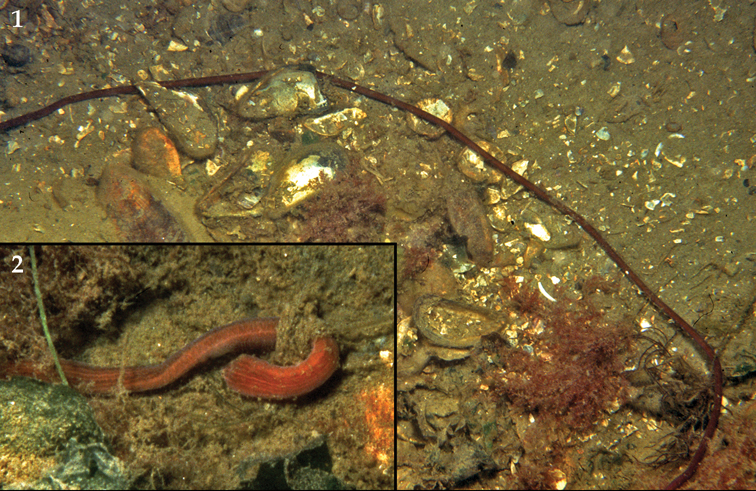

The 180-foot record no one has ever seen again
Ribbon worms, or nemerteans, are a phylum of soft-bodied, unsegmented worms named for their long, flattened shape. The World Nemertea Database lists roughly 1,300 to 1,400 described species, the great majority of them marine, living under tidal rocks, in mudflats, and across ocean floors from the intertidal zone to the deep sea. How incomplete that catalog still is became clear in 2024, when U.C. Davis undergraduate Madeline Frey surveyed the shorelines and mudflats around Bodega Bay, California, and identified 34 nemertean species, only 13 of which (38 percent) matched any formally described species. The other 62 percent, including 11 entirely new to science, were published in the journal ZooKeys.
The species that put the phylum on record books is the bootlace worm (Lineus longissimus), a thread-thin, near-black worm usually only 5 to 10 millimeters in diameter. In 1864, after a severe storm, a specimen washed ashore near St Andrews, Scotland, and was described by the Scottish marine zoologist William M'Intosh at more than 55 meters, or about 180 feet. That's longer than the largest blue whale ever recorded, a 33.58-meter (110-foot) female measured at a South Georgia whaling station in 1909, and it's the figure still cited today as the longest single animal ever measured.
That record has never been repeated. Typical bootlace worms measure 5 to 15 meters, with some collected specimens reaching close to 30 meters, but marine biologists who study live nemerteans near Bergen, Norway, report the longest individuals they've actually found top out around 2 meters. The gap has a straightforward anatomical explanation: nemerteans have no rigid skeleton, relying instead on a fluid-filled hydrostatic body that lets them stretch to many times their resting length when disturbed, handled, or tossed around by storm surf. Developmental biologist Bruno Vellutini, who studies nemertean biology, has written that length records for the group deserve caution for exactly this reason: a stressed, storm-battered worm stretched taut on a beach isn't the same measurement as a calm, undisturbed one.
The 'longest animal' title itself is also contested by something that isn't really a single animal at all. In March 2020, researchers aboard the Schmidt Ocean Institute's research vessel Falkor, exploring the Ningaloo Canyons off Western Australia at a depth of about 631 meters, filmed a giant siphonophore of the genus Apolemia coiled into a spiral. A laser-equipped drone measured just the coil's outer ring at about 47 meters (150 feet), but the team couldn't fully measure the unresolved inner coils and estimated the creature's total length at more than 120 meters (390 feet). A siphonophore is a colony of thousands of genetically identical, specialized zooids functioning together, not one organism in the way a worm is, but even the directly measured 47-meter figure is comparable to the bootlace worm's disputed 1864 record, and the team's fuller estimate would put it well past it.
A proboscis built like a grappling hook
Ribbon worms don't have jaws, claws, or a stinger. What they have is a proboscis: a separate, muscular, fluid-filled tube stored in its own internal chamber above the gut, called the rhynchocoel, and shot outward through an opening near the mouth to grab prey. In one major group, the Hoplonemertea, the proboscis ends in a sharp, needle-like barb called a stylet that punctures and injects; in others, including Lineus, the proboscis instead has a sticky, branching surface coated in toxin that wraps around and immobilizes prey without a barb at all.
Either way, what gets injected is a cocktail, not a single poison. A 2020 proteo-transcriptomic study of the ribbon worm Amphiporus lactifloreus, published in Marine Drugs, found its proboscis secretes a mix of paralytic toxins and enzymes such as metalloproteinases: a combination that immobilizes prey (typically bristle worms, small mollusks, and other soft invertebrates) while simultaneously starting to break its tissue down, before the worm has even begun to feed. A related 2022 study in Molecular Biology and Evolution, sequencing venom genes and proteins in the Antarctic ribbon worm Antarctonemertes valida, identified more than 80 distinct putative toxins expressed separately in predatory versus defensive tissue, showing a single worm can carry different toxin cocktails depending on whether it's attacking prey or fending off a threat.
A genuine video, an invented caption
In late December 2023, a video began circulating online showing a ribbon worm on land, apparently firing a branching, tree-like structure out of its body, captioned as the worm 'spitting a living, tree-like proboscis to hunt its prey.' Snopes fact-checked the footage and confirmed the video itself is genuine: that branching structure is a real proboscis, and some nemertean species do have one shaped that way instead of a simple barbed tube.
The hunting claim was invented, though. Snopes traced similar footage back to a nearly identical video that went viral in 2015, which Mental Floss had asked a specialist to explain at the time. Sebastian Kvist, then an associate curator of invertebrates at Toronto's Royal Ontario Museum who studies nemerteans specifically, said the worm throws out its proboscis as a defensive strategy, not to hunt: "What we're seeing is a very stressed worm that's doing everything it can to try to get away from the situation that it's in." Other marine animals have different defenses involving internal structures: some sea cucumbers fire adhesive tubules at a threat. That expulsion differs from a ribbon worm extending its proboscis. What's misleading here isn't the worm's biology but the caption slapped on top of it, the same dynamic that turned an ordinary desert arachnid into an internet monster through a misleading forwarded photo.
Cut one in half and you might get two worms
Nemerteans are famously fragile: collectors and researchers regularly find that handling a specimen causes it to break apart on its own, sometimes into many pieces. In most cases that's simply damage. But in a handful of species, that fragility doubles as a reproductive strategy: large individuals of the ribbon worm Lineus sanguineus, historically also described under the now-outdated name Lineus socialis, have been documented breaking into six to twenty or more pieces, each of which forms a mucous cyst and regenerates into a complete, smaller worm.
The regenerative ceiling for that same species is higher still. A 2022 methods paper in the NCBI Bookshelf, describing protocols for studying whole-body regeneration in Lineus sanguineus, reports that the worm can regrow a complete individual from a midbody fragment as small as one quarter of its original length, provided that fragment retains even a small piece of the lateral nerve cord running the length of its body. Lose that nerve fragment, and the regenerative capacity disappears. Regeneration also occurs in a different marine group: a detached Elysia sea slug head can regrow a body, including the heart. The discarded body did not grow a new head in that study. Ribbon-worm regeneration from body fragments follows a different route.
A tetrodotoxin worm now living in English oyster beds
Not every ribbon worm story is decades old. Cephalothrix simula is a small ribbon worm native to the Pacific, first flagged as a public-health concern in a 2013 study that reported high concentrations of tetrodotoxin (the same fast-acting neurotoxin found in pufferfish) in specimens from Hiroshima Bay, Japan. A later survey of the species and a related nemertean in Peter the Great Bay, in the Sea of Japan, measured tetrodotoxin concentrations ranging from roughly 86 to more than 7,100 micrograms per gram of tissue, a wide spread the researchers linked to interactions between the worm and toxin-producing bacteria living inside it.
The worm has since turned up well outside its native range. It's now established as a non-native species in parts of England, and a study published in the journal Marine Drugs in October 2024 investigated whether it could explain sporadic tetrodotoxin contamination in British shellfish. Sampling seawater and Pacific oysters (Magallana gigas) farmed at a site in southern England across 2021, the researchers found a statistically moderate correlation between the amount of C. simula environmental DNA in the water and tetrodotoxin levels measured in the oysters, with both the worm's DNA and toxin levels spiking in June and July of that sampling year. The study describes the link as evidence supporting the hypothesis, not final proof, but it points to an invasive ribbon worm as a plausible new route for a marine toxin best known from a very different animal.