
The email that built the camel spider legend
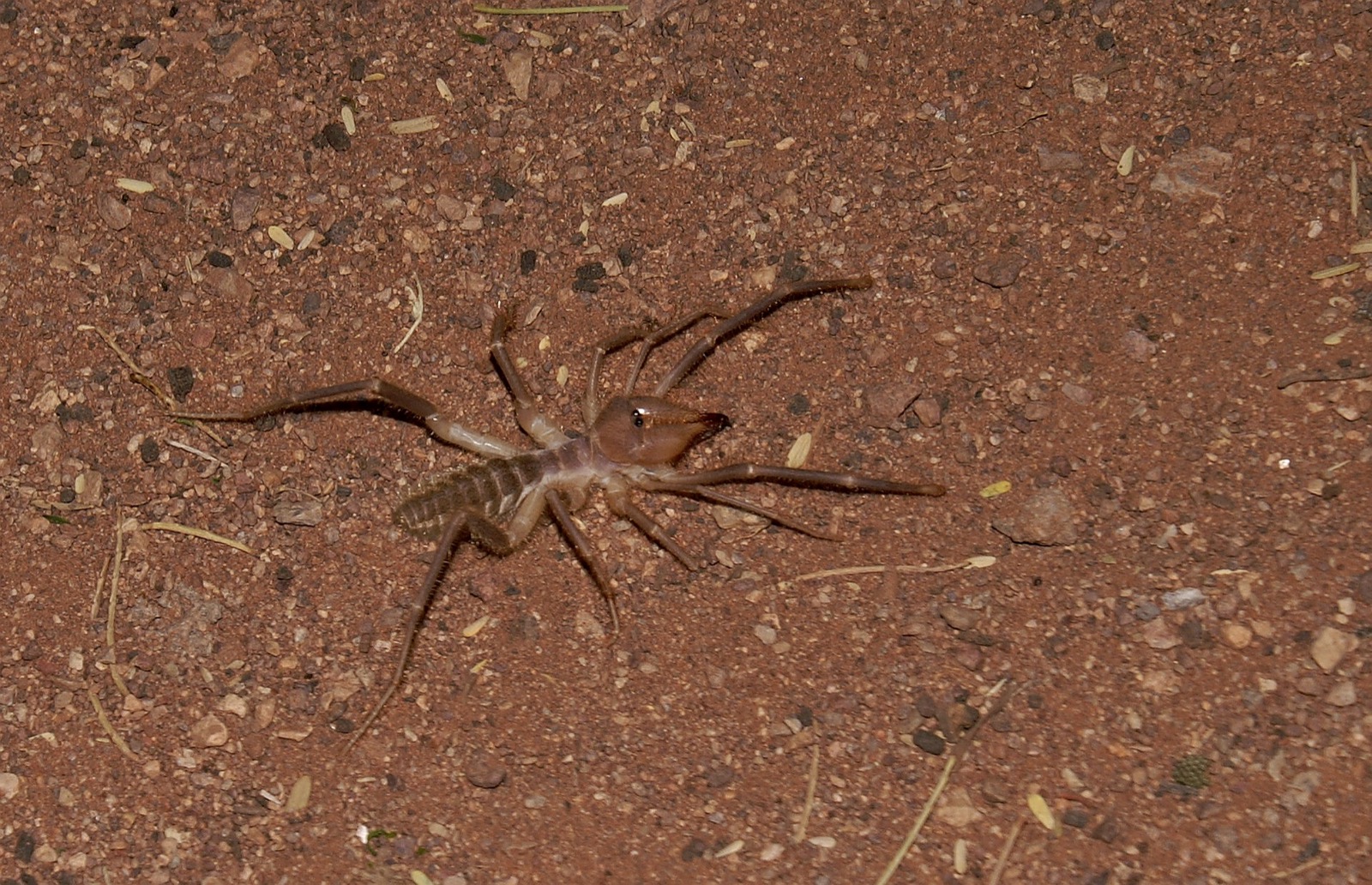
On 4 April 2004, Rod Crawford, who curates arachnids at the Burke Museum in Seattle, started receiving copies of a mass email with a photograph attached. The message said it came from someone stationed in Baghdad and framed the picture as a look at what deployed troops were dealing with. Three days later Snopes published a fact check of the same image, where David Mikkelson gave it the status line "Real picture; inaccurate description."
The claims that traveled with the photo, in that first message and the follow-ups that piled on afterward, were specific and vivid. The animals supposedly ate the stomachs of camels and laid eggs under camel skin, which was said to explain the name. They could allegedly cross sand at 25 miles per hour while screaming, jump four to six feet straight up, and chase a person down. They were described as venomous, with an anesthetic in the venom that numbed sleeping soldiers so the animals could feed on them unnoticed.
None of that is true, and most of it had been circulating since the 1991 Gulf War before the 2004 photo gave it a face. Crawford noticed something else about the timing: the version he received was dated 4 April, and he suspected the original had gone out three days earlier, on April Fools' Day.
Why the camel spider photo looks wrong
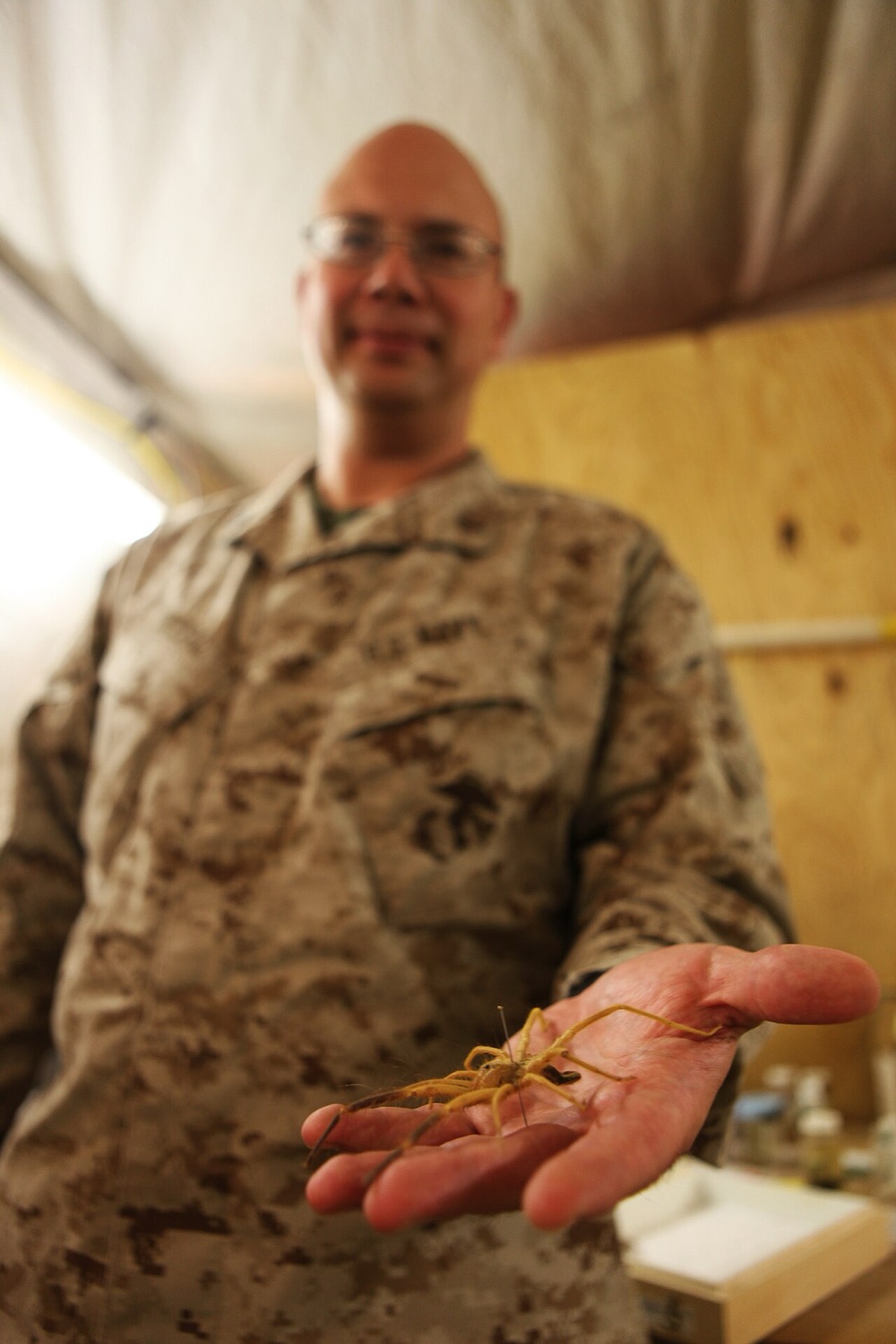
The picture was not doctored. Both Snopes and the Museum of Hoaxes reached the same conclusion, which is that the animals were simply held near the camera while the rest of the scene sat farther back, so the lens did the exaggerating. Crawford put numbers on it: the solifuges in the frame look around 40 centimeters long, roughly eight to ten times life size, and a correspondent who knew the sergeant in the photo reported the actual animals were about 4 centimeters.
Real sizes are far less dramatic. Crawford gives 5 centimeters as the maximum body length for a near-eastern solpugid. The American Arachnological Society describes the whole order as ranging from a few millimeters to 10 centimeters in length. Wikipedia puts the largest species at 12 to 15 centimeters counting the legs, and Snopes put the leg span at roughly five to six inches, which lands in that same range. A large one is a hand-sized animal.
Popular accounts inflate animals this way regularly, and the mechanism is usually mundane. The sea lizard Mosasaurus picked up its oversized reputation from a single outsized jaw bone that got scaled up past what the rest of the fossil evidence supported. Here it was a camera angle rather than a bone, and the resulting figure proved just as durable.

The speed figure everybody repeats, and where it came from
The chain email claimed 25 mph. Nearly every correction to it, Snopes included, offers 10 mph as the real figure. National Geographic's species page states that their top speed is estimated at 10 miles per hour and cites nothing further. Wikipedia's current Solifugae article no longer gives a top speed for the species (checked 13 October 2026). The corrected number rests on a popular-science estimate, and the trail ends there.
The figures offered against it are lower, but they are not better sourced. The American Arachnological Society, writing about the order it specializes in, says many solifuges run at 53 centimeters per second, which works out to about 1.9 km/h or 1.2 mph. That page names no study, no method, and no species. Crawford, who went looking for the underlying data, wrote: "The maximum speed cited in scientific sources is ten miles per hour, and the only accurately measured speeds I could find were less than 1 mile per hour." He also noted that nobody passing along the faster claims ever explained how the speed or the jumping height had been measured.
Those two low figures do not quite agree with each other, either, since 53 centimeters per second sits just above the 1 mph ceiling Crawford describes. What the disagreement exposes is that none of the numbers in circulation, high or low, traces back to a published measurement a reader can check. Solifuges are quick for their size and run in bursts, and no single figure would cover an order this varied anyway. The pattern resembles what happened to Tyrannosaurus rex, where a hunter-versus-scavenger controversy lived in documentaries and press coverage long after the scientific literature had settled the question.
No venom, and nothing to inject it with
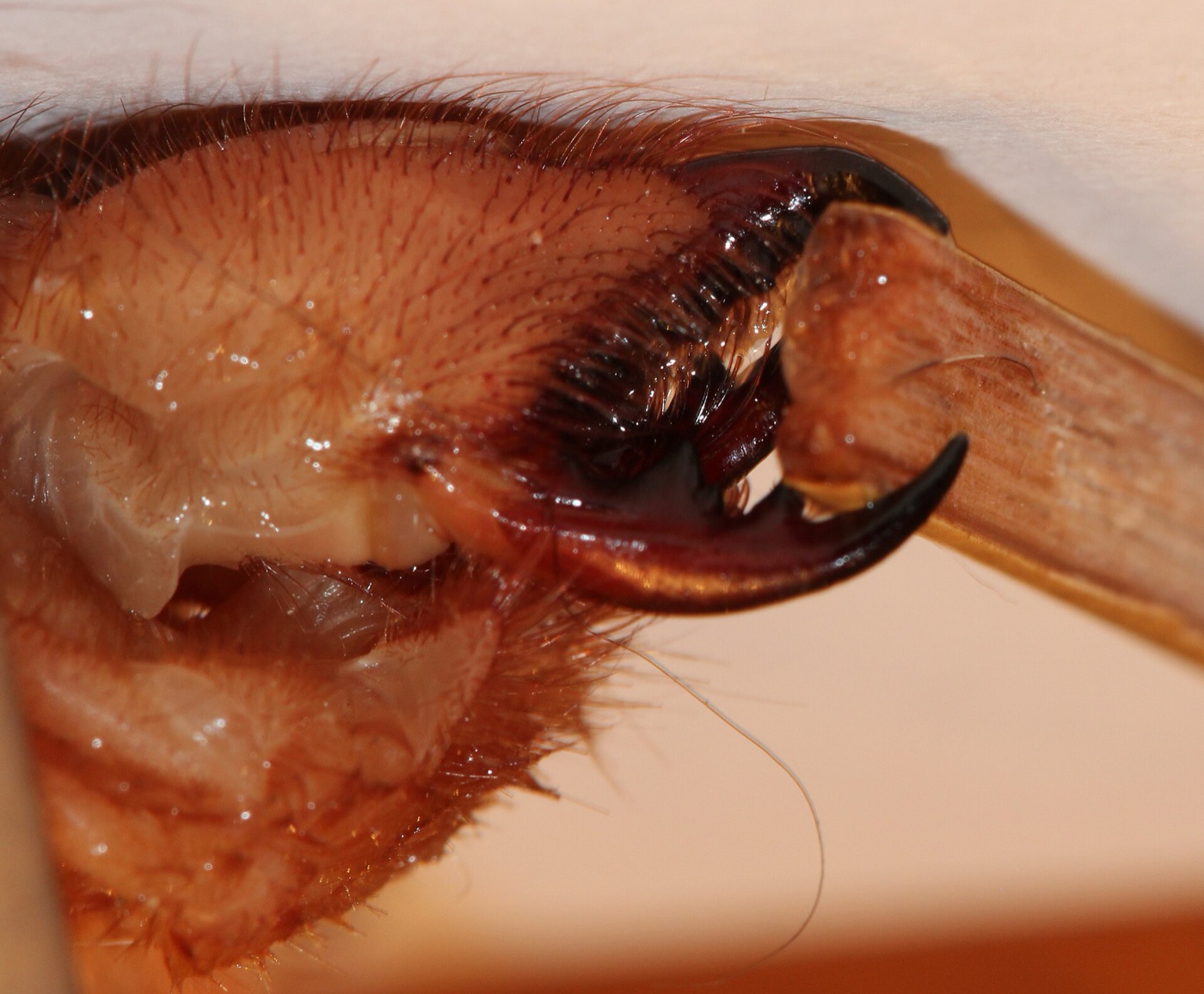
The anesthetic story is the most repeated claim and the easiest to rule out. Crawford states it without hedging: "They positively have no venom, and no way to inject it even if they did have it!" Solifuges have no venom glands, and nothing comparable to the fangs of a spider or the sting of a wasp with which to deliver any.
One 1978 report from India is still quoted as an exception, claiming that Rhagodes nigrocinctus possessed venom glands. A 2014 review of neglected venomous invertebrates traced the actual experiment: extract from the gland region was injected into ten Hemidactylus geckos, and seven of them became paralyzed and recovered within 48 to 72 hours, not the outright lethality sometimes attributed to it secondhand. No later study has confirmed the glands or reproduced the result. Anja Klann's 2009 comparative study of solifuge organ systems at the University of Greifswald, which worked through the digestive, respiratory, nervous, and reproductive systems in detail, touches on the 1978 claim only to say that those glands and their supposed role in feeding remain questionable given the methods and illustrations the original authors supplied. Those authors also identified no natural mechanism by which the animal could deliver the substance to prey; the geckos were dosed by direct hypodermic injection rather than a bite.
They can still bite, and it can hurt, because the chelicerae are large and powerful for the body size. A bite that breaks the skin carries an infection risk like any other puncture wound, which Crawford suggests may be the seed of some of the flesh-loss stories, and he notes that disinfectant handles it.

Why they seem to chase people
Solifuges are mostly nocturnal and avoid direct sun, and the shade a standing person casts is a usable patch of cover in open desert. Crawford's explanation is that when one runs toward a soldier, a camel, or a tent, it is heading for shadow. If the person moves, the shadow moves, and the animal follows the shadow. From the inside it looks exactly like pursuit.
The screaming has a smaller kernel of truth behind it. Some species stridulate using the chelicerae, producing what Crawford describes as a barely audible buzz or hiss. That is a long way from the banshee noise of the emails, but it is not invented from nothing.
The camel connection is invented, though. Solifuges lay eggs in soil, they are predators of arthropods and other small animals, and they do not feed on animals the size of camels or humans. The name most likely reflects nothing more than a shared desert habitat. Names attach themselves to these animals carelessly in general: in southern Africa they are called haarskeerders and baardskeerders, hair shavers and beard shavers, after a folk belief that they cut hair to line their nests. The species living in Iraq are not mysterious, either. Crawford points out that British scientists studied them during the 39 years, from 1919 to 1958, that the country was under British control, and their anatomy and physiology have been documented since. A different desert animal from the same region shows how much distance can open up between an animal's popular reputation and its measured biology: the fennec fox's own basal metabolic rate turns out to run 39 per cent below what its body size predicts, a fact its reputation as a cute, low-maintenance exotic pet rarely mentions.
Not a spider, and still barely studied
Camel spiders belong to the order Solifugae, which sits alongside spiders and scorpions in the class Arachnida rather than inside either one. The World Solifugae Catalog, maintained by the Natural History Museum Bern, currently lists 1,220 described species in 151 genera across 15 living families, plus one known only from fossils. They are also called sun spiders, wind scorpions, and jerrymanders, and none of those names is more accurate than the others. Common names outrun biology often enough that an animal as familiar as the pterodactyl turns out not to be a single real species at all.
What is genuinely strange is how little formal science exists on them. A 2024 review in the Zoological Journal of the Linnean Society by Eileen Hebets, Alfredo Peretti, and nine colleagues opens on exactly this point: "Despite having >1200 described species and despite their nearly worldwide distribution and prevalence in many xeric ecosystems, relative to many other arachnid groups, we know little about the natural history and behaviour of animals in the order Solifugae." The paper is written as an invitation, laying out where solifuges could contribute to research in ecology, evolution, and behavior, and adaptations for speed is one of the open areas it flags.
The number repeated in nearly every article about camel spiders is not a measurement anyone has published, and the specialists who work on the order are still asking for that basic natural history to be done. Widely known animals often turn out to be documented far less well than their fame suggests, and sometimes the gap is in the animal itself rather than the numbers: the axolotl kept in laboratories is not genetically the same animal as the one in Xochimilco.