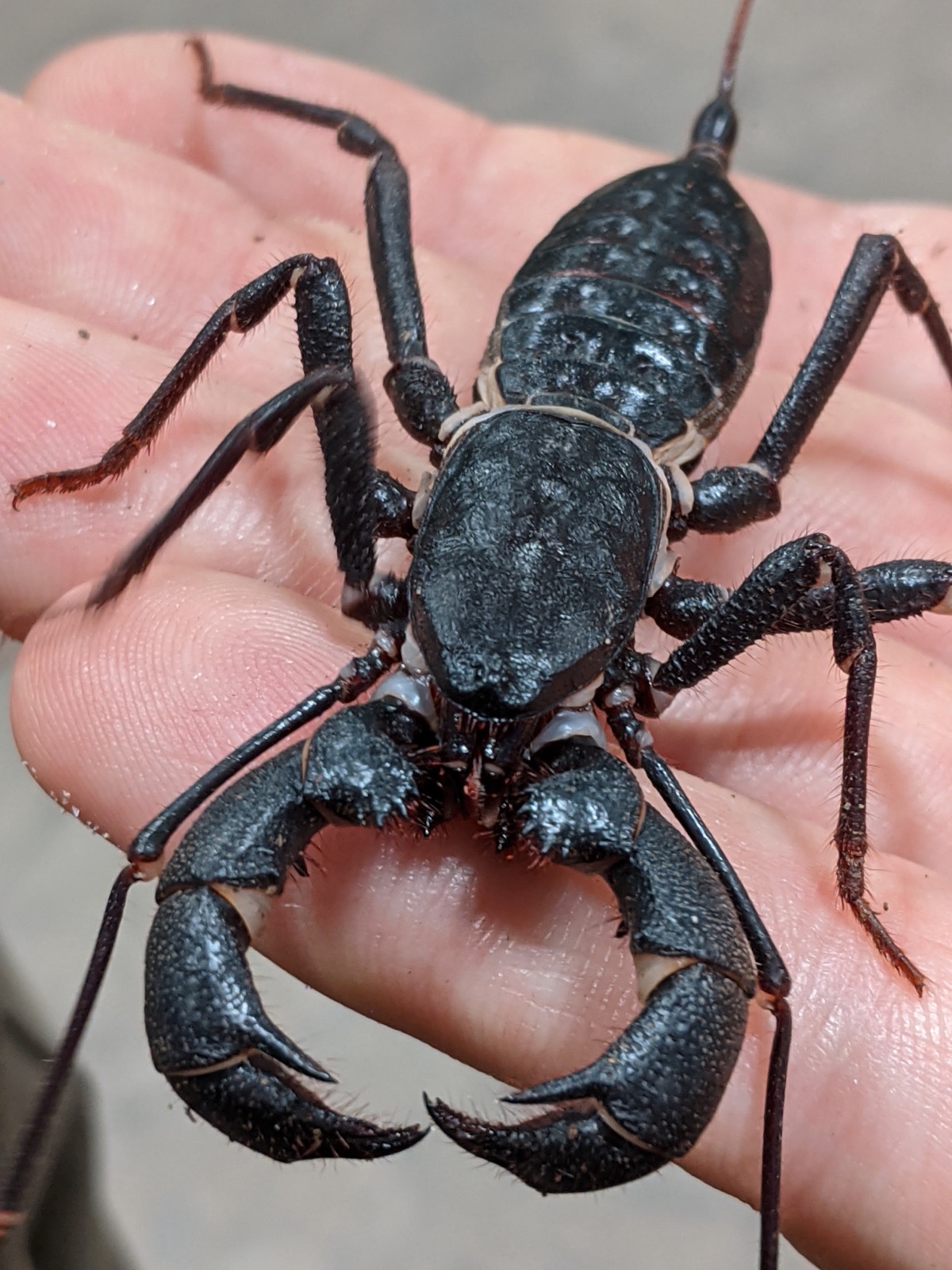
_closeup.jpg)
It looks like a scorpion but belongs to its own order
A vinegaroon has the pincer-like pedipalps of a scorpion, a hard armored body, and a thin tail trailing behind it, and that combination reads as "venomous predator" to most people who meet one for the first time. None of the three features that build that impression works the way it looks. Vinegaroons belong to the order Thelyphonida (also called Uropygi in older literature), a separate branch of the class Arachnida from Scorpiones, the order that contains true scorpions with a venom-injecting stinger, or Araneae, the spiders. Lorenzo Prendini's 2025 catalog of the order in Megataxa counts 123 extant thelyphonid species worldwide (plus 15 more known only from fossils), all sharing the same body plan: heavy raptorial pedipalps for grabbing prey, a first pair of legs modified into long, thin antenniform feelers rather than walking legs, and that trailing tail.
The tail is the part most often mistaken for a weapon, and it is the opposite of one. It is a multi-segmented flagellum covered in sensory hairs, used the way an insect uses antennae, to feel the ground and the air behind and around the animal while it forages at night. It has no venom gland connected to it and no mechanism to inject anything into anything. Whip scorpions have no true venom apparatus at all; the only chemical weapon in the body is located elsewhere, at the rear of the abdomen. A different arachnid order gets the same 'not what it looks like' treatment for a different reason: camel spiders have no venom either, despite a 2004 email chain that paired a misleadingly scaled photograph with older myths about anesthetic-laced bites.
The real weapon is a spray, not a sting, and it is concentrated acid
What actually defends a vinegaroon sits at the junction of its last abdominal segment, a pair of glands called pygidial glands that can eject a fine, forcibly aimed mist in almost any direction the animal chooses, including straight backward over its own body. Thomas Eisner, Jerrold Meinwald, Alfred Monro and Robert Ghent analyzed that spray directly in a 1961 study in the Journal of Insect Physiology and found it consists of 84 percent acetic acid, 5 percent caprylic acid, and 11 percent water. Ordinary household vinegar runs about 4 to 5 percent acetic acid, which puts the vinegaroon's spray at somewhere around 17 times that concentration, among the strongest natural acid defenses documented in any animal. The caprylic acid is not incidental: Eisner and colleagues found it acts as a wetting agent, spreading the spray across a predator's cuticle and increasing how deeply the acetic acid penetrates the waxy epicuticular layer that would otherwise limit its effect.
That chemistry is a completely different solution to the same problem millipedes address with defensive gland secretions whose chemistry varies by species, including benzoquinones or hydrogen cyanide, a defense strategy detailed in FactCrumbs' millipede coverage. Both are contact irritants aimed at driving off predators rather than killing prey; neither is built to subdue something the animal plans to eat, which is a distinction that separates true venom, delivered through a bite or sting to incapacitate prey or a threat internally, from a defensive secretion meant only to make an attacker retreat.
What actually happens if the spray hits you
Clinical data on human exposure exists because people occasionally get sprayed while handling vinegaroons as pets or encountering them in the wild in the southwestern United States. Sheila Smolinske, Steven Seifert, Bruce Warrick and Yolanda Tadford searched a regional poison center's records from 1998 through 2022 and published the results in Toxicon in 2022, identifying 50 reported human exposures across that 24-year window, in patients ranging from 5 months to 54 years old, 32 female and 17 male. The reported effects were pain, redness, numbness or tingling, itching and swelling, and symptoms were present in 88 percent of cases. Only four non-eye exposures were followed through to an outcome, and their effects lasted from under an hour to more than two days. The paper also notes that 36 of the 50 reports were described as bites and only 13 as skin contact with the secretion, although the paper's own background section says vinegaroons do not bite. The report does not explain the mismatch.
Eyes were a different story. The study recorded three ocular exposures, and all three involved pain, with one case also producing blurred vision; the paper's authors reported that ocular exposures were associated with more symptoms and a longer duration of effects than skin contact. That pattern lines up with the chemistry: an 84 percent acetic acid solution is a genuine irritant to mucous membranes even though it causes no systemic poisoning, which is the same reason poison-center staff recommend flushing the eyes immediately and thoroughly if a spray ever lands there. The takeaway from a 24-year, 50-case dataset is close to what Toxicon's abstract for the study frames it as: a real but generally minor hazard, nothing close to the systemic risk poison centers track for an actually venomous arachnid like the black widow spider, which has its own decade of poison-data-system records built around a very different chemical, alpha-latrotoxin.
One widespread species turned out to be seven
For most of the last two centuries, the giant vinegaroon of the southern United States and Mexico was treated as a single species, Mastigoproctus giganteus, first described by Pierre Hippolyte Lucas in 1835 and assumed to simply vary in appearance across a wide range. That assumption held until Diego Barrales-Alcalá, Oscar Francke and Lorenzo Prendini re-examined specimens across that entire range and published a systematic revision in the Bulletin of the American Museum of Natural History in 2018, using morphological characters in adult males, including the arrangement of spines on the pedipalp trochanter, the position of a structure called the epistoma on the carapace, a stridulatory organ on the chelicerae, a patch of setae on the fifth abdominal sternite, and the surface sculpture of the pedipalp femur, to demonstrate that the "single" species was actually a complex of seven range-restricted species.
Under the revision, three species occur in the United States, one each in Arizona, Texas and Florida, six occur in Mexico, and two of those ranges straddle the border. The taxonomy has kept moving since: a further new species, Mastigoproctus spinifemoratus, was formally described from Mexico as recently as 2024. None of this changes what a giant vinegaroon looks like or how it behaves day to day; it changes how precisely a name maps onto a population, which is exactly the kind of revision that happens when specimens finally get compared side by side instead of assumed to be the same thing because they look similar at a glance.
A body plan that predates the dinosaurs by hundreds of millions of years
Whip scorpions are an old lineage by almost any measure available. The fossil record for Thelyphonida reaches back to the Carboniferous period, and in 2024 Richard Knecht, Jacob Benner, Jason Dunlop and Mark Renczkowski described a new fossil species, Parilisthelyphonus bryantae, in the Zoological Journal of the Linnean Society, recovered from the Rhode Island Formation and measuring more than 34 millimeters long, the largest Palaeozoic whip scorpion documented to date. The same paper described a smaller trace fossil from an animal under 10 millimeters long found alongside it, giving researchers both size extremes from a single Carboniferous rock unit more than 300 million years old.
The lineage's Mesozoic record is thinner but still informative: Jason Dunlop reported the first confirmed Mesozoic thelyphonid fossil, Mesoproctus rowlandi, from Brazil's Crato Formation, dated to roughly 115 million years ago in the Early Cretaceous. Put together, the fossil record shows a body plan, heavy grasping pedipalps, antenniform front legs, and a segmented tail flagellum, that was already established before the Carboniferous ended and has persisted with only modest changes through everything that followed, including the extinction event that ended the age of dinosaurs.
Courtship is a marathon, and the young ride on the mother's back
German arachnologist Peter Weygoldt documented the reproductive behavior of Mastigoproctus giganteus in Florida in a 1971 study in the Journal of Zoology, describing a courtship ritual that plays out at night in stages: the male locates a female using his antenniform legs, grapples with her, and the pair moves into a prolonged, coordinated back-and-forth exchange in which he taps and strokes her with his pedipalps and she responds in kind, stretching over several hours before he deposits a spermatophore on the ground for her to take up. There is no venom or sting involved anywhere in the sequence, only an extended tactile exchange between two animals that spend most of their lives avoiding contact with anything larger than their prey.
After mating, the female digs a burrow and lays a clutch of roughly 20 to 40 eggs into a fluid-filled sac she carries attached to her abdomen for about two months until they hatch. The newly emerged young are pale, soft-bodied, and ride on their mother's back for a period after hatching before dispersing to fend for themselves, a level of parental carrying not far removed from what true scorpions do with their own live young, even though the two groups arrived at similar-looking behavior along entirely separate evolutionary paths.
What people who actually handle them say
Outside the academic literature, the most consistent real-world account of vinegaroon temperament comes from the hobbyists who keep them, discussed at length in threads like "Vinegaroons aggressive?" on Arachnoboards, a long-running arachnid-keeping forum. Multiple keepers in that thread describe captive-kept vinegaroons as calming down within minutes of being picked up, comparing their defensiveness to that of emperor scorpions, an arachnid widely regarded in the hobby as docile despite its intimidating size. One keeper reported handling five or six individuals with only one showing any irritation, and none resorting to spraying.
Wild encounters read differently in the same discussions, and that difference is itself informative: keepers describe wild vinegaroons responding to a threat with a clear escalation, spraying first, pinching only if the spray does not work, and running rather than pressing an attack. That sequence, spray, then pinch, then flee, is exactly what the biology predicts for an animal with no venom and nothing built for offense: every option in its defensive toolkit is aimed at making a predator back off, not at winning a fight.