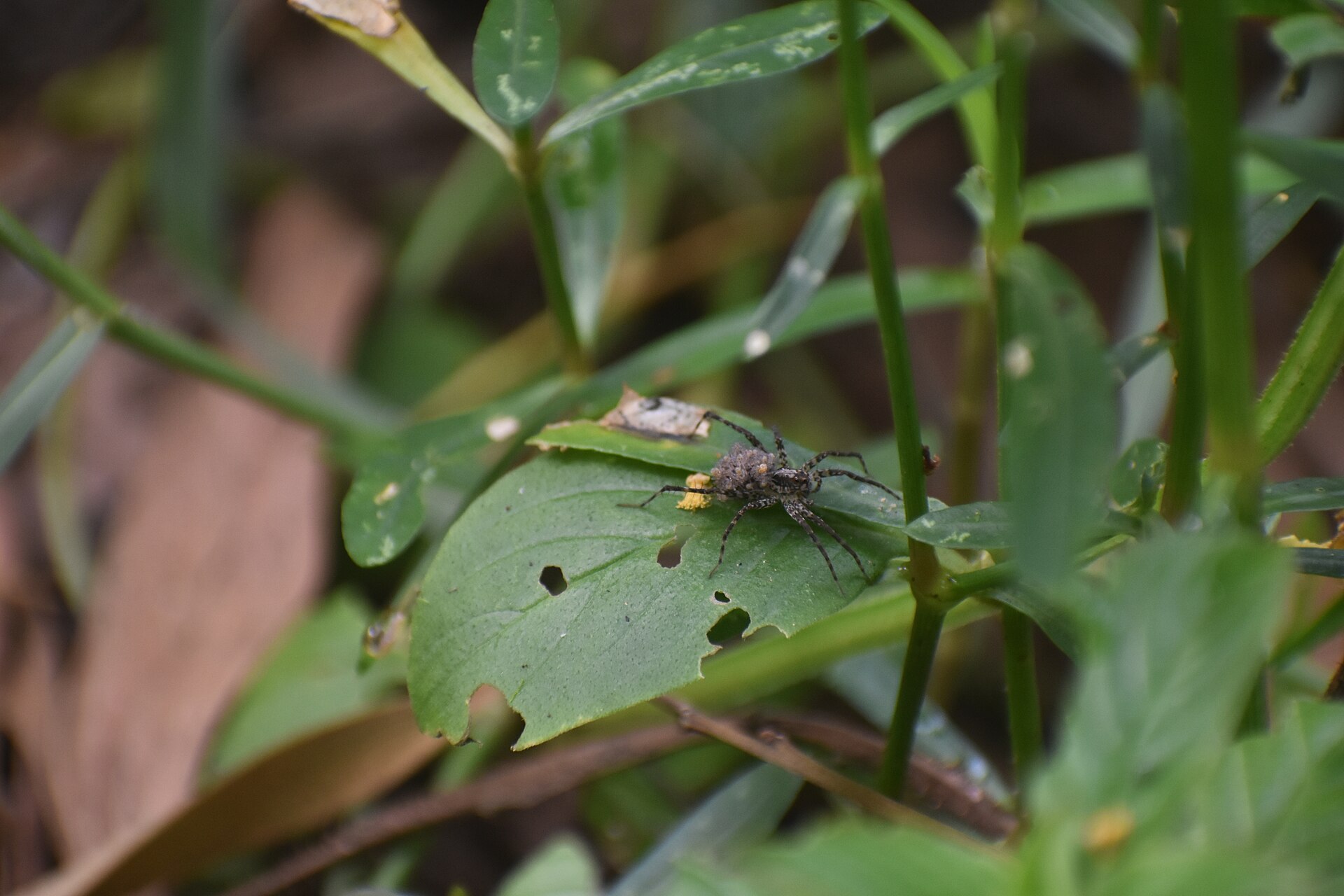

The only prospective bite study: 45 cases, mostly nothing
Geoffrey Isbister and Volker Framenau recruited subjects prospectively between February 1999 and April 2001, drawing from participating hospital emergency departments and state poison information centers across Australia, and published the results in the Journal of Toxicology: Clinical Toxicology in 2004. A case only counted as a definite wolf spider bite if the patient had collected the spider responsible and an arachnologist had confirmed its identity, a much higher bar than the self-reported "probably a wolf spider" that fills most casual accounts.
Forty-five bites cleared that bar: 23 male and 22 female patients, ages 1 to 69, median age 28. Species-level identification was possible for 31 of the 43 spiders retained as evidence, covering 14 species across seven generic groups. Most bites came from four genera: Tasmanicosa, Venator, Venatrix and Hogna, the last of which also contains North America's largest wolf spiders.
Pain showed up in all 45 cases and was rated severe in 24 per cent. Redness followed in 67 per cent, visible puncture marks or bleeding in 33 per cent, swelling in 20 per cent and itchiness in 13 per cent. Minor systemic effects such as nausea, headache and malaise appeared in 7 per cent of cases. No case produced a necrotic ulcer. Bites from spiders longer than 5 millimetres produced more severe pain, and Tasmanicosa bites specifically produced more itchiness and redness than the rest, about the only pattern the authors could tie to species identity, not just to the mechanics of the bite itself.
The paper's overall picture is that most of what a wolf spider bite does to a person is mechanical: the puncture of two fangs breaking skin, with genuine envenomation effects, where they existed at all, staying minor and species-dependent.
Fifty years of case reports: one doctor, one child
Before that Australian series, the published human record on wolf spider bites was thin enough that one entry exists specifically because a doctor wanted to add to it. John Redman, in the Division of Urology at the University of Arkansas Medical Center, wrote up his own envenomation by a lycosid in Archives of Dermatology in 1974. He framed the report as an argument for better identification of the responsible spider and more published case reports, given how little other literature on the subject existed at the time: a doctor volunteering himself as a data point because almost nobody else had.
Fifty years later the case-by-case pattern continues, and not always in the reassuring direction the 2004 average would predict. In 2026, Bharati Bansal and colleagues reported in Wilderness & Environmental Medicine a confirmed wolf spider bite in a 10-year-old boy in Texas who developed nausea, vomiting, severe abdominal pain and headache within minutes, systemic symptoms well outside what a 7 per cent rate in a 45-case series would suggest is typical. Everything resolved within three hours of supportive care, with no complications at discharge, but the case is a reminder that a low average rate still leaves room for an outlier, and that the literature on this family is still small enough for one unusual bite to be worth a published report.
The necrotic-wound reputation the data don't support
Wolf spiders carry an older reputation than the 2004 study was built to address. A 2012 review of wolf spider envenomation in Wilderness & Environmental Medicine, by Zhanna Livshits and colleagues, notes that the family had historically been presumed responsible for necrotic arachnidism, the same category of flesh-damaging wound usually blamed on the brown recluse, and that the limited prospective clinical data collected since, including the Australian series, show no cutaneous necrosis at all.
The brown recluse itself has the more thoroughly documented version of this problem. Entomologists at the University of California, Riverside, home to longtime spider researcher Richard Vetter, count roughly 40 medical conditions, several of them dangerous bacterial infections, that get misdiagnosed as brown recluse bites, frequently in regions where the species has no established population. In 2017, Vetter joined dermatologists William Stoecker and Jonathan Dyer in JAMA Dermatology to publish a mnemonic, NOT RECLUSE, meant to stop the misdiagnosis: a genuine brown recluse bite is usually solitary, not numerous, occurs when the spider is disturbed, shows a pale or purplish flat center, not a red one, and does not ulcerate before roughly a week to ten days or produce much swelling or pus.
Wolf spiders sit inside the same confusion from the opposite direction. They are large, often visibly hairy, active in daylight as well as at night, and routinely found indoors, which makes them a plausible-looking suspect for a wound that, most of the time, no spider actually caused. The same gap between reputation and documentation shows up in their desert cousins: camel spiders were long credited with an anesthetic venom that turns out not to exist at all.
Eyeshine: finding a hunter that carries no web
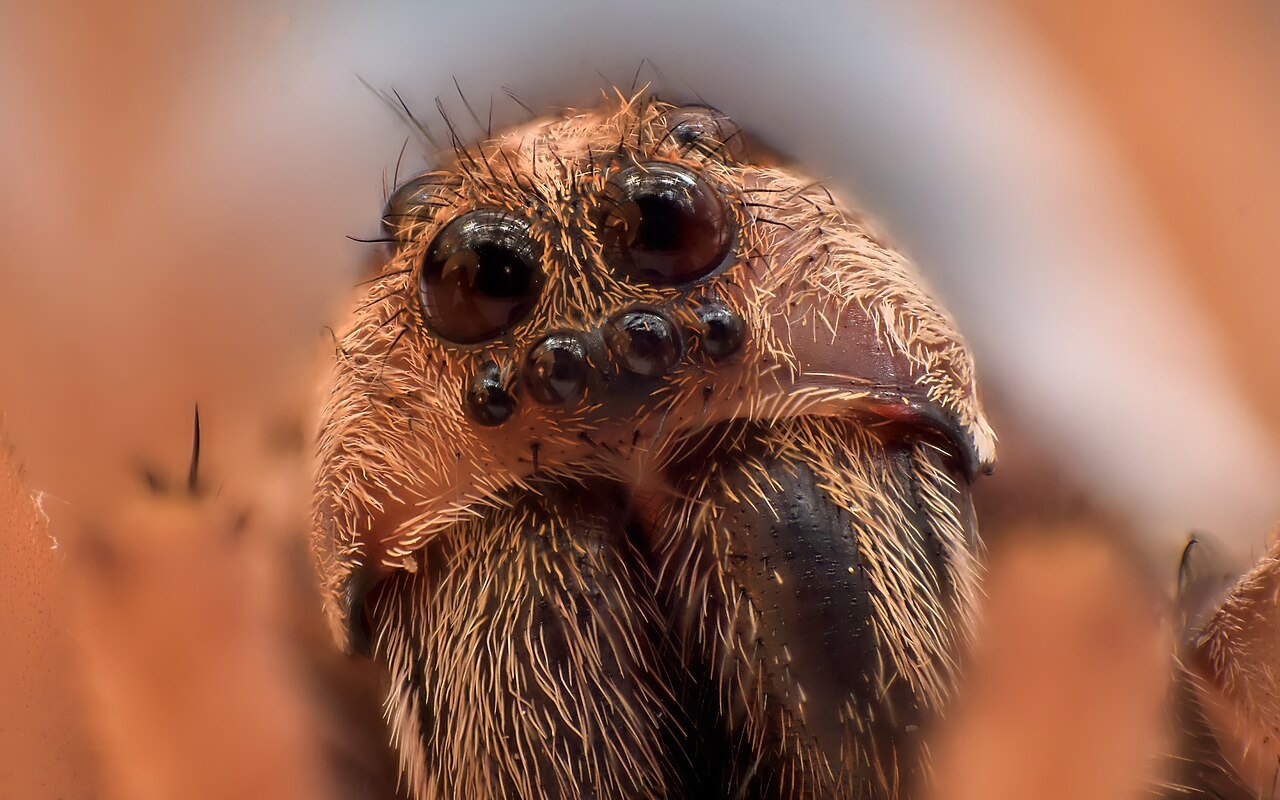
Because wolf spiders hunt on the ground and never spin a web to catch prey, they are otherwise easy to miss after dark, except for their eyes. Their posterior median eyes carry a tapetum lucidum, a reflective, guanine-based layer that Kari Benson and Robert Suter described in a 2013 Journal of Arachnology study of eyeshine in lycosoid spiders, that bounces a flashlight beam straight back at the observer as a sharp point of green light. A single patch of lawn or grassland at night can show dozens of these points scattered across the ground, each one a spider that would otherwise be invisible against soil and leaf litter. The technique is reliable enough that it has been adapted into an actual field-ecology teaching method, a nighttime transect exercise published in The American Biology Teacher built around exactly this reflex.
Actual density counts, using an entirely different method, suggest how many spiders those flashlight beams are picking up. Balázs Kiss and Ferenc Samu individually marked more than 5,000 Pardosa agrestis wolf spiders using a multiple mark-recapture method across two Hungarian alfalfa fields over two weeks in August 1995 and 1996, publishing the results in the European Journal of Entomology in 2000. One field held roughly 2 males and 1 female per square metre; the other held about 4.5 of each, close to 9 wolf spiders per square metre. A single agricultural field can carry a population dense enough that a flashlight swept across the grass at night finds eyeshine in nearly every direction.

The name comes from a spider that was probably not guilty
The word tarantula did not originally mean what it means today. It comes from Taranto, a port city in southern Italy, and named a real regional animal: Lycosa tarantula, a ground-dwelling wolf spider. Between roughly the 14th and 17th centuries, southern Italy recorded recurring outbreaks of tarantism, a condition in which the afflicted fell into a melancholic, lethargic state said to lift only when musicians played a fast, whirling dance, the tarantella, until the dancer collapsed from exhaustion. The bite of Lycosa tarantula was blamed.
Modern historians treat tarantism as a culture-bound psychogenic phenomenon, not a genuine mass envenomation syndrome, and the entomology underneath the folklore does not hold up well either. Lycosa tarantula lives in a burrow in the ground and is shy around humans, which makes it an unlikely serial offender for an illness reported across an entire region for centuries. Where later writers have tried to identify an actual spider behind real bite cases from that era, the better candidate is the European black widow, Latrodectus tredecimguttatus, an entirely different genus with an entirely different venom. A word that now names one of the most recognized groups of spiders in the pet trade started out attached to a wolf spider that most likely never caused the syndrome named after its hometown. Folklore outrunning the animal underneath it is a recurring pattern in this corner of natural history: the hunter-versus-scavenger debate around Tyrannosaurus rex lived on in documentaries for decades after the scientific literature had largely settled the question.
The wolf spider mother who never lets go
Most spiders lay their eggs and leave. Female wolf spiders do not. After mating, a female spins a silk egg sac and attaches it directly to her spinnerets, at the rear of her abdomen, then carries it with her everywhere she hunts. She periodically turns the sac toward the sun to help regulate its temperature and will reattach it if it snags loose; females that have had a sac removed experimentally have been observed to accept and carry an unrelated one in its place, not abandon the behavior outright.
Care does not end when the eggs hatch. The spiderlings climb onto their mother's abdomen and ride there, packed across her back, for roughly one to three weeks until their first molt, living off yolk reserves, not feeding from her. Only after that molt do they disperse to hunt independently, and once they do, cannibalism among siblings and between generations is a documented feature of Lycosidae biology: the same ground-hunting instinct that makes a lone adult an efficient insect predator makes a smaller sibling or an unrelated spiderling equally fair prey to a larger one. It is a level of post-hatching parental investment that most spider families, which simply leave an egg sac to hatch or not, never attempt.
The taxonomy keeps moving: 2,548 species and counting
The scale of the family is still growing on paper. The World Spider Catalog, maintained by the Natural History Museum Bern and last updated on 3 December 2025, lists 2,548 accepted species of Lycosidae across 143 genera, with new genera such as Erranticosa, split out by Yuri Marusik and colleagues in 2026, still being carved from older ones.
The internal structure keeps shifting too. Luis Piacentini and Martín Ramírez, both at the Museo Argentino de Ciencias Naturales in Buenos Aires, published the most comprehensive molecular phylogeny of the family to date in Molecular Phylogenetics and Evolution in 2019. Their analysis recovered most Lycosidae subfamilies as coherent groups for the first time and found that two previously separate subfamilies, Piratinae and Wadicosinae, were not distinct from Zoicinae and Pardosinae, folding them together. Their dating placed the split between Lycosidae and its closest relatives, the Trechaleidae, in the late Paleocene, roughly 54 to 51 million years ago, around the same time as the Paleocene-Eocene Thermal Maximum, and linked the family's diversification to the spread of open, non-forested habitat. Genus-level reassignment turns out to be common across the tree of life once anyone actually runs the analysis: even the largest dinosaur most people picture turned out to belong to a different genus once its most famous skeleton was reexamined.