.JPG)
What actually makes a spider an "orb weaver"
"Orb weaver" describes a web shape, not a single species: the flat, wheel-like spiral of silk radiating out from a central hub that most people picture when they hear the word "spiderweb." The spiders that build it belong mostly to one family, Araneidae, which the World Spider Catalog (the taxonomic reference researchers actually use to track valid species) lists at over 3,100 described species (3,182 as of the Catalog's late-2025 count, a total that grows as new species are described), making it the third-largest spider family after the jumping spiders (Salticidae) and the sheet weavers (Linyphiidae). Britannica's entry on the group describes the classic build: silk radii laid down first like spokes, then a spiral of sticky capture thread wound around them from the center outward, an engineering solution that turns out to have been discovered independently more than once in spider evolution.
That last point matters for one specific, commonly confused group: the golden orb-weavers, the large, brightly banded spiders often sold in the pet trade or photographed spanning garden paths. For most of the 20th century they sat inside genus Nephila, itself inside Araneidae. Their family-level classification has been unusually unsettled ever since taxonomist Matjaž Kuntner first split them out as a separate family, Nephilidae, in a 2006 study in Zoologica Scripta: other researchers have re-merged the group back into Araneidae and Kuntner's team has re-split it out again more than once in the years since, and the World Spider Catalog currently notes the family-versus-subfamily rank is still being decided by majority vote among specialists rather than settled outright. The genus-level question is more resolved: a 2019 phylogenomic study by Kuntner and colleagues, published in Systematic Biology, split most of the species formerly lumped into Nephila into a new genus, Trichonephila, leaving just two species, Nephila constricta and Nephila pilipes, under the original name, a change the catalog reflects without dispute. Golden orb-weavers still build a recognizable orb web and still get called "orb weavers" in ordinary conversation regardless of which side of the family-rank argument currently has the votes. It's a different kind of mismatch than camel spiders, which despite the name are neither camels nor true spiders: there the common name is simply wrong, while here it's the specialists who can't agree. It's also a smaller-scale version of what happened to basic facts about Uranus, where a single 1986 spacecraft flyby got treated as the last word on the planet's magnetosphere and internal heat for nearly 40 years before 2024 and 2025 reanalyses revised both conclusions.
The web doesn't last a day, and the spider knows it
Most orb weavers don't patch an old web; they take the whole thing down, generally once every roughly 24 hours, and build a new one from scratch. Silk is metabolically expensive to produce, which raises an obvious question: why not just repair the sticky spiral that insects have already worn thin and coated in debris, instead of manufacturing an entirely new set of threads every night?
Part of the answer is decades old. In 1971, David Peakall ran an experiment on Araneus diadematus, the European garden spider, feeding spiders radioactively labeled silk and then tracking that label through the webs they built afterward, published in the Journal of Experimental Zoology. The result: silk protein was highly conserved from one web-building cycle to the next, and the effect held regardless of whether the spider was also fed flies or unlabeled amino acids in between. The timing turned out to matter, too, since a spider that skips eating its old web before spinning a new one loses that conservation. In practice, that means an orb weaver eating its own web isn't simply cleaning up; it is recovering material it built the night before and feeding a meaningful share of it straight back into tonight's web, an efficient system for an animal spinning fresh silk on close to a daily schedule.
One relative in this group holds the world toughness record
Not every orb weaver's silk is remarkable, but one species pushed the material to an extreme that still stands as the benchmark. Darwin's bark spider, Caerostris darwini, was first noticed by researchers spinning webs across rivers and streams in Madagascar's Ranomafana National Park in 2001, and studied in detail in the forests around Andasibe-Mantadia between 2008 and 2010. A 2010 study by Ingi Agnarsson, Matjaž Kuntner and Todd Blackledge, published in PLOS ONE, measured the toughness of its dragline silk at an average of 350 megajoules per cubic meter, with the toughest individual samples reaching 520, more than twice as tough as any silk described before it and roughly ten times tougher than Kevlar, the synthetic fiber used in bulletproof vests. The advantage comes mostly from stretch: the dragline silk is roughly twice as extensible as dragline silk from other orb weavers, and that added give, multiplied by respectable raw strength, is what produces the record toughness rather than raw strength alone. The webs those spiders anchor with that silk are enormous by any spider's standard, with bridge lines spanning rivers up to 25 meters wide.
The molecular reason took almost another decade to pin down. A 2019 study sequencing the spider's silk-gland transcriptome, published in Communications Biology, identified a silk protein unique to this lineage, MaSp4, unusually rich in the amino acid proline, which is already known to enhance stretchability in other structural proteins. Darwin's bark spider is a single species within a family of more than 3,000, not a stand-in for orb-weaver silk generally, but it demonstrates what the same basic silk-production system these spiders all share is capable of at its most extreme.
The zigzag decoration that still doesn't have a settled explanation
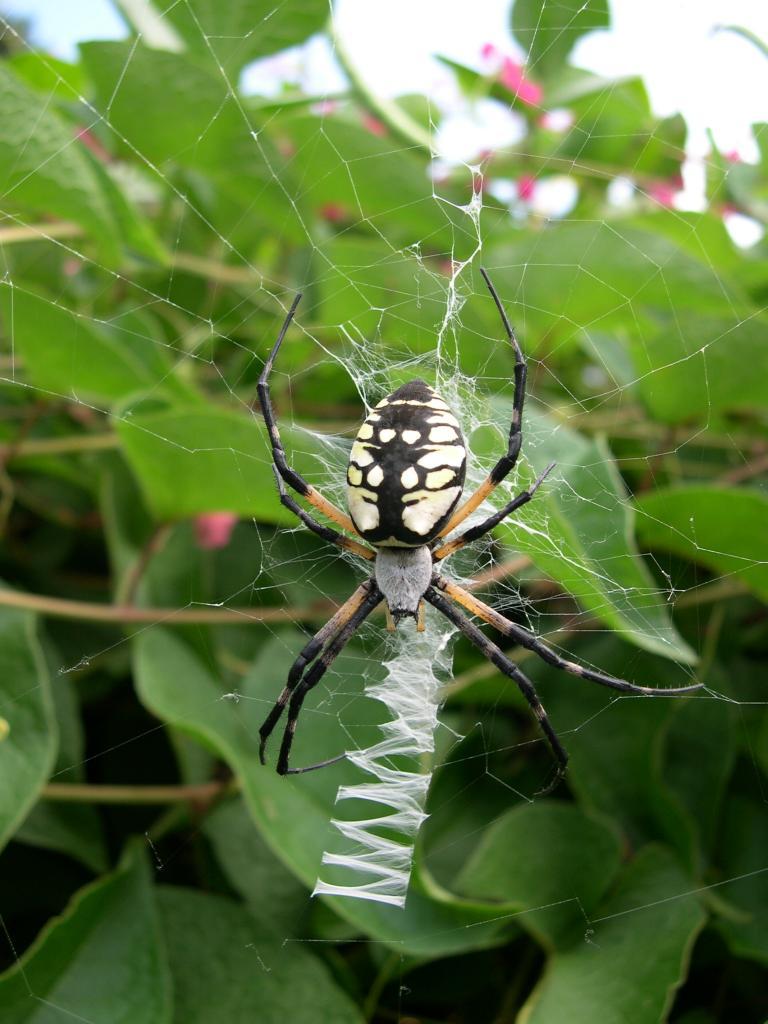
Some orb weavers, most visibly spiders in the genus Argiope, weave a thick band of white silk in a zigzag or cross pattern through the center of an otherwise nearly invisible web, a structure called a stabilimentum. What it's actually for has been argued over since at least 1990, when William Craig and Gary Bernard, publishing in the journal Ecology, reported that the stabilimentum silk strongly reflects ultraviolet light in the same way many flowers do, and that webs carrying the decoration caught more Drosophila flies than webs without it, evidence for a prey-attraction function, effectively an insect-visible "eat here" sign.
A different experiment pointed the other way. In 2001, Todd Blackledge and John Wenzel released mud-dauber wasps, natural predators of orb weavers, at spiders in webs with and without stabilimenta and reported in the journal Behaviour that Argiope trifasciata with a stabilimentum in place survived those attacks significantly more often, an effect that held up even after accounting for spider size and web location. Their proposed mechanism was defensive: the bright silk pattern may delay a wasp's strike, help camouflage the spider's outline against the bold zigzag, or simply distract the attacker for the split second the spider needs to drop from the web. Twenty years and multiple follow-up studies later, the honest state of the research is that no single explanation has won out, and the decoration most likely serves more than one purpose depending on the species and the predator or prey involved.

Males a fraction of the female's size, and a study that undercut the standard explanation
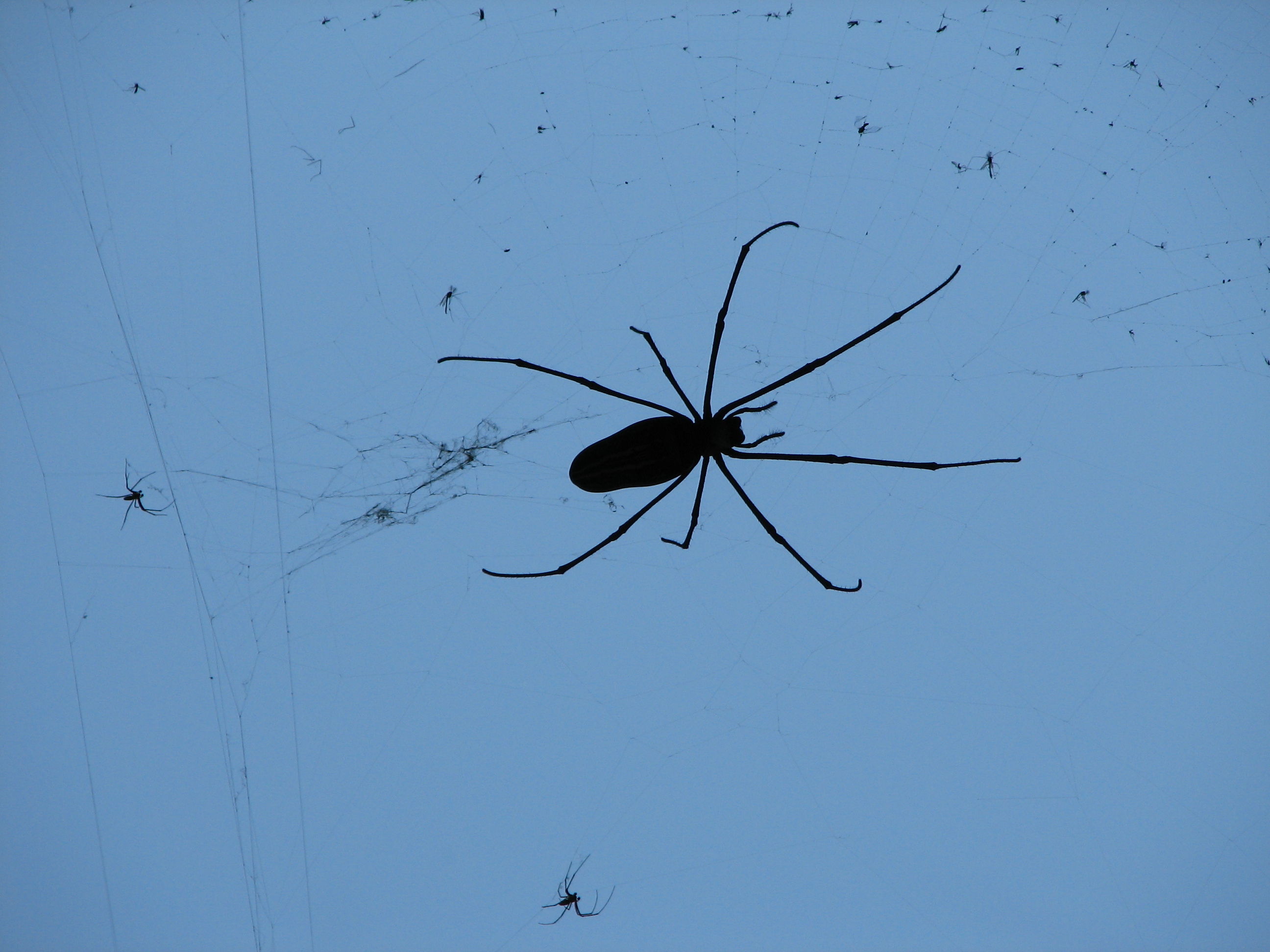
In several orb-weaving lineages, adult males are dramatically smaller than females of the same species. Nephila pilipes, the northern golden orb-weaver, is one of the most extreme examples in any terrestrial animal: females reach a body length of roughly 30 to 50 millimeters, while mature males top out around 5 to 6 millimeters, small enough that a male is sometimes mistaken for a different species entirely, or missed altogether, on the same web as a female many times his size.
One long-standing explanation for why males stay small is sexual cannibalism: a 1996 study by Mark Elgar and Bernard Fahey on Nephila plumipes, another golden orb-weaver, published in Behavioral Ecology, found competing pressures acting on male size. Smaller males were less likely to be detected and eaten by the female before or during mating, but larger males were better at physically excluding smaller rivals from the web's central hub, where mating actually takes place, a trade-off between staying safe and staying in the competition for the same female.
A separate, more recent piece of the puzzle undercut a different, older explanation. The "gravity hypothesis" holds that small males are simply more agile, better able to climb upward and to bridge, meaning cross gaps on a dragline of silk, in search of mates. A 2019 study on Nephilingis cruentata, a related golden orb-weaver in the same broader family, published in PLOS ONE, tested that assumption directly by timing males of different sizes climbing and bridging, and found the opposite of what the hypothesis predicted: larger, heavier males climbed faster, and small body size conferred no measurable agility advantage at all. Extreme male dwarfism in this group is well documented; a straightforward mobility payoff for it is not.
Is the bite actually dangerous? What the data says
Every orb weaver has venom, since nearly every spider does, but the toxin is built to subdue insects, not mammals, and the practical medical risk to a person bitten by one is close to zero. Pennsylvania State University's extension entomology program, profiling the yellow garden spider (Argiope aurantia), one of the largest and most visible orb weavers in North America, states plainly that the species is not known to be medically important, and that on the rare occasions a bite occurs it causes only localized pain, redness and swelling, comparable to a wasp or bee sting.
That reassurance holds up under closer laboratory scrutiny, not just field observation. A 2001 study by Mark Foradori and colleagues, published in Comparative Biochemistry and Physiology, tested whether Argiope aurantia's digestive fluid, which does contain a collagenase capable of breaking down connective-tissue proteins in a lab dish, could actually cause the kind of necrotic, slow-healing wound sometimes blamed on spider bites generally. Injected directly into rabbit skin, it produced no necrotic lesions at all. The enzyme exists and does what enzymes that digest prey are supposed to do, but the data don't support treating it as a cause of tissue damage in a bitten mammal. It's the same pattern that shows up with wolf spiders: a reputation for causing serious wounds that the actual clinical and laboratory evidence doesn't back up, and one more entry in FactCrumbs' running check of animal reputations against primary sources.