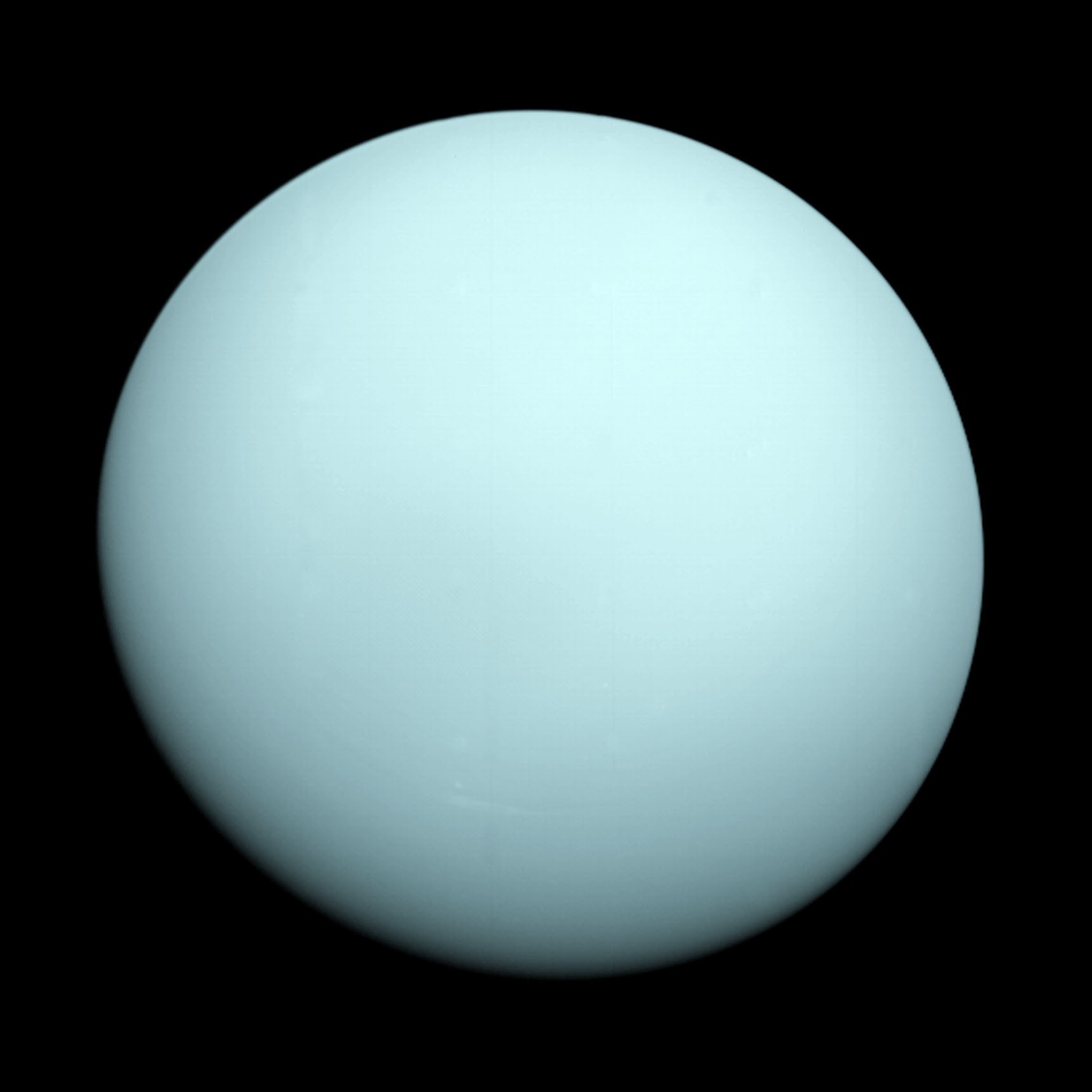

One 5.5-hour flyby, one freak solar storm
Voyager 2 is still the only spacecraft ever to visit Uranus, and it only got one pass: a single flyby on January 24, 1986, at a range of about 81,500 kilometers, before continuing on toward Neptune. Every popular description of the planet's magnetic field, radiation belts, and moons traces back to the roughly 5.5 hours of close-range data that flyby produced. For nearly 40 years, that data described a magnetosphere that looked strange even by the standards of a tilted, sideways-spinning planet: it was almost entirely empty of plasma, and its electron radiation belts were far more energetic than models predicted they should be.
A 2024 study in Nature Astronomy, led by JPL physicist Jamie Jasinski, went back through archived Voyager 2 data and cross-referenced it with solar wind records from around the same period. The team found that an intense burst of solar wind had struck Uranus just days before the spacecraft arrived, compressing its magnetosphere to roughly 20% of its normal volume. NASA's own writeup of the paper put the timing plainly: "The spacecraft saw Uranus in conditions that only occur about 4% of the time." The compression, the study argues, would have driven plasma out of the system, which explains both the empty-looking magnetosphere and the supercharged electron belts Voyager 2 recorded, and it also explains why the flyby found no trace of water ions around Uranus's five major moons, an absence that had been read for decades as evidence the moons were geologically dead. If the compressed state was temporary rather than typical, that absence stops being decisive, raising the possibility that some of those moons are more active than the flyby data suggested.
The sideways tilt everyone states as settled fact — it isn't
Uranus spins on its side, tilted about 98 degrees from the plane of its orbit, so that instead of spinning like a top the way Earth or Jupiter do, it rolls around the sun more like a ball. Most quick-facts pages state the cause as if it were closed: a giant impact early in the solar system's history knocked the planet over. That is the leading hypothesis, but the mechanism underneath it is still being actively argued over, not settled.
The simplest version of the giant-impact idea, a single collision with a body one to three times Earth's mass, runs into a real problem: Uranus's moons and rings orbit neatly around its tilted equator, not at random angles the way debris from one violent, one-off collision would be expected to settle. A 2012 study by Alessandro Morbidelli and colleagues in Icarus proposed a fix, modeling a series of smaller impacts rather than one knockout blow, gradual enough that the disk of debris orbiting Uranus could re-align with the planet's new tilt as it happened. A separate 2018 modeling study by Jacob Kegerreis and colleagues, published in the Astrophysical Journal, ran detailed impact simulations and found that different impact angles and speeds produce meaningfully different outcomes for the planet's rotation, internal structure, and how much atmosphere gets stripped away in the process. None of this is fossil evidence in the way a dinosaur bone is; it's competing computer simulations of an event nobody observed, which is a very different, and much shakier, kind of certainty than the flat, one-line explanation most Uranus pages offer. Spinosaurus's decade-long swimming debate ran on comparably thin evidence: one Moroccan skeleton generating study after contradictory study, each one treated briefly as the final word before the next one arrived.
The heat mystery that took until 2025 to resolve
Jupiter, Saturn, and Neptune all radiate significantly more heat than they receive from the sun, left over from their formation. Uranus, according to the Voyager 2 data, appeared to radiate almost none, an anomaly that never fit any standard model of how giant planets form and cool, since nothing about Uranus's size or composition should make it behave that differently from Neptune, its near-twin in mass.
A July 2025 study in Geophysical Research Letters, led by Xinyue Wang at the University of Houston, worked through decades of accumulated brightness measurements from Voyager, Hubble, and ground-based telescopes and found that Uranus does emit internal heat after all, about 12.5% more than it absorbs from sunlight. That is real, but it's a fraction of Jupiter's, Saturn's, and Neptune's fluxes, which run to 100% or more above what they absorb, so the puzzle isn't fully closed: the study's authors say it remains unclear why Uranus's internal heat output is so much weaker than its fellow giants', and they found the output varies with the planet's seasons, each of which lasts roughly 20 years given Uranus's 84-year orbit and extreme tilt. It's the kind of long-run physics mismatch that Brachiosaurus's blood-pressure problem represents in miniature: a basic physical constraint that stayed unexplained for decades because nobody had gathered enough of the right data to actually test it.
_(01K2283APYH89WYXJRX28XW5RT).png)
A moon count that's already wrong on half the internet
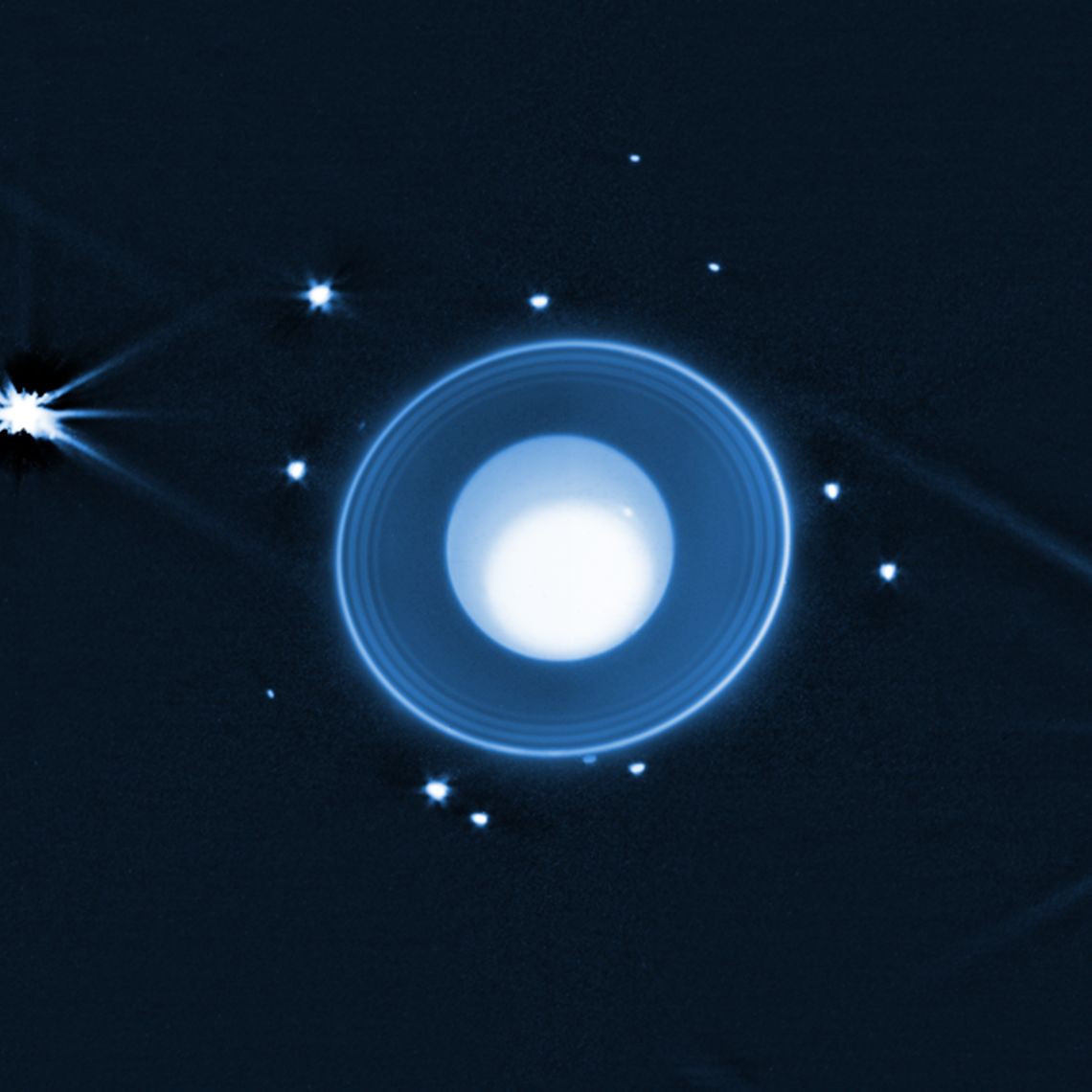
Plenty of reference pages still quote Uranus at 27 or 28 moons, and both numbers used to be correct. Astronomer Scott Sheppard spotted a new one, designated S/2023 U1, in Magellan telescope images taken in November 2023; at roughly 8 kilometers across, it's among the smallest moons known anywhere in the solar system, and it was the first new Uranian moon found in over two decades when its discovery was announced in February 2024, bringing the total to 28.
That number was out of date within eighteen months. In February 2025, a team led by Maryame El Moutamid of the Southwest Research Institute used the James Webb Space Telescope to spot yet another moon, S/2025 U1, roughly 10 kilometers across, and its discovery was announced in August 2025, pushing the count to 29. Uranus's five largest moons, Titania, Oberon, Umbriel, Ariel, and Miranda, were all found between 1787 and 1948, and every one of the other 24 has been found by telescope surveys since, none by a spacecraft that actually visited. New observations can change a reference entry, though for different reasons: the orb weaver spider's classification has been revised as taxonomists reconsider its family and genus boundaries. Uranus gained newly detected moons; the spiders changed taxonomic placement.
Will another spacecraft ever go back?
In 2022, the National Academies' Planetary Science and Astrobiology Decadal Survey named a Uranus Orbiter and Probe as its single highest-priority large mission for the 2023-2032 decade, the same process that greenlit prior flagship missions to Mars and Europa. The recommendation came with a specific window attached: launching in 2031 or 2032 would let the spacecraft use a gravity assist from Jupiter to reach Uranus in about 13 years, and after 2033 Jupiter won't be positioned correctly for that kind of assist again until the mid-2040s.
That window is already slipping, for two separate reasons. According to Scientific American's reporting on the mission's status, the agency's internal budget planning would not begin requesting money for the mission until 2025, a funding trajectory a space-policy expert quoted in the piece says won't support a 2032 launch. Separately, an agency official told the Outer Planets Assessment Group in May 2023 that NASA may not have enough plutonium-238 on hand to power the mission until the latter half of the 2030s, since existing production is already earmarked for missions launching earlier in the decade. Missing the Jupiter-assist window doesn't cancel the mission, but it does mean a slower, more expensive trajectory, or a wait of over a decade for the next one, on top of the roughly 13-year cruise once it does launch. Until it flies, Voyager 2's 5.5 hours in 1986 remain the only close-up data anyone has.