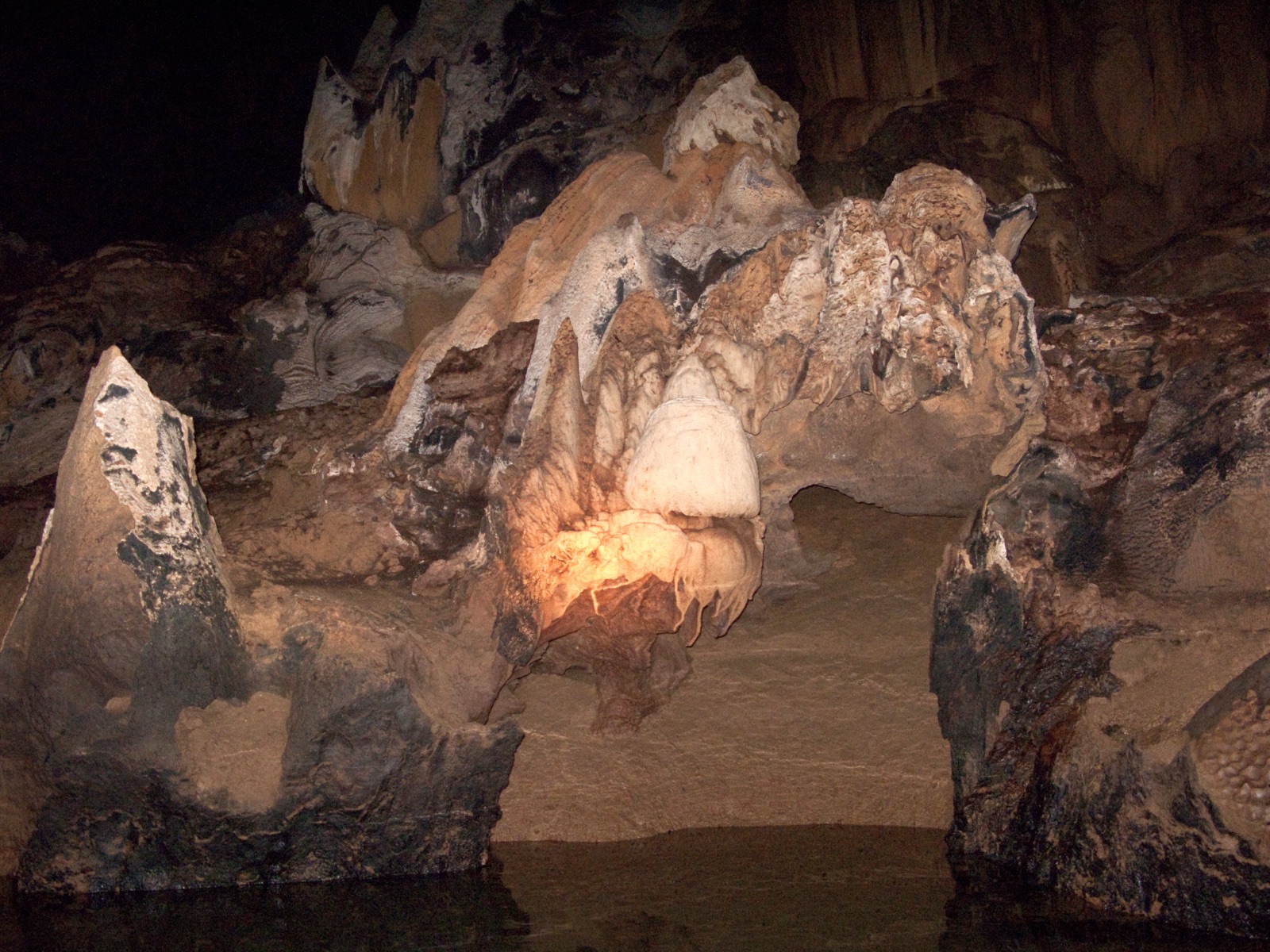

How a stalagmite actually forms, and how it differs from a stalactite
Rain absorbs a small amount of carbon dioxide as it falls and picks up more moving through soil, forming a weak carbonic acid solution that dissolves calcium carbonate out of the limestone bedrock it seeps through on its way underground. Once that mineral-loaded water reaches a cave and a drop forms on the ceiling, exposure to the cave's air lets some of the dissolved carbon dioxide degas and a little water evaporate, both of which push the drop past the point where it can hold all that dissolved calcium carbonate in solution. The excess precipitates out as solid calcite, and it does so twice for every drop: once as a microscopically thin ring left behind on the ceiling before the drop falls, building a stalactite downward, and again where the drop lands on the cave floor, building a stalagmite upward, one nearly imperceptible layer at a time. That same mineral-laden dripping has built something more famous a short drive from one of the wettest places on Earth: a stalagmite cluster inside Mawjymbuin Cave near Mawsynram is shaped enough like a Shivling that Khasi and Hindu visitors treat it as a natural shrine.
The two names are easy to mix up, but the common mnemonic tracks the actual geometry: a stalactite clings tight to the ceiling ('c' for ceiling), while a stalagmite grows up from the ground ('g' for ground). Left undisturbed for long enough, with a steady drip landing in the same spot, a hanging stalactite and a rising stalagmite beneath it can eventually meet and fuse into a single floor-to-ceiling column, a formation caving scientists just call a column, dropping both individual terms.
The 2025 study that finally explained why stalagmites take the shapes they do
Cavers have known for centuries that stalagmites come in a limited handful of recognizable shapes, tall thin spires, broad rounded domes, flat-topped stumps, but a full mathematical account of why a given drip site produces one shape rather than another had eluded geologists since at least 1965, when the geologist H. W. Franke first proposed a growth model based on the oversaturation of calcium ions in the dripping solution. In October 2025, Piotr Szymczak of the University of Warsaw and colleagues published a paper in the Proceedings of the National Academy of Sciences that finally solved Franke's model analytically, producing a closed-form description of stalagmite shape governed by a single dimensionless value called the Damköhler number, essentially a ratio between how quickly calcite precipitates out of the drip water and how quickly that water spreads across the stalagmite's growing tip.
The theory predicts exactly three ideal shapes. Concentrated, steady dripping onto a small area produces a classic column; water spreading out before it lands produces a flat-topped pedestal; and a high flow rate, or a drip falling directly from the ceiling onto the stalagmite itself rather than splashing off first, produces a sharply pointed cone. To check the model against real formations and not leave it as pure theory, the researchers X-ray-scanned stalagmites from Slovenia's Postojna Cave at Ljubljana University Medical Center and compared the scans to what the equations predicted. The match held even for fine internal detail, including the exact point inside a stalagmite where its growth transitioned from a flat top to a narrower column as underlying cave conditions shifted over time.
How fast a stalagmite actually grows
Despite the popular image of caves as places where formations grow visibly over a human lifetime, published growth rates from studied caves worldwide cluster mostly between about 0.1 and 2 millimeters a year, governed largely by how much dissolved calcium and carbon dioxide happens to be present in the drip water feeding a given site, which is why two stalagmites in the same chamber can grow at noticeably different speeds. At the low end of that range, a single one-meter-tall stalagmite can represent roughly 10,000 years of continuous, undisturbed dripping, which is the practical reason cave management agencies ask visitors never to touch formations: skin oils and mechanical damage can scar or halt growth that took millennia to accumulate, in a spot no cave manager can simply repair.
At the fast end, a stalagmite nicknamed Proserpine in Belgium's Han-sur-Lesse cave grew to roughly two meters over the last thousand years or so, a sustained rate of up to two millimeters a year, among the fastest documented anywhere. It grows quickly enough, and in cleanly defined enough annual layers, that researchers publishing in the European Geosciences Union journal Climate of the Past were able to count individual growth bands and match seasonal chemistry shifts to specific calendar years, reading the stalagmite the way dendrochronologists read tree rings to study Little Ice Age climate variability in northwestern Europe.
A slow-growing rock with a climate record reaching back 75,000 years
A stalagmite's real scientific value goes beyond its shape or speed: each layer of calcite locks in the oxygen isotope ratio of the water it precipitated from, and that ratio shifts in predictable ways with temperature and the source of the rainfall feeding the cave above. Because calcite also incorporates trace uranium that decays into thorium at a known rate, individual layers can be dated with uranium-thorium decay to a precision ice cores and tree rings can't always match outside polar and temperate regions, which makes stalagmites one of the few land-based climate archives available across large parts of the tropics and subtropics.
The clearest demonstration of that value is a 2001 study in Science by Yongjin Wang and colleagues, who analyzed oxygen isotopes from five stalagmites in Hulu Cave near Nanjing, China, precisely dated with uranium-thorium decay. Their combined record, spanning roughly 11,000 to 75,000 years ago, tracked the same abrupt warm-cold swings already documented in Greenland's GISP2 ice core, confirming that a cave record from the opposite side of the planet, dated by a completely different method, could resolve the same rapid global climate shifts ice cores were already known for. Layered growth preserves environmental information in other materials too: certain barnacle shells record a whale's ocean travel through oxygen isotopes accumulated while the barnacle grows. A shell does not cover the whale's entire life. The deposits of an erupting composite volcano also preserve a sequence, of lava and ash from successive eruptions, a different archive from cave-water isotopes.
The actual tallest stalagmite in the world, and a location Guinness itself gets wrong
Guinness World Records lists the tallest stalagmite in the world at roughly 70 meters (230 feet), located in Zhijin Cave. Guinness's own page for the record names the location as Zhejiang Province, but that appears to be an error carried on that same source: independent sources, including Guizhou's provincial tourism authority and the cave's English-language listing on the caving reference site showcaves.com, place Zhijin Cave in Guizhou Province, roughly a thousand miles from Zhejiang. A separate, unofficial claim exists too: in 2009, cavers with the British-Vietnamese Cave Expedition Team laser-measured a stalagmite inside Vietnam's Son Doong Cave, the world's largest cave passage by volume, at approximately 80 meters, which would exceed the official Guinness figure, though that measurement has not been formally adopted as the record.
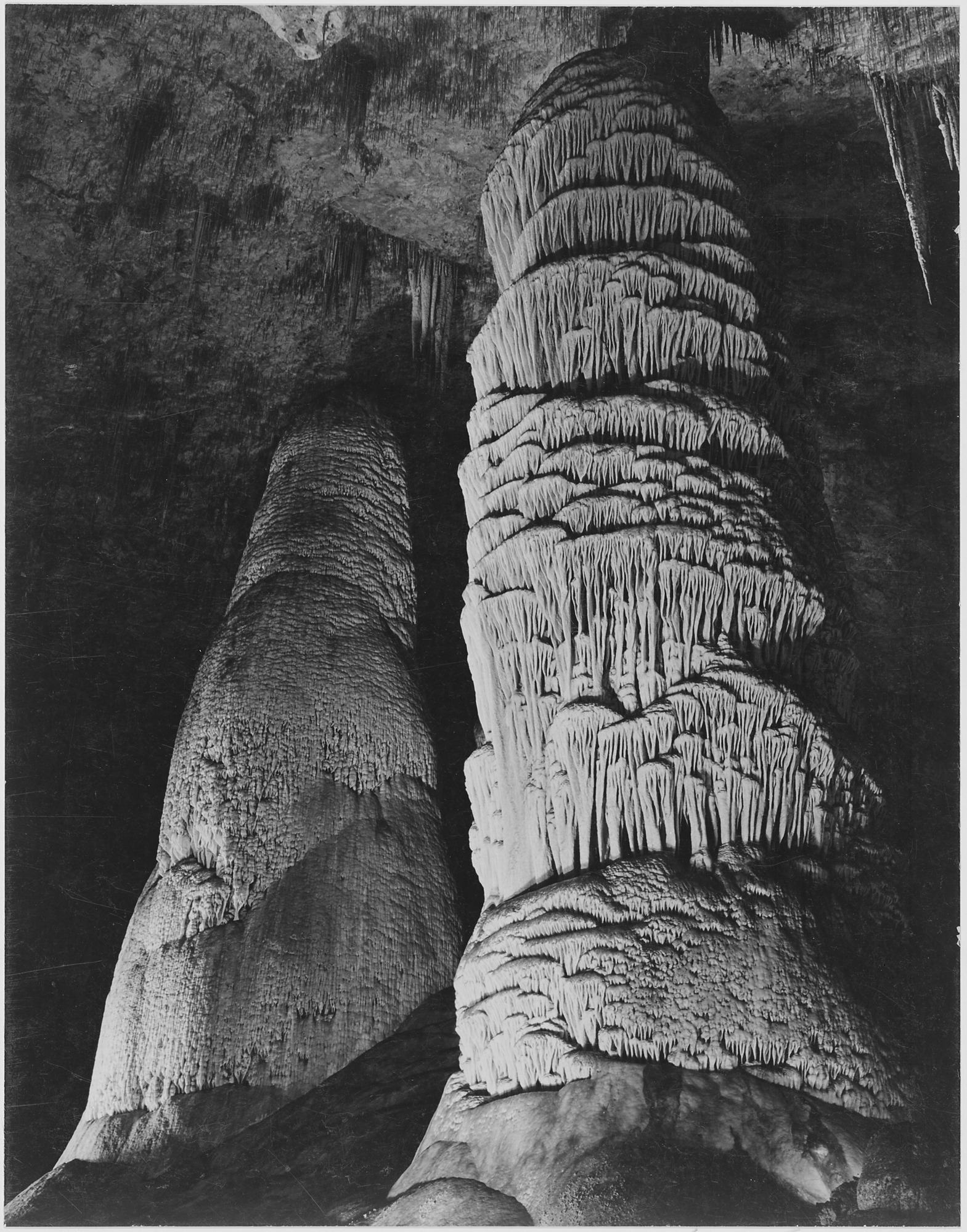
A far more visited, if far smaller, formation is the Giant Dome in the Hall of Giants section of Carlsbad Caverns' Big Room in New Mexico, a stalagmite the U.S. National Park Service describes on different pages as either 50 feet or 62 feet tall with a 16-foot diameter, an inconsistency that turns up even within a single federal agency's own materials. The Park Service also notes that Crystal Springs Dome is one of the few formations still actively growing inside Carlsbad Cavern today, implying that Giant Dome and most of the cave's other large stalagmites are not, likely because the desert surface above the cave now receives too little rainfall to keep the drip water flowing at anything close to the rate that built them in the first place.

Why the timing shows up in the fossil record too
Stalagmite records like Hulu Cave's help date abrupt late-Pleistocene climate shifts independently of fossil bone. North America's end-Pleistocene losses included the saber-tooth tiger and the short-faced bear. Fossil dates require their own regional context and dating scale: late short-faced-bear records cited in that guide fall about 12.7 thousand years BP on a calibrated scale, rather than establishing a continent-wide extinction date. Researchers must compare dated cave layers and fossil records on compatible scales before judging whether a climate shift coincided with a species' disappearance. That comparison can constrain the timing; it does not by itself establish whether climate, hunting or population changes caused an extinction.