
What actually has to be true for a fossil to count
Geologists don't call just any old fossil an index fossil, also known as a guide fossil. Britannica defines it around four practical tests: an organism distinctive enough to identify at a glance, abundant everywhere it turns up, spread across a wide geographic area, and confined to a short slice of geologic time, ideally under a million years or so, so that finding the same species in two separate rock layers means those layers formed close together in time.
None of that gets you an actual number in years. Index fossils only provide relative age, meaning geologists can say two rock layers are close in age, or that one is older than another, but not that a layer is exactly 94 million years old. That number comes from a separate technique, radiometric dating, which measures the decay of radioactive isotopes locked inside volcanic ash beds or certain minerals, ash that piles up one eruption at a time at a place like an active composite volcano rather than settling all at once. In practice geologists lean on both together: index fossils for fast correlation across huge distances, radiometric dates for pinning an actual number onto the specific layers where datable ash happens to be preserved.
The idea comes from a canal surveyor's notebook, not a museum
The practice dates to William Smith, an English surveyor who spent the 1790s and early 1800s crisscrossing England on canal, mining, and drainage projects. Digging through the same rock layers over and over in different counties, Smith noticed something nobody had written down formally before: each layer carried its own specific, repeatable set of fossils, stacked in the same vertical order everywhere he checked. That pattern is now called the law of faunal succession, and Smith used it to build the first geological map to cover an entire country, publicly dated 1 August 1815 though full distribution of the roughly four hundred copies ran into 1817.
Smith followed the map with a companion reference explaining exactly which fossils belonged to which layer: Strata Identified by Organized Fossils, published in four separate parts between June 1816 and June 1819, a total of nineteen hand-colored copperplate engravings, each pairing a rock unit with the fossils that marked it. That pairing, a specific fossil tied to a specific narrow span of time, is the entire concept an index fossil still runs on two centuries later.
Smith wasn't working in isolation. Eight years before the first part of Smith's plates appeared, in 1808, the French anatomist Georges Cuvier had used the Maastricht marine lizard whose first remains came from a Dutch chalk quarry in 1764 to argue that entire species really could disappear from the Earth forever, later writing that pinning down the animal mattered "for the theory of zoological laws, as for the history of the globe." Faunal succession and species extinction ended up as complementary discoveries from the same period: rock layers stacked in a fixed order, each with organisms that showed up, thrived, and then vanished for good, one layer at a time, across the planet.
Ammonites, trilobites, and how a 'zone' actually gets built
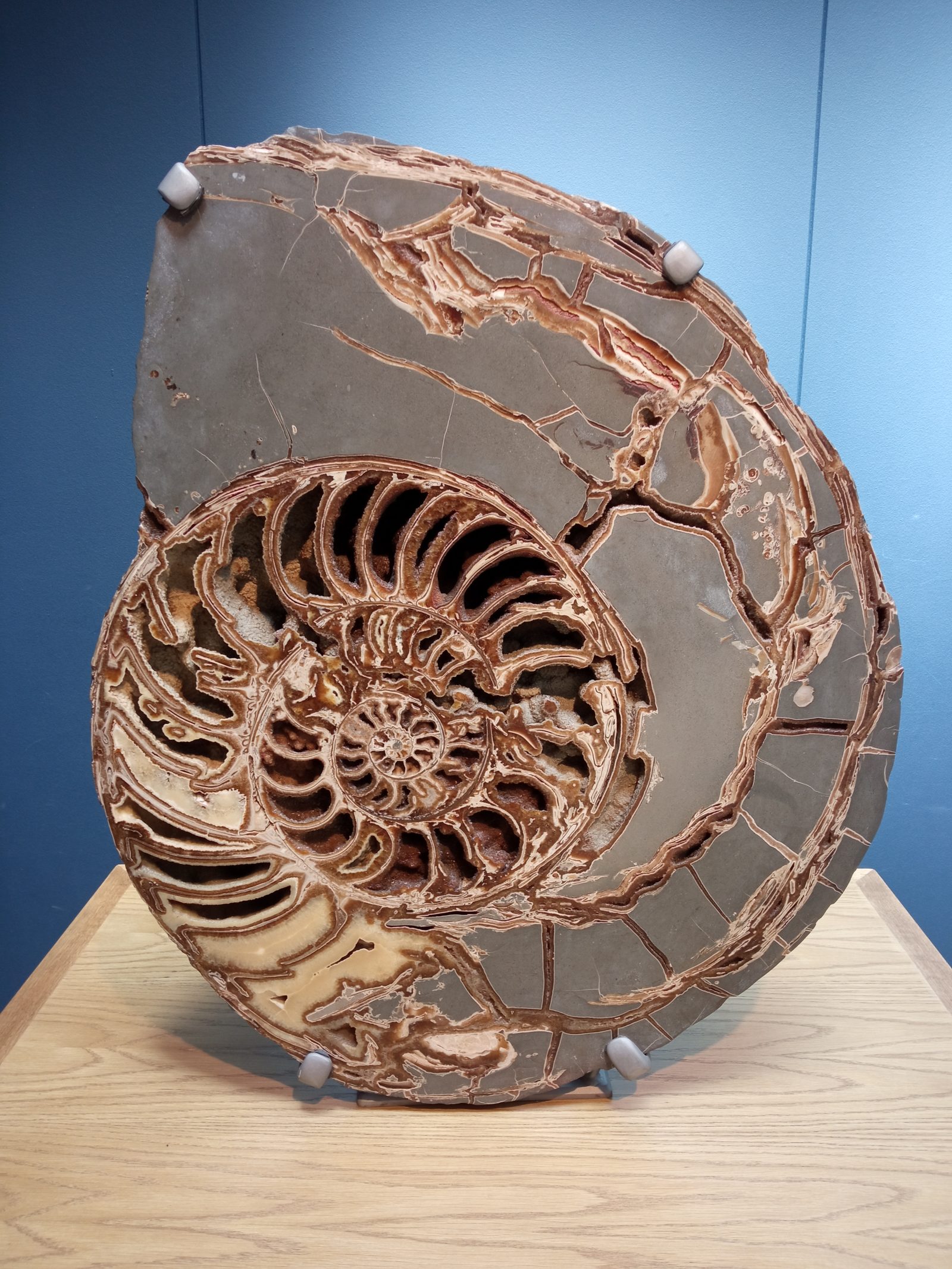
Ammonites, the coiled shelled relatives of squid and octopus that filled Mesozoic seas, are the standard textbook example, and the reason is almost entirely practical. They evolved fast, so a given species usually existed for only a few hundred thousand to a couple million years before turning into something recognizably different, and their hard shells fossilize easily in shallow marine mud. A 2006 USGS zonal table built by paleontologist William Cobban and colleagues carves more than 30 million years of Late Cretaceous rock across the American West, from partway through the Cenomanian stage to the very end of the Maastrichtian and the extinction of the dinosaurs, into 67 distinct ammonite-and-clam zones. Find the ammonite species Watinoceras devonense in a road cut in Wyoming and another in New Mexico, and Cobban's table says those two rock layers formed within the same narrow window, even with the outcrops sitting hundreds of miles apart.
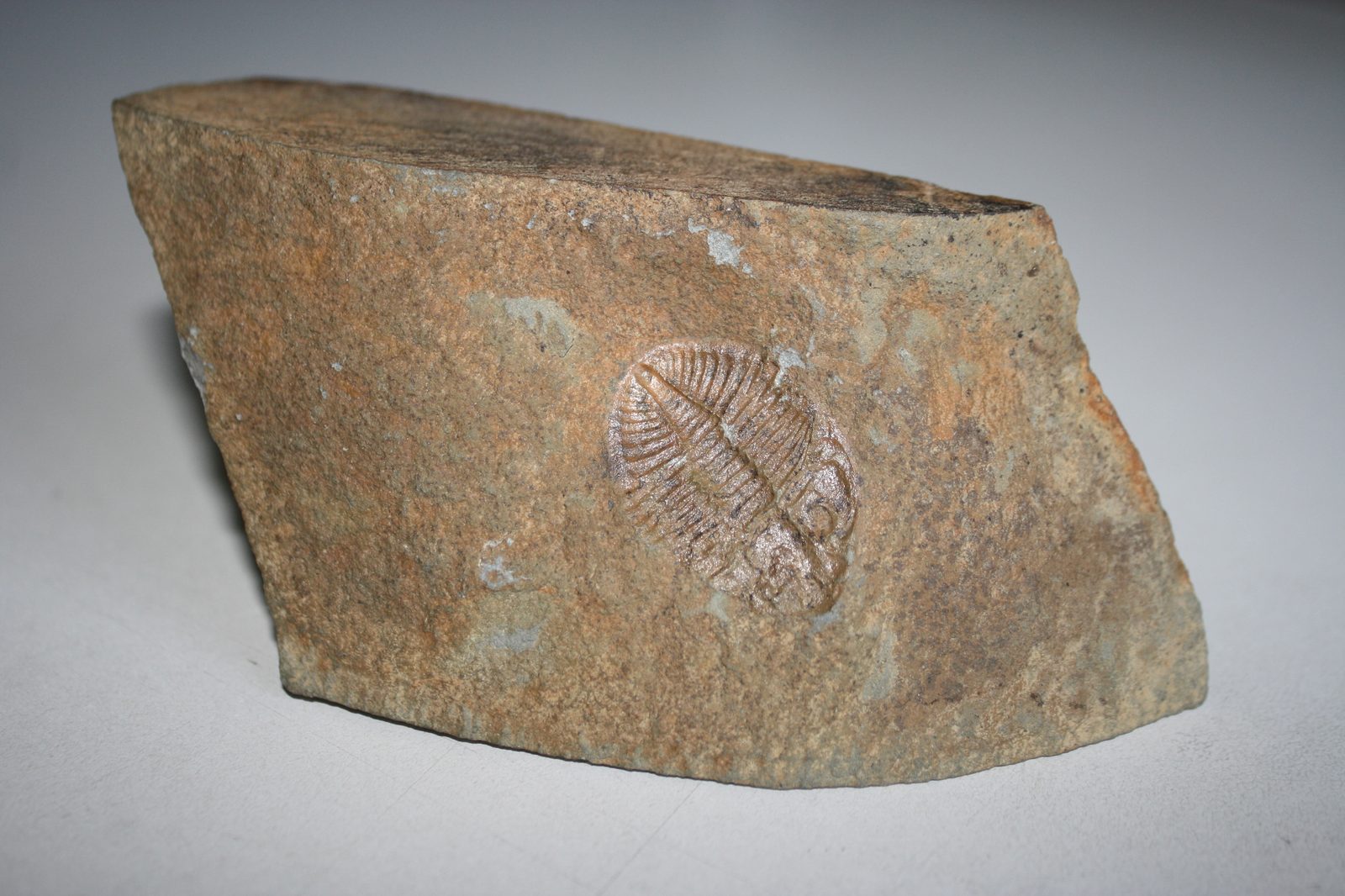
Trilobites do the same job for older rock. Often called the index fossils of the Paleozoic Era, these hard-shelled marine arthropods first appear around 521 million years ago in the early Cambrian and diversified rapidly across roughly 270 million years, right up until the mass extinction that ended the Permian period around 252 million years ago. Individual trilobite genera and species stayed confined to spans short enough, with shells common enough in the rock, to pin down a Cambrian or Ordovician layer with the same precision ammonites offer for the Cretaceous.

Why the most famous dinosaur on Earth doesn't qualify
Every confirmed Tyrannosaurus rex skeleton, including famous mounts like Sue and Stan, comes from a narrow band of western North America: the Hell Creek, Lance, Scollard, Frenchman, and Ferris formations, all laid down within roughly the last two million years of the Cretaceous. That is the opposite of globally widespread, which rules the species out on one criterion no matter how short its time range was. Healed bite wounds on hadrosaur tails answered the old question of whether T. rex hunted live prey or only scavenged, a debate that ran louder in documentaries than in journals, but geographic reach was never in question. It stayed local.
Abundance is where the mismatch gets stark. Researchers led by Charles Marshall at UC Berkeley calculated, in a 2021 Science study, that around 2.5 billion T. rex individuals lived and died across the roughly 2.4 million years the species existed, based on population-density and generation-time modeling scaled up from living reptiles. And yet, more than a century after the species was first described in 1905, only a few dozen partial skeletons have ever been recovered. Being common while alive and being common in the rock afterward turn out to be two different kinds of abundance, and index fossils only care about the second one. Ammonites and trilobites left millions of hard, mineralized shells behind in shallow seafloor mud that fossilizes easily. A land predator's skeleton mostly never gets that chance. Popular fame and the official technical record point in different directions elsewhere in earth science, too: the "wettest place on Earth" has more than one rightful claimant, depending on which of several official rainfall records actually gets checked.