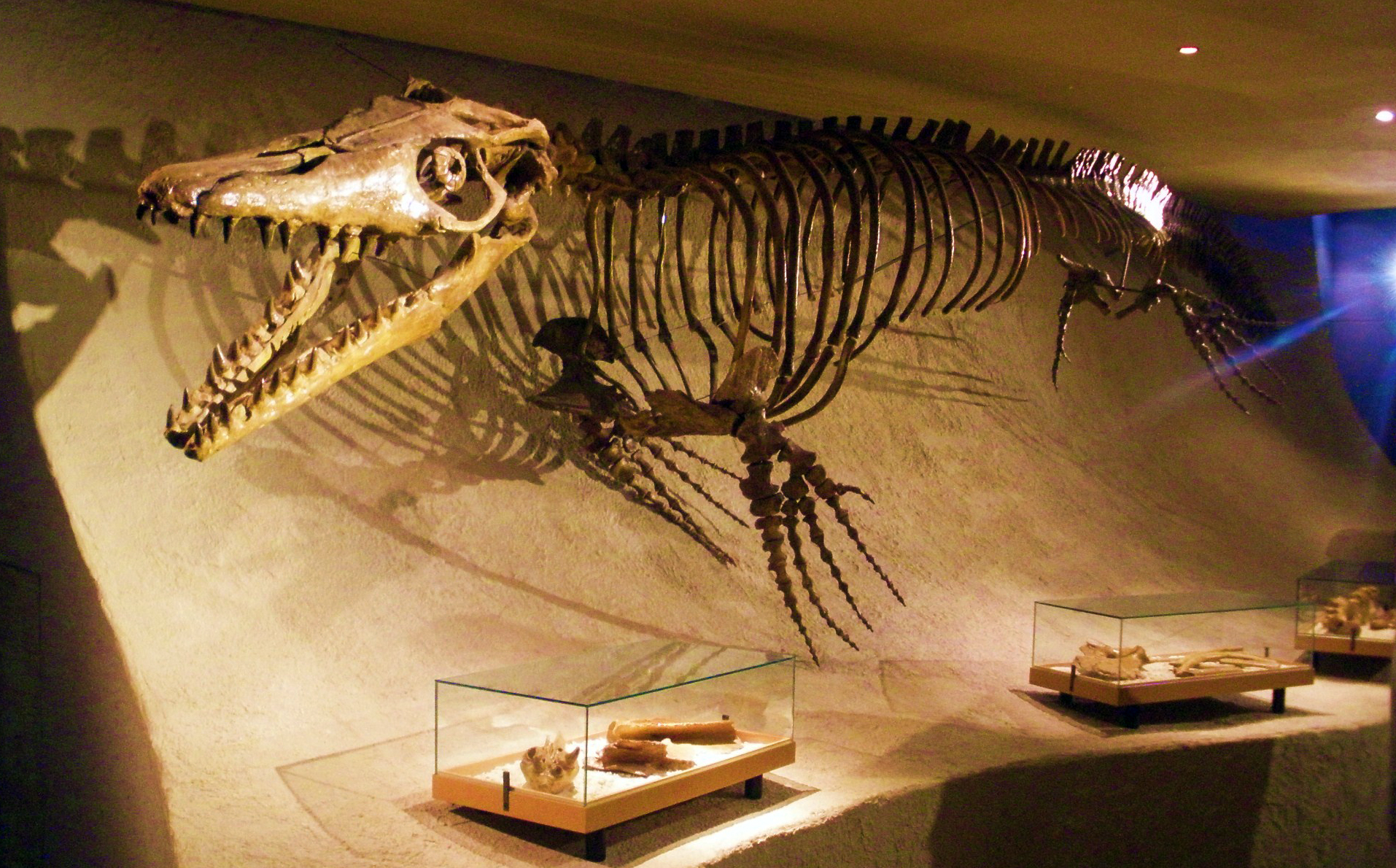

The fossil that helped prove extinction was real
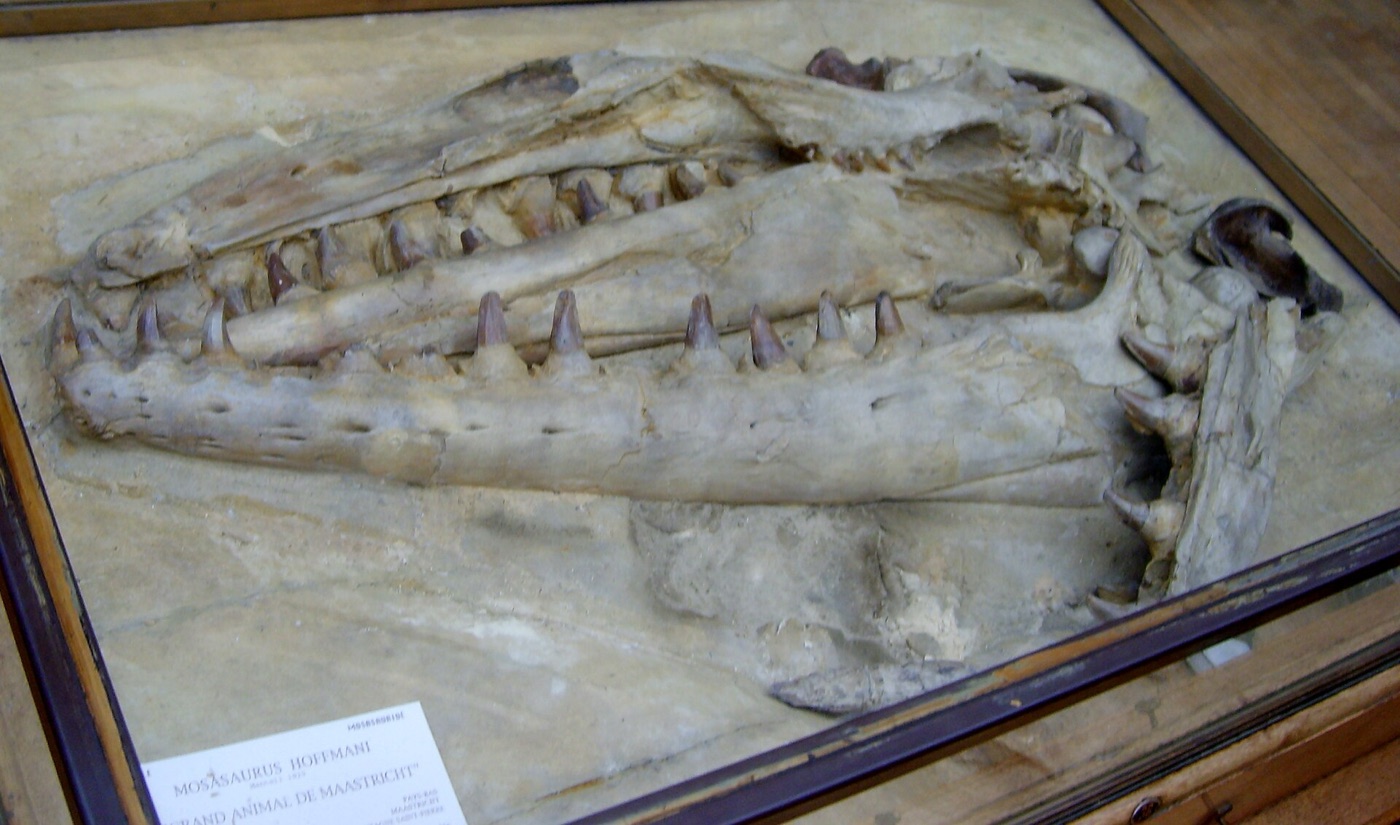
The first Mosasaurus remains, skull fragments, came out of an underground chalk quarry beneath Mount Saint Peter near Maastricht in the Netherlands in 1764; a Dutch army officer, Jean Baptiste Drouin, is credited with collecting them in 1766. A far more complete skull turned up at the same quarry in 1778, and it caught the attention of Johann Leonard Hoffmann, a retired Dutch physician who assumed it was a crocodile until his contemporary Petrus Camper showed him an actual crocodile jaw and talked him out of publishing that claim.
The specimen sat as a curiosity, "the great animal of Maastricht," until French naturalist Georges Cuvier examined it in 1808 and confirmed it was a giant marine reptile unlike anything alive. In his subsequent published writeup, Cuvier called the determination important "for the theory of zoological laws, as for the history of the globe." That mattered well beyond one weird skull: Cuvier was in the middle of building the case that extinction was a real, repeatable fact of natural history rather than a theological impossibility, and the Maastricht animal became one of his supporting examples in that broader argument. English geologist William Conybeare formally named the genus Mosasaurus in 1822, from the Latin name for the Meuse river (Mosa) that runs through Maastricht, literally "lizard of the Meuse."
That extinction argument didn't happen in a vacuum. Cuvier was comparing the Maastricht animal against a growing catalogue of other fossils that had no living counterpart, mammoths, giant ground sloths, and other Ice Age megafauna among them, building toward a conclusion that unsettled a lot of his contemporaries: entire species had existed, then vanished completely, with nothing like them left alive anywhere on Earth. That's an ordinary assumption today, but in the early 1800s it ran against the then-common belief that a divinely created natural world didn't lose species outright, so a giant reptilian skull nobody could match to anything living carried more scientific weight than its size alone would suggest.

It wasn't a dinosaur, and the difference matters
Mosasaurus is routinely lumped in with dinosaurs in movies and toy aisles, but it belongs to Squamata, the same reptile order as modern lizards and snakes, and its closest living relatives are thought to be monitor lizards (the group that includes the Komodo dragon). Dinosaurs are a separate branch of the reptile family tree defined by a distinct hip and limb structure built for walking upright on land; mosasaurs evolved from land-dwelling squamate ancestors that moved back into the ocean during the Cretaceous, the same general pattern whales followed tens of millions of years later when their mammal ancestors returned to the sea. The same mix-up happens overhead instead of underwater: the crested, toothy reptiles people call flying dinosaurs were pterosaurs, yet another separate lineage entirely, not dinosaurs at all.
Other marine reptile lineages, including plesiosaurs, also lay outside Dinosauria. On land, Tyrannosaurus rex and the crested, duck-billed Parasaurolophus were true dinosaurs, though they lived at different times within the Late Cretaceous. Living at the same time does not place mosasaurs and dinosaurs in the same reptile group. Mosasaurs died out, while other squamates, including snakes and monitor lizards, survive. That is a different history from the surviving lineage discussed in the coelacanth account. The precise placement of mosasaurs within Squamata remains debated.
How big it actually was, and where the 17-meter number came from
The number that circulates most widely, up to 17 meters (about 56 feet), traces back to a single lower jaw bone from Penza, Russia, roughly 1.5 times the size of an average known Mosasaurus hoffmanni jaw, scaled up using standard skull-to-body ratios. It's a real fossil, but it's also a big extrapolation from one incomplete data point, and paleontologists studying the fuller body of evidence have treated it cautiously.
A 2024 reassessment by Gayford and colleagues, published in Ecology and Evolution, went back to that same Penza jaw bone with a more conservative skull-to-body ratio and brought the estimate down to roughly 12 meters (about 39 feet), five meters shorter than the original extrapolation from the identical fossil. Estimates for an average-sized Mosasaurus hoffmanni put its weight in the ten-to-fifteen-tonne range. That's still an enormous predator, longer than a city bus, but it's a meaningfully smaller animal than the record-chasing 17-meter figure that shows up in documentaries and games. Most of what's preserved of Mosasaurus is skull material; postcranial (body) skeletons are much rarer, which is exactly why single outlier bones keep pulling the popular size estimate upward.
The mismatch matters for a practical reason: skull-to-body scaling only works as well as the ratio it's built on, and that ratio comes from the small number of specimens where a skull and a reasonably complete body were found together. A jaw bone that's unusually large for its species doesn't automatically belong to an unusually large individual overall; it can just as easily mean the ratio itself breaks down at the extremes, the same statistical trap that has inflated size estimates for other predators known mostly from partial skeletons, megalodon among them.
The shark-like tail nobody could see in the bones alone
For nearly two centuries, reconstructions of mosasaur tails were based purely on the vertebrae, which taper gradually and look superficially like an ordinary lizard's tail. That changed with a fossil dug up in a Jordanian quarry in 2008 and rediscovered, unstudied, in the Eternal River Museum of Natural History in Amman four years later. Researchers led by Johan Lindgren of Lund University, publishing in Nature Communications in 2013, found the specimen (a mosasaur called Prognathodon, roughly six feet long) preserved soft tissue outlining a two-lobed, shark-style tail fin, something no skeleton alone could have revealed since the fin itself had no internal bone.
The team described the structure as a hypocercal (down-turned) fin with a large fleshy lower lobe doing most of the propulsive work, the same basic body plan sharks, ichthyosaurs, and some whales independently evolved for fast, efficient open-ocean swimming. As the researchers put it, mosasaurs "presumably swam like pelagic sharks," a genuinely different animal from the eel-like undulating swimmer earlier reconstructions had imagined.
Warm-blooded in a cold ocean
A 2010 study in Science by Aurélien Bernard and colleagues measured oxygen isotope ratios in fossilized tooth enamel from mosasaurs, ichthyosaurs, and plesiosaurs, then compared those ratios against fish teeth from the same sites and time periods (fish are cold-blooded, so their isotope signature tracks ambient water temperature directly). The marine reptiles didn't track the water the way fish did: mosasaur teeth implied a body temperature around 35-39°C (±2°C) regardless of how cold the surrounding sea was, in the same range as the ichthyosaur and plesiosaur signal. Bernard and colleagues were more confident about those last two groups, both pursuit predators that would have needed sustained high metabolic output to chase prey; they described the mosasaur reading itself as more equivocal, since an ambush hunter wouldn't necessarily need the same output.
That gap is part of why a second study followed. A 2016 paper in the journal Palaeontology by Harrell, Perez-Huerta, and Suarez tested the mosasaur result specifically, comparing three mosasaur genera against coeval fish and pelagic seabirds (known endotherms) as temperature benchmarks. All three mosasaur genera came back with elevated body temperatures closer to the seabirds than to the fish, the signature of endothermy, generating and holding internal heat rather than depending on the environment for it, the same basic strategy modern whales and dolphins use. That gave mosasaurs the metabolic engine to hunt fast and range into cooler waters most cold-blooded reptiles couldn't tolerate. A different example of anatomy supporting vigorous activity comes from pterosaurs, the pterodactyl's actual relatives, whose large breastbones provided attachment areas for flight muscles.