
The Jurassic Park raptors are Deinonychus under a borrowed name
Michael Crichton built the raptors of Jurassic Park out of Deinonychus antirrhopus, the dromaeosaur that Yale paleontologist John Ostrom formally described in 1969, then attached a different genus name to them. Ostrom described the phone call to The New York Times in a 1997 interview, in an account Yale News revisited in 2015: "Crichton, in an apologetic way, explained that in the novel he decided to use the name Velociraptor, that I had said was the closest relative to the animal that I had found. He said, 'It's more dramatic.'" Writing in Discovery magazine in 1993, Ostrom had already recorded that Crichton confirmed the fictional animal was modelled on Deinonychus in "almost every detail," and concluded that "the Terror of Jurassic Park really is Deinonychus parading around under an assumed name." Steven Spielberg's production team went on to request copies of Ostrom's published Deinonychus papers while designing the film's creatures.
There was a taxonomic fig leaf available at the time. In his 1988 book Predatory Dinosaurs of the World, paleoartist Gregory S. Paul argued that Deinonychus belonged inside the genus Velociraptor and relabeled it Velociraptor antirrhopus, on the grounds that the two skulls resemble each other far more closely than either resembles Dromaeosaurus. Barsbold and Osmólska published a rebuttal in Acta Palaeontologica Polonica in 1999, listing anatomical characters that keep the genera apart, and Paul's synonymy never took hold among working paleontologists. The book itself was widely read, though, and Crichton drew on it.
The gap between the two animals is mostly scale. Paul's own figures put adult Deinonychus at 3.3 to 3.4 meters long with a hip height near 0.87 meters, and published mass estimates run from his 60 to 73 kilograms up to the roughly 100 kilograms Campione and colleagues derived in 2014 from femoral circumference, which puts the film's model animal somewhere in the weight class of a large human.
How big was a Velociraptor, actually?
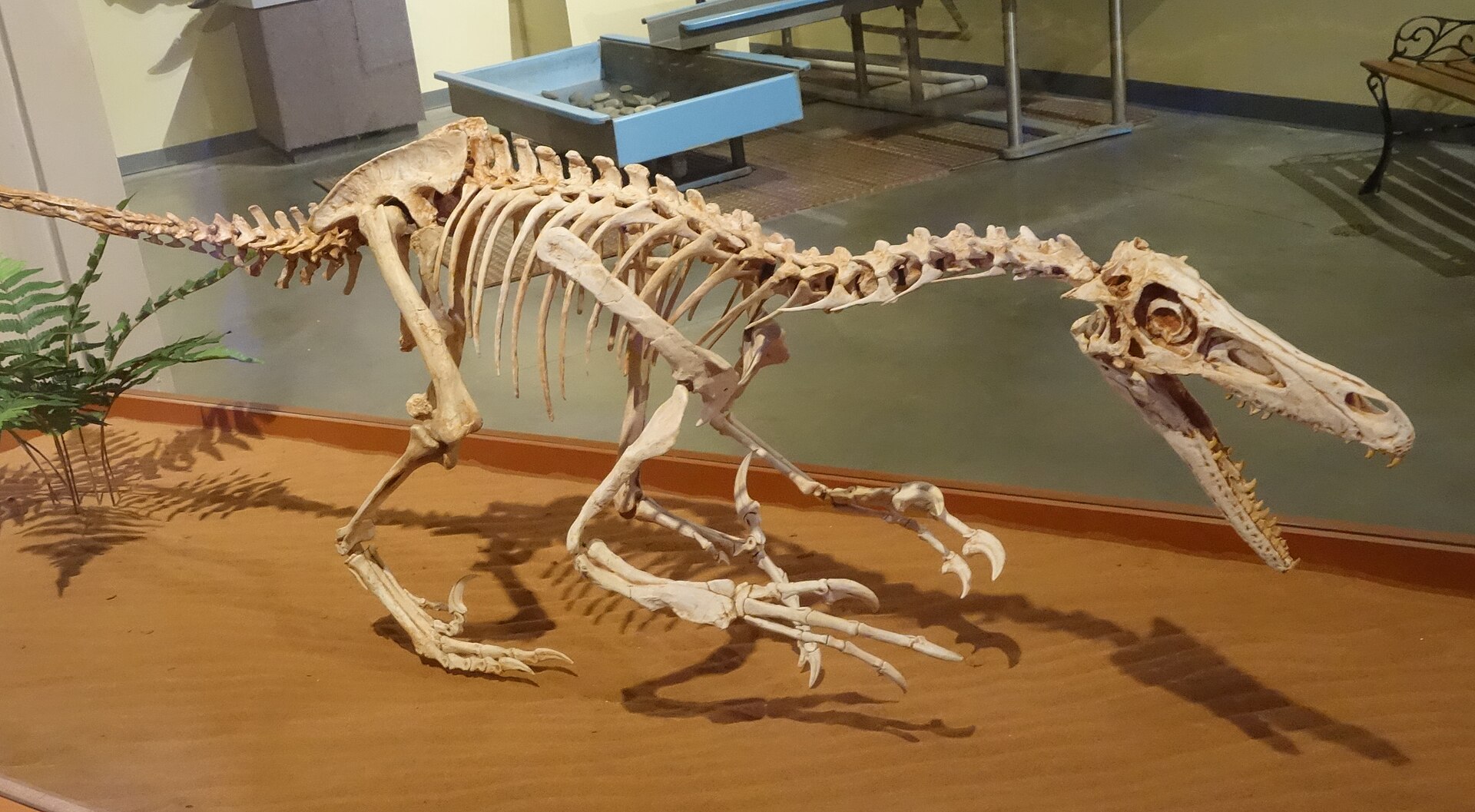
Peter Kaisen collected the first Velociraptor material on 11 August 1923 at the Flaming Cliffs in Mongolia during an American Museum of Natural History expedition. The holotype, AMNH 6515, is a crushed but complete skull with one hand claw and the adjoining finger bones. Henry Fairfield Osborn named the genus the following year from the Latin velox (swift) and raptor (robber). A second species, Velociraptor osmolskae, was named from Chinese material by Godefroit and colleagues in 2008.
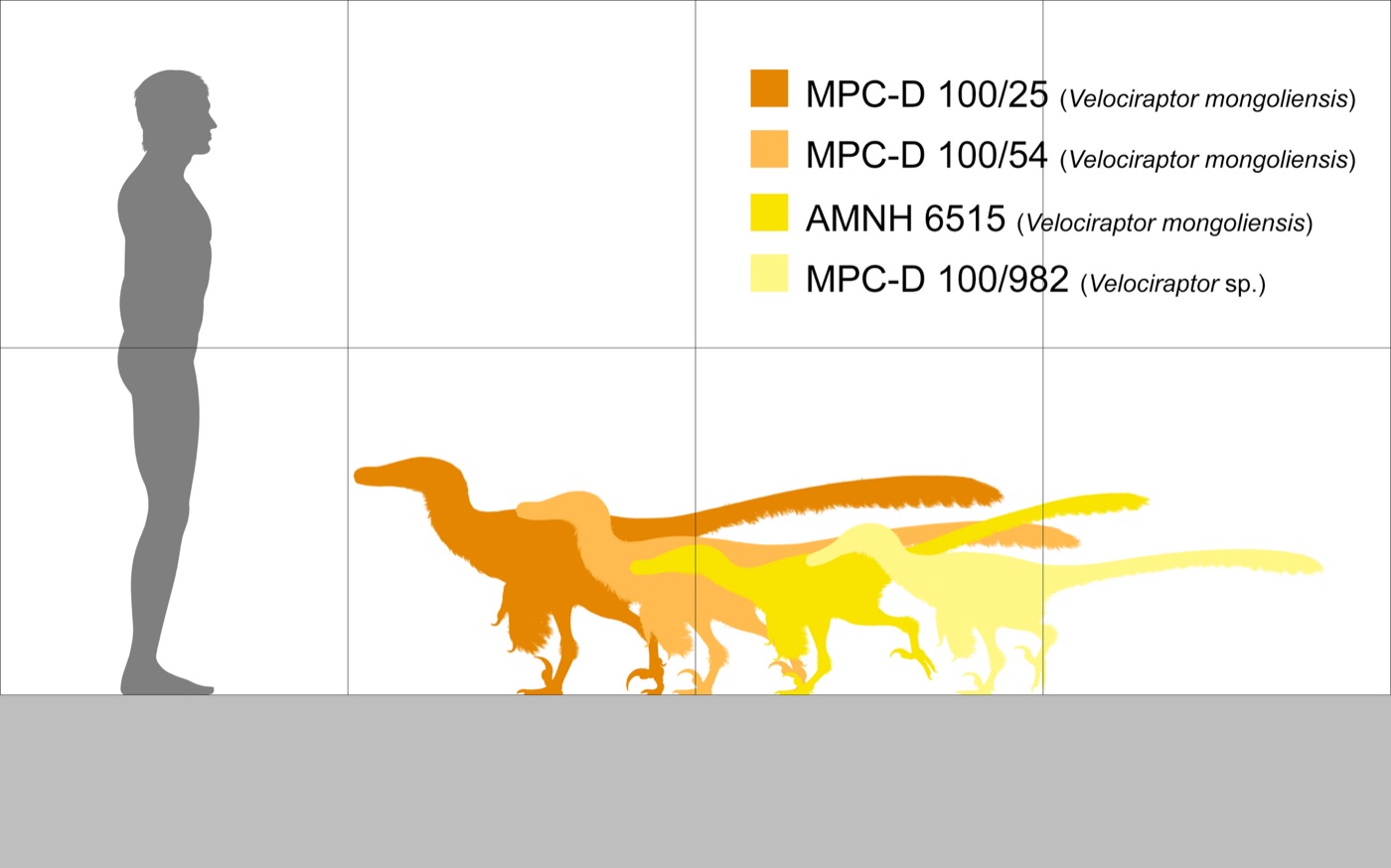
Adult Velociraptor mongoliensis ran roughly 1.5 to 2.07 meters from snout to tail tip and stood about 0.5 meters at the hip. Campione and colleagues put its mass at 14.1 to 19.7 kilograms, or 31 to 43 pounds; Gregory Paul's field guide allows a large individual up to 2.5 meters and 28 kilograms. A big share of that length is stiffened tail, and a hip height of half a meter puts the animal at roughly knee level on a standing adult. The Natural History Museum's shorthand for it is a Thanksgiving turkey. National Geographic estimates its top speed at around 24 miles per hour.
Numbers in the wild vary far more than the fossils justify. National Geographic's feature on the animal cites weights up to 100 pounds, which sits much closer to Deinonychus than to any measured Velociraptor specimen, and describes the animals as waist-high where the skeletal proportions give knee-high. The estimates built directly from the Mongolian material stay inside that 14 to 20 kilogram band. The Cretaceous sea lizard Mosasaurus also acquired disputed popular size claims, through a different mechanism: one outsized jaw bone got scaled up into a figure that outran the rest of the evidence. Living animals are not immune either: the camel spiders of the 2004 Iraq photo look ten times their real length purely because of where they sat relative to the lens.

Did Velociraptor have feathers? Six bumps on a forearm bone say yes
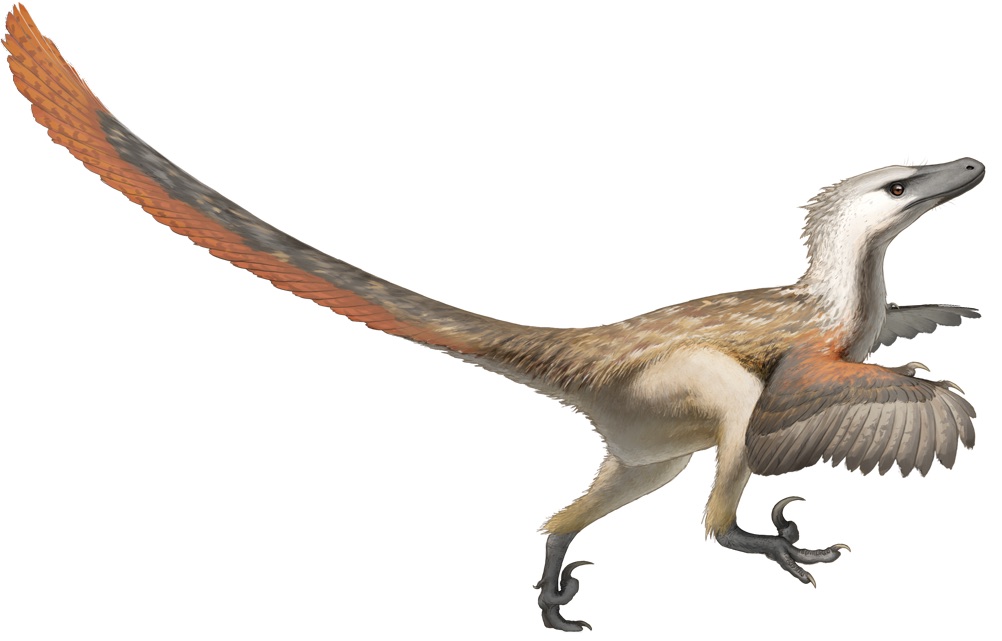
In 2007, Alan Turner, Peter Makovicky and Mark Norell were examining a Velociraptor forearm, specimen IGM 100/981, collected at Ukhaa Tolgod in Mongolia in 1998, when they noticed six evenly spaced knobs of bone running along the back edge of the right ulna. Quill knobs are the attachment points where the ligaments of large wing feathers anchor into bone, and they are visible on plenty of living birds. The team published the find in Science on 21 September 2007.
For most dinosaur genera the feather question rests on inference from relatives; here it rests on marks in the bone. Turner put the logic plainly in the museum announcement: "A lack of quill knobs does not necessarily mean that a dinosaur did not have feathers. Finding quill knobs on velociraptor, though, means that it definitely had feathers." From the spacing he estimated roughly 14 secondary feathers along the forearm, with a structure implying modern-style vaned feathers instead of the hair-like filaments found on more distant relatives. Norell drew the wider conclusion: "The more that we learn about these animals the more we find that there is basically no difference between birds and their closely related dinosaur ancestors like velociraptor."
Velociraptor could not fly. It was too heavy for its arm length, and it belonged to a different archosaur lineage from the flying pterosaurs, which were not dinosaurs. Feathers on a flightless ground animal of this size point instead to insulation, display, shielding eggs during brooding, or the balance work described below. Paleontologists have no comparable evidence for T. rex, where every skin impression examined so far shows scales.

The sickle claw gripped prey; it did not slash
The disembowelling claw is one of those ideas that sounds obviously right and then fails when somebody tests it. Phillip Manning and colleagues built a hydraulically powered robotic dromaeosaur hindlimb fitted with a reconstructed digit-II claw and drove it into animal tissue at both low and high speed. Their paper, "Dinosaur killer claws or climbing crampons?", appeared online in 2005 and in print in Biology Letters the following year. Impact, they reported, "produced small, round puncture wounds... with minimal trauma to surrounding tissues: no slashing/cutting occurred, even with a reconstructed claw that was at least 40 times stiffer than beta-keratin." The claw punched holes and left the surrounding tissue intact. Manning's team stopped short of declaring the function settled, suggesting only that the claw may have aided prey capture, possibly working like a climbing crampon.
Six years later Denver Fowler and colleagues approached the same problem comparatively, measuring dromaeosaur foot anatomy against living birds of prey. Their PLOS ONE paper, published on 14 December 2011, proposed the raptor prey restraint model: the enlarged digit-II claw "was functionally analogous to the enlarged talon also found on D-II of extant Accipitridae," meaning hawks and eagles, and kept a grip on prey of roughly the predator's own body size while the animal's weight pinned it down and the jaws did the actual killing. The same paper introduced "stability flapping," beating the forelimbs to stay balanced on top of struggling prey, and argued that behavior may have been an early step toward the flight stroke. A mechanical test and a comparative anatomy survey have very little in common as methods, and they landed in the same place, which is the strongest thing that can currently be said for the grip model.
Did Velociraptor hunt in packs? The evidence says no
The hunting pack, three raptors flanking prey with something resembling a plan, is the film's most durable invention, and it did begin from a real fossil observation. Several Deinonychus individuals turned up near a single Tenontosaurus carcass, and for decades that association was read as evidence of group predation.
Brian Roach and Daniel Brinkman of Yale's Peabody Museum took the inference apart in a 2007 review in the Bulletin of the Peabody Museum of Natural History, testing the mammal-style pack hypothesis against how living reptiles and birds actually feed. They judged cooperative hunting both unparsimonious and unlikely for these animals, argued that the default assumption should be solitary hunting or at most loose associations, and reported new evidence from the Deinonychus type locality of probable intraspecific aggression. Their reading of theropod behavior is closer to Komodo dragons than to wolves: animals converging on a carcass and then fighting each other over it, which leaves the same jumble of bones without anyone cooperating.
A 2020 study brought chemistry to the same question. Joseph Frederickson, Michael Engel and Richard Cifelli measured stable carbon isotopes in Deinonychus tooth enamel across a range of tooth sizes and found the small teeth enriched in carbon-13 relative to the large ones, which means juveniles and adults were eating different prey. Animals that hunt in coordinated groups feed their young from shared kills, and that pulls juvenile and adult isotope signatures together. The authors were careful about how far to push the comparison, noting that dromaeosaurs may have shown more ratite-like parental care than the fully antagonistic relationship Komodo dragons have; what the isotopes rule out is the shared-kill pattern, not every form of sociality. The paper ran in Palaeogeography, Palaeoclimatology, Palaeoecology, and Ben Creisler circulated it to the Dinosaur Mailing List on 4 May 2020, the long-running paleontology forum where this particular argument has gone back and forth since the 1990s.
For Velociraptor the case is thinner again. No Velociraptor specimens have ever been recovered grouped together in any arrangement suggesting social behavior, so even the ambiguous Deinonychus evidence has no counterpart in the genus that got the movie credit.
The Fighting Dinosaurs fossil caught one mid-attack
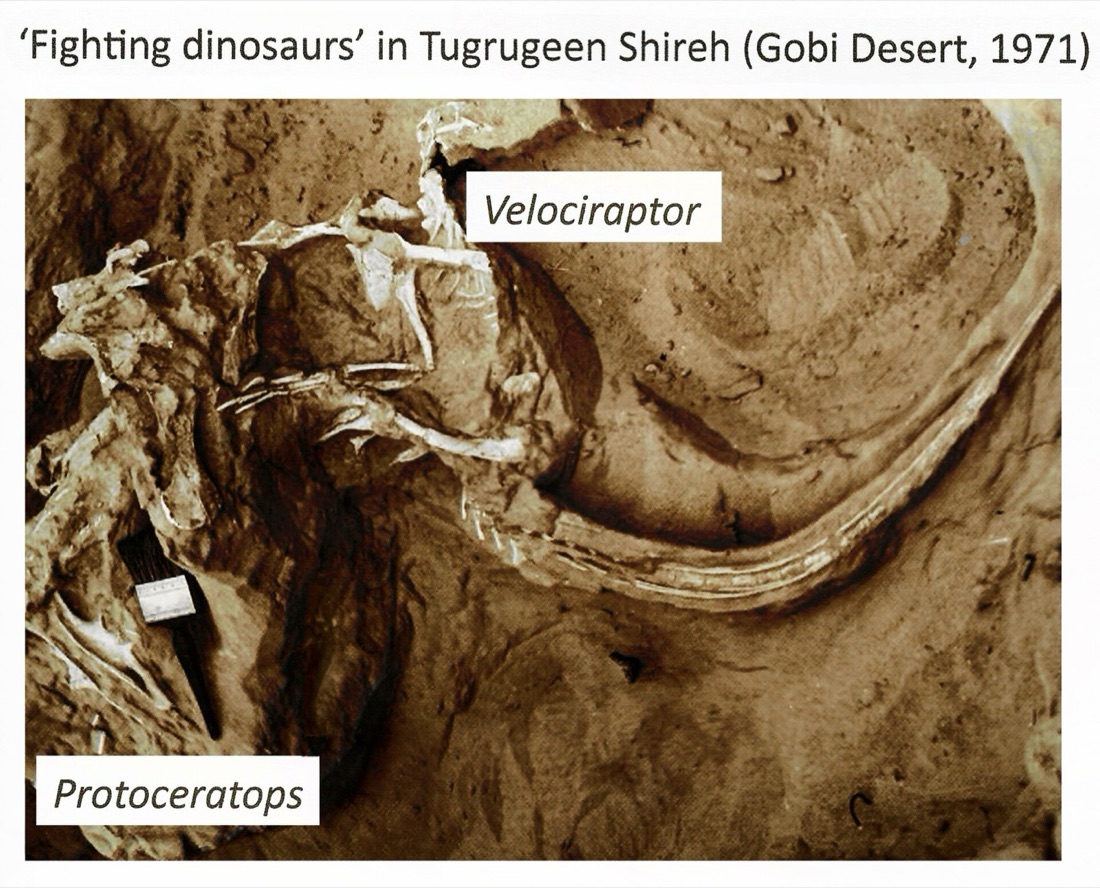
A Polish-Mongolian expedition working at Tugrugeen Shireh in the southern Gobi in 1971 uncovered the specimen paleontologists call the Fighting Dinosaurs: a Velociraptor mongoliensis (catalogued MPC-D 100/25) and a Protoceratops andrewsi (MPC-D 100/512) preserved locked together, buried sometime between 75 and 71 million years ago. Where almost every other dinosaur fossil preserves anatomy, this one preserves an event.
The arrangement is specific enough to read off the bones. The Velociraptor has its sickle claw driven into the throat region of the Protoceratops, while the Protoceratops has its beak clamped down on the raptor's right forelimb, which is broken. Something buried both animals fast enough to freeze the position, most likely a collapsing dune or a sudden flow of sand. The specimen is held in Mongolia and has left the country only on temporary loan, including a stint at the American Museum of Natural History in 2000.
The claw ended up at the throat, not the belly, which is what the robotic model and the accipitrid comparison would predict and not what the slashing attack of the popular image would. One fossil cannot settle a behavioral question by itself, and this one happens to line up with the biomechanics.