
The cost of holding a head nine metres up
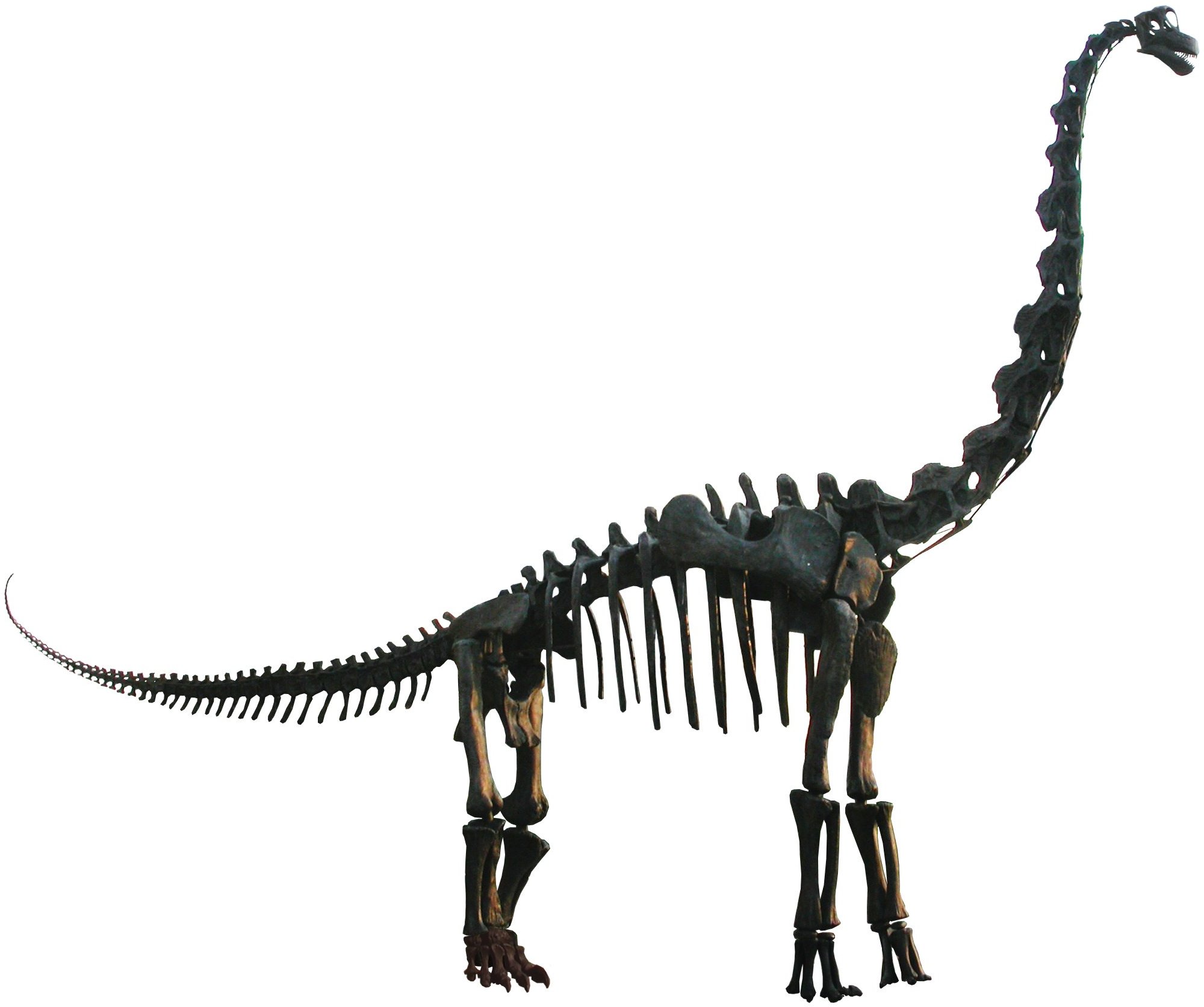
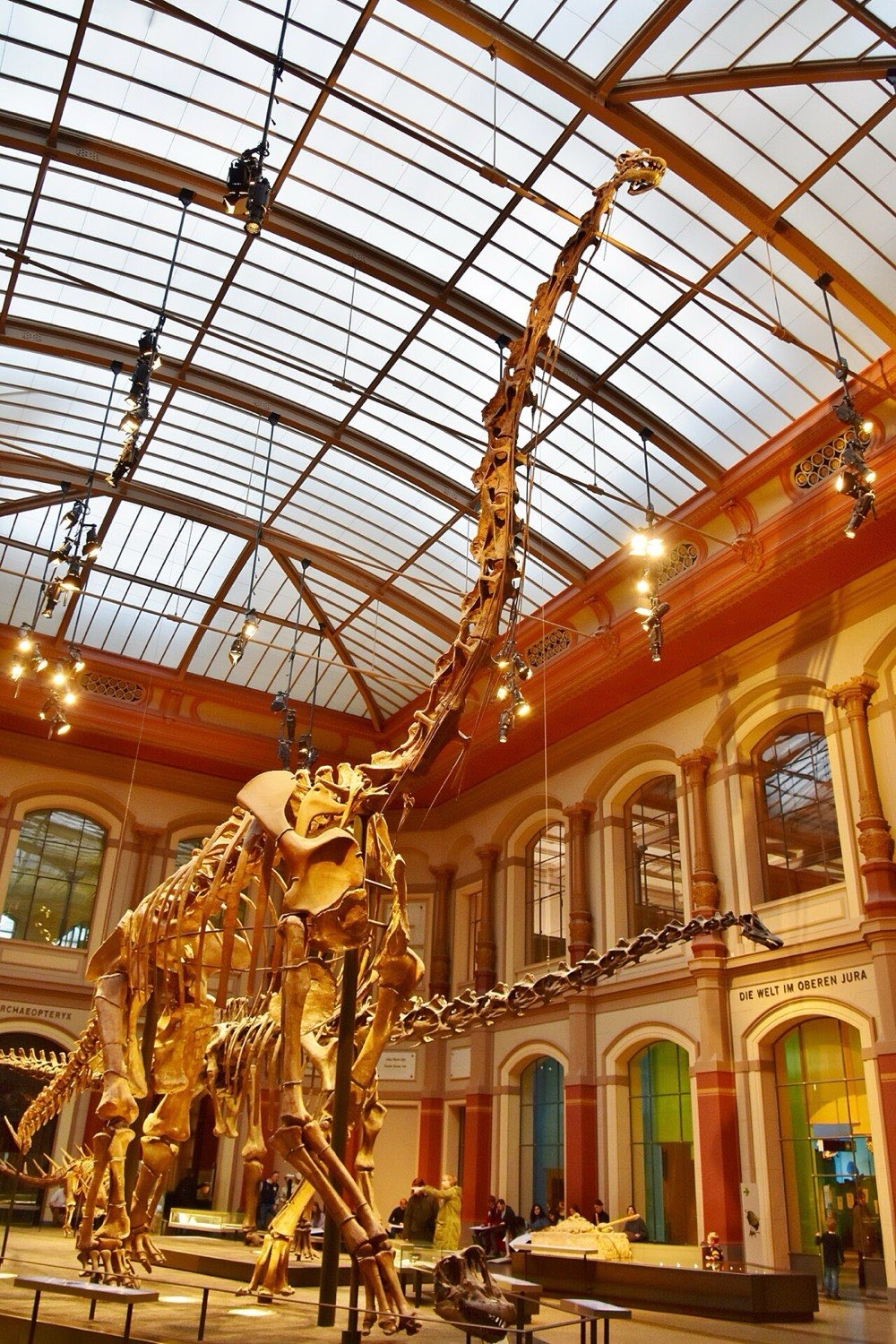
Roger Seymour's 2009 paper in Biology Letters starts with a measurement, not an argument. Reconstructions of Barosaurus at the American Museum of Natural History and of the Berlin brachiosaur, he notes, place the head roughly 9 metres above where the heart must have been, in the body cavity near the lungs. Blood and mercury have known densities, so each metre of that column converts directly into 78 mm Hg of pressure. The static column alone therefore produces 700 mm Hg at heart level. Add perhaps 50 mm Hg to actually induce flow and you land at a mean arterial pressure of 750 mm Hg, against roughly 100 mm Hg in a small mammal and roughly double that in a giraffe.
Earlier work had already worked out what kind of pump that implies. Working from measurements by Seymour and Blaylock of the range of tensions real cardiac muscle can exert, Seymour and Lillywhite estimated a heart weighing 5 per cent of body weight to produce 700 mm Hg beneath an upright Barosaurus neck. By the law of Laplace such a heart would have walls five times thicker and 15 times heavier than a similarly sized animal running at 100 mm Hg would need.
Seymour's contribution was to price it. Cardiac work rate runs around 10 per cent of metabolic rate in small mammals at 100 mm Hg, and he estimates about 18 per cent in an adult giraffe. Scale that relationship up and an animal producing 750 mm Hg does cardiac work about 7.5 times higher. In his words, a sauropod with its head in the trees "would therefore have to increase its metabolic rate to 175 per cent, and, at this level, expend 49 per cent of its total energy requirements just to circulate the blood." At 750 mm Hg the circulation costs about as much as the entire rest of the body.
The part of the argument that is easiest to check is the geometry, and it does not favor reaching up. The cost of the heart rises with the height of the head, but the volume of the feeding sphere that height opens up shrinks as you go. Seymour points out that raising the neck past about 30 degrees buys sharply diminishing returns, and past 70 degrees the vertical component of the blood column is already nearly maximal. His conclusion is that feeding "with its neck close to horizontal" made more sense, sweeping a 9 metre radius laterally and reaching perhaps 6 metres up, about 3 metres above the heart, with no cardiovascular trouble. He writes: "Taking a pace of 1 m horizontally would potentially make more food available than raising the head 1 m."
He does grant this animal one concession. "The long front legs of Brachiosaurus may be an adaptation for raising the heart, much as the long legs of the giraffe."
The siphon answer, seven years later
The counter-case is that a closed circulatory loop does not have to lift the blood column the way a bucket lifts water. In a siphon, the descending venous column pulls while the ascending arterial column pushes, and the two roughly cancel, so the heart only pays for friction. Whether that works in an animal has been contested for decades, largely because veins are floppy and a siphon needs its return tube not to collapse.
Stephen Hughes, John Barry, Jeremy Russell, Robert Bell and Som Gurung tested it with hardware. Their 2016 paper in the Journal of Experimental Biology built a physical model and reported that "the siphon principle is able to explain how blood was able to adequately perfuse the sauropod brain," with the return circulation plausibly protected "by a structure akin to the vertebral venous plexus." From the model they derived an equation relating neck height to mean arterial pressure, and the number that falls out is a good one: "with a mean arterial pressure similar to that of the giraffe, the maximum safe vertical distance between heart and head would have been about 12 m."
That figure is interesting because it is not much above the longest necks anyone has dug up, which is exactly what the authors seize on. They propose that "the maximum neck length in the fossil record is due to the siphon height limit," a physical ceiling on how long a sauropod neck can usefully get. The same equation has an awkward corollary they state plainly: to migrate over high ground, sauropods would have needed either to raise their arterial pressure substantially or keep their necks below a height that depends on altitude.
Seymour did not let the model stand unanswered. He and Harvey Lillywhite published a rebuttal in the same journal a few months later, titled bluntly "Why vascular siphons with sub-atmospheric pressures are physiologically impossible in sauropod dinosaurs." Their objection goes after the mechanism itself: a vein running below atmospheric pressure would collapse outside the protection the skull gives the brain's own circulation, and the reduced pressure would pull dissolved gas out of the blood as bubbles. Hughes and his co-authors answered in the same issue, defending the model. The cardiovascular question therefore runs to at least three published rounds pointing in different directions, one from an energy budget, one from a bench model, and one attacking that bench model's central assumption, and none of them has been retracted.
Brachiosaurus neck posture: nobody agrees where the neck was in the first place
Underneath the physiology sits a bone argument that is, if anything, less settled. Kent Stevens and Michael Parrish published a digital study of Apatosaurus and Diplodocus in Science in 1999, articulating the neck vertebrae into the best fit between adjacent joints, the arrangement in which the paired facets on the rear of one vertebra overlap the matching pair on the front of the next as fully as possible. That configuration is now called the osteological neutral pose, or ONP. Their DinoMorph models put both animals' necks at or below horizontal and unable to raise the head far above it. Reconstructions and museum labels followed.
Michael Taylor, Mathew Wedel and Darren Naish went after the method in Acta Palaeontologica Polonica in 2009, and their objection is simple enough to check on a pet. Living animals do not stand around in the neutral pose. Drawing on X-ray studies of primates, cats, rabbits, rodents and birds, they report that in living amniotes "the neck is maximally extended and the head is maximally flexed, so that the mid-cervical region is near vertical." Their conclusion follows directly: "Unless sauropods behaved differently from all extant amniote groups, they must have habitually held their necks extended and their heads flexed." The neutral pose, on their reading, is not a posture any animal adopts: "ONP is merely the midpoint between the postural extremes."
They also question how the horizontal reconstruction won. Stevens and Parrish's inflexibility result rested on an assumption that one of those facets, the zygapophysis, could slide across its neighbor only until the overlap fell to about 50 per cent, a figure the 2009 paper describes as based on unpublished manipulations of extant bird necks, and one Stevens and Parrish appear to contradict themselves when they note that giraffes bending their necks sideways show almost no overlap at all. There is a physical check too. When Ken Carpenter manipulated the mounted Diplodocus DMNH 1494, a cast of the very individual Stevens and Parrish modelled digitally, he got a neck that extended further both vertically and horizontally than the software allowed. Taylor and colleagues draw the obvious lesson: "it is evident that the results of such computerised studies are not as objective as they may appear," and DinoMorph "is a hypothesis to be tested by other lines of evidence rather than a firmly established fact."
On how the subhorizontal neck became standard, they write that horizontal necks "seem to have been accepted as the new orthodoxy, not through independent replication of Stevens and Parrish's (2005a, b) results, nor through their hypothesis having survived attempted rebuttals, but simply through lack of published counter-arguments."
They do work a brachiosaur case through in detail, and it is worth being precise about which one. Their figured example is the Tendaguru animal they still call Brachiosaurus brancai, the species that was moved to the genus Giraffatitan in a separate paper the same year. Even for that animal, which is known from far more material than its American namesake, the answer runs out. Judging how much the base of the neck could bend requires the vertebrae where the neck meets the back, and they note that the neural arches of that cervico-dorsal transition are unknown in the species altogether, so it cannot be determined.
Brachiosaurus vs Giraffatitan: the animal you are picturing is a different genus
The Brachiosaurus of posters, films and museum halls is largely a different animal, which is why so much of the above has to be hedged. The paper that established this appeared in the Journal of Vertebrate Paleontology in the same year as Seymour's and Taylor's neck papers.
The abstract of Michael Taylor's redescription says so outright: "Although the macronarian sauropod Brachiosaurus is one of the most iconic dinosaurs, its popular image is based almost entirely on the referred African species Brachiosaurus brancai rather than the North American type species Brachiosaurus altithorax." Werner Janensch had folded the Tanzanian Tendaguru material into the American genus in 1914 on the strength of what Taylor counts as only four shared derived characters, an argument he judges would not convince anyone today. Set the two side by side properly and at least 26 characters of the dorsal and caudal vertebrae, coracoids, humeri, ilia and femora separate them. The African animal accordingly became Giraffatitan brancai, a name Gregory Paul had floated as a subgenus in 1988 and George Olshevsky had raised to genus rank in 1991 without either version catching on.
Taylor clearly did not enjoy the outcome. The last line of the acknowledgements reads: "Finally, I beg forgiveness from all brachiosaur lovers, that so beautiful an animal as 'Brachiosaurus' brancai now has to be known by so inelegant a name as Giraffatitan."
The consequence for everything above is severe. The holotype FMNH P 25107, collected in 1900 in the Grand River valley of western Colorado by the Field Columbian Museum expedition under Elmer Riggs and named in 1903, consists of the last seven dorsal vertebrae, the sacrum, the first two caudals with one in very poor condition, a left coracoid, a right humerus, ilium and femur, a fragmentary left ilium, and dorsal ribs. Taylor states what is absent: no material "from the skull, neck, anterior dorsal region, median or posterior parts of the tail, distal parts of the limbs or feet." Riggs also had the coracoid on the wrong side, which Taylor corrects from right to left. The tall neck this animal is famous for is not part of the type specimen at all, and the only cervicals ever referred to it, BYU 12866 and 12867, would if correctly assigned indicate neck proportions identical to Giraffatitan anyway.
So Seymour's 9 metre column comes from the Berlin mount, which is Giraffatitan brancai, and the brachiosaur neck posture in the Taylor, Wedel and Naish figures is labelled Brachiosaurus brancai, the name still in use as their paper went to press. Neither is an error. Both illustrate how much of the standard account of Brachiosaurus is measured on its African cousin.
The mixture is physically visible in Chicago. The skeleton in the photograph at the top of this page, the mount that stood outside the Field Museum, is a cast built on the holotype with the missing parts filled in from the Berlin Giraffatitan MB.R.2181. The Field Museum's 1993 indoor version, moved to O'Hare Terminal 1 in 1997, likewise combines real fossil casts with model bones modelled on Giraffatitan. The outdoor cast was taken apart in 2022 after an inspection found severe damage.
None of this stops people telling the two apart, or trying to. A November 2025 thread in r/Dinosaurs, "Is this a brachiosaurus or giraffatitan skull?", has commenters arguing it out from the shape of the crest and the taper of the snout, one noting that the Jurassic Park films used a Giraffatitan skull, another pointing out that at the time Giraffatitan was considered a species of Brachiosaurus anyway. Working out which animal a famous skeleton actually belongs to is a recurring job in this group: Ankylosaurus turns out to be reconstructed largely from its relatives for much the same reason.

How much did Brachiosaurus weigh? Depends whose assumptions
Published masses for this animal range from roughly 23 to 35 tonnes, and the spread comes mostly from modeling choices, not new bones.
Taylor estimated volumes for the type specimens of both species by graphic double integration and got 28,688 kg for Brachiosaurus and 23,337 kg for Giraffatitan, making the American animal about 23 per cent bulkier. Paul, working from separately sculpted models in 1988, had found only an 11 per cent difference, at 35,000 kg against 31,500 kg. Taylor's figures come to 82 and 74 per cent of Paul's, and he traces most of the gap to a single assumption: he used a uniform density of 0.8 kg per litre from Wedel's work on Diplodocus, where Paul used 0.6 for the neck and 0.9 for the rest, averaging 0.861. Rerun with Paul's density and Taylor's numbers still come in at 88 and 80 per cent of Paul's, the remainder presumably sitting in how bulky the two sets of models were sculpted. For comparison, Henderson's 2004 estimate for Giraffatitan, 25,789 kg, lands near Taylor's.
The proportional differences behind the mass gap are measurable, not just a visual impression. Summed over dorsals 6 to 12, the vertebral column of Brachiosaurus runs 226 cm against 183 cm in Giraffatitan, so the trunk is about 23 per cent longer, a difference Taylor calls apparent to the naked eye. The single known caudal is taller in both centrum and neural arch than its Giraffatitan equivalents, with roughly 2.25 times the area for ligament attachment on the neural spine, suggesting a tail perhaps 20 to 25 per cent longer. The limb bones, by contrast, are nearly the same size: the humeri of the two type specimens differ by 3 cm, or 1.4 per cent, and the femora by 8 cm.
One more caveat sits under all of it. Taylor notes that although the Brachiosaurus holotype was the larger animal overall, it was "probably immature, as its coracoids were not fused to its scapulae." The reference specimen for the genus was still growing. Size figures for fragmentary giants have a way of drifting, and the drift tends to run one direction, as the long career of the overgrown Mosasaurus shows.
The skull that spent a century as somebody else's head
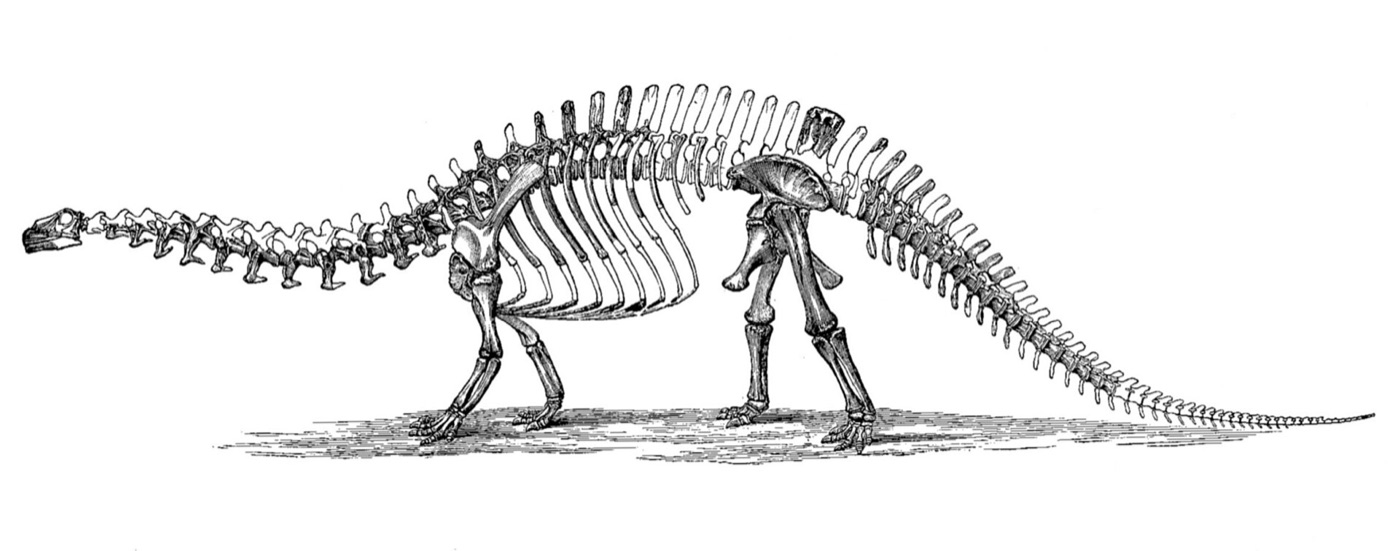
In 1883 an 81 cm sauropod skull came out of Felch Quarry 1 at Garden Park, Colorado, and was shipped to Othniel Charles Marsh at Yale. An illustration of it was used in Marsh's 1891 restoration of Brontosaurus, which is how a brachiosaur head ended up on the most famous wrong skeleton in palaeontology. The specimen later moved to the National Museum of Natural History as USNM 5730. John McIntosh and David Berman established in 1975 that it did not belong to Apatosaurus, describing it instead as being of the general Camarasaurus type. Kenneth Carpenter and Virginia Tidwell described it properly in 1998, found it intermediate between the skulls of Camarasaurus and the Berlin brachiosaur, and referred it to Brachiosaurus sp.
Whether it is Brachiosaurus altithorax specifically cannot be established, and the reason is the recurring one. There is nothing in the holotype to compare it against. Carpenter and Tidwell say the skull may belong to the species but that testing this is currently impossible for lack of comparable parts.
There was very nearly more. A 99 cm cervical vertebra lay near the skull, probably from the same kind of animal, and would have been unusually valuable given how little North American brachiosaur neck material exists. McIntosh and Berman record that it was destroyed during attempts to collect it.
The loss matters more than one bone usually would. The blood pressure argument, the posture argument and the height figures all turn on the neck, and for the type species of Brachiosaurus the neck is the part nobody has. Headline numbers in this corner of palaeontology tend to rest on thinner evidence than their confidence suggests, which is how Quetzalcoatlus ended up with two different wingspans in circulation from a single monograph.