
The fossil Georges Cuvier initially called a fraud
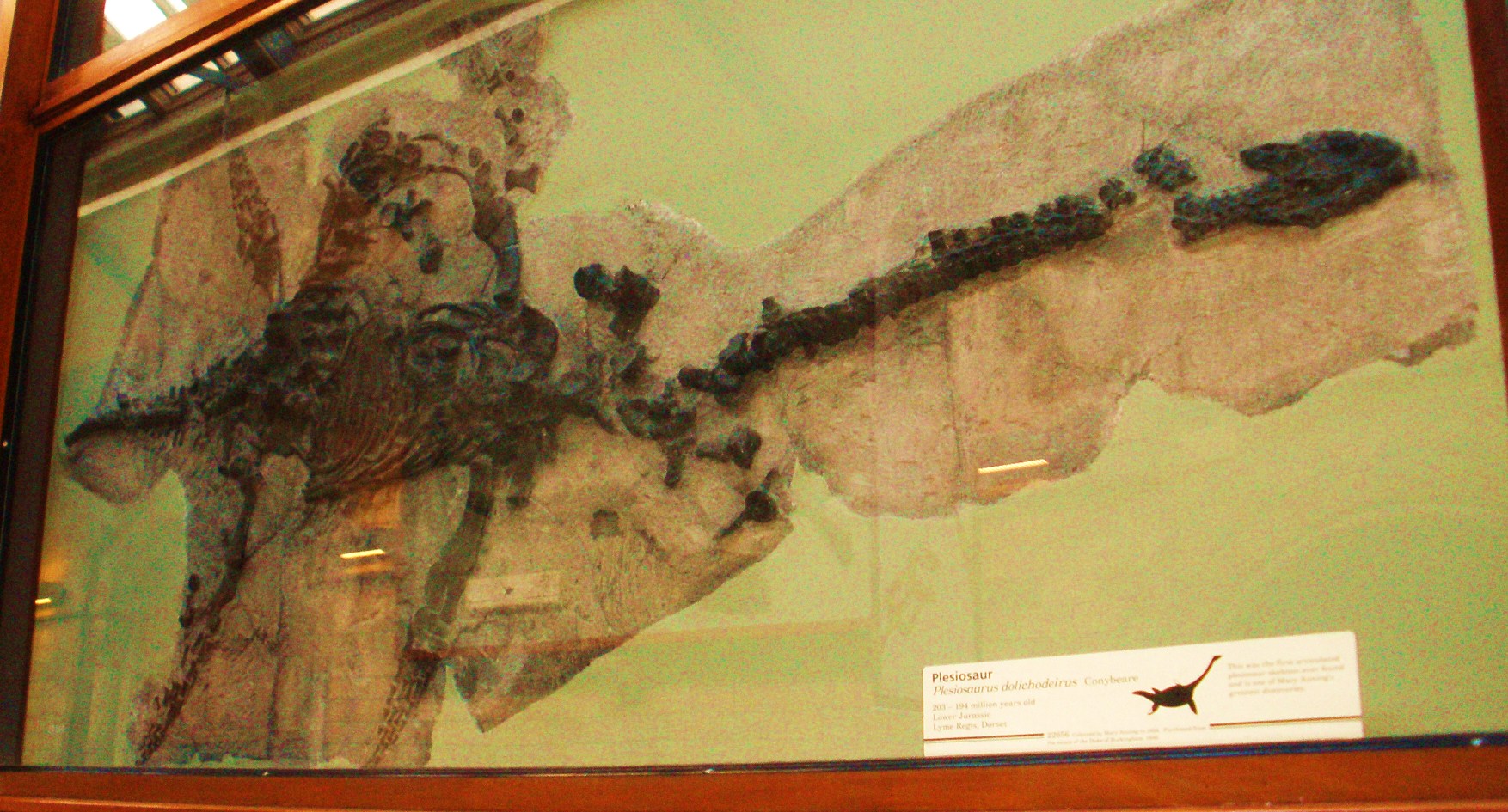
Mary Anning, working the fossil-rich cliffs around Lyme Regis, England, found the first complete plesiosaur skeleton on 10 December 1823, after her brother Joseph had recovered a partial specimen years earlier. English geologist William Conybeare formally described and named it Plesiosaurus dolichodeirus in 1824, from the Greek for "near to reptile" and "long-necked." The animal's proportions were so unlike anything then known, a small body, four paddle-like limbs, and a neck longer than its torso and tail combined, that Georges Cuvier, the leading comparative anatomist of the era and the same naturalist whose 1808 work on the Mosasaurus holotype had helped establish that species really do go extinct, suspected the London skeleton was an assembled fake before even seeing it in person.
Conybeare and fellow geologist William Buckland eventually persuaded Cuvier the specimen was genuine, and he retracted the fraud charge and discussed the find in print, then sent an emissary to Britain to acquire specimens for the Paris museum. The reptile was a genuine sensation among London scientific circles, though Anning herself, despite having found and prepared the fossil, was not invited to the Geological Society of London meeting where it was formally presented.
It isn't a dinosaur, and its family includes both long and short necks
Plesiosaurs belong to Sauropterygia, a distinct branch of marine reptiles unrelated to Dinosauria despite living through the same Mesozoic era as the Tyrannosaurus rex and other land dinosaurs. "Plesiosaur" covers two visibly different body plans: long-necked, small-headed plesiosauromorphs like Plesiosaurus and Albertonectes, and short-necked, large-headed pliosauromorphs such as Polycotylus and the genuinely enormous Pliosaurus and Kronosaurus, built more like an alligator with flippers. Both groups shared the same four-flipper swimming plan and lived alongside other non-dinosaur marine reptiles of the period, including the Mosasaurus, which arrived later in the Cretaceous.
The group first appears in the fossil record in the Late Triassic, roughly 215 million years ago, and persisted for close to 150 million years before disappearing entirely in the mass extinction about 66 million years ago that also ended the Tyrannosaurus rex.
A famous paleontology blunder: the skull that got mounted on the tail
A related plesiosaur, Elasmosaurus platyurus, produced one of the best-documented errors of 19th-century American paleontology. When Edward Drinker Cope described the newly discovered Kansas specimen in 1868, he reconstructed and illustrated the skeleton with the skull attached to the tip of the long tail rather than the long neck, an understandable mistake given how unlike any living reptile the animal's proportions were. Anatomist Joseph Leidy examined the mount, identified the reversal, and formally published the correction in the American Journal of Science; Cope, embarrassed, rushed out a correction and reportedly tried to buy back copies of the journal that had printed the original error.
The popular version of the story credits paleontologist Othniel Charles Marsh, Cope's rival in the Bone Wars fossil-collecting feud, with catching the mistake on the spot and humiliating Cope in front of colleagues. Later historical research complicates that account: Marsh was present at the 1870 meeting where the specimen was discussed, but the claim that he first spotted the error only surfaced in an anecdotal newspaper quotation roughly two decades later, after Leidy had already published the correction under his own name.
How they actually swam: front flippers doing the work, back flippers stealing the wake
Older reconstructions imagined plesiosaurs rowing with alternating paddle strokes, but the animal's four identical, wing-shaped flippers don't match how any living paddle-swimmer moves. Shanshan Liu and colleagues addressed the question computationally in a 2015 PLOS Computational Biology study, running a digital, physics-simulated plesiosaur through thousands of stroke-pattern variations. Within biologically plausible joint ranges, the simulation converged on the same solution every time: an underwater-flight stroke powered mostly by the front flippers, the same basic swimming mode sea turtles and penguins use, with the hind flippers contributing comparatively little thrust on their own.
That left an open question: if the rear flippers weren't doing much independent work, why did plesiosaurs keep two full pairs for well over 100 million years instead of losing the redundant set? Luke Muscutt and colleagues tested a physical answer in a 2017 Proceedings of the Royal Society B study, 3D-printing a four-flippered robotic plesiosaur model and running it through a water tunnel with tandem front-and-back flipper pairs. When the timing was right, the rear flippers weren't swimming independently at all, they were intercepting the vortices the front flippers had already shed into the water and extracting extra energy from them, increasing the hind pair's thrust by up to 60 percent and propulsive efficiency by up to 40 percent compared with those hind flippers operating alone. It's the same wake-capture principle birds use flying in formation, applied underwater across a single animal's own body. A separate Harvard experiment used laser-lit particle imaging in a water track to measure how basilisk lizards manage to run across the surface of water without sinking. Forces were inferred from the motion of particles in the water.
The record-holding neck, and why it couldn't curve like a swan's
Albertonectes vanderveldei, a plesiosaur pulled from an Alberta ammonite mine in 2007 and described by the Royal Tyrrell Museum team in 2012, holds the record for the most neck vertebrae of any known animal: 76 cervical vertebrae making up about 7 meters of its roughly 11.2-meter total length, edging out the previous record-holder, Elasmosaurus, by four vertebrae.
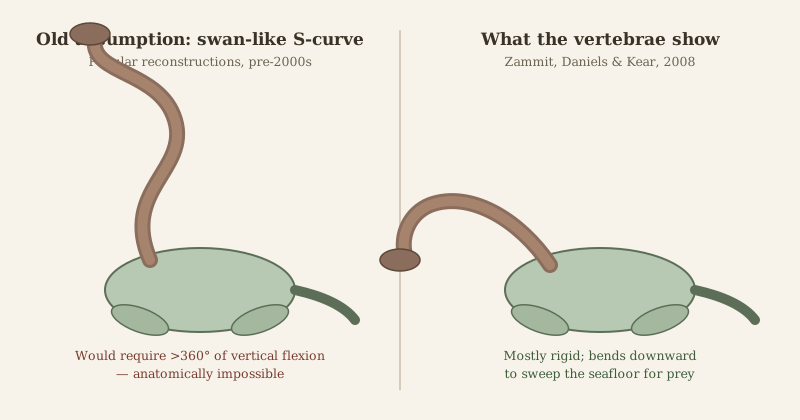
That much length invited a century of artistic license, most famously the swan-like S-curve neck posture that shows up in older museum murals and documentaries. A 2008 study in Comparative Biochemistry and Physiology by Maria Zammit, Christopher Daniels and Benjamin Kear modeled the actual range of motion permitted by elasmosaurid cervical vertebrae and found the swan pose implausible on anatomical grounds: it would require more than 360 degrees of combined vertical flexion, far beyond what the joint surfaces allow. Their reconstruction instead found the neck was comparatively stiff overall, with cervical ribs in many species fused to the vertebrae, and that its main functional range was 75 to 177 degrees of downward, or ventral, bending, consistent with sweeping the neck beneath the body to hunt near the seafloor or within the water column below, not arcing it up and over like a heron.
Live birth, not eggs: the pregnant fossil that settled the question
Whether plesiosaurs laid eggs on land, the way sea turtles still do, or gave birth to live young at sea had been an open debate, complicated by the fact that a body built for open-ocean swimming, with rigid, paddle-shaped limbs, would have made hauling out onto a beach to nest almost impossible. F. Robin O'Keefe and Luis Chiappe settled the question with a 2011 Science paper describing a 78-million-year-old adult Polycotylus latipinnis, a short-necked plesiosaur, fossilized together with a partial embryonic skeleton, ribs, roughly 20 vertebrae, shoulder and hip bones, and paddle elements, preserved inside the body cavity.
The find was the first direct fossil evidence of live birth in any plesiosaur. O'Keefe and Chiappe's analysis also pointed to an unusual reproductive strategy for a marine reptile: rather than many small offspring, Polycotylus appears to have invested in a single, comparatively large newborn, a pattern closer to modern whales and dolphins than to the many-egg or many-hatchling strategy typical of sea turtles and most other reptiles, and one the authors suggested implies some degree of parental care.
Why the timeline rules out Loch Ness, freshwater fossils and all
The Loch Ness Monster legend draws its imagery directly from plesiosaur skeletons, and the comparison runs into an immediate dating problem. Plesiosaurs, along with the non-avian dinosaurs, went extinct in the Cretaceous-Paleogene mass extinction roughly 66 million years ago. Loch Ness itself is far younger than that: the loch is a glacially carved basin that only took its current form around 10,000 years ago, as ice sheets retreated at the end of the last glacial period. A surviving plesiosaur population would need an unbroken 66-million-year fossil and genetic gap, plus a large enough breeding population to avoid extinction, fit inside a single freshwater Scottish loch that did not exist for all but a sliver of that time.
A 2022 discovery adds a wrinkle without closing that gap: Georgina Bunker, Nick Longrich and colleagues, publishing in Cretaceous Research, described small plesiosaur fossils, adult and juvenile bones and teeth, from a roughly 100-million-year-old river system preserved in the Kem Kem Group of Morocco, the same Kem Kem beds that produced the semiaquatic dinosaur Spinosaurus. The find shows at least some plesiosaur species tolerated or lived in freshwater alongside crocodiles and frogs, well before the group's Cretaceous-Paleogene extinction. That pushes back on the old assumption that every plesiosaur was strictly marine, but it doesn't touch the two hard numbers that rule out Loch Ness: the 66-million-year-old extinction date and the 10,000-year-old loch.