
The short version
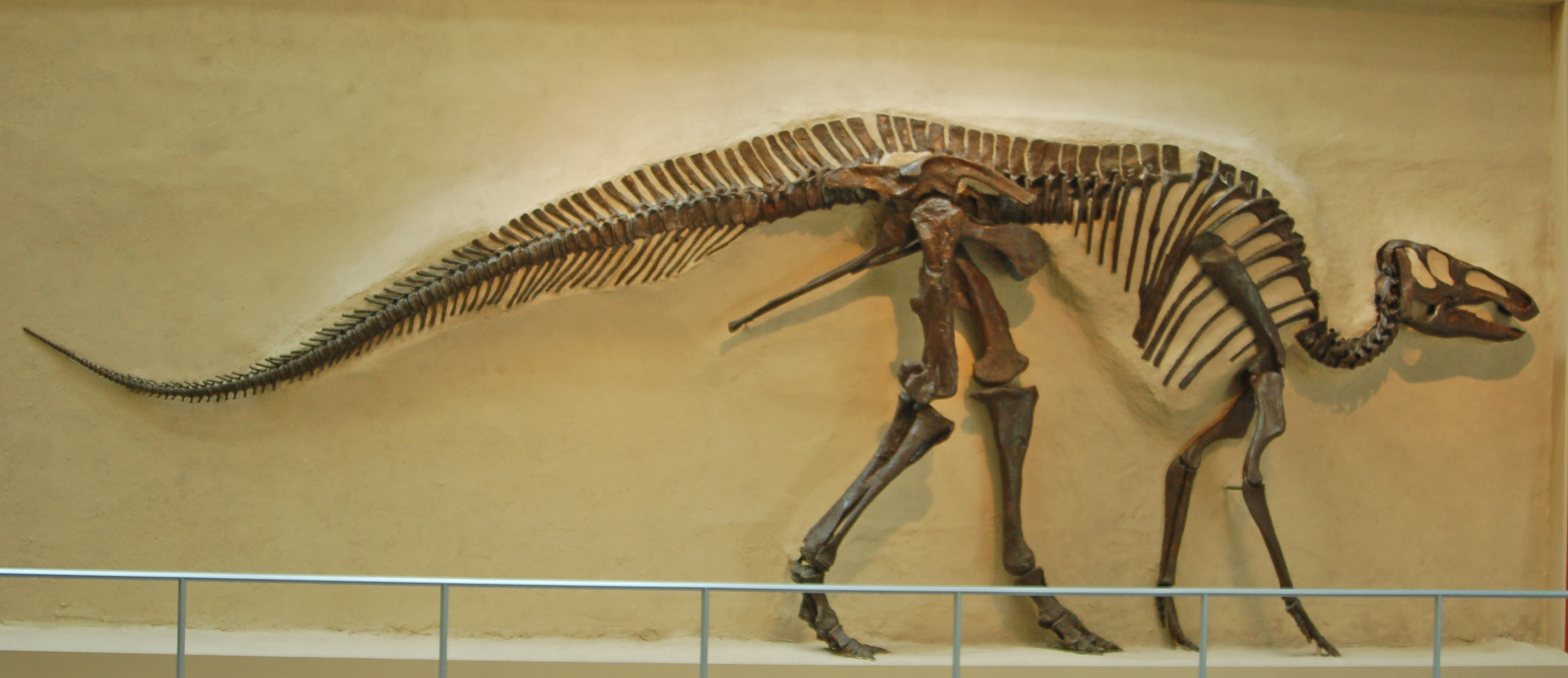
A hadrosaurid is a member of Hadrosauridae, the family of herbivorous, duck-billed dinosaurs that dominated the landscapes of Asia, Europe and North America for roughly the last 20 million years of the Cretaceous. The name comes from the flattened, broadened snout that gives many species a beak resembling a duck's bill. Adults in most well-known genera ran roughly 9 to 12 meters (30 to 40 feet) long, though the family spanned a wide range, from lambeosaurines a third that size up to some of the bulkiest ornithopods on record.
The family splits into two subfamilies based on the shape of the head. Lambeosaurinae carried hollow, tube-like crests, Parasaurolophus and Corythosaurus among them, built from looping extensions of the nasal passages. Saurolophinae, called Hadrosaurinae in most literature before 2010, had solid crests or none at all. Both groups shared the trait that made hadrosaurids such efficient herbivores: jaws packed with hundreds of interlocking teeth, replaced continuously from below rather than shed all at once.
One genus in particular, Edmontosaurus, shared its Hell Creek Formation habitat with armored dinosaurs like Ankylosaurus, while marine reptiles such as Mosasaurus patrolled Late Cretaceous coastlines nearby.
The New Jersey farm bones that started 'dinomania'
The first hadrosaurid fossil recognized as a dinosaur in North America turned up on a New Jersey farm twice, twenty years apart. In 1838, farmhand John Estaugh Hopkins dug up large bones on his employer's property near Haddonfield while digging marl for fertilizer and set them aside without knowing what he'd found. In 1858, William Parker Foulke, a member of the Academy of Natural Sciences of Philadelphia summering nearby, heard about the old bones, got permission to excavate the site properly, and uncovered a partial skeleton with hind legs noticeably longer than its front ones.
Foulke brought in Joseph Leidy, the Academy's leading anatomist, and the two presented the find at an Academy meeting on December 14, 1858. Leidy's full published description followed in 1859, naming the animal Hadrosaurus foulkii in Foulke's honor; taxonomists still credit the name to 1858, the year of that first presentation. Ten years later, in 1868, sculptor Benjamin Waterhouse Hawkins built casts to fill in the skeleton's missing bones and mounted it upright for display at the Academy, the first dinosaur skeleton ever assembled and shown to the public anywhere in the world. Close to 100,000 visitors came to see it, and museums worldwide followed the Academy's lead within a generation.
Hadrosaurus foulkii caused one more upheaval a century and a half later. Edward Drinker Cope built the family name Hadrosauridae around it in 1869, and for well over a century most solid-crested hadrosaurids were grouped into a subfamily called Hadrosaurinae, named for that same genus. A 2010 phylogenetic analysis by Albert Prieto-Márquez, published in the Zoological Journal of the Linnean Society, found that Hadrosaurus foulkii actually sits outside the solid-crested clade, as a separate branch near the root of the family tree. Since naming rules require a subfamily to include the genus it's named for, the solid-crested group had to be renamed Saurolophinae, after Saurolophus. Older books and websites that still say Hadrosaurinae for that group are using a name that hasn't applied to it since 2010.
Teeth built like a conveyor belt
Hadrosaurids didn't lose teeth the way most reptiles do. At each of the dozens of tooth positions along a jaw, up to 60 per side according to a 2016 study in BMC Evolutionary Biology by Aaron LeBlanc, Robert Reisz, David Evans and Alida Bailleul, several teeth sat stacked on top of each other at different stages of growth, connected by ligaments within a flexible structure the researchers call a dental battery. In species like Edmontosaurus, the battery could contain up to 300 teeth in each jaw ramus, including developing teeth, and well over 1,000 across the whole mouth once the developing replacements are counted.
Developing teeth sat beneath the chewing surface. As older teeth wore down, extensive root resorption let teeth advance within the battery; the researchers identified ligaments and root elongation as likely agents of movement. Their evidence challenged the older model in which young teeth simply pushed older ones upward. LeBlanc's team found the mechanism relied on halting the normal tooth-replacement cycle other dinosaurs used and repurposing the tooth root itself as part of the chewing surface, a solution unique among reptiles for grinding tough, fibrous Cretaceous plant material.
Crests built to be heard, not just seen
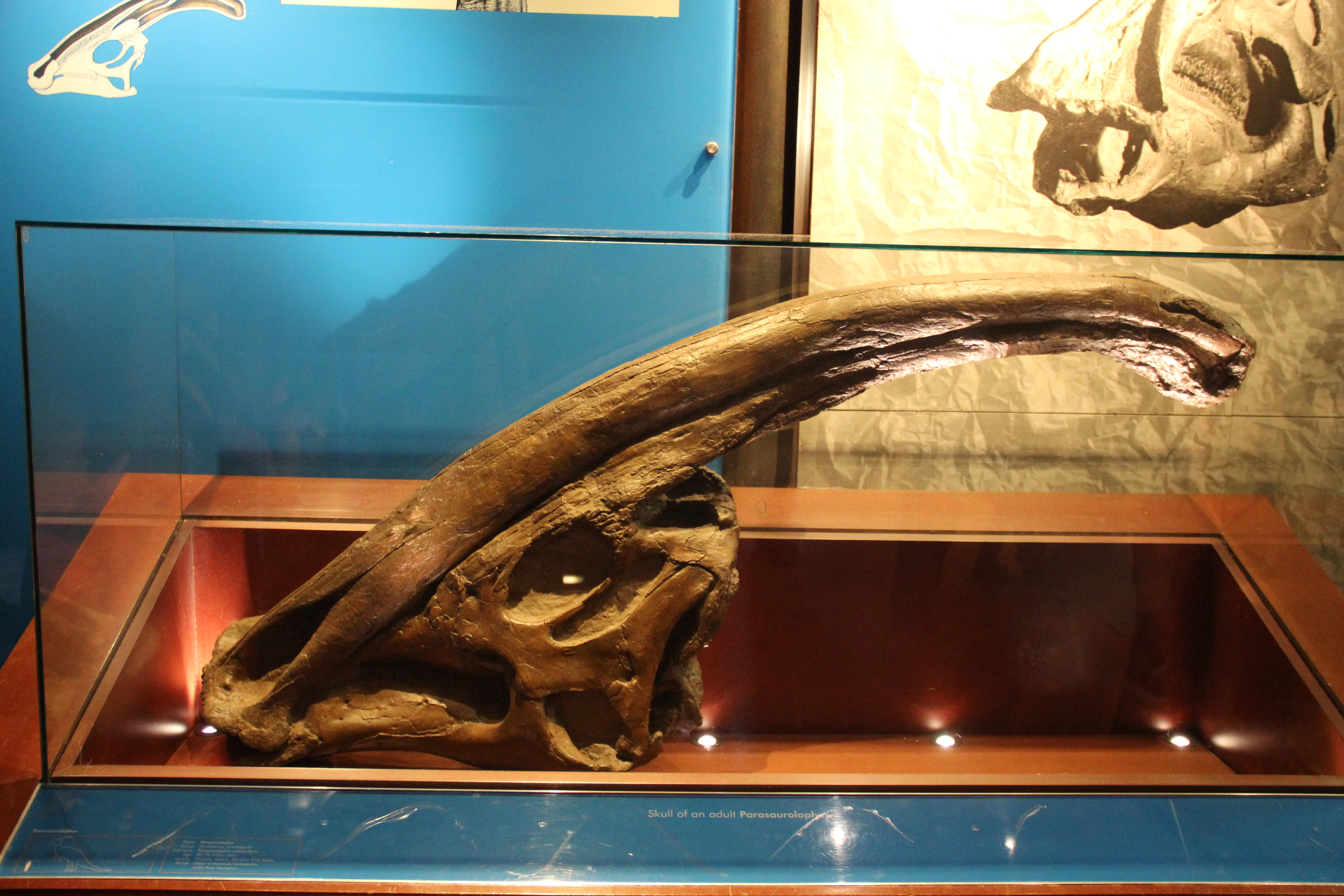
Lambeosaurine crests weren't solid bone. Inside a Parasaurolophus skull, the crest is hollow, looping the animal's nasal passages up and back before doubling down toward the throat. One long-standing hypothesis treats that internal tubing like a wind instrument: air pushed through the looping passages would resonate, producing a call rather than serving purely as a visual display. Researchers eventually tested the idea directly, CT-scanning a well-preserved skull, building a digital model of the crest's internal air passages, and calculating what frequency those passages would naturally resonate at.
The Parasaurolophus page has the full story: who first proposed the idea, and how a 1990s CT scan of a fossil skull turned it into a reconstructed call.
The nesting ground that proved dinosaurs were caring parents
In 1977, Marion Brandvold, who ran a rock and fossil shop in Bynum, Montana, found small bones on a ranch near Choteau. She showed them to paleontologist Jack Horner the following year, and Horner, working with Robert Makela, traced the bones to a bonebed that turned out to hold fourteen nests clustered together in one spot, later nicknamed Egg Mountain. The nests held eggs, hatchlings and juveniles at several different growth stages in the same tight area, evidence that a hadrosaurid species had returned to the same ground to nest as a group and that at least some young stuck around in the nest well past hatching.
Horner and Makela published the find in Nature in 1979 under the title 'Nest of juveniles provides evidence of family structure among dinosaurs,' naming the species Maiasaura peeblesorum, roughly 'good mother lizard.' It was the first solid physical evidence that any dinosaur exhibited complex parental care rather than simply laying eggs and leaving. A 2025 follow-up in Scientific Reports modeled hatchling Maiasaura's likely metabolic rate against living animals with known development patterns and estimated the nestlings needed something like 40 to 75 days of parental care after hatching before they were ready to leave the nest, a figure consistent with modern altricial birds rather than reptiles that fend for themselves from birth.
A 2025 fossil that revealed hooves nobody expected
In October 2025, a research team led by Paul Sereno of the University of Chicago published two new Edmontosaurus annectens specimens from Wyoming in the journal Science, and both preserved far more than bone. One, a juvenile and the first of its kind ever found, kept a fleshy crest running along its neck and back intact. The other, an adult, preserved a row of interlocking spikes running from its hips to the tip of its tail, along with hooves capping its three hind toes, the earliest documented hooves in any land vertebrate and, per Sereno, the first confirmed hooved reptile.
The preservation itself was the real discovery. The team found both specimens in coarse, well-drained river sediment, an unusual setting for this level of soft-tissue detail, and worked out that a thin film of clay, less than a hundredth of an inch across, had molded around the carcasses shortly after death and burial, casting the shape of skin, spikes and hooves in three dimensions before the underlying tissue broke down. The authors called the process clay-template mummification: the preserved surface is a mineral template of skin that has since decomposed. Their reconstruction includes initial drying before burial and the formation of the clay film; the better-known Edmontosaurus specimen nicknamed Dakota was found in North Dakota in 1999. The bite marks on other hadrosaurids weren't so gentle: healed tailbone injuries on separate Edmontosaurus specimens carry tooth damage matching Tyrannosaurus rex, direct evidence that at least some individuals survived an attack from the era's dominant predator.
The duck-bill that swam to Africa
For decades, hadrosaurid fossils turned up on every continent except Africa and Australia, and paleontologists generally assumed the family never reached either one. That changed in 2020, when Nicholas Longrich of the University of Bath and colleagues described jaw and tooth fossils recovered from phosphate mines near Sidi Chennane in Morocco's Khouribga province, publishing the find in Cretaceous Research as a new genus, Ajnabia odysseus. It was small for a hadrosaurid, an estimated 3 meters long, and belonged to Lambeosaurinae, specifically a group called Arenysaurini that had previously only turned up in Europe.
The genus name, Ajnabia, means 'stranger' or 'foreigner' in Arabic, a nod to how out of place a hadrosaurid fossil was in Africa. Through most of the Late Cretaceous, Africa sat as an island continent, cut off from Europe by open sea. For a European lambeosaurine's descendants to end up in Morocco, Longrich's team concluded, some ancestor had to cross hundreds of kilometers of open ocean, most plausibly by swimming or rafting on floating debris, since hadrosaurids show no obvious adaptations for a fully aquatic lifestyle. It's one of the better-documented cases of a large land animal apparently crossing open ocean to colonize new territory.