
The short version
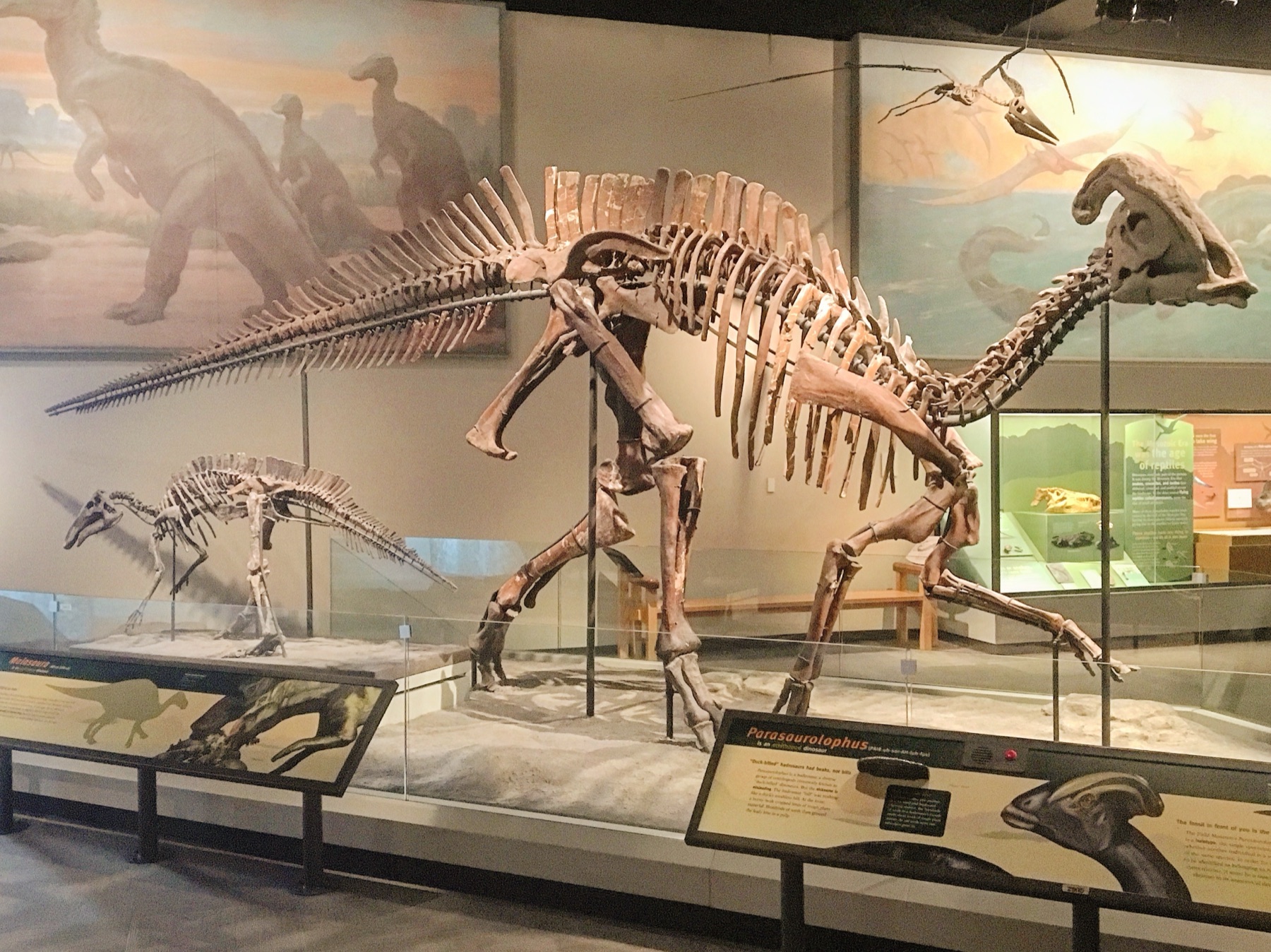
Parasaurolophus was a plant-eating dinosaur in the hadrosaurid, or duck-billed, family, set apart by a long, hollow crest that swept back from its skull in a tube shape rather than sitting as a solid plate. Fossils place it in western North America, in what's now Alberta, New Mexico and Utah, during a roughly 3.5-million-year window near the end of the Cretaceous. Three species carry the name: P. walkeri, the first described and the type species; P. tubicen, the largest; and P. cyrtocristatus, the smallest and most tightly curled.
The name itself is a small joke at another dinosaur's expense. "Parasaurolophus" translates roughly to "near crested lizard," a nod to Saurolophus, a solid-crested relative that had already been named when Parasaurolophus turned up, close enough in form to earn a name built on the comparison.
If the name sounds familiar from a screen rather than a museum hall, that's likely ARK: Survival Evolved, whose tameable "Parasaur" borrows the look and little else, down to an in-game threat-detection ability the real animal's anatomy doesn't support.
Three species, one crest shape mistaken for all of them
The first Parasaurolophus fossil, a skull and partial skeleton, came out of the ground in 1920 near Sand Creek along Alberta's Red Deer River, collected by a University of Toronto field party. Canadian paleontologist William Parks described it in 1922 as Parasaurolophus walkeri, naming it for Sir Byron Edmund Walker, chairman of the board at the Royal Ontario Museum, where the specimen still resides. A second species, P. tubicen, turned up further south in New Mexico's Kirtland Formation and was named by Swedish paleontologist Carl Wiman for its long, straight, deeply resonant-looking crest, tubicen being Latin for trumpeter.
The third species has the more tangled history. Charles Sternberg collected a partial skull and skeleton from New Mexico's Fruitland Formation in 1923, and American paleontologist John Ostrom described it in 1961 as Parasaurolophus cyrtocristatus, distinguished mainly by a shorter, more sharply curved crest. For close to sixty years afterward, telling the three species apart relied almost entirely on that one feature, crest shape, even though crests are known to change substantially as an animal grows. A new, well-preserved partial skull from the same rock unit as Ostrom's original specimen finally gave researchers something else to work with: in 2021, Terry Gates, David Evans and Joseph Sertich published a full rediagnosis in the journal PeerJ, identifying additional cranial traits that hold up independently of crest curvature and confirming P. cyrtocristatus as a distinct species on firmer ground than crest shape alone.
Pinning down when these animals actually lived draws on the same toolkit used across the Cretaceous rock record generally: radiometric dates from volcanic ash layers interbedded with the fossils, cross-checked against index fossils, species known to have existed only briefly enough to mark a specific slice of time.
Joe, the smallest and most complete Parasaurolophus on record
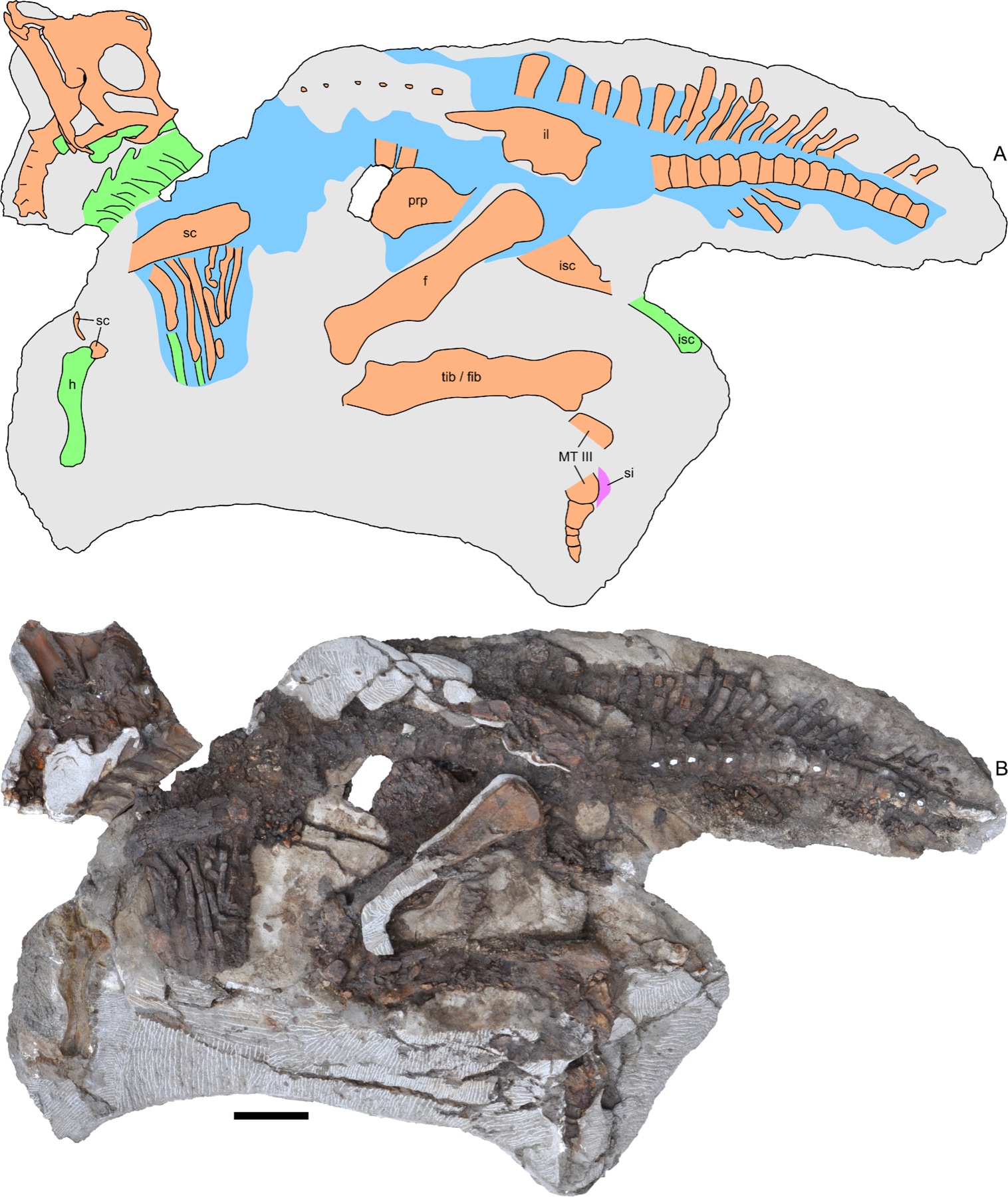
In 2009, high school student Kevin Terris was on a Webb Schools paleontology field trip in Utah's Grand Staircase-Escalante National Monument when he spotted bone fragments weathering out of the rock, in a spot two professional paleontologists had walked past just days earlier without noticing anything. What came out of the ground over the following excavation was a skeleton so complete and so well-articulated that paleontologist Andrew Farke and four coauthors, publishing the description in PeerJ in 2013, called it the most complete Parasaurolophus specimen then known, informally nicknaming it Joe.
Joe wasn't an adult. At roughly 2.5 meters long, about a quarter the length of a full-grown Parasaurolophus, and with tibia bone tissue showing no lines of arrested growth, the yearly rings that form each time a growing animal's development pauses for a season, Farke's team concluded Joe hadn't yet reached its first birthday when it died. Coauthor Sarah Werning, describing the histology in the study's press release, put it plainly: "Dinosaurs have yearly growth rings in their bone tissue, like trees. But we didn't see even one ring. That means it grew to a quarter of adult size in less than a year."
What made the specimen scientifically valuable wasn't just its completeness: Joe already had a small but clearly developing crest, far earlier in its growth than related hadrosaurids sprout theirs. "Our baby Parasaurolophus is barely one-quarter of adult size, but it had already started growing its crest," Farke said. "This is surprising, because related dinosaurs didn't sprout their ornamentation until they were at least half-grown. Parasaurolophus had to get an early start in order to form its unique headgear." The pattern, formally called peramorphic heterochrony, means crest development began earlier in the animal's growth and ran for longer than it did in the group's more modestly crested ancestors, rather than the crest simply scaling up in step with the rest of the body.
Complete 3D scans of Joe's skeleton were released freely online alongside the paper, making it one of the most digitally accessible dinosaur fossils described up to that point.

How it got around, and what it ate
Parasaurolophus's limb proportions point to an animal that walked on all fours most of the time and could rear up onto its hind legs when it needed speed or a better vantage point, a stance shared broadly across hadrosaurids. It was a herbivore, cropping vegetation with the same kind of continuously replacing dental battery, rows of interlocking teeth stacked several deep and replaced from below as the working surface wore down, found across the wider hadrosaurid family.
Size varied noticeably by species. The P. walkeri holotype measures out to roughly 9.5 meters (31 feet), while P. tubicen ran larger still, an estimated 10 to 11 meters, and P. cyrtocristatus was distinctly smaller, around 7.5 to 8 meters, the runt of the three.
The narrow strip of land it called home
During the Campanian, the landmass Parasaurolophus lived on wasn't the North America of today. A shallow inland sea, the Western Interior Seaway, split the continent in two, and the animals whose fossils turn up in Alberta, New Mexico and Utah lived on Laramidia, a long, narrow strip of land squeezed between that seaway to the east and the Pacific to the west. Marine reptiles including plesiosaurs patrolled the seaway's waters not far from the coastal plains and floodplains where Parasaurolophus grazed.
The crest, and why the video-game version has it backward
The leading scientific hypothesis, first proposed by Johns Hopkins paleontologist David Weishampel in a 1981 paper and tested directly in 1997 when Sandia National Laboratories built a 3D digital model from CT scans of a well-preserved skull, holds that Parasaurolophus used its hollow, looping crest to produce a low, resonant call, air pushed through the internal passages the way it moves through a wind instrument. Other proposed functions, including visual species recognition and body-temperature regulation, remain live possibilities that current evidence hasn't ruled out, according to London's Natural History Museum. The full account of how researchers tested the sound hypothesis lives in the wider duck-bill lineage writeup, which distinguishes hollow-crested lambeosaurines from hadrosaurids with solid crests or no crest.
ARK: Survival Evolved's in-game Parasaur gives the crest a different job entirely: switched into "turret mode," it automatically detects nearby creatures and players and alerts whoever tamed it, functioning as a living motion sensor. That's a game designer's invention, not a paleontological one. Every serious hypothesis about the real crest treats it as a structure built to emit sound or serve as a visual signal, not to detect anything in the surrounding environment.