
A 1901 fossil that fit no living family
When H.L. Beadnell, a surveyor with the Egyptian government's Survey Department, turned up a set of massive fossil skulls in the Faiyum Depression in 1901, he was looking at an animal that matched nothing alive. He published a preliminary description in Cairo the following year, naming it Arsinoitherium zitteli: the genus after Arsinoe II, the Ptolemaic queen for whom the Faiyum region was renamed in the third century BC, and the species after Karl von Zittel, the German paleontologist Beadnell credited as the field's founding figure in Egypt. Charles William Andrews, who had joined the fieldwork, followed up with the animal's full anatomical treatment in his 1906 monograph on Faiyum vertebrates for the British Museum, a 324-page catalogue that remains a working reference for the group more than a century later.
Working out what Arsinoitherium actually was took decades longer than naming it. Early classifications lumped it with the amblypods, a catch-all grouping long since abandoned, and for a stretch it was filed under Barypoda, a now-discarded label for an oddly proportioned branch of proboscideans. It now sits in its own order, Embrithopoda, inside the broader group Paenungulata, the lineage that produced elephants, hyraxes, and sirenians as well, the manatees and dugongs that live in water today. None of those animals resembles Arsinoitherium today, but the skeleton, not the surface impression of a horned rhino, is what settles the question: this is an elephant's distant cousin built on a rhinoceros-shaped frame, not a member of the rhinoceros lineage.
The horns almost certainly weren't bare bone
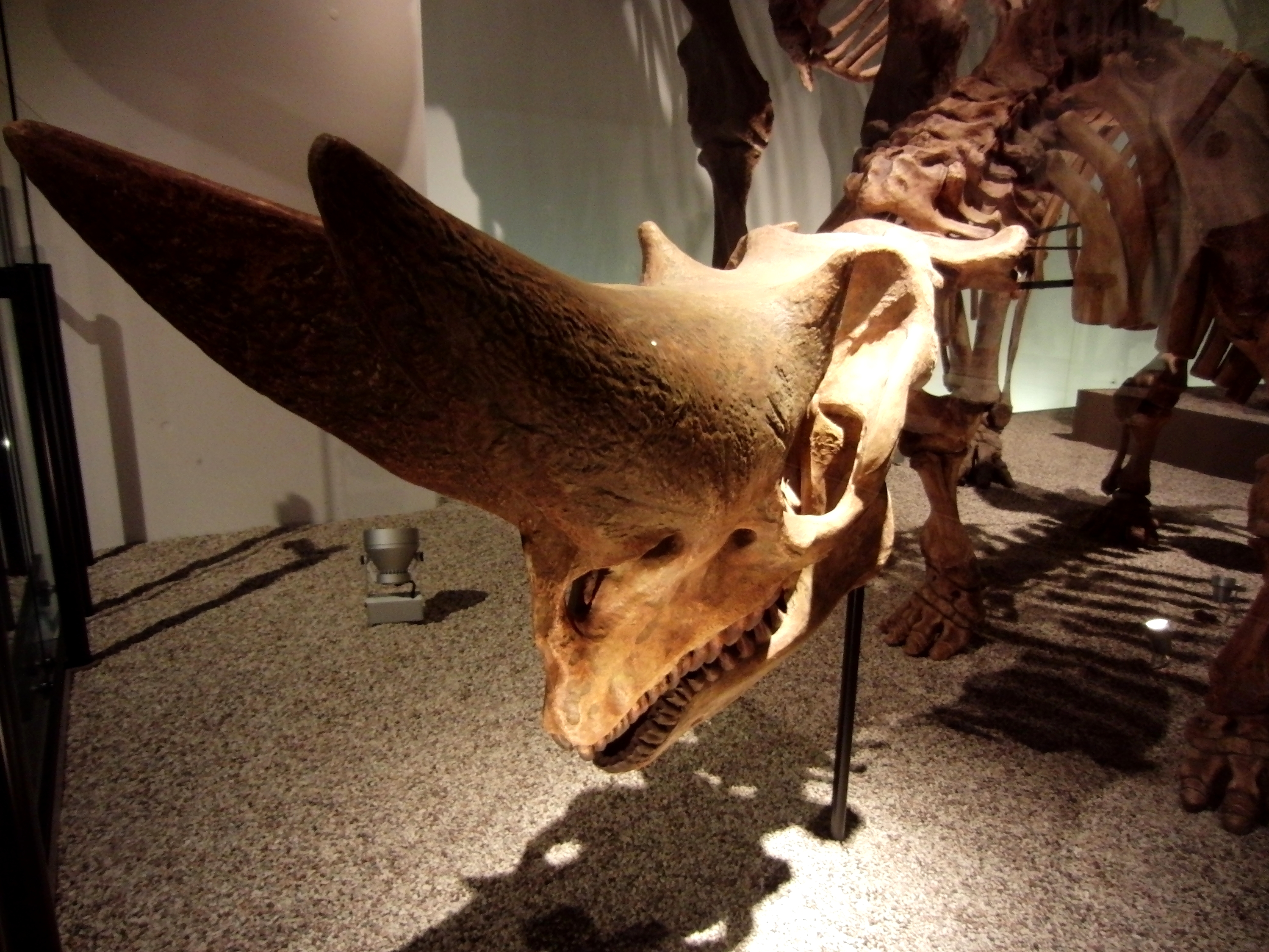
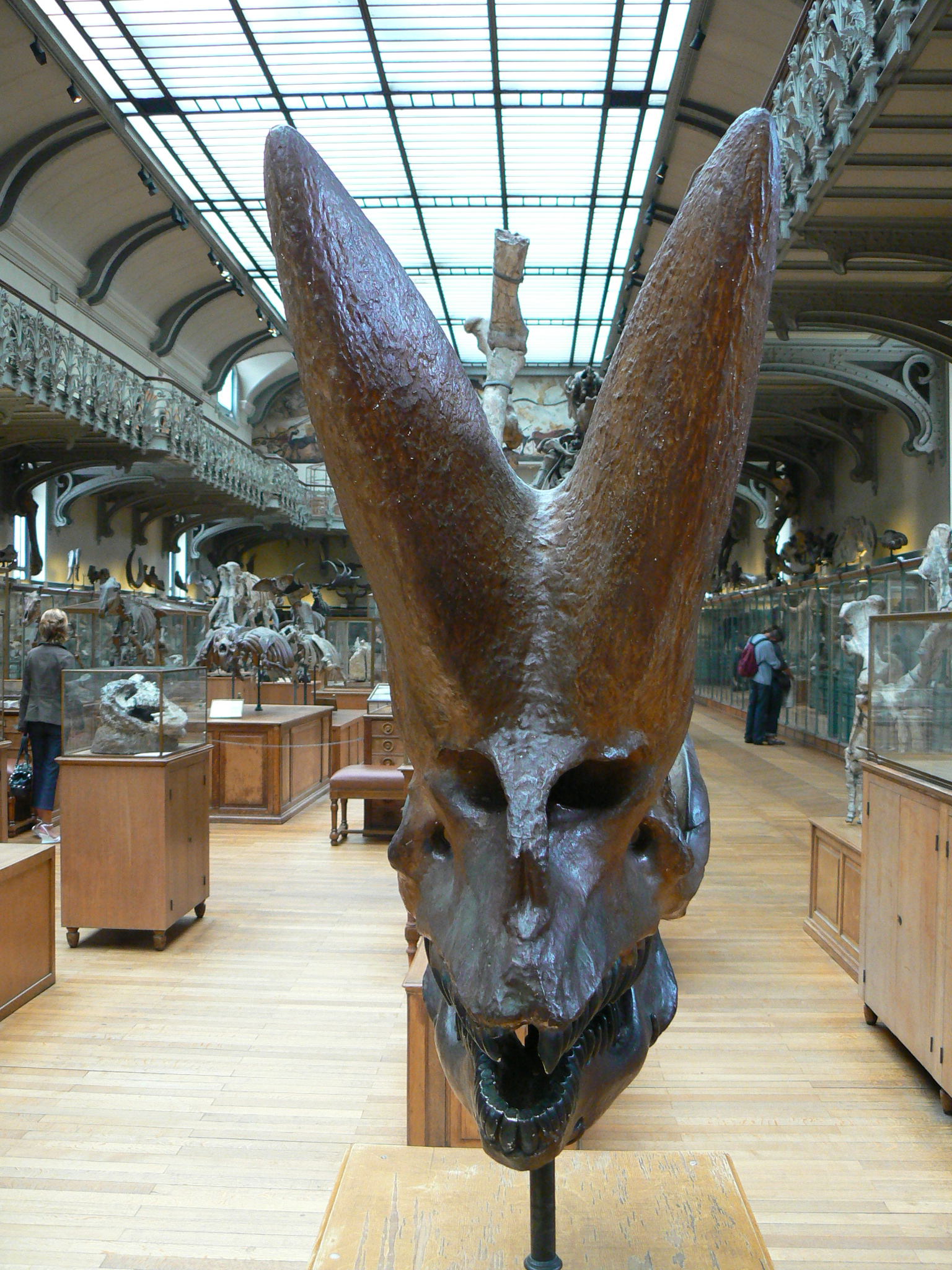
Arsinoitherium's two long nasal horns and its smaller pair above the eyes are, structurally, hollow bony cores that connect internally to the skull's frontal sinus system, an arrangement that would have made them lighter but also more fragile than they look. Their outer surface is covered in fine vascular grooves, the kind of texture that in living mammals marks tissue with a rich blood supply pressed against it in life, and Andrews read that pattern in 1906 as evidence for a keratin sheath, the same kind of tough covering that wraps a bull's or antelope's horn. Palaeoartist Mark Witton revisited the question in detail in a 2017 blog post comparing Arsinoitherium's horn surface texture, growth pattern, and internal structure against the three main modern analogues, keratin-sheathed bovid horns, skin-covered giraffe ossicones, and shed deer antlers, and concluded the sheathed-horn model fits best, though he noted the idea isn't new (it goes back to Andrews) and isn't universally accepted: Donald Prothero and Robert Schoch argued in 2002 for ordinary skin instead, and Kenneth Rose made a similar case in 2006.
One detail from Witton's research is easy to miss in museum displays: PV M 8463, the specimen Andrews illustrated and the single most reproduced Arsinoitherium skull in the literature, is not fully complete. Andrews marked the transition with dotted lines in his 1906 plate, and everything past those lines, most of the horn tips, is a later reconstruction, not fossil. Most of the mounted skulls and museum casts visitors see today trace their proportions back to that one partly restored specimen, which means the exact final length and curvature of a complete, undamaged Arsinoitherium horn is still something of an open question.

Built like a tank, but it wasn't wading like a hippo
Arsinoitherium's limbs are graviportal, meaning built as thick, weight-bearing pillars the way an elephant's are, not built for speed or agility. That heavy build, combined with fossil sites that preserve coastal swamp and mangrove-margin environments, led some researchers, notably Nancy Court in a 1993 study, to argue Arsinoitherium lived a semi-aquatic, hippo-like existence, wading through shallow water much of the day. The idea held for years, but a 2008 study in Palaios by Mark Clementz, Patricia Holroyd, and Paul Koch tested it directly with stable isotope analysis, a method that reads the chemical signature aquatic habits leave behind in tooth enamel, and found Arsinoitherium's signature matching fully terrestrial browsers rather than semi-aquatic animals like hippos. Supporting evidence followed: tooth-wear patterns, bone chemistry, and the animal's presence at sites well away from any coastline all point the same direction, and by 2010 a review chapter by William Sanders, Denise Rasmussen, and John Kappelman treated terrestrial habits as the better-supported reading of the evidence.
A separate line of research adds an unexpected behavioral detail. A 2013 study of the inner ear in Geobios, led by Julien Benoit, examined the cochlear structure of Arsinoitherium under CT scan and found it lacked a secondary bony lamina, a feature tied to sensitivity for very low-frequency sound in living elephants. That points to Arsinoitherium communicating, at least in part, through infrasound, frequencies too low for a human ear to register, the same channel elephants use today to coordinate across long distances. Pinning an actual number of years on either species still comes down to radiometric dating, the method underneath index fossil zones elsewhere in the rock record, since fossils alone only establish which layers are older or younger relative to each other.
A 2020 case for horn-locked wrestling matches
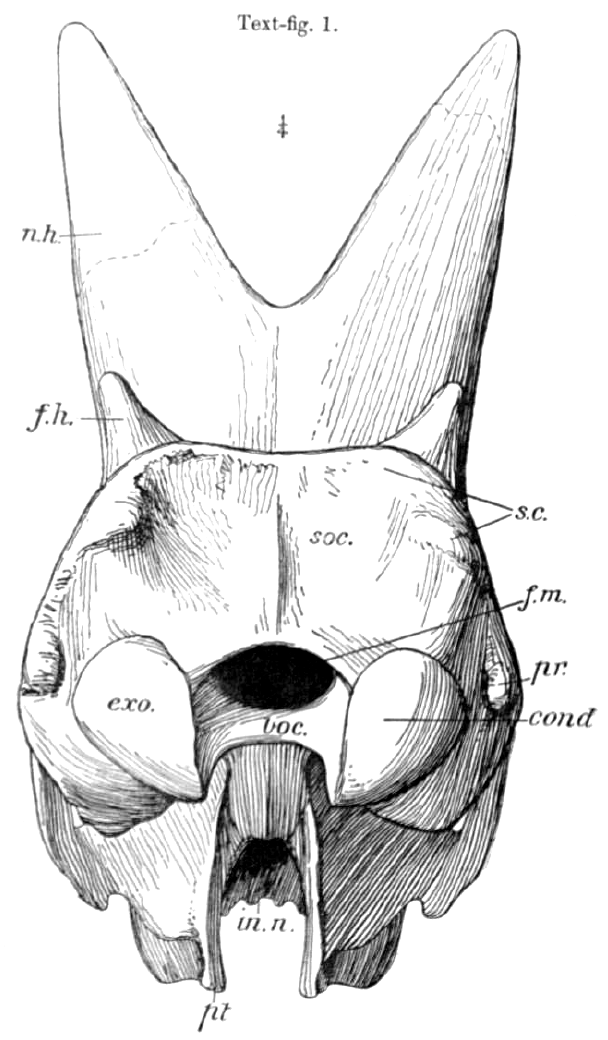
What the horns were actually used for went mostly undiscussed until Mark Witton returned to the animal in a February 2020 post, this time working from the back of the skull, not the horns themselves. Reconstructing the likely arrangement of neck and jaw muscles around the occiput, the bony structure at the rear of the skull where it meets the spine, Witton found an unusual concentration of muscle-attachment area positioned to swing the head sharply upward relative to the neck, more forcefully than a typical mammal skull is built to manage. He also noted that this elaborated occiput anatomy shows up mainly in the largest skulls, plausibly males, and not in smaller individuals.
Putting the head anatomy together with the horns, Witton proposed that adult Arsinoitherium may have engaged in horn-locked pushing contests over territory or mates, an idea he only half-jokingly labeled the "ArSUMOitherium hypothesis." The forward-tilted horns look, in his description, like they could interlock the way antelope horns do during a shoving match, and the powerful upward head-swing would let one animal jab, parry, or attempt to unbalance another at close range. He pointed to a second supporting detail from Court's 1993 study: the retractor muscles in Arsinoitherium's limbs, originally proposed as evidence for swimming, would work just as well for bracing against the ground and driving the body forward during a terrestrial wrestling match, whatever their original evolutionary purpose actually was.
One species or three? Sorting out the size range
For most of the twentieth century, Arsinoitherium meant one species: A. zitteli, known almost entirely from the Faiyum Depression in Egypt and dated to roughly 36 to 30 million years ago. That changed in 2004, when William Sanders, John Kappelman, and D. Tab Rasmussen described new fossils from Chilga, in the Ethiopian highlands, dated to about 28 to 27 million years ago, younger and geographically distant from anything previously known. The measured teeth exceeded those of A. zitteli, supporting the authors' diagnosis of A. giganteum, the largest and geologically youngest arsinoithere on record.
That same 2004 paper, along with a 2010 follow-up review by Sanders, Rasmussen, and Kappelman, also cleaned up an older mess: larger Faiyum specimens had been assigned to A. andrewsi. The 2004 authors argued that the measured variation could fit a single, sexually dimorphic A. zitteli population, the kind of taxonomic overcorrection and later walk-back seen in more than one famous fossil, the short-faced bear among them. Later fieldwork also broadened the map considerably: fragmentary Arsinoitherium remains, mostly teeth, have turned up in Libya, Tunisia, Angola, Oman, Saudi Arabia, and Kenya, and more distant embrithopod relatives, Palaeoamasia and Hypsamasia among them, are known from Turkey, with Crivadiatherium recorded in Romania. Egypt's Faiyum fossils remain the most complete skeletons, but Arsinoitherium and its relatives were never confined to one river valley.