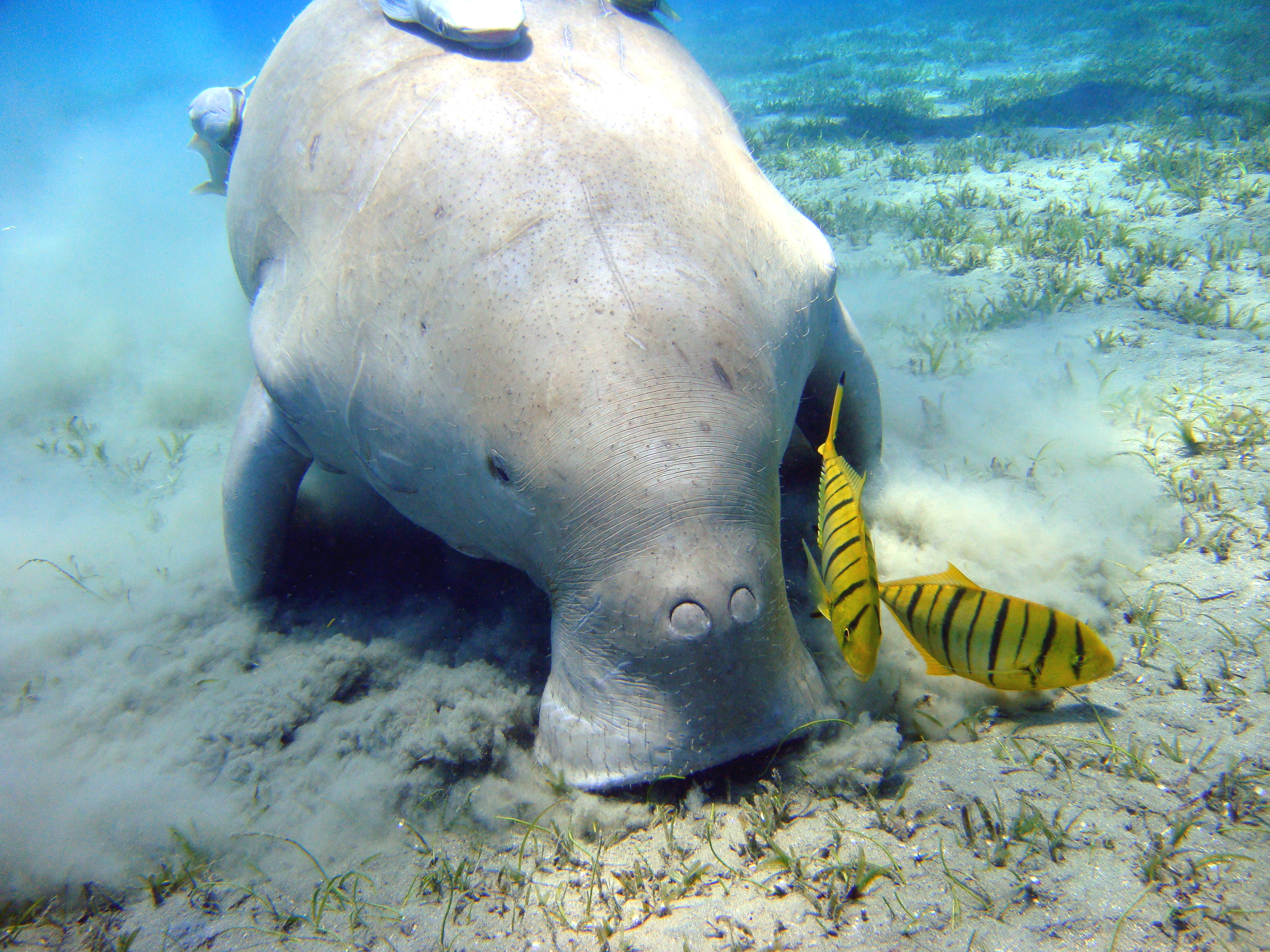

One dugong family, three manatee species
Dugongs and manatees both belong to the mammalian order Sirenia, herbivores that evolved from four-legged land ancestors roughly 60 million years ago and never went back to shore. But within that order they split into two separate families early on. The dugong (Dugong dugon) is the sole surviving member of Dugongidae, found today in warm coastal waters from East Africa and the Red Sea across South and Southeast Asia to northern Australia, with its largest and most stable population in Australian waters. Manatees form a different family, Trichechidae, with three living species: the West Indian manatee (Trichechus manatus), found in the southeastern United States, the Caribbean, and along the Atlantic coast of Central and South America; the West African manatee (Trichechus senegalensis); and the Amazonian manatee (Trichechus inunguis), confined to the freshwater Amazon basin.
Dugongidae once had a second member: Steller's sea cow (Hydrodamalis gigas), a roughly 30-foot, slow-moving giant that fed on kelp around the Commander Islands in the Bering Sea. Naturalist Georg Wilhelm Steller described it to European science in 1741 after his ship, part of Vitus Bering's Great Northern Expedition, wrecked nearby; fur traders and sealers who followed Bering's route soon began hunting the animal for meat, fat, and hide, and by some estimates only around 2,000 individuals existed at the time of that first contact. The species could barely submerge and had almost no ability to flee a harpoon. It was extinct by 1768, twenty-seven years after Steller's description reached Europe, making it one of the fastest human-driven extinctions of a large marine mammal on record.
The tail is the fast tell; the teeth are the real story
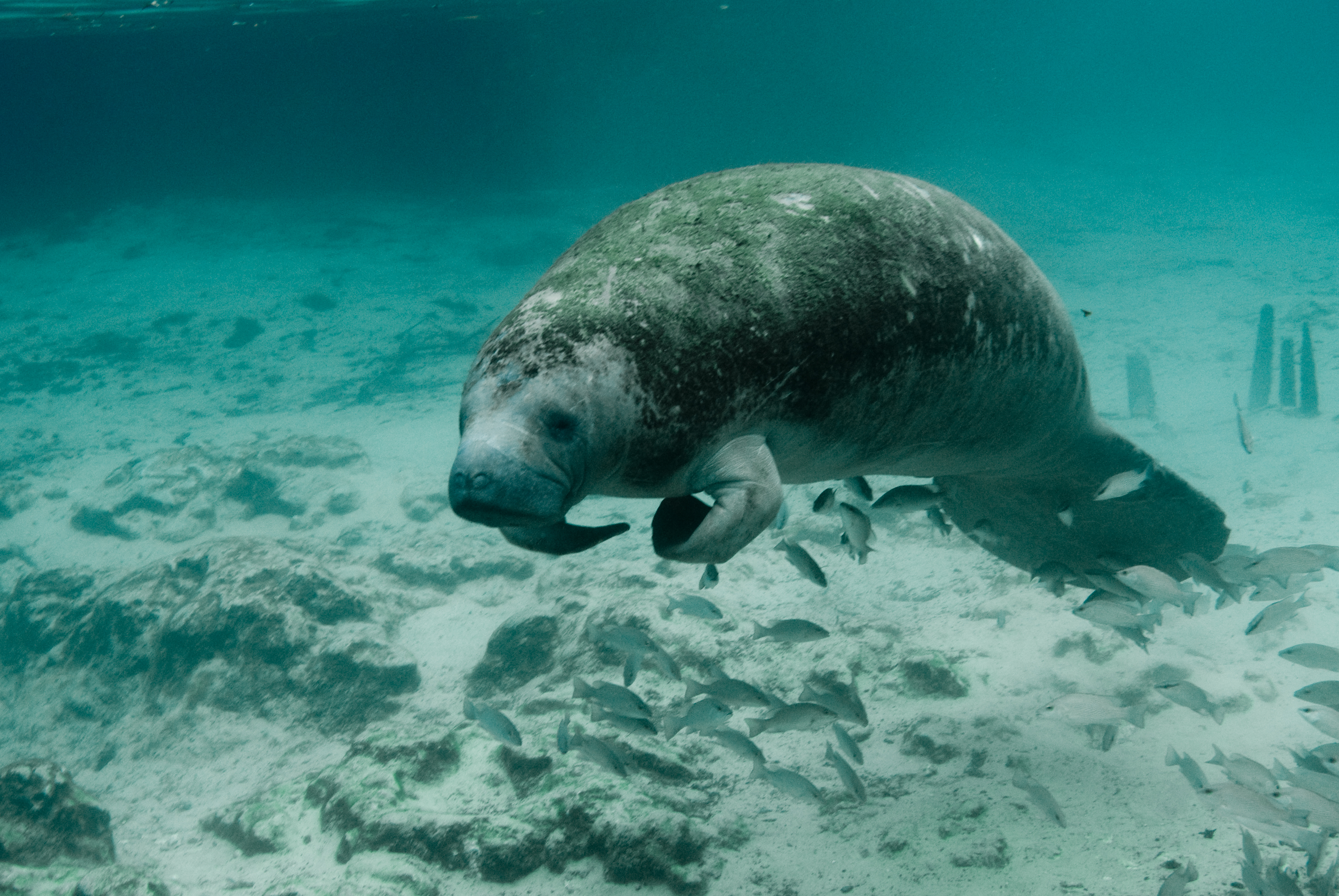
Side by side, the quickest way to identify either animal is the tail. Dugongs have a fluked, notched tail with two lobes that spreads like a whale's or dolphin's, an adaptation for the more open, energetic swimming their exclusively marine habitat demands. Manatees have a single, round, paddle-shaped tail, closer in silhouette to a beaver's than to a cetacean's. The snout tells a similar story: a dugong's face is short, broad, and turns sharply downward, built for grazing seagrass rhizomes on the seafloor, while a manatee's upper lip is more flexible and whisker-covered, used almost like a pair of hands to grasp and pull in floating and submerged vegetation.
The more telling difference is inside the mouth. A 2012 study in The Anatomical Record by paleontologist Brian Beatty documented that manatee molars are replaced through continuous, horizontal "conveyor-belt" tooth replacement: new molars form at the back of each jaw quadrant, gradually shift forward as older ones wear down from a lifetime of grinding abrasive, grit-covered plants, and are eventually resorbed at the roots and shed at the front. A manatee can cycle through 30 or more sets of molars this way over its life. The only other living mammal with a comparable system is the elephant, whose molars also erupt at the back of the jaw and migrate forward, though an elephant gets only six sets in total, typically finishing its last around age 30 and often dying once that set wears out decades later, since it has no seventh set to replace it.
Dugongs took a different route entirely, one that never involved a conveyor belt of any kind. A 2012 study in the journal Reproduction, led by Elizabeth Burgess with Janet Lanyon and Tamara Keeley, tracked fecal testosterone levels in 322 free-ranging dugongs in Moreton Bay, Australia, and found that male dugongs grow a pair of tusk-like incisors that erupt at puberty, roughly when body length reaches 240 to 260 centimeters, coinciding with a fourfold rise in testosterone. Erupted tusks also appear in females, but the study noted this happens only rarely and typically past age 40. It's a different tooth than the one behind a walrus's ivory, which grows from enlarged upper canines present in both sexes rather than incisors confined almost entirely to males, and the dugong's is tied to a specific hormonal trigger rather than growing steadily from birth.

Salt water only, versus a life that crosses both
Dugongs never leave salt water at all; per marine biology field surveys of the species, they spend their entire lives in shallow, sheltered coastal habitats, bays, mangrove-fringed shorelines, and seagrass meadows, rarely venturing far from the coastline where their food grows. Manatees are more varied because the three species aren't equally tied to the ocean. The West Indian and West African manatees move freely between salt water and fresh water, using coastal mangroves and coral-adjacent shallows as well as rivers, lakes, and inland lagoons; Florida manatees, for instance, regularly travel up rivers and congregate in freshwater springs during cold winters. The Amazonian manatee is the outlier: it lives exclusively in fresh water, confined to the Amazon River basin, and never enters brackish or salt water at all, a physiological as well as behavioral divide from its two saltwater-tolerant relatives.
Feeding trails a drone can map from above
Dugong feeding leaves a visible signature. When seagrass grows in soft sediment and belongs to smaller-bodied species, dugongs often feed in excavation mode, digging out both the leaves and the nutrient-rich rhizomes below the sediment surface rather than just cropping the exposed shoots. Each excavation pass can leave a long, winding furrow, typically 10 to 25 centimeters wide, several meters long, and up to 6 centimeters deep, known in the research literature as a dugong feeding trail. These trails are distinctive enough that a 2021 study published in PeerJ used aerial drone surveys to map and analyze them across seagrass meadows, and a separate study in PLOS ONE, applying deep neural networks to UAV imagery, showed the trails could be automatically extracted from overhead photographs at scale.
The trade-off behind that digging behavior is a real predator-avoidance calculation. Excavating rhizomes yields more energy per bite, but it means a dugong's head is down and its view of open water is blocked, leaving it less able to spot an approaching shark, one of the species' few natural predators. Cropping just the exposed shoots is less nutritionally efficient but lets the animal keep scanning its surroundings, and researchers studying feeding-trail patterns have found dugongs shift between the two modes depending on how dense the surrounding seagrass cover is. Manatees don't leave comparable excavation trails; their more flexible, muscular lips let them strip and gather floating and submerged vegetation, including invasive water hyacinth in some ranges, without needing to dig into the substrate the way a dugong does for buried rhizomes.
Vulnerable, downlisted, and one branch already gone
The IUCN lists the dugong as Vulnerable, with populations decreasing across most of its range; the assessment describes dugongs as relatively secure in Australian and Persian Gulf waters but critically endangered or already extinct in parts of East Africa, East Asia, and several island territories. The main pressures are entanglement in gillnets used for fishing, seagrass habitat loss, and, in some regions, continued hunting. The U.S. Fish and Wildlife Service reclassified the West Indian manatee from endangered to threatened under the Endangered Species Act in April 2017, citing an improving population trend, though a proposed rule published in January 2025 would split that single listing in two, keeping the Florida manatee at threatened status while uplisting the Antillean manatee, which ranges across the wider Caribbean and shows a less favorable trend, back to endangered.
Both animals share the same underlying vulnerability that made Steller's sea cow such an easy target two and a half centuries ago: they're slow-reproducing, long-lived, and easy to approach in shallow water, a combination the IUCN's own dugong assessment names directly as the reason the species struggles to recover from any spike in human-caused mortality. The contrast is the California sea lion's more visible recovery story, with a U.S. stock that grew at up to 7 percent a year between 1975 and 2014, while sirenians reproduce far more slowly and have far less room for error.