

A tooth that grows through the lip, not a horn
Narwhals (Monodon monoceros) are small Arctic toothed whales that spend their entire lives in and around sea ice, primarily off Greenland and the eastern Canadian Arctic. Per NOAA Fisheries, adult females reach up to 13.8 feet and 2,204 pounds, and adult males up to 15.7 feet and 3,527 pounds. But despite the "toothed whale" classification, a narwhal's mouth has no other erupted teeth to speak of. Teeth get reinvented just as strangely elsewhere in the marine mammal world: manatees replace teeth like elephants do, on a continuous conveyor-belt system that their closest look-alike, the dugong, never evolved at all.
What it has instead is a single long canine that, in males, breaks through the upper left lip and grows in a counterclockwise spiral for the rest of the animal's life, reaching up to 9.8 feet and weighing more than 20 pounds, according to NOAA. Tusk growth isn't as tidy a rule as popular summaries suggest: a 2022 study sampling 173 narwhals from Greenland's Inuit hunt, published in Polar Research, found 2.8% of males had no tusk at all, 0.9% of males grew a rare second tusk, and 1.5% of females grew one too, including one sexually mature, 18-times-pregnant female whose tusk measured up to 151 cm. The tusk's length also scales disproportionately with the animal's overall body size, a pattern biologists recognize as a classic signature of a sexually selected trait, the same category antlers and peacock tails fall into.
How researchers proved it senses the ocean
For most of the tusk's scientific history, its function was unresolved: proposed uses ranged from a jousting weapon to an ice pick to a sound-focusing organ, none of them well supported. Dental researcher Martin Nweeia led a roughly decade-long, multidisciplinary study (combining dentistry, marine biology, and collaboration with Inuit hunters who had their own long-standing observations of the animals) that reframed the question entirely: instead of asking what the tusk does to things outside the narwhal, it asked what it tells the narwhal.
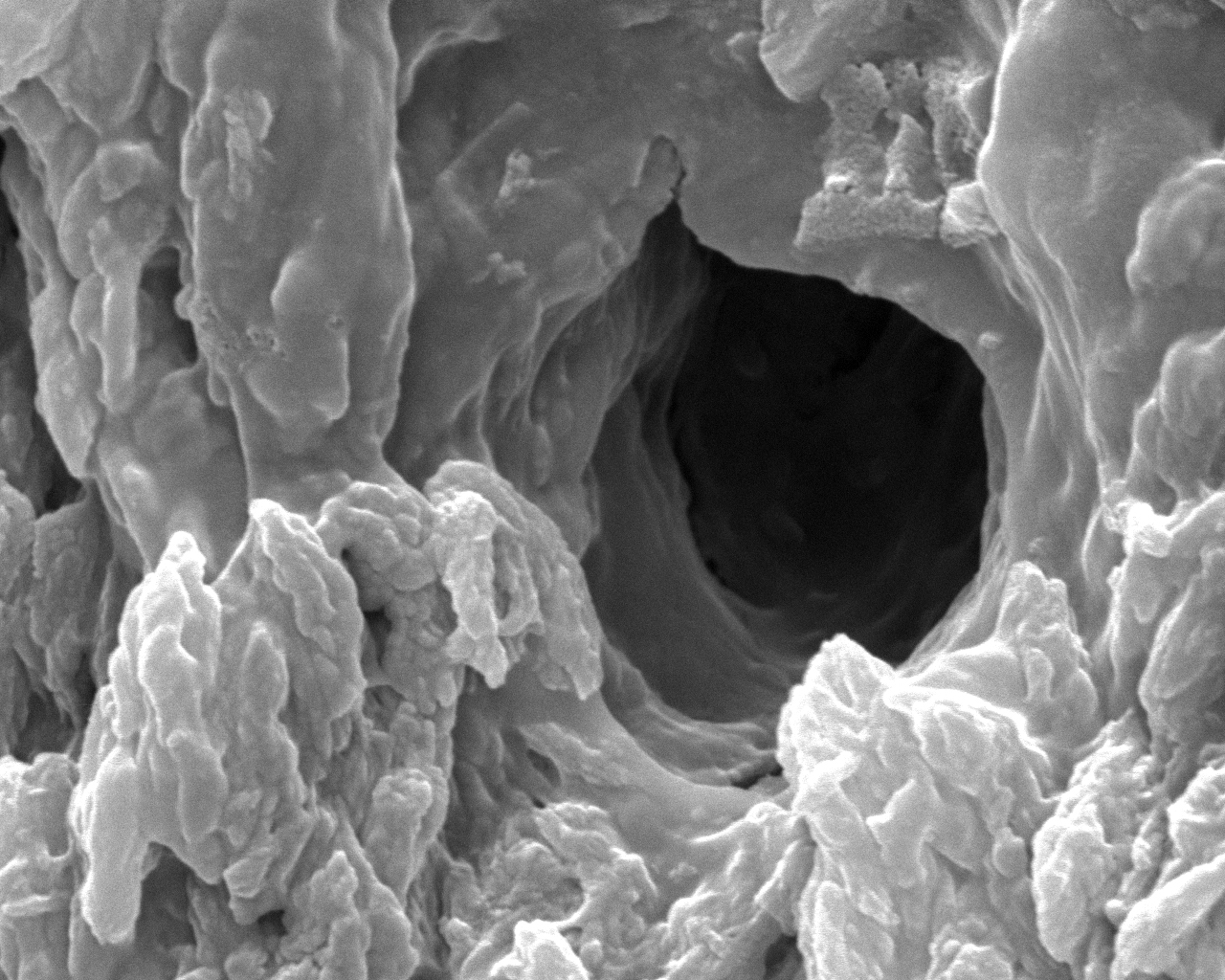
The anatomy backs that up. Unlike a normal tooth, the tusk's outer cementum layer has no enamel, leaving it porous enough for seawater to reach a dense network of dentinal tubules that run into the tusk's pulp (science coverage of the study has since described the resulting nerve network as roughly 10 million endings), with signals carried to the brain via the maxillary branch of the trigeminal (fifth cranial) nerve. Nweeia's team went a step further than anatomy and tested function directly: using a clear plastic "tusk jacket" fitted over the tusk of a temporarily restrained live narwhal, they alternated exposing it to high-salinity and fresh water and recorded significant changes in the animal's heart rate in response. That's physiological proof the tusk actively reads the surrounding water, not just decorates the animal. Human skin solves a comparable sensing problem with entirely different hardware: fingertips pack thousands of Meissner's corpuscles, touch receptors tuned to read texture through direct skin contact, a mechanical trick that has nothing to do with the tusk's open channels for tasting salinity. Wolf spiders offer another case where appearance and medical risk should be kept separate: the prospective bite record found no necrosis. That does not establish why earlier accounts assigned a weapon function to the narwhal tusk.

It also stuns fish: caught on drone camera in 2017
Sensing salinity isn't the only documented job the tusk does. In 2017, researchers from Fisheries and Oceans Canada, working with the University of Windsor, WWF Canada, Vancouver Aquarium, and the Inuit community of Pond Inlet, flew drones over narwhals' summering grounds in Tremblay Sound, Nunavut, and captured the first video evidence of narwhals using their tusks to hunt: quick, precise strikes that stunned Arctic cod before the whales circled back to eat them.
The behavior itself wasn't news to everyone. Inuit traditional knowledge had described narwhals using their tusks this way for generations, but it had never been captured on camera or entered the formal scientific record before that footage. Researchers are careful to frame it as a secondary function layered on top of the tusk's primary role: given how disproportionately tusk length scales with body size, and that only males normally grow one, sexual selection remains the leading explanation for why the tusk exists at all. Stunning cod looks like an opportunistic use of a structure that evolved for an entirely different reason, not the reason it evolved.
Centuries as a fake unicorn horn
The tusk was already famous for centuries before anyone understood what it actually did, just for the wrong reasons. In medieval and Renaissance Europe, unicorns were widely believed to be real animals, and their horns were credited with the power to detect and neutralize poison, a belief specific enough that nobles had drinking vessels made from or lined with the material, expecting them to "sweat" or bubble in the presence of poison. Norse and other Arctic traders supplied that market for centuries by selling narwhal tusks as unicorn horns, commanding prices far beyond what any ordinary animal product could fetch, without ever revealing where the "horns" actually came from.
Queen Elizabeth I's court collected more than one of these fakes. In 1577, English explorer Martin Frobisher returned from an Arctic expedition with a long, spiraled tusk recovered from a dead "sea-unicorn" on the Canadian coast (he recorded the find in his own account of the voyage) and presented it to the queen, who had it kept with the crown jewels; it eventually became known by the name it still carries, the Horn of Windsor. Around the same period, a separate jewel-encrusted narwhal tusk reached Elizabeth's court as a gift tied to explorer Humphrey Gilbert, valued at roughly £10,000, a sum that, at the time, could have bought and staffed a small castle. Secondary accounts of this era disagree on exactly which tusk carried that price tag, but they agree on the scale of it: fearing assassination by poison from rivals including Mary, Queen of Scots, Elizabethan nobility paid castle-sized sums for what they believed was a magical antidote and was actually a whale's tooth. A chain-email photograph also amplified exaggerated claims about camel spiders, but those stories had older roots and received a museum rebuttal in 2004.
A narwhal's heart nearly stops when it's afraid
The tusk isn't the only counterintuitive finding in narwhal physiology. In a 2017 study published in Science, researchers Terrie Williams (UC Santa Cruz) and Mads Peter Heide-Jørgensen (Greenland Institute of Natural Resources) tagged wild narwhals in Scoresby Sound, on Greenland's east coast, with sensors tracking heart rate and swimming effort after the animals were released from entanglement in fishing nets. During the hard-swimming escape dives that followed, heart rates crashed to just 3 to 4 beats per minute, far below the 10 to 20 beats per minute typical of a normal dive, and a fraction of the roughly 60 beats per minute narwhals show resting at the surface.
Williams described it as a "paradoxical escape response": intense muscular exertion paired with a heart rate that "seems to cancel out the exercise response" instead of rising to support it, because, as she put it, escaping animals "are trying to integrate a dive response on top of an exercise response on top of a fear response." The combination is metabolically expensive: escape dives burned through roughly 97% of the whales' oxygen supply, compared with about 52% for a normal dive of similar depth and duration, which raises real concern about repeated human-caused disturbance. Narwhals show unusually high site fidelity to specific summering grounds rather than ranging widely the way some other cetaceans do, and as shrinking Arctic ice opens more of that habitat to shipping and industrial noise, the same kind of vessel disturbance already flagged as a stressor for Iberian orcas becomes harder for narwhals to simply swim away from.
What actually threatens narwhals today
The global conservation picture looks better than the physiology might suggest. The IUCN reclassified narwhals from Near Threatened, where they sat from 2008 to 2017, to Least Concern in 2017, with a global population estimated around 123,000 mature individuals. In the U.S., narwhals are protected under the Marine Mammal Protection Act, and they're listed on CITES Appendix II internationally. But that global label smooths over real regional variation: several discrete stocks, particularly in East Greenland, are still managed as more vulnerable populations given their smaller size and heavier local pressure.
The forward-looking threat is less about hunting than habitat. NOAA lists narwhal prey as deep-water Arctic species (cod, polar cod, turbot, squid, and shrimp) reached via dives to depths of nearly 4,000 feet, and the sea ice narwhals depend on for shelter from predators like orcas doubles as a barrier that has historically kept large-scale shipping and industrial traffic out of their range. As that ice retreats, the barrier goes with it, which is why most current conservation attention centers on vessel traffic and underwater noise, not direct hunting pressure.