_05.jpg)
An apex predator built backwards from what people expect
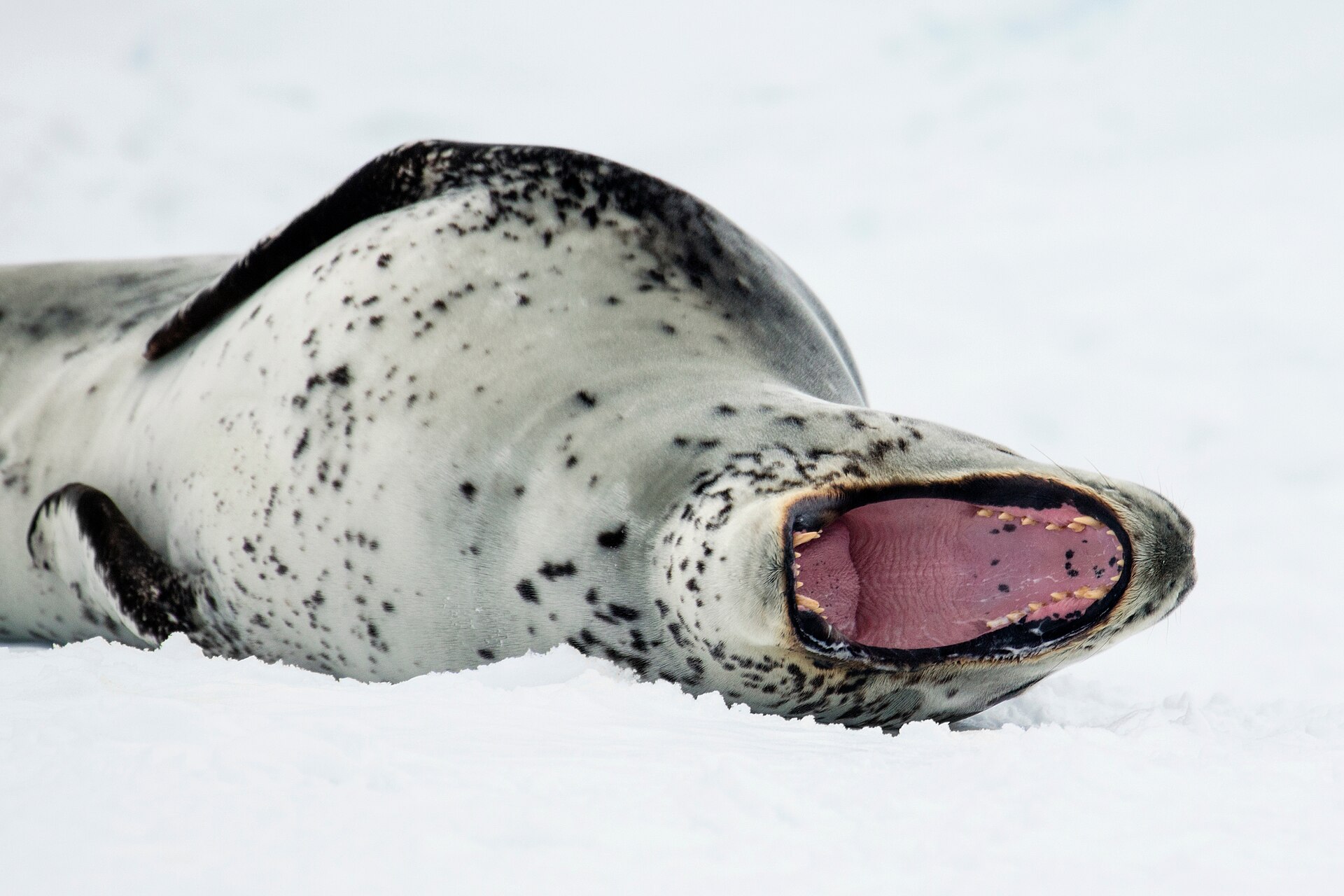
The leopard seal (Hydrurga leptonyx) takes its name from a coat of scattered grey-black blotches over pale fur, more freckled than a true leopard's rosettes but a close enough resemblance that the name stuck. It's the second-largest seal species in Antarctica after the southern elephant seal, and like most "true seals" in the family Phocidae, it runs on reversed sexual dimorphism: females are the bigger sex. Per National Geographic's species profile, males typically run about 2.8 meters and 320 kilograms, while females average larger, around 3.0 meters and 370 kilograms, with the biggest females on record exceeding 3.5 meters and 500 kilograms. As a phocid, or "true seal," it also has no external ear flaps and hind flippers that can't rotate forward, so on land it can only hitch along on its belly, unlike an eared seal such as a sea lion, which can prop itself up and walk on all four limbs. Telling similar-looking marine mammals apart by body plan isn't unique to seals, either: a fluked tail is the fastest way to separate a dugong from a manatee at a glance, the same kind of single visible cue that splits an eared sea lion from a true seal like this one.
What makes the skull unusual is that it's built for two different feeding strategies at once. The long front canines, up to roughly 2.5 centimeters, are for gripping and holding prey as large as a penguin or a seal pup. Just behind them sit the postcanine molars, which are trident-shaped and interlock into a fine sieve with gaps only a few millimeters wide. To feed on krill, the seal draws in a mouthful of water, then forces the water back out through that sieve while the krill stays trapped inside, functionally the same trick a baleen whale uses, just built out of teeth instead of baleen plates rather than out of an entirely different anatomy. No other seal in the Antarctic hunts at both ends of that size range with the same mouth.
The only seal that hunts other seals, and how it actually kills a penguin
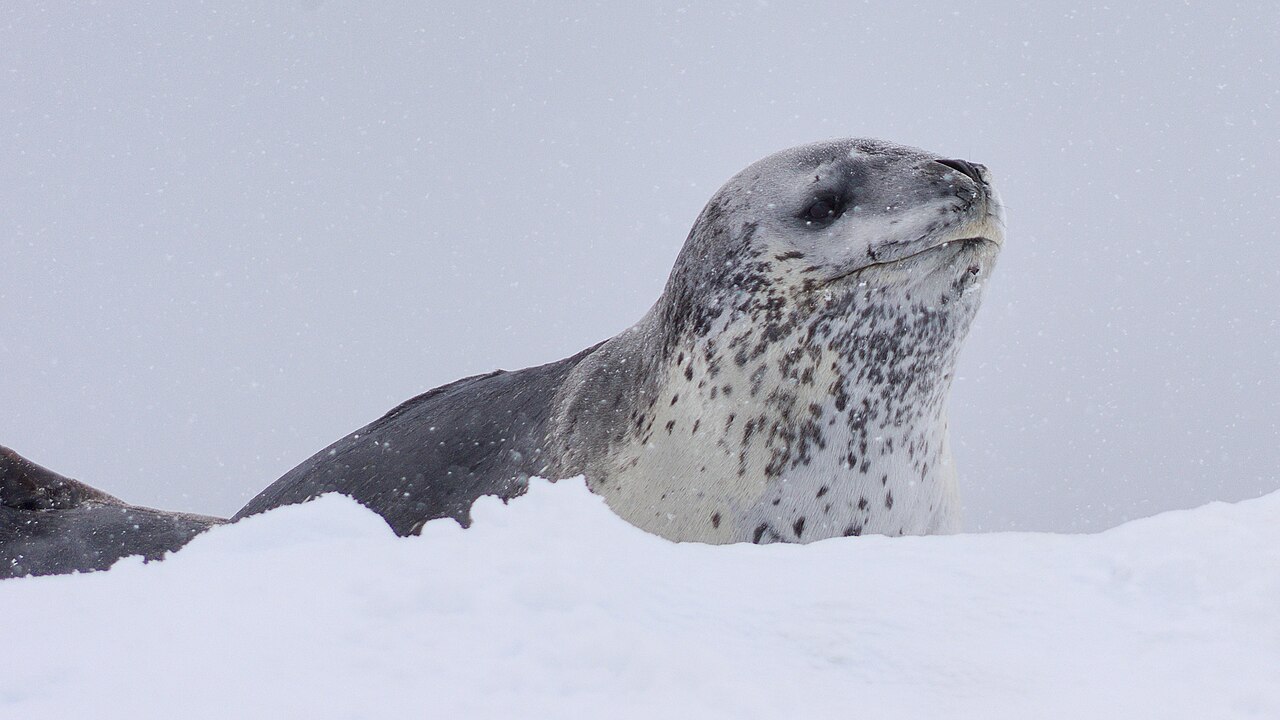
Per the Australian Antarctic Program, leopard seals are the only seal species known to actively prey on both penguins and the pups of other seal species, a hunting role most comparable to what orcas fill elsewhere in the Southern Ocean food web. They hunt by waiting submerged near the ice edge where penguins enter the water, or by patrolling close to shore where seal pups are learning to swim, and in open water they're capable of roughly 40 kilometers per hour (25 mph), fast enough to run down a fleeing penguin.
Killing a penguin isn't quick. Once a leopard seal has hold of one, it thrashes the bird violently against the surface of the water in what researchers at LeopardSeals.org describe as a degloving technique: the repeated impacts strip feathers and skin away from the carcass before the seal eats the meat underneath. The same violent surface-thrashing shows up in accounts of the species processing other large prey, including seal pups, and it's the reason wildlife documentaries built around Antarctic Peninsula penguin colonies tend to linger on leopard seals patrolling just offshore during fledging season, when young penguins are entering the water for the first time.
The one confirmed human death, and how it happened
On 22 July 2003, British Antarctic Survey marine biologist Kirsty Brown, 28, was snorkeling at her survey site in the bay next to Rothera Research Station on the Antarctic Peninsula when a leopard seal attacked without warning. According to BAS's own account of the incident, the seal held her underwater for around six minutes at depths reaching 70 meters, and she suffered 45 separate lacerations. A two-person shore-cover team saw the attack and launched a rescue boat; colleagues pulled her from the water and began resuscitation on the way back to the station, where the station doctor and her colleagues carried out CPR for a full hour. She could not be revived. Brown was an experienced diver with BSAC dive-leader qualifications and a commercial HSE Part IV professional diving certificate, with prior diving experience off Greenland, Australia, and in UK waters. She remains, per BAS, the first and only confirmed human death caused by a leopard seal.
That singularity matters for context. Thousands of visitors travel through the Antarctic Peninsula on expedition cruises and zodiac excursions each season, and leopard seal sightings, including close ones, are a routine part of many of those trips. Brown's death happened to a trained researcher working at very close range underwater, doing the kind of survey diving that puts a person directly into the water where this predator actually hunts, not to a tourist observing from a boat or the shore.
Three years later, a different one tried to feed a diver
In 2006, National Geographic photographer Paul Nicklen was on assignment on the Antarctic Peninsula, free-diving to photograph leopard seals, an animal he expected to be dangerous based on their reputation. Instead, in his own account published by National Geographic, a large female leopard seal spent roughly four days approaching him in the water, bringing him penguins, first live, then progressively weaker ones, then dead ones, and at one point appearing to demonstrate how to catch and eat one, as though he were a fellow predator she judged too incompetent to feed himself. Nicklen has described the encounter as one that has stayed with him ever since.
It's a single, extraordinary case, not a demonstrated pattern of how leopard seals typically treat divers, and the same species killed Kirsty Brown doing essentially the same activity in the same ocean. What the encounter does show, alongside the Rothera attack, is a wide behavioral range in how individual leopard seals react to a human in the water, from lethal to, by Nicklen's account, protective. Both stories get told separately far more often than they get told together, even though they involve the same predator within a few years of each other.
How many are left, and why the count is 25 years old
The IUCN Red List assessment, last updated in 2015, classifies the leopard seal as Least Concern, based on a circumpolar population estimate of more than 35,000 individuals. That figure comes from a survey conducted in 1999-2000, and the assessment itself describes the number as likely a substantial underestimate, with considerable uncertainty around it and no clear evidence of decline. What it does not have is a more recent circumpolar count: as of this writing, no updated survey covering the whole population has been published since.
That gap matters because the habitat itself has measurably changed. Per the Antarctic Environments Portal, sea-ice extent in the western Antarctic Peninsula, the region with the highest concentration of leopard seals, has declined by an estimated 21 to 28 percent, shrinking both a breeding and resting platform and, indirectly, access to the krill that underpins much of the food web the species depends on. Expanding krill fisheries in ice-free periods add further pressure on the same food source. None of that has yet been enough to change the species' official conservation status, but it leaves the leopard seal in the position of a lot of Antarctic wildlife: officially fine, on population data that's now a quarter-century old, in a habitat that keeps changing underneath it. The beluga whale offers a contrasting monitoring example at the opposite pole: its Cook Inlet population had a full survey in 2022 and a follow-up aerial survey in 2025, alongside research on estimating living whales' ages from skin samples.