_diving,_S%C3%A3o_Miguel_Island,_Azores,_Portugal_(PPL1-Corrected).jpg)
The head that measures its own owner
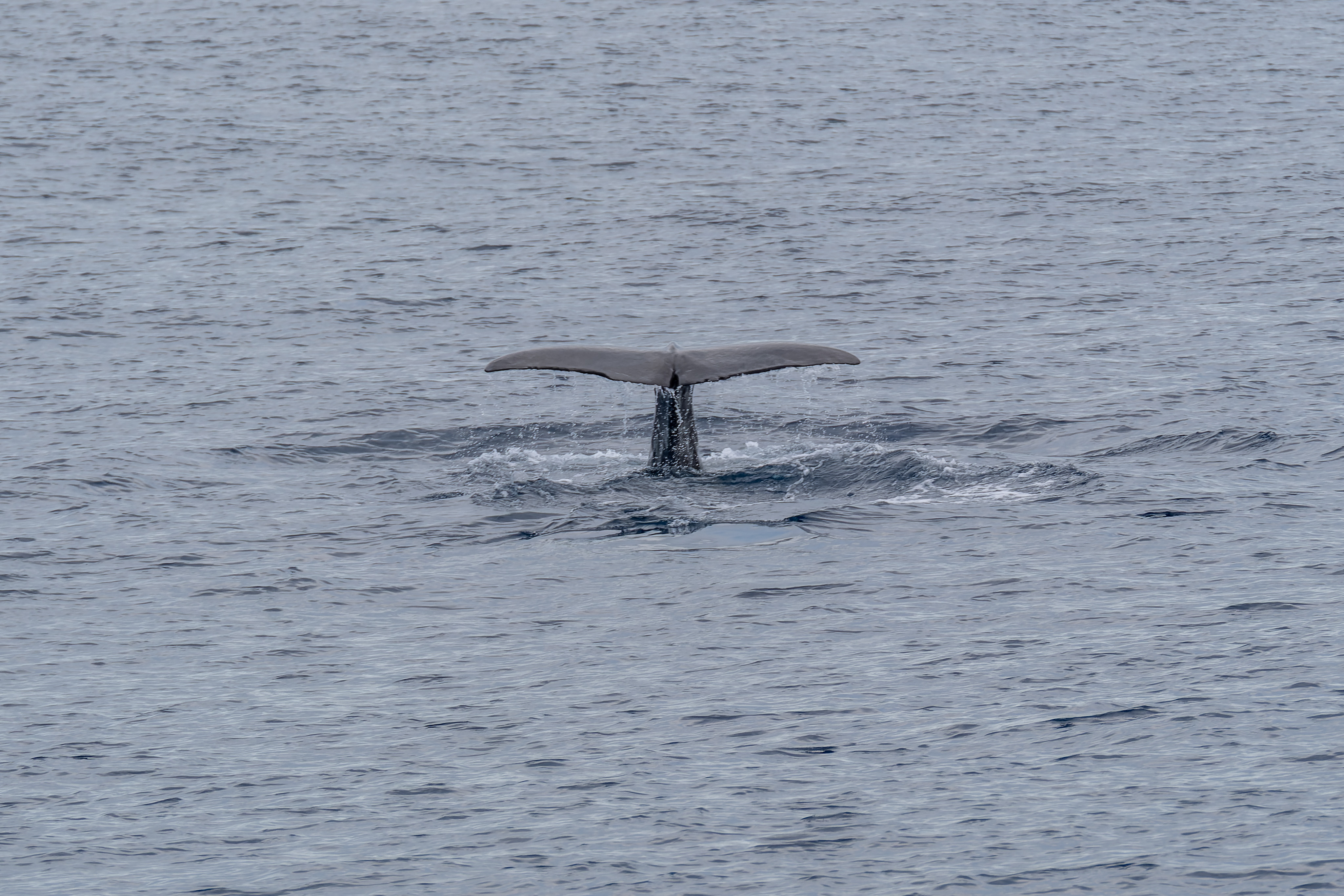
Per NOAA Fisheries, adult female sperm whales weigh up to 15 tons and reach 40 feet, while males run larger, up to 45 tons and 52 feet, with a lifespan of up to 60 years. They're the largest of the toothed whales, and the reason their head alone accounts for roughly a third of that length is a pair of oil-filled compartments called the spermaceti organ and the junk, stacked one on top of the other and taking up most of the skull's volume. Baleen whales are the other group of giants, and the humpback whale vs blue whale guide compares two of them. How much pressure a sperm whale takes on its routine hunting dives is charted in our deep-dive pressure explorer.
That structure isn't just storage. A sperm whale generates its clicks by forcing air past a structure near the front of its head called phonic lips, and the resulting pulse travels backward through the spermaceti organ, reflects off an air sac at the rear of the skull, and travels forward again through the junk before it exits into the water, a round trip that leaves a measurable second pulse trailing the first. NOAA Fisheries scientists surveying the Gulf of America in 2025 used exactly that inter-pulse interval, the gap between the first pulse and its echo, to estimate the size of a whale's head from its clicks alone, then scaled that up to a full body-length estimate, since the head-to-body ratio holds fairly consistently across the species. It's a strange bit of physics: the same clicks a sperm whale uses to find prey in total darkness are also, incidentally, printing its own tape measure into the recording.
236 decibels, and the myth that comes with it
In a 2003 study in the Journal of the Acoustical Society of America, Bertel Møhl and colleagues at Aarhus University recorded on-axis sperm whale clicks with source levels up to 236 decibels referenced to 1 micropascal, a figure NOAA Fisheries now states plainly: sperm whale clicks are the loudest sound made by any animal on Earth. Underwater decibels and the airborne decibels most people picture (a jet engine, a rock concert) are built on different reference pressures and different physical media, so the two numbers aren't directly interchangeable the way a quick mental conversion might suggest, a point the ocean-acoustics research group Discovery of Sound in the Sea spells out in detail.
That raw number has fed a specific, widely repeated claim: that a close-range click could stun or injure a person, an idea traced largely to a single secondhand anecdote about a diver's temporarily paralyzed hand, popularized in science writer James Nestor's public talks and writing. The competing, and better-tested, hypothesis is that the clicks stun prey outright rather than just locating it. A 2016 study in Scientific Reports, using sound-and-movement tags on hunting sperm whales, found the opposite of what that theory predicts: received sound levels at the fish and squid being hunted were more than an order of magnitude below what would be needed to debilitate them, and whales actually reduced their click intervals and estimated source levels during the final "buzz" phase of an attack, the moment they're closest to prey, rather than blasting louder. No confirmed human injury or death from a sperm whale click exists in the record, which puts the species in a different category from, say, the one confirmed leopard-seal fatality on file, a documented case, not an anecdote.
A four-part alphabet found in 8,719 codas
Sperm whales communicate in codas, short rhythmic bursts of three to forty clicks, and for decades researchers had catalogued roughly 150 distinct coda types worldwide, 21 of them specific to the Eastern Caribbean clan that whale biologist Shane Gero has followed off Dominica since 2005 through the Dominica Sperm Whale Project. In May 2024, Gero and a team led by MIT computer scientist Pratyusha Sharma, alongside Roger Payne (the researcher who first showed humpback whales sing), published a study in Nature Communications that broke that catalogue open. Analyzing 8,719 codas recorded from the clan between 2005 and 2018, they identified four combinable building blocks, two context-independent ones they called rhythm and tempo, plus two newly described, conversation-sensitive ones called rubato and ornamentation, that together let whales systematically generate a far larger set of distinguishable codas than anyone had previously catalogued: "nearly an order of magnitude more," in the authors' own phrasing.
That doesn't mean the codas have been translated, or that sperm whales possess grammar in the way linguists define it for human language; the paper's own framing is narrower and more careful, that the system shows contextual and combinatorial structure previously undescribed in a non-human communication system, which is itself a meaningful finding. A related structural echo shows up much closer to home in Arctic waters: the beluga's forehead "melon" reshapes as the animal vocalizes to focus its own calls, a different organ solving a version of the same sound-shaping problem a sperm whale's spermaceti organ solves in the deep ocean.
The four-feature framework has since gained a layer researchers hadn't spotted in 2024. A November 2025 study in Open Mind, led by UC Berkeley linguist Gašper Beguš using the same Dominica recordings, described two discrete spectral shapes nested inside individual clicks that the team nicknamed "a-coda" and "i-coda" vowels, along with diphthong-like formant shifts, rising, falling, or both, within a single click. A follow-up in the April 2026 issue of Proceedings of the Royal Society B tied those vowel-like qualities back to the older rhythm-and-tempo coda types and reported edge-click coarticulation: clicks at the start or end of one coda sometimes bend toward the sound of the coda next to it, a pattern the authors liken to how adjacent sounds blend into each other in human speech.
The 1820 sinking that got its own biomechanics study
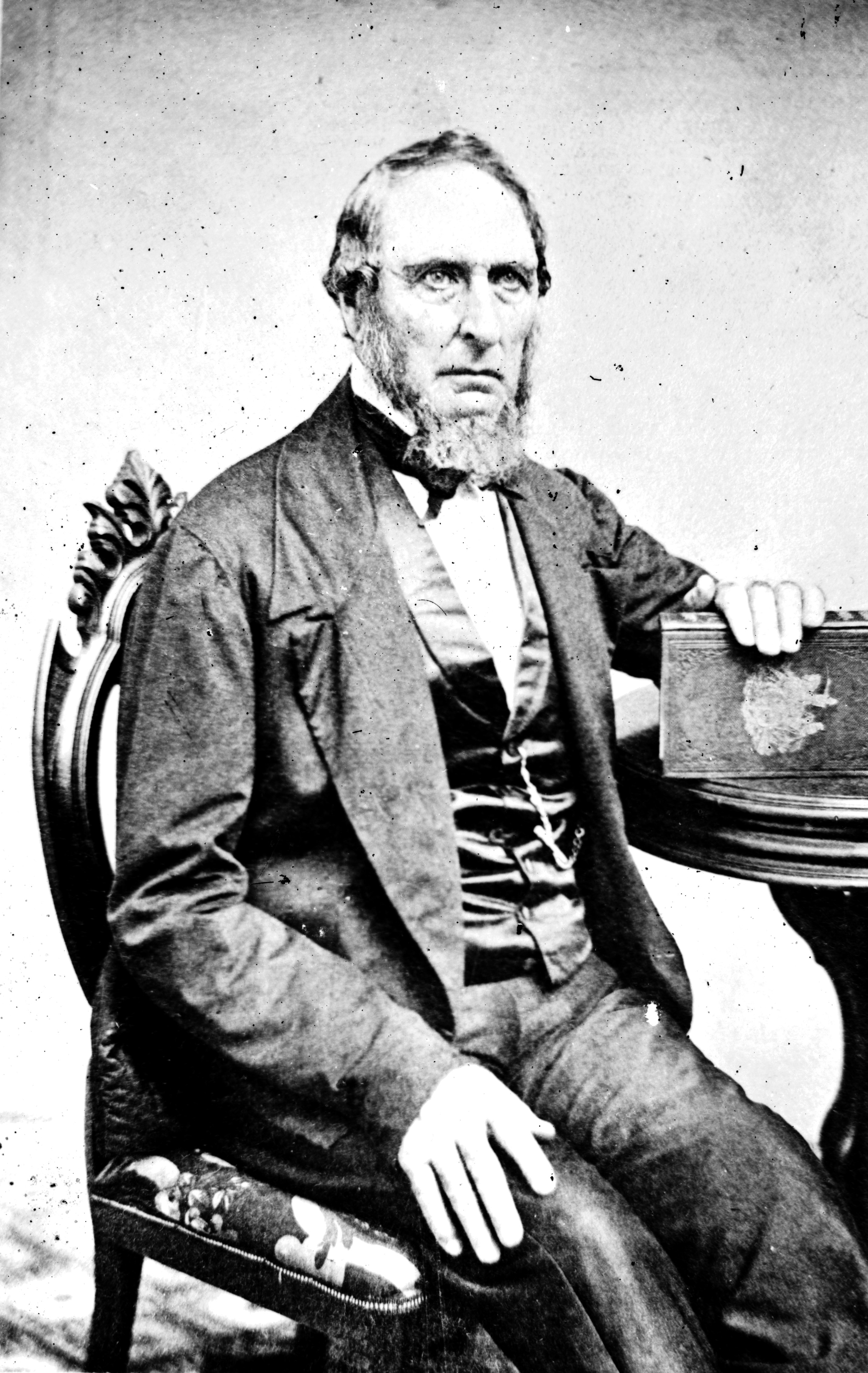
On November 20, 1820, roughly 2,000 miles off the western coast of South America, an unusually large bull sperm whale rammed the 238-ton Nantucket whaling ship Essex twice and sank it, an event first mate Owen Chase described in his own 1821 narrative: it came "with twice his ordinary speed... and it appeared with tenfold fury and vengeance in his aspect." Chase's account put the whale at around 85 feet long, a figure that exceeds NOAA's confirmed maximum of 52 feet for the species by a wide enough margin that it's generally read today as an estimate inflated by the trauma of the moment, not a reliable measurement. Of the 20-man crew, three stayed behind on Henderson Island and were rescued the following April; the other seventeen set out in open whaleboats, and only five of them were still alive when a passing ship found them three months later, after the survivors had resorted to cannibalism. Owen Chase's and cabin boy Thomas Nickerson's later written accounts of the ordeal helped inspire Herman Melville's Moby-Dick three decades on.
The Essex wasn't a one-off, either: a second Nantucket whaler, the Ann Alexander, was rammed and sunk the same way in 1851. Those two incidents are also where a real, testable scientific question came from. In a 2016 study in PeerJ, researchers led by Olga Panagiotopoulou built a biomechanical model of the sperm whale forehead specifically to test whether the junk's internal architecture, layered partitions of dense connective tissue running through the oil-filled sacs, could plausibly survive the forces of a deliberate ramming collision, a competing use for the same structure alongside its established roles in echolocation and buoyancy. Their models found the architecture is consistent with functioning as a shock-absorbing battering ram capable of surviving impacts against objects several times the whale's own mass, a structure the researchers argue likely evolved for male-on-male competition over mates rather than for sinking ships, with the Essex and the Ann Alexander serving as the historical incidents that made the question worth testing in the first place.