
A "melonhead" built for sound, not sight
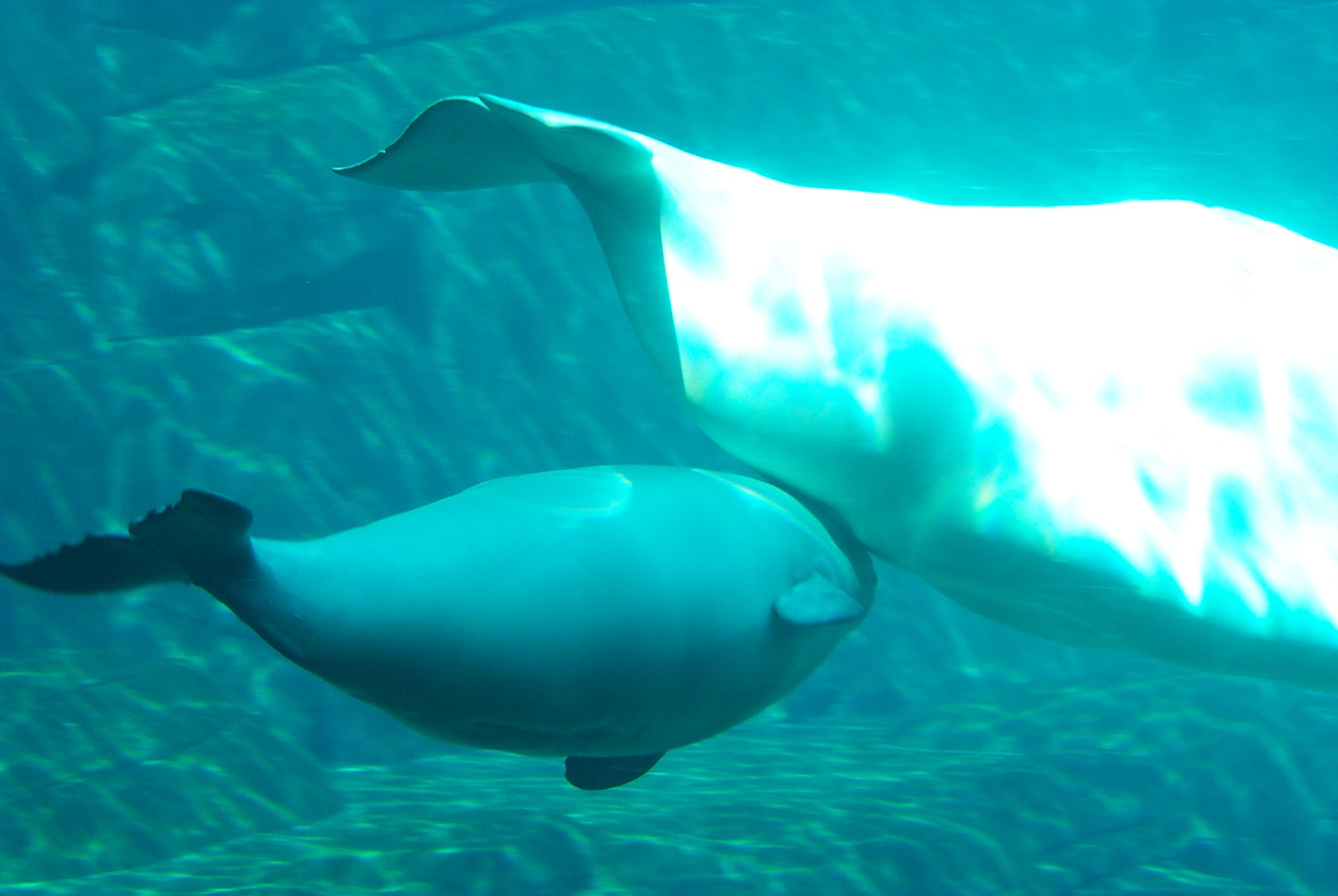
Belugas are toothed whales that live year-round in Arctic and sub-Arctic waters across Russia, Alaska, Canada, and Greenland, moving seasonally between sea ice, open ocean, and river estuaries. They belong to family Monodontidae, which contains exactly one other living species, the tusked narwhal; the two are each other's closest living relatives, though narwhals stay further offshore in deeper Arctic waters while belugas range more into shallow coastal and river systems. Per NOAA Fisheries, beluga calves are born dark gray and roughly 5 feet long, weighing 90 to 130 pounds; they don't turn fully white until they reach maturity, years later. Adults reach 11 to 15 feet, with males weighing up to about 3,300 pounds and females, which stay noticeably smaller, up to around 3,000 pounds.
Two features set belugas apart from most other whales. The first is a complete absence of a dorsal fin. NOAA Fisheries and other researchers tie this to a life spent swimming close beneath sea ice, where a protruding fin would catch on ice, get in the way of breaking through thin ice to breathe, and lose body heat the species can't afford to spare. The second is the "melon," a rounded, fatty structure on the forehead that visibly changes shape as the whale vocalizes, focusing and directing the echolocation clicks it uses to navigate and hunt in dark, ice-covered water. A much larger relative solves a version of the same problem with a different organ: the sperm whale's oil-filled spermaceti organ shapes and bounces its clicks inside an oversized head before they exit into the water. Belugas are also unusually vocal, producing clicks, whistles, chirps, and squeals across a wider range than most other marine mammals, enough that NOAA Fisheries calls them the "canary of the sea," a name that turned out to undersell just how far their vocal range could stretch.
Noc: the captive male who taught himself to mimic human speech
A beluga named Noc was captured off the coast of Manitoba, Canada, in August 1977 as part of the U.S. Navy Marine Mammal Program's Arctic sonar initiative, and held at the program's facility in San Diego. His unusual vocal ability wasn't noticed until 1984, when researchers began picking up sounds resembling garbled human speech traced back to him. It took until 2012 for the finding to be formally analyzed and published: neurobiologist Sam Ridgway and colleagues Donald Carder, Michelle Jeffries, and Mark Todd, writing in Current Biology under the title "Spontaneous human speech mimicry by a cetacean," reported that Noc's speech-like sounds carried a rhythm resembling human speech cadence, with fundamental frequencies several octaves below a typical beluga call and far closer to the human vocal range. "We were amazed — the voiceprint really reminded us of humanlike sounds and unlike normal whale sounds," Ridgway said of the recordings.
The mimicry was also mechanically strange. Toothed whales don't vocalize with a throat and vocal cords the way humans and most land mammals do; they produce sound by forcing air through phonic lips deep in their nasal passages. To approximate human speech, Ridgway's team found, Noc had to deliberately over-inflate a vestibular sac beneath his blowhole and vary the air pressure and muscular tension in his nasal tract, a labored, non-default way of vocalizing rather than something that simply happened on its own. The behavior faded within about four years of Noc reaching sexual maturity, though he remained highly vocal in ordinary beluga ways until his death in 1999.
Every summer, some belugas shed their skin
Belugas also do something almost no other whale is documented doing on a predictable annual schedule: shed their skin. NOAA Fisheries' science page on the species describes some beluga populations undergoing a molt each summer, sloughing off a thickened, yellowed outer skin layer that builds up over the rest of the year. The molt is concentrated in the warm, low-salinity river estuaries the whales return to seasonally, and researchers think the warmer water either speeds up the natural turnover of epidermis or serves as an environmental cue that triggers it.
Belugas help the process along mechanically, crowding into shallow water and rubbing their bodies against coarse river gravel, with the warm fresh water softening and hydrating the old skin layer first. A similar gravel-rubbing molting behavior, dubbed "rock-nosing," has since been documented in bowhead whales, a separate Arctic species, in a 2017 study published in PLOS One, suggesting an annual skin shed timed to summer estuary conditions may be a broader adaptation among Arctic whales rather than a beluga-specific quirk.
A DNA test that can age a living whale, built for the population that needs it most
Determining a whale's exact age has traditionally required counting growth-layer groups in its teeth, a method that only works on a dead animal recovered through stranding or subsistence harvest. A 2021 study published in Evolutionary Applications, led by researchers including Eleanor Bors, changed that for belugas: using a custom DNA methylation array, the team measured activity at 37,491 genetic sites across skin samples from 67 dead Cook Inlet belugas whose ages were already known from tooth layers, then used a statistical model to narrow that down to 23 sites that reliably tracked age, accurate to a median error of just 2.9 years in cross-validation. Applied to skin samples collected by biopsy dart from 38 living, wild whales sampled between 2016 and 2018 (a technique that doesn't require capturing or restraining the animal), the model estimated ages ranging from 11 to 27 years, the first time individual living beluga ages had been reliably estimated at all.
The tool wasn't built for belugas generally; it targeted the one population under the most acute threat. NOAA Fisheries listed the Cook Inlet, Alaska beluga subpopulation as endangered under the U.S. Endangered Species Act in 2008 and designated critical habitat for it in 2011, after the population declined by roughly 80% between 1979 and 2018, from about 1,300 whales down to an estimated 279. The most recent full survey, from June 2022, put the population at 331, a tentative sign of stabilization NOAA is still confirming with a follow-up aerial survey conducted in June 2025. That regional crisis sits oddly alongside the species' global picture: the IUCN reclassified belugas as a whole from Near Threatened to Least Concern in 2017, estimating a worldwide population in the range of 136,000 mature individuals. That means the same species can be doing fine globally while one geographically isolated, genetically distinct population is on a path toward disappearing.
Hvaldimir: the beluga Norway called a Russian spy
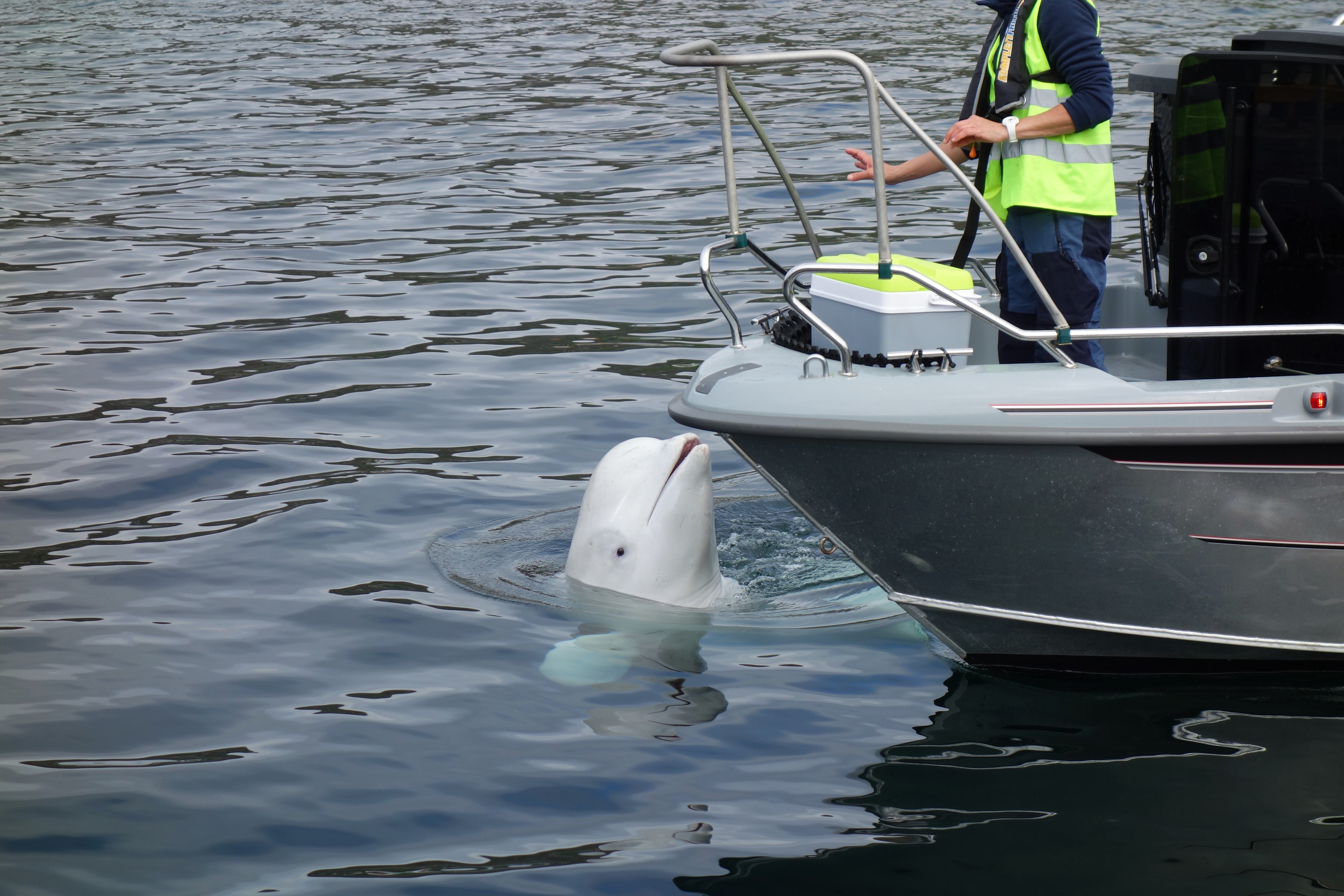
In April 2019, fishermen off Hammerfest in northern Norway found a beluga whale approaching their boats wearing a tight harness fitted with equipment mounts, one of them stamped "Equipment St. Petersburg." Given Russia's documented history of training marine mammals for military use, the harness fueled immediate speculation that the whale had escaped a Russian navy program, and it was quickly nicknamed Hvaldimir, a portmanteau of the Norwegian word for whale, hval, and Vladimir Putin's first name. The 2019 discovery prompted speculation about naval training, without establishing a Russian navy connection. The harness alone did not establish who had trained him. Another reputation that outran its evidence belongs to camel spiders, whose exaggerated claims spread through a distorted photograph despite a museum rebuttal in 2004.
Whatever his origin, Hvaldimir's behavior wasn't typical of a wild beluga: he persistently approached boats and swimmers, retrieved a woman's dropped phone, and stole and returned a kayaker's GoPro, prompting the nonprofit OneWhale to form specifically to monitor and protect him. Where the Iberian orcas off Gibraltar treat passing boats as something to attack, Hvaldimir treated them as playmates, a sociability OneWhale warned made him vulnerable to boat strikes and litter ingestion, especially once he began swimming alone roughly 2,000 kilometers south along the Norwegian coast and into Swedish waters in 2023, far from the food sources he was used to. He was found dead in Risavika Bay near Stavanger on August 31, 2024, estimated to be 14 to 17 years old. OneWhale and the Norwegian group NOAH initially alleged he'd been shot, pointing to bleeding holes in his skin, but a police autopsy and X-ray found no bullet fragments; examiners concluded the holes were superficial marks likely left by birds pecking at his carcass after death. The Norwegian Veterinary Institute's completed post-mortem instead pointed to a probable natural cause: a stick roughly 35 centimeters long, apparently swallowed while fetching sticks that people threw for him, had become lodged in his mouth and made it hard for him to eat, and his decomposed internal organs suggested a combination of infection and starvation. Police closed the case in October 2024, with investigator Amund Preede Revheim of the Southwest Police District stating there was nothing in the examination to suggest Hvaldimir had been illegally killed.