
A tusked relative of the sea lion, not the seal
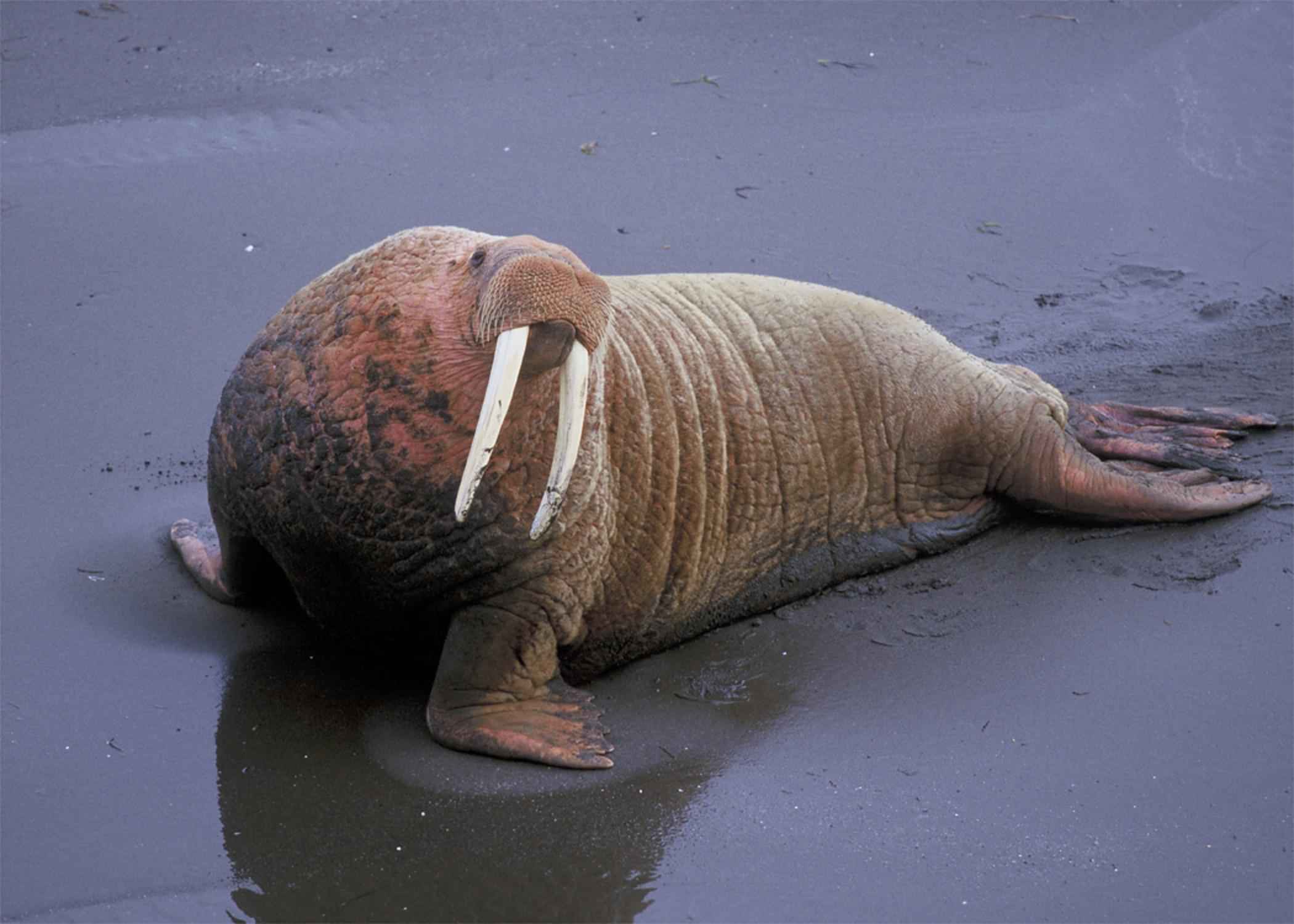
The walrus (Odobenus rosmarus) is the only living species in its own pinniped family, Odobenidae, but it isn't as distant from sea lions as the tusks suggest. Taxonomists group walruses with fur seals and sea lions in the eared-seal lineage (Otarioidea), and per the U.S. Fish and Wildlife Service, which manages the species, walruses share the same forward-rotating hip joint that lets a sea lion prop itself up and walk on all four limbs. That's unlike a true seal such as a leopard seal, which has no external ears and hind flippers that can't rotate, leaving it to drag itself forward on its belly instead of walking. A walrus is bulkier than either: adult males can reach roughly 12 feet and 2 tons, with females typically topping 1 ton.
The tusks themselves are simply oversized upper canine teeth that never stop growing, reaching up to about a meter in males and somewhat less in females, and both sexes use them the same practical way: as ice hooks to haul their own bulk out of the water and onto a ledge, and as levers against rivals in dominance fights. That's a very different job from the one performed by another Arctic mammal's tooth-turned-tusk: a narwhal's single spiraled tusk is a nerve-packed sensor that reads salinity in the surrounding water, not a tool for leverage. Underwater, a walrus dives to the shallow seafloor and feels along the mud with its whiskers for the bivalves that make up most of its diet, then clamps its lips around a shell and draws its tongue back sharply enough to suction the meat out without cracking the shell open. A single animal can work through several thousand clams in a day this way. Per the U.S. Fish and Wildlife Service, a walrus can live roughly 40 years in the wild, most of them spent in the loose, highly social herds that define the species' haul-out behavior in the first place. Calves typically nurse for more than a year and often stay close to their mothers into their second or third year, a long dependency period that leaves them particularly exposed whenever a haul-out turns dangerous.

From no autumn gathering to 35,036 walruses on one beach
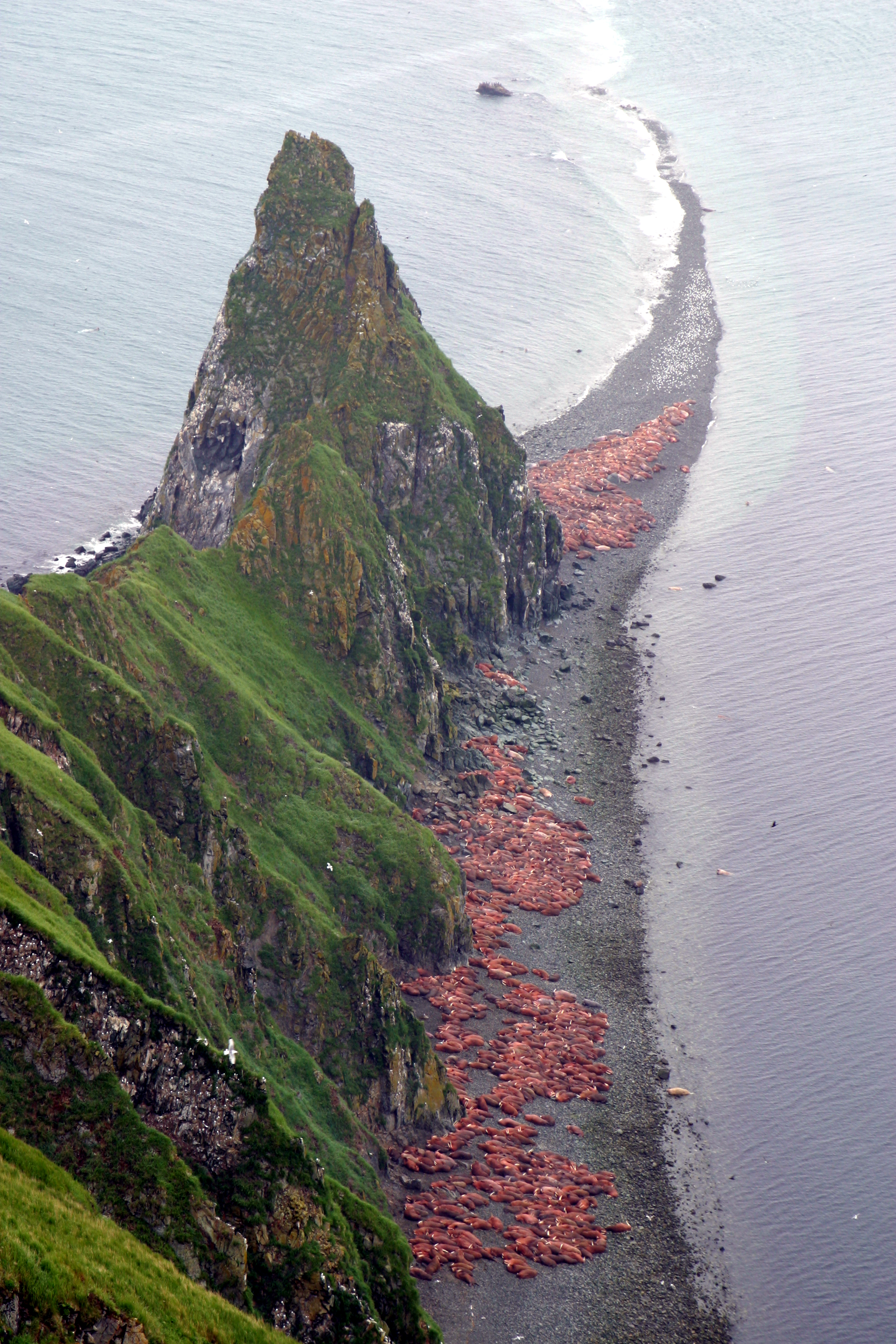
For most of the twentieth century, female and juvenile Pacific walruses spent the ice-free season riding sea ice north as it retreated over the Chukchi Sea's continental shelf, diving to the shallow seafloor for clams and climbing back onto a floe to rest between dives. That pattern held as long as the ice stayed over water shallow enough to reach bottom from the surface. Per USGS, the first large autumn haul-out of females and calves on the northwest Alaska coast, near the village of Point Lay, was observed in 2007, the same year Arctic sea-ice extent fell about a million square miles below average, an area larger than Alaska and Texas combined. When the remaining ice retreats past the shelf edge into the deep water of the Arctic Basin, it stops functioning as a resting platform near food, so instead of following the ice out to sea, the walruses come ashore.
The autumn gathering near Point Lay has recurred nearly every year since, missing only 2008 and 2012, and it has grown. A NOAA aerial survey run by the agency's National Marine Mammal Laboratory photographed the beach after sea ice receded past the shelf on 25 and 27 September 2014, and the resulting count, 35,036 walruses, is among the largest assemblies of the species ever documented on land in one place. Some later years have produced even larger rough estimates in press reports, but 2014 remains the most precisely counted gathering on record. The seasonal timing has also crept earlier over the years, with several later summers setting new records for how soon walruses started arriving near Point Lay, each one beating the last.
131 carcasses at Icy Cape, 64 more at Point Lay
A crowd of that size turns routine disturbances dangerous. Stampedes happen when something, whether a polar bear, low-flying aircraft, a boat, or hunters, startles the herd into rushing for open water at once, and animals too small or slow to get out of the way get trampled. On 14 September 2009, USGS researchers Anthony Fischbach, Deborah Monson, and Chadwick Jay documented the worst known result: 131 walrus carcasses spread along roughly 120 kilometers of Chukchi Sea beach near Icy Cape, Alaska, most concentrated where a large haul-out had formed days earlier. A follow-up necropsy study led by Carrie Goertz, published in Polar Biology in 2017, examined 71 of those carcasses, performing full necropsies on 9 and external exams on the rest, and found the animals were almost entirely calves; the most likely causes of death were crushing trauma to the chest, neck, and head, or asphyxiation from being trampled by larger walruses.
Icy Cape wasn't a one-time event. On 11 September 2017, a resident of Point Lay working with the U.S. Fish and Wildlife Service surveyed a mile of coastline near the village and counted 64 dead walruses, most of them younger than a year old. Federal wildlife officials again suspected a stampede, though as in 2009, no one witnessed the triggering disturbance directly.
Why the population math favors hunting over stampedes
Pacific walrus subsistence hunting by Alaska Native and Russian coastal communities is legal, culturally central, and monitored, with harvest records going back decades. The open question researchers faced as land haul-outs grew was how two very different mortality sources compared in their effect on the species over time: a managed harvest spread across age classes, and a new, calf-heavy toll from stampedes at crowded beaches. Mark Udevitz and coauthors built a population model to answer it, published in Polar Biology in 2013, using demographic data and harvest records to project the female Pacific walrus population forward under different assumptions about future hunting levels and haul-out-related mortality.
Their result was not the intuitive one. An increase in haul-out mortality affecting only calves had a greater effect on projected population size than an equivalent increase in harvest mortality distributed across all age classes, even though both scenarios removed the same number of animals. The logic follows standard age-structured population dynamics: a calf killed before it has ever bred represents the loss of its entire future reproductive output, while a harvest spread across ages inevitably includes some older animals that have already contributed most of the offspring they ever will. Concentrate new mortality on the one age class with nothing yet subtracted from its future, in other words, and the population absorbs a bigger hit than the same body count spread more evenly. The Pacific walrus's current abundance is estimated at roughly 257,000 animals based on aerial survey data collected between 2013 and 2017, and the IUCN currently lists the species as Data Deficient rather than assigning it a threat category, citing the difficulty of tracking a population whose habits are still shifting with the ice.
Even a walrus's predators mostly leave healthy adults alone
That calf-heavy toll from stampedes matches a pattern that already exists in ordinary predation. Orcas and polar bears are the walrus's only significant natural predators, and both are documented favoring calves, sick animals, and stragglers over a healthy adult, whose tusks can gore a bear's face or a killer whale's flank badly enough to end the hunt in the walrus's favor. A polar bear's jaws alone typically can't crack an adult walrus's thick skull, which is one reason attacks on healthy adults are rare enough that biologists once treated eyewitness reports of them skeptically.
One specific version of those reports has since held up under scrutiny. Ian Stirling, Kristin Laidre, and Erik Born reviewed roughly 200 years of accounts, many from Inuit hunters, describing polar bears hoisting rocks or blocks of ice and hurling or bludgeoning them onto a walrus's head, and published their assessment in the journal Arctic in 2021. They cross-checked the oral accounts against forensic details, including the physical plausibility of a bear lifting and throwing an object that heavy and the head trauma a walrus skull would show, and concluded the behavior, while rare, most likely does occur. That makes it one of the few documented cases of tool use in a wild polar bear population, and a rare instance of a predator engineering its way around a healthy adult walrus's main defense.