_in_La_Jolla_Cove.jpg)
An eared seal built to walk, not just swim
"Sea lion" refers to several species of eared seal in the family Otariidae, distinguished from true seals by visible external ear flaps and, more importantly, by hind flippers that rotate forward, a joint structure true seals lack, which is why sea lions can prop themselves up and move on all four limbs on land while a true seal can only awkwardly hump along on its belly. The most familiar species, and the one behind both stories in this piece, is the California sea lion (Zalophus californianus). Per NOAA Fisheries, adult females reach about 6 feet and 240 pounds, adult males about 7.5 feet and 700 pounds, and the species can live 20 to 30 years.
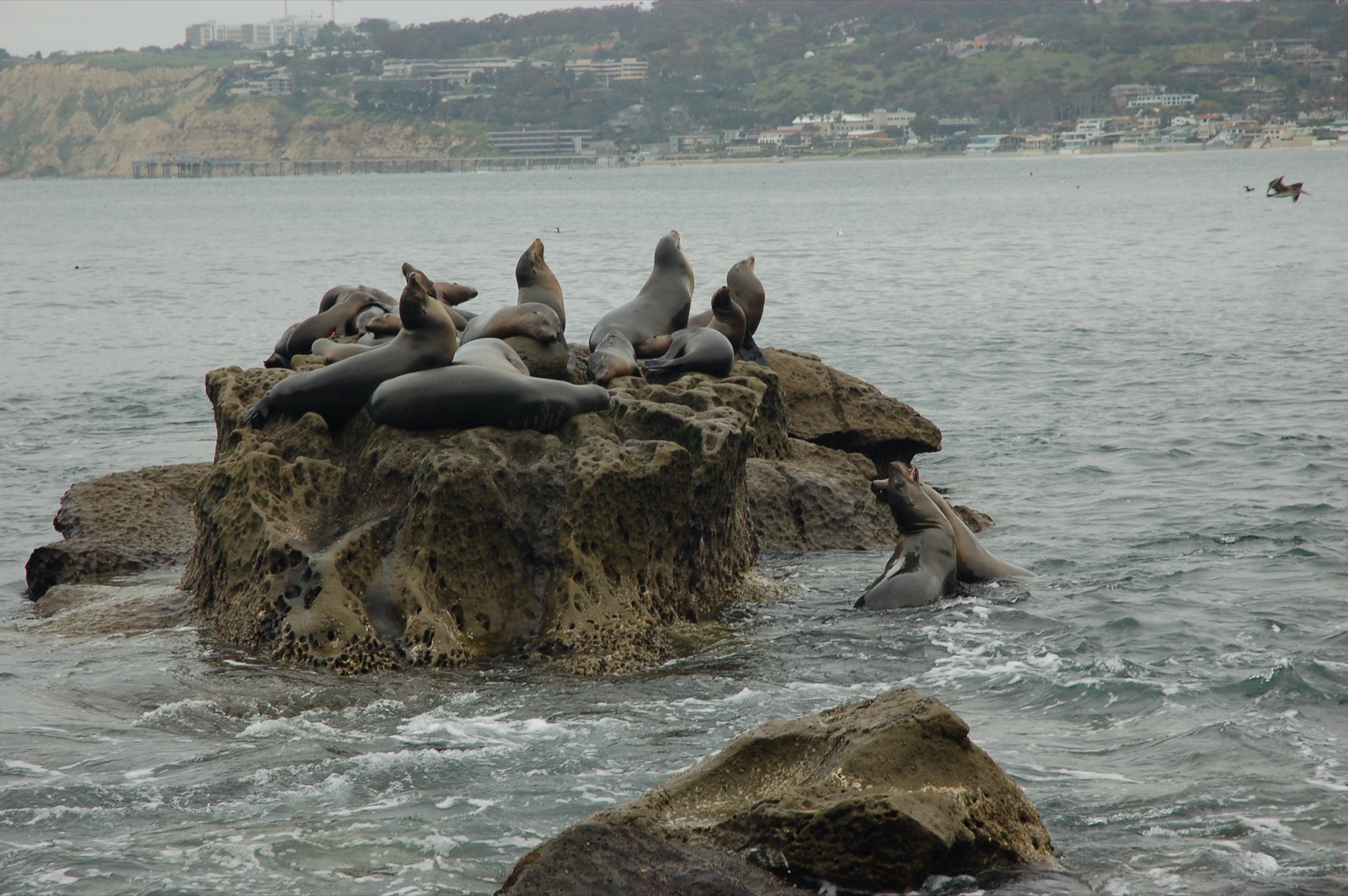
They range along the eastern North Pacific from southeast Alaska to central Mexico, hauling out in large, noisy, tightly packed groups on beaches, rocks, docks, and buoys. NOAA describes them as "very social... and very vocal (sounding like barking dogs)," which is exactly the trait on display in a colony like the one at La Jolla Cove. In the water they're the fastest pinnipeds alive, cruising at 5 to 15 knots with bursts up to roughly 30 knots using their long front flippers for propulsion, a different swimming stroke from the rear-flipper undulation true seals rely on. Underwater, a much larger relative holds a louder record still: the loudest sound in the animal kingdom comes from sperm whale clicks, measured at up to 236 decibels. Breeding runs late June through early August, with males holding harems of up to 14 females and most pups born the following May and June after an implanted, delayed-gestation pregnancy.
That land mobility and trainability are exactly why California sea lions, not true seals, are the animals held at research facilities like UC Santa Cruz's Long Marine Laboratory, where a sea lion named Ronan became the subject of one of the more counterintuitive findings in animal cognition.

Ronan's 2013 debut broke a theory about who can feel a beat
Until 2013, the leading theory of rhythmic entrainment (the ability to synchronize movement to an external beat) held that it required vocal learning, the capacity to imitate sounds rather than produce them instinctively. The theory, formalized by neuroscientist Aniruddh Patel and gaining traction after viral 2009 videos of Snowball, a vocal-mimicking cockatoo, dancing to music, implied the trait should be limited to vocal-learning species: parrots, some songbirds, humans, and a handful of others, but not seals or sea lions.
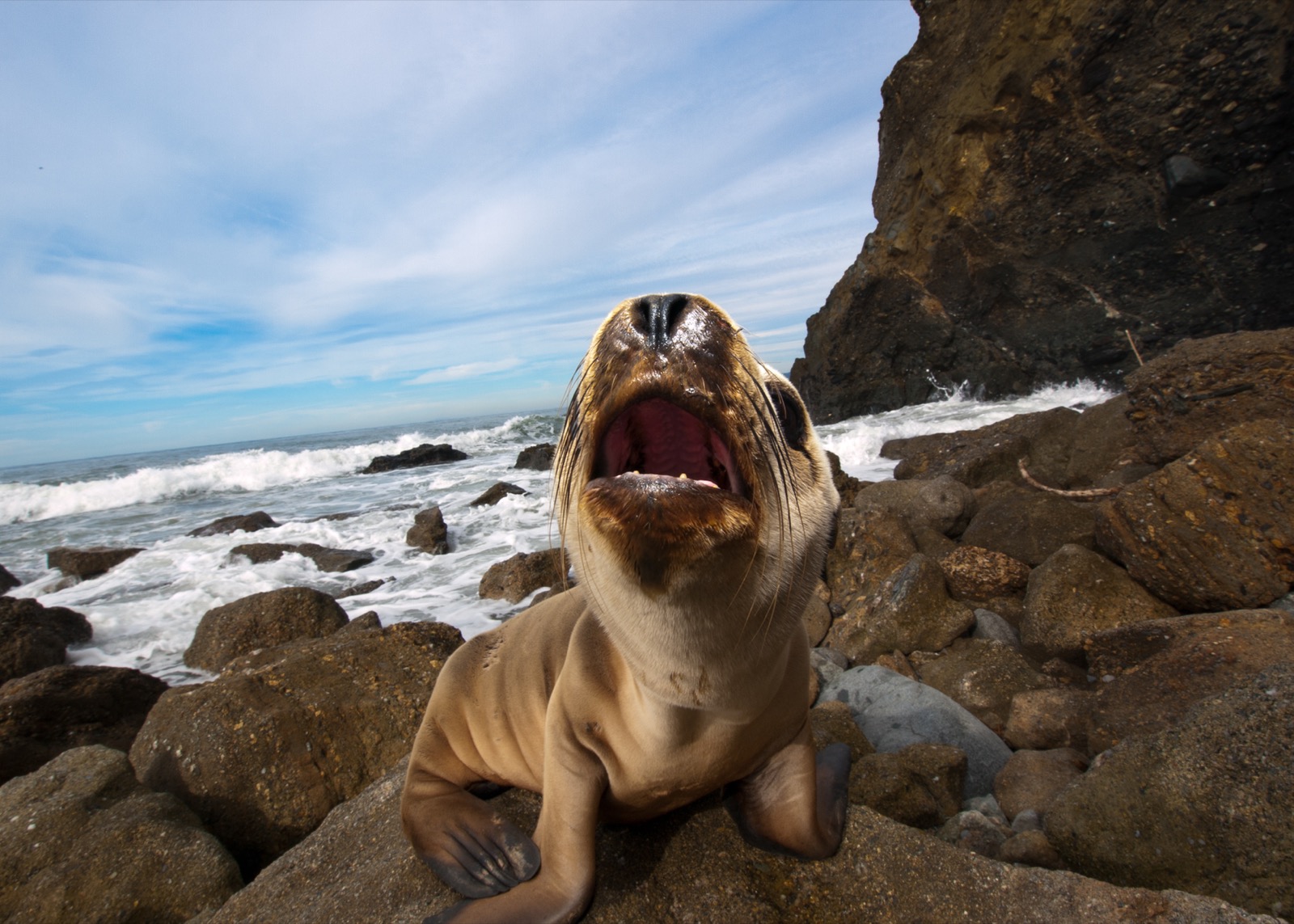
Peter Cook, Andrew Rouse, Margaret Wilson, and Colleen Reichmuth tested that prediction directly on a California sea lion named Ronan at UC Santa Cruz's Long Marine Laboratory, training her over several months to bob her head in time with rhythmic sound tracks and then checking whether the skill generalized. It did: Ronan kept time not just with the training rhythms but with new tempos and music she had never heard, a transfer test the theory did not predict she should pass. The team published the result in the Journal of Comparative Psychology in April 2013, and Cook did not soften the implication: "Ronan's success poses a real problem for the theory that vocal mimicry is a necessary precondition for rhythmic entrainment." He also drew a direct, unflattering comparison to the bird that had inspired the vocal-learning theory in the first place: "In the videos, [Snowball] fall[s] off the beat a lot... She stays right on the beat."
A 2025 study found she keeps time better than the humans tested against her
A dozen years and roughly 2,000 short training sessions later, Cook returned to Ronan's rhythm with a more rigorous comparison. Published in Scientific Reports in May 2025, the follow-up study, led by Cook with Carson Hood, Andrew Rouse, and Colleen Reichmuth, had ten UC Santa Cruz undergraduates perform arm motions synchronized to percussive metronome beats at 112, 120, and 128 beats per minute, then measured their timing precision against Ronan's head-bobbing on the same tempos. A statistical model extrapolating the human results to a simulated population of 10,000 people placed Ronan's reliability in the 99th percentile: her cycle-to-cycle timing varied by only about 15 milliseconds, a tenth the length of a single human eye blink, and less than the variability shown by any individual undergraduate in the comparison group. "She is incredibly precise, with variability of only about a tenth of an eyeblink from cycle to cycle," Cook said. Reichmuth, director of the lab's pinniped research program, pointed to what the years of practice revealed: "One of the most important outcomes of the study is the fact that maturation and experience matter." Direct measurements also let researchers investigate the sensory function of a narwhal's tusk beyond anatomical inference alone. That salinity experiment addressed a different question from musical timing.
When "demonic" sea lions are poisoned, not vicious
The same species behind Ronan's cognitive research has also become the public face of a recurring West Coast health crisis. Pseudo-nitzschia, a diatom that blooms rapidly in nutrient-rich, upwelled coastal water, produces a neurotoxin called domoic acid that accumulates in the small fish and shellfish sea lions eat. Per NOAA Fisheries, the toxin does not harm the fish carrying it and poses no direct risk to swimmers in the water, but it causes seizures, brain damage, and death in the marine mammals that eat enough contaminated prey.
In the first weeks of June 2023, in what NOAA and rescue groups described as the worst bloom on record to that point, the toxin is believed to have killed hundreds of California sea lions and close to 60 dolphins along the Southern California coast; the Channel Islands Marine & Wildlife Institute fielded more than 1,000 reports of sick or dead marine mammals between June 8 and June 14 alone, while managing over 200 such reports on an average day during the outbreak. The Marine Mammal Care Center in Los Angeles admitted more than 120 adult sea lions over the following seven weeks. Similar blooms recurred in August 2024, when the Channel Islands Marine & Wildlife Institute, which covers Santa Barbara and Ventura Counties, rescued 45 sea lions showing domoic acid symptoms in the first ten days alone, and again in 2025, with reporting describing Los Angeles County conditions as worse than 2023. In March 2025, surfer RJ LaMendola was attacked roughly 150 yards off Oxnard, California, by a sick sea lion that bit him severely; in a widely quoted account of the attack, he described the animal's expression as "feral, almost demonic," language that spread through subsequent news coverage of the bloom. The pattern has continued: SCCOOS monitoring found Pseudo-nitzschia levels surging at Southern California piers by late February 2026, and the Marine Mammal Center treated roughly 13 sea lions for domoic acid poisoning on the Central Coast in late March and early April 2026, with staff there describing the outbreaks as increasingly unpredictable in timing rather than confined to summer. Veterinarians who treat the affected animals are consistent on the mechanism behind that kind of behavior. Dr. Alissa Deming, vice president of conservation medicine and science at the Pacific Marine Mammal Center, has described poisoned sea lions as "hyperactive, confused and disoriented" and "completely unaware of their surroundings": sick and frightened, not hunting or attacking with intent. It's a reputation-versus-cause mix-up with a cousin in the arachnid world, where a chain-email photo, not any documented behavior, built the camel spider's entire fearsome reputation. Here, though, the "monster" framing is attached to an animal that is, underneath the illness, one of the more cognitively sophisticated marine mammals studied.
A federally protected species with a real, recurring threat
Outside of algal bloom years, the California sea lion population has been a genuine conservation recovery story. The species has been protected under the U.S. Marine Mammal Protection Act since 1972, and NOAA Fisheries reports the U.S. stock grew at a maximum rate of 7 percent per year between 1975 and 2014, fast enough that population growth, not decline, has been the more common long-term headline. Domoic acid poisoning complicates that picture without reversing it: it is an episodic, weather- and ocean-condition-driven mortality event rather than a sustained population-level decline, but the West Coast Marine Mammal Stranding Network still fields large volumes of stranding calls every time a bloom hits, and rescue capacity is a real bottleneck during outbreaks. Treatment for affected animals includes fluids to flush the toxin and anti-seizure medication where needed. Separately, transient orcas hunt marine mammals like this one for food. California sea lions therefore appear in several parts of this story: a trained subject in one lab, prey in the wild, and a bellwether for a toxin problem tied to changing ocean conditions. Not every pinniped's biggest threat is a toxin, either: walrus calves crushed in stampedes on crowded beaches, driven there as sea ice keeps retreating, were examined in a 2013 population model. The model projected that an increase in calf mortality could affect the population more than an equivalent increase in hunting mortality spread across age groups; it did not rank their observed present-day totals.