
The short answer, with the numbers
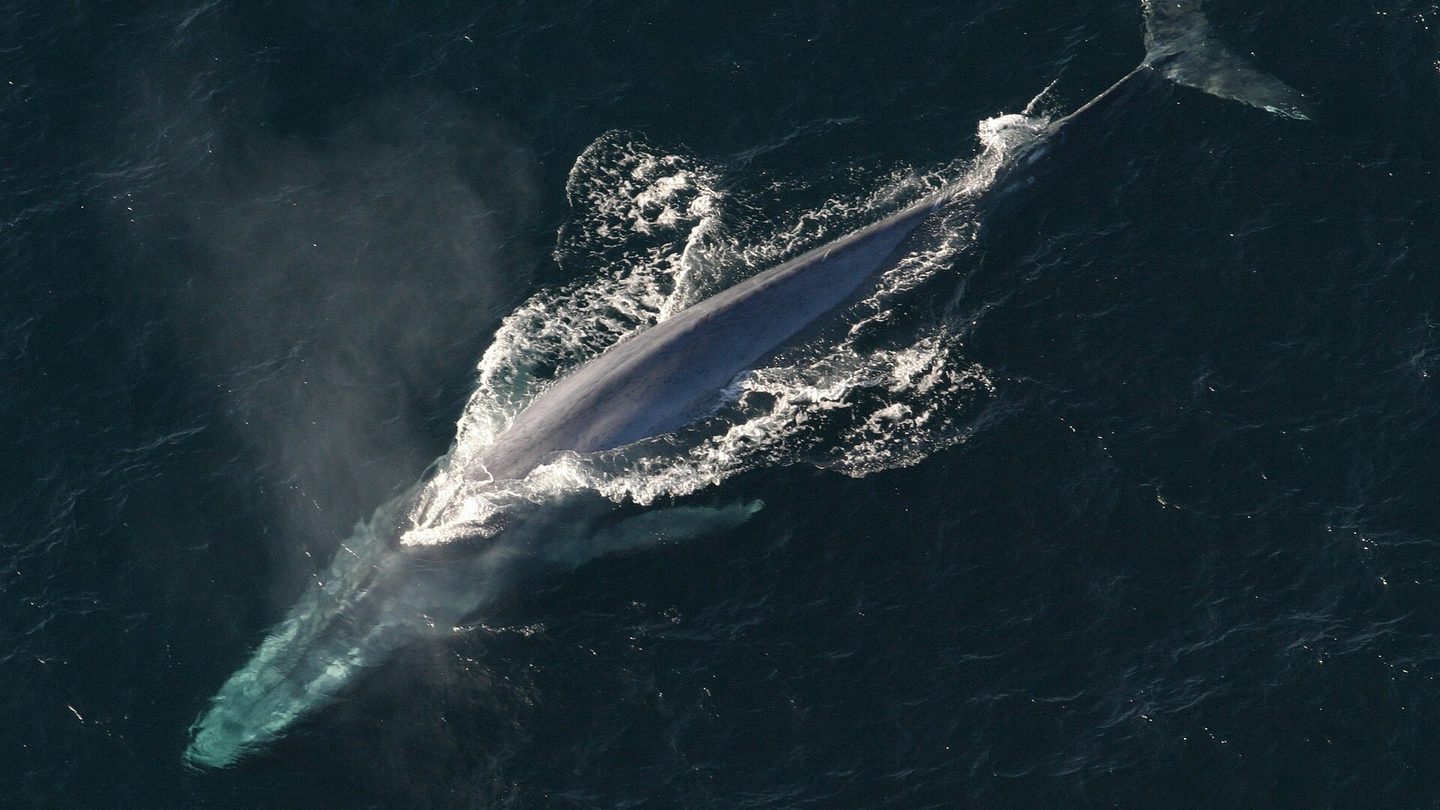
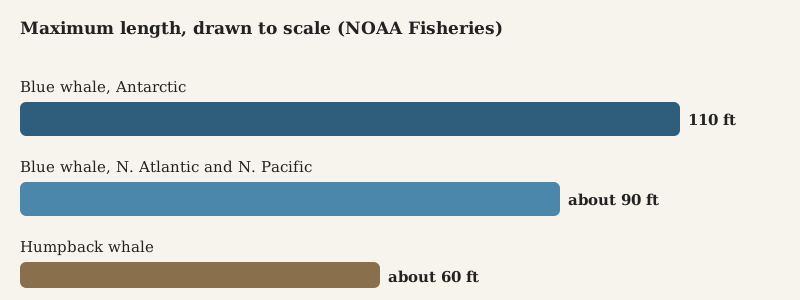
The blue whale is much bigger. NOAA Fisheries lists it at up to 110 feet and up to 330,000 pounds, and calls it the largest animal ever to live on the planet. The same agency gives the humpback whale as up to about 60 feet and up to about 40 tons. Both are rorquals, both filter food through baleen, and NOAA gives both a lifespan of roughly 80 to 90 years.
The table puts the two side by side, with the source for each row. Beyond size, they differ in body shape, feeding method, and voice.
| Trait | Blue whale | Humpback whale | Source |
|---|---|---|---|
| Length | Up to 110 ft (Antarctic); up to about 90 ft in the North Atlantic and North Pacific | Up to about 60 ft | NOAA Fisheries |
| Weight | Up to 330,000 lb (Antarctic); over 100,000 lb in the North Atlantic and North Pacific | Up to about 40 tons | NOAA Fisheries |
| Lifespan | Estimated 80 to 90 years | About 80 to 90 years | NOAA Fisheries |
| Body | Long, slender, mottled blue-gray | Distinctive hump, long pectoral fins, mostly black | NOAA Fisheries |
| Food | Almost exclusively krill, up to 6 tons a day | Krill and small fish, often with bubble nets | NOAA Fisheries |
| Voice | Calls at 8 to 25 Hz, up to 188 dB | Male songs at 100 Hz to 4 kHz | Wikipedia summaries of the research |
| US listing | ESA endangered throughout its range | 4 of 14 population segments endangered, 1 threatened | NOAA Fisheries |
NOAA does not say which kind of ton it means for the humpback. Wikipedia's humpback article (checked 13 October 2026) gives up to 40 metric tons, or 44 short tons. Either way the comparison holds.
How much bigger is a blue whale?
Take NOAA's maximums. An Antarctic blue whale at 110 feet is about 1.8 times the length of a 60-foot humpback. Even the smaller blue whales of the North Atlantic and North Pacific, at up to about 90 feet, are about 1.5 times as long. On weight, 330,000 pounds against roughly 80,000 pounds (40 US tons) is a gap of about four to one.
Those are record-end figures. NOAA's 110 feet is a ceiling, and Wikipedia gives (checked 13 October 2026) the longest confirmed blue whale as about 98 to 100 feet. A fairer test compares averages. Wikipedia's blue whale article (checked 13 October 2026) puts the average adult at 72 to 135 metric tons. Its humpback article gives 40 metric tons as the top figure. So an ordinary adult blue whale outweighs the biggest humpbacks, and the two are not close.
NOAA also notes that female blue whales are generally larger than males, and that Antarctic blue whales are generally larger than other subspecies. So which blue whale you mean changes the number, though not the conclusion.
How to tell them apart at sea
Shape is the quickest cue. NOAA describes the blue whale as long and slender, with a mottled blue-gray coat that looks light blue underwater. Wikipedia adds (checked 13 October 2026) a small, sickle-shaped dorsal fin set far back near the tail. The humpback is a stockier animal. Its common name comes from the hump on its back, and its scientific name, Megaptera, means "big-winged" for its very long pectoral fins.
Tails and behavior help too. NOAA says humpback flukes can be up to 18 feet wide, serrated along the trailing edge, and that fluke pigment and scars are distinctive enough for scientists to identify individual whales from photographs. Humpbacks also breach and slap the water with their fins and tails, and they are often found close to shore. Blue whales, by NOAA's description, more often travel alone or in pairs.
Color is less reliable than it sounds. NOAA notes that humpbacks are mostly black but carry varying amounts of white, and that Southern Hemisphere humpbacks tend to show more white. Both species can look gray-blue in poor light, so body length and the dorsal fin are safer clues.
How each one feeds
Blue whales eat almost exclusively krill; humpbacks take krill and small fish, using several feeding techniques. NOAA says blue whales swim toward dense krill schools with the mouth open, then close it around the krill while the throat pleats inflate, and push the water out with the tongue. Some of the biggest individuals may eat up to 6 tons of krill a day. Wikipedia reports (checked 13 October 2026) that a blue whale can engulf about 220 tons of water in one gulp.
The humpback is more of a generalist. NOAA says humpbacks filter-feed on small crustaceans, mostly krill, and small fish, and use bubbles, sounds, the seafloor, and even their pectoral fins to herd prey. Its best-known method is group coordinated bubble-net feeding. Whales blow curtains of bubbles to pack prey together, then lunge up through the ring. NOAA adds that bubble-feeding habits differ between populations. Wikipedia lists (checked 13 October 2026) herring, capelin, and sand lances among the fish they take.
Diving differs as well. Wikipedia says (checked 13 October 2026) humpback dives in summer typically stay under five minutes, and reach 15 to 20 minutes in winter. For feeding blue whales in the eastern North Pacific it gives an average depth of about 201 meters and an average dive of 9.8 minutes.
Which one is louder, and who sings?
Blue whales are among the loudest animals on Earth. NOAA says they emit pulses, groans, and moans, and that in the right ocean conditions other whales may hear them from up to 1,000 miles away. Wikipedia gives (checked 13 October 2026) the fundamental frequency of their calls as 8 to 25 Hz, with a maximum loudness of 188 dB.
The humpback is the famous singer. Male humpbacks produce complex songs in the winter breeding season, in a range of about 100 Hz to 4 kHz, with harmonics reaching 24 kHz or more. Wikipedia says (checked 13 October 2026) the sound can travel at least 10 kilometers, and that singing bouts run from 4 to 33 minutes depending on the region, with a recording of up to seven hours in Hawaii. What the songs are for is still debated.
Blue whales have songs of their own, and Wikipedia says (checked 13 October 2026) the A and B calls of the eastern North Pacific population are sung only by males, which points to a role in reproduction. The difference is that humpback songs are built from repeated phrases and themes in a pitch range far above the blue whale's. For another loud whale, the sperm whale guide covers its clicks.
Who would win a fight?
None of the sources checked for this guide records a fight between the two species, and there is little reason for one. Neither hunts mammals. Blue whales feed almost entirely on krill, while humpbacks also take small fish, and NOAA lists their main modern threats as entanglement in fishing gear, vessel strikes, and ocean noise. Any "who wins" answer is a thought experiment, and the only real data point is size, which favors the blue whale by a wide margin.
Orcas are the main documented natural attackers of both species. Wikipedia says (checked 13 October 2026) the only documented attacks on blue whales involve orcas, which often target calves, and that scars show orcas also prey on juvenile and sometimes adult humpbacks. A 2014 study in Western Australia, it says, saw young humpbacks attacked, and that mothers and other adults escort calves to deter it. The orca guide explains why some orca populations hunt marine mammals and others eat mostly fish.