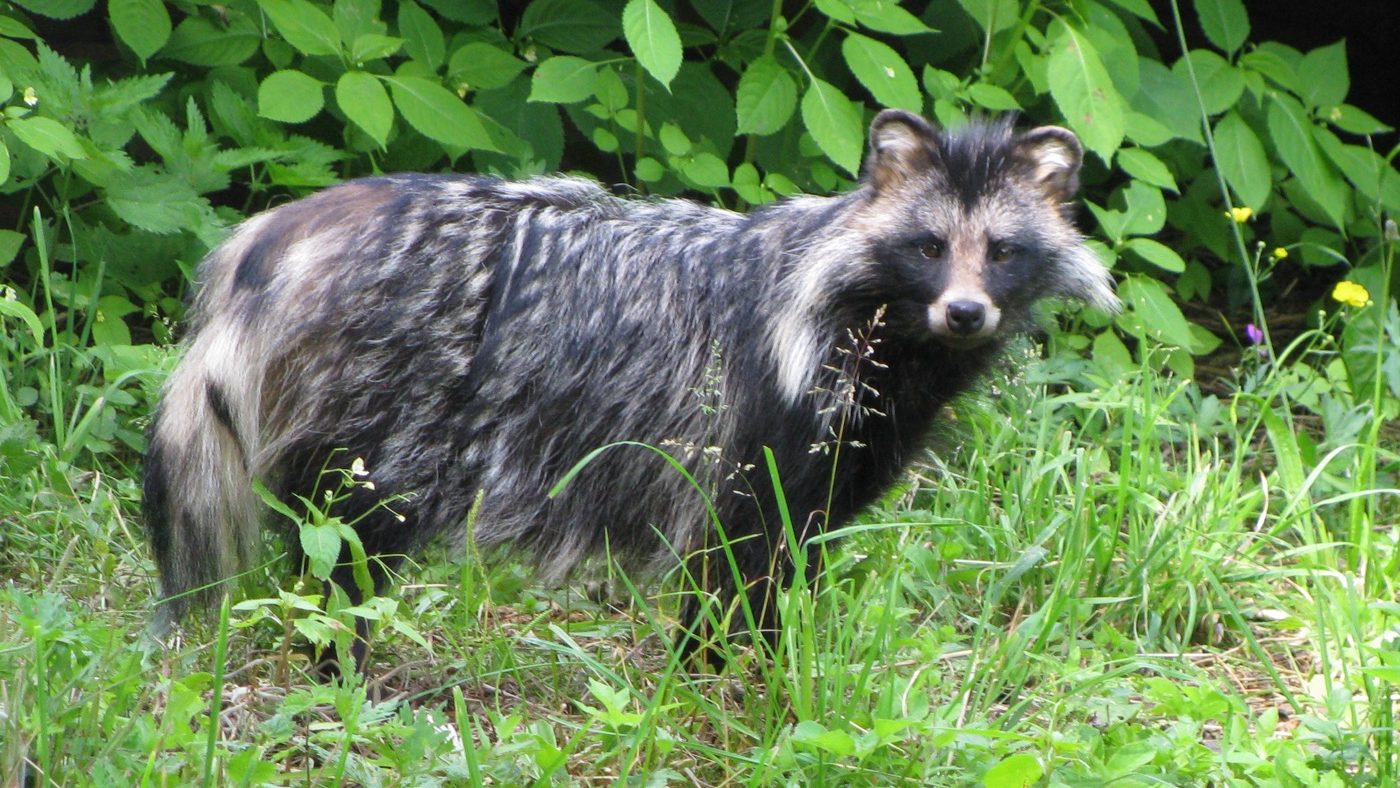

Same mask, different families
The raccoon dog (Nyctereutes procyonoides) is a heavy-set, fox-like canid native to East Asia. Its closest living relatives are the true foxes (the fennec fox is one of them), and a 2011 mitochondrial genome study, described on the dhole page, placed the raccoon dog genus and the fox genus Vulpes among the earliest canid lineages to split off, ahead of the wolf, coyote and dog group. The raccoon (Procyon lotor) is a North American mammal in the family Procyonidae, and it is the largest procyonid. One lives in the dog family and the other does not, which is the whole answer to the question people usually type in.
The names point the wrong way. Procyon, the raccoon's genus, was coined in 1780 and can be read as 'before the dog' or 'doglike', so a procyonid carries a dog reference in its own scientific name. The raccoon dog was named for its raccoon-like face markings. It is not the only canid with a name that misleads: the maned wolf is not closely related to wolves, foxes or domestic dogs either.
A third animal belongs in the comparison. The Japanese raccoon dog, or tanuki (Nyctereutes viverrinus), is the only other living member of the genus. It lives only in Japan, and some taxonomic authorities still file it as a subspecies of the common raccoon dog. The table below sets all three side by side.
Raccoon dog, tanuki and raccoon compared
| Trait | Common raccoon dog | Japanese raccoon dog (tanuki) | Raccoon |
|---|---|---|---|
| Family | Canidae (dog family) | Canidae | Procyonidae |
| Native range | East Asia | Japan only | North America |
| Length | 45 to 71 cm including the tail | Not separately measured in the sources read | 40 to 70 cm, tail not included |
| Tail | 12 to 18 cm, short, darker than the body | Not separately measured in the sources read | 20 to 40 cm, usually about 25, ringed |
| Typical weight | About 3 kg in March, 6.5 to 7 kg for males in late summer, up to 9 to 10 kg | Not found in the sources read | Usually 5 to 12 kg, range 2 to 26 kg |
| Winter | Hibernates, the only canid known to | Not found in the sources read (fur is shorter and less insulating than on the mainland) | A winter rest in the northern part of its range |
| Lifespan in the wild | At least 6 to 7 years in the wild; 11 in captivity | 7 to 8 years; 13 in captivity | 1.8 to 3.1 years on average; over 20 in captivity |
| EU status | Union list of invasive alien species, applied from 2019 | Not checked; the listing names N. procyonoides | Union list since 2016 |
Read the length row with care. The raccoon dog figure counts the tail and the raccoon figure does not, so the two ranges are not measured the same way. Add the raccoon's 20 to 40 cm tail and it is clearly the longer animal, so the two length rows are not directly comparable. Where the cells say a figure was not found, that is a gap in the sources read for this page, not a claim that the figure does not exist.
How to tell them apart in a photo
Start with the tail, because it is the one feature that a bad photo rarely hides. A raccoon's tail is bushy and banded. A raccoon dog's tail is short, less than a third of its total length, and darker than the body.
Next check the feet and the posture. The raccoon's front paws are extremely sensitive, with five digits and no webbing between them, and the animal uses them to handle objects. A raccoon dog is built like a canid: a long torso on short legs, short ears that barely protrude, and cheeks coated in long whiskery hairs. A dark stripe along its back also broadens over the shoulders into a rough cross.
Finally think about the ground under the animal. A photo taken in East Asia or the Baltic region is more likely to show a raccoon dog. A photo from the United States or Canada is more likely to show a raccoon. Both animals now live in parts of Europe, so location is a clue and not a proof there.
Two invasive species on the same European list
Raccoon dogs reached Europe through the fur trade. From 1928 to 1958, roughly 10,000 animals of the Ussuri subspecies were released across 76 districts, territories and republics of the Soviet Union to improve fur quality, and they spread west from there. The raccoon's European history runs through escapes and deliberate introductions in the mid twentieth century, and Kassel in Germany has hosted one of the continent's densest urban populations since the 1960s.
Both now sit on the European Union's list of invasive alien species of Union concern. The raccoon was on the original 2016 list, and the raccoon dog was added in the 2019 update. For each species the listing means it cannot be imported, bred, transported, commercialised or deliberately released anywhere in the Union.
In the 2021 study commissioned by the UK's Department for Environment, Food and Rural Affairs, the common raccoon dog appeared among 20 invasive species judged likely to spread to Britain. The UK sits outside the EU list, so that assessment is a separate piece of evidence and not the same legal status.
Why raccoon dogs keep turning up in COVID-19 stories
Raccoon dogs entered the news in a way raccoons never did. In early 2020, swabs were taken from surfaces at the Huanan market in Wuhan after it was closed. A 2024 paper in the journal Cell by Alexander Crits-Christoph and colleagues reanalysed that environmental data. They found that wildlife DNA was present in every SARS-CoV-2-positive sample from one stall, including DNA from civets, bamboo rats and raccoon dogs, and the team also detected animal viruses that infect those species.
That result shows animal DNA and viral material turning up in the same places. It does not show that a raccoon dog passed the virus to a person. The samples were surface swabs, and swabs from the living animals would have been more conclusive but were not collected. The authors presented the work as a shortlist of candidate intermediate hosts for further testing. Raccoon dogs are also known to be able to catch and spread the virus, which is why they stayed on that shortlist.