.jpg)
The short answer
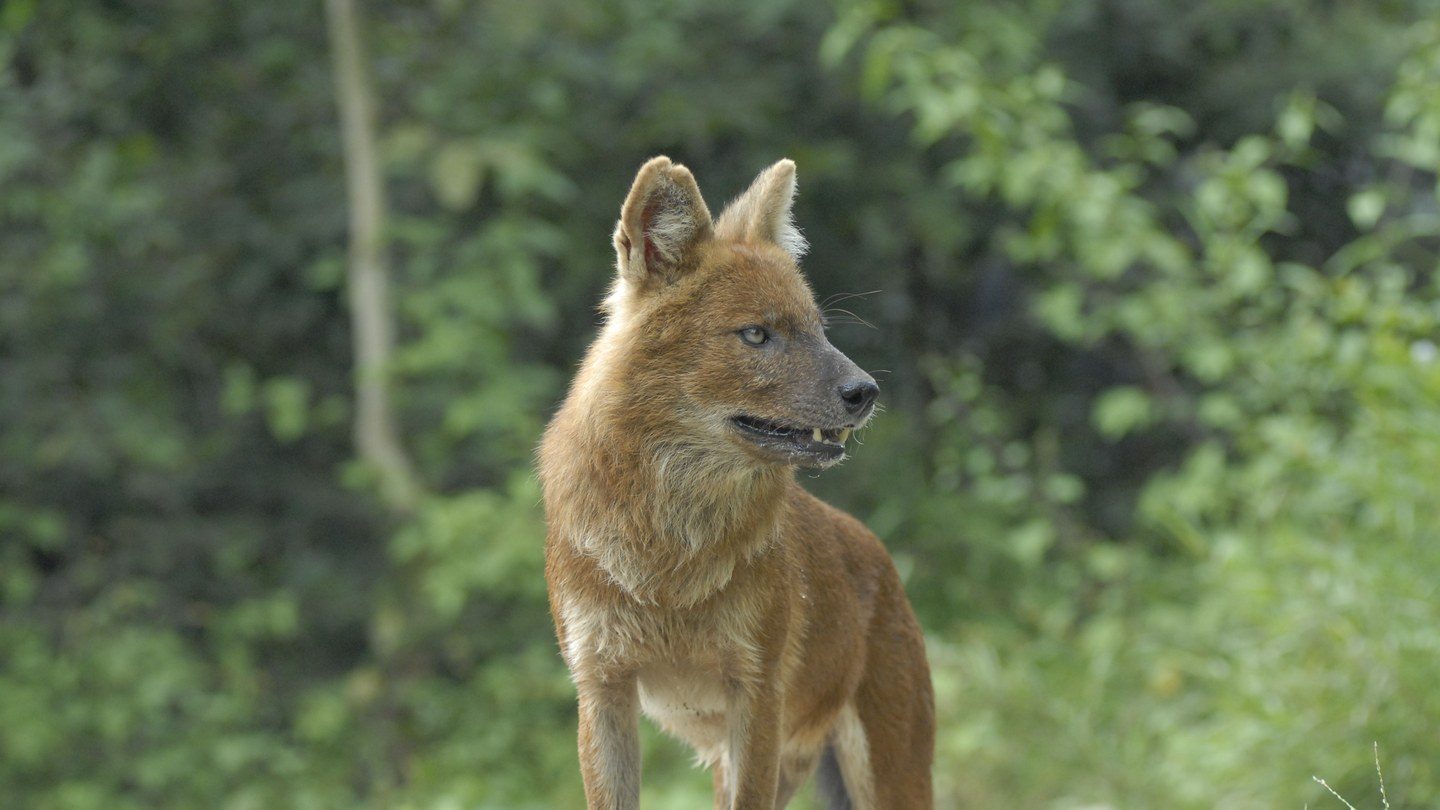
The dhole (Cuon alpinus) is a reddish-coated, pack-hunting wild dog native to forests and grasslands across South, Southeast, and East Asia, known by a string of other names, Asiatic wild dog, Indian wild dog, red dog, and whistling dog among them. At 12 to 20 kilograms, it's built roughly like a lean, long-legged domestic dog, smaller than a wolf but larger than a fox, with rounded ears, a bushy black-tipped tail, and a bite adapted for a diet almost entirely of hunted prey.
What sets it apart isn't its looks. It's the only living member of its own genus, its social calls do something few other canids can manage, and real field data on its packs and its population, gathered over decades of study in Indian tiger reserves, tells a more specific story than the usual "endangered wild dog" summary.
A separate branch, not a close wolf relative
Cuon alpinus sits alone in its genus, and the molecular evidence backs up how isolated that branch really is. A 2011 study in Molecular Biology Reports sequenced the dhole's complete mitochondrial genome and ran phylogenetic analysis across eight canid species. The result placed the fox genus Vulpes and the raccoon dog genus Nyctereutes as the earliest canid lineages to split off, with Cuon branching away next, and the genus Canis, which holds wolves, coyotes, jackals, and domestic dogs, diversifying only after that. In practical terms, a dhole is not a wolf that happens to live in Asia; it's a separate evolutionary experiment that had already gone its own way before the wolf-dog-jackal group existed in its current form.
The same study found the dhole's mitochondrial genome runs 16,672 base pairs, the shortest of the canid genomes it compared, with the size difference traced to shorter tandem-repeat segments in one non-coding control region. It's a small, technical detail, but it's a concrete marker of just how long the Cuon lineage has been evolving on its own trajectory, distinct enough at the genetic level to show up in genome architecture, not just in appearance or behavior.
A call with two pitches at once
Dholes are nicknamed "whistling dogs" for a repetitive contact call used to keep a scattered pack in touch across dense forest, where sightlines are short and a bark wouldn't carry the same information. What's unusual is what that call is made of. A 2002 study in Bioacoustics analyzed 1,317 recorded calls from 14 captive dholes and found many were biphonic, meaning the call contains two independent fundamental frequencies at once rather than one clean tone. The proportion of biphonic calls varied a lot by individual, from as low as 20% to as high as 92%, averaging 44.3% across the study group. The researchers found no overall difference in how often males versus females or adults versus subadults produced biphonic calls, though subadults leaned more toward high-frequency-only calls and adults toward low-frequency-only ones.
A follow-up 2006 study in the journal Ethology tested why the trait might exist at all, proposing that joining two frequency components into one biphonic call increases the acoustic complexity available for identifying who, specifically, is calling. In a species that coordinates pack movement and hunts by sound across terrain where animals frequently can't see each other, a call that's harder to confuse with another individual's isn't a curiosity, it's a plausible functional advantage.
The same vocal anatomy as a red fox, used differently
Producing two pitches at once usually implies some specialized anatomy, so a 2016 study in PLOS ONE went looking for it directly. Researchers dissected the vocal tracts of four captive dholes (one male, three female) and two wild red foxes, comparing the physical structures involved in sound production, and separately recorded and analyzed the calls made by the same dholes before they became post-mortem specimens. Every dhole in the study produced both high-frequency and biphonic calls. The anatomical comparison found the dhole's vocal morphology closely resembles the red fox's, despite red foxes being incapable of producing the same biphonic calls.
That's the counterintuitive part: dog-like canids such as the dhole can produce a second, higher simultaneous frequency that fox-like canids structurally cannot, yet the underlying anatomy looks almost the same across both groups. The researchers concluded the biphonic and high-frequency calls likely come down to how the existing laryngeal and nasal structures get used, not from any dhole-specific adaptation built for the purpose. The vocal hardware, in other words, isn't unusual. What the dhole does with it is.
Real pack numbers from a two-year field study
Much of what's known about dhole pack life traces back to a study by A.J.T. Johnsingh, who followed a single pack at Bandipur Tiger Reserve in Karnataka, India, from August 1976 to July 1978 and published the results in the Journal of Zoology in 1982. The pack held a home range of about 40 square kilometers, with a smaller 20-square-kilometer core area used at a density of 0.35 to 0.9 dholes per square kilometer. Counting only adults, the pack averaged 8.3 animals; counting pups too, the mean pack size reached 16. The adult sex ratio consistently favored males roughly two to one, and lone females that tried to breed outside the group had little to no success raising a litter, evidence that this species' reproduction is tightly bound to functioning as a cooperative unit, not a collection of independent pairs. Pups left the den at 70 to 80 days old and were already taking part in kills by around seven months.
Numbers like these are why the dhole is grouped with a small set of canids, including the African wild dog on a different continent, whose survival strategy depends on group coordination and not solitary or loosely paired hunting. That's a real contrast with a canid like the maned wolf, which despite the name is typically solitary or found in loosely bonded pairs instead of a coordinated pack.
Why packs shrink where tigers are common
A frequent question about the dhole is how it fares sharing forest with tigers, which outweigh it many times over. The most direct answer comes from a 2021 study in Ecology and Evolution that compared dhole pack sizes at sites across central India with differing tiger densities. Packs averaged 16.8 members (plus or minus 3.1) at sites with low tiger density, about 0.46 tigers per 100 square kilometers, but only 6.4 members (plus or minus 1.3) where tiger density reached 5.36 per 100 square kilometers. Across a wider, range-spanning comparison, pack size was negatively associated with tiger density and positively associated with prey abundance. The researchers point to a specific mechanism rather than fights: intense competition with tigers over the same prey and denning areas can cost dhole packs experienced breeders and helpers to injury or predation, which lowers hunting efficiency and pup survival and, over time, shrinks the group.
An earlier, more foundational study, Karanth and Sunquist's 1986-to-1992 fieldwork in Nagarahole published in the Journal of Zoology in 2000, looked at how tigers, leopards, and dholes manage to coexist in the same forest at all. Their answer wasn't that dholes actively flee tigers. All three predators selected different prey by species, size, and age class, and dhole hunting activity showed only partial temporal separation from the two cats. The authors concluded that ecological factors, mainly the availability of appropriately sized prey and adequate cover, drove the separation more than direct behavioral avoidance between species. Put together, the two studies suggest packs aren't shaped by dholes squaring off against tigers and losing; they're shaped by tigers indirectly raising the cost of maintaining a large, cooperative group nearby.
A population still sliding
The IUCN Red List classifies the dhole as Endangered, estimating a global population of 4,500 to 10,500 total individuals, of which only 949 to 2,215 are believed to be mature adults capable of breeding. The same assessment records the species as having disappeared from more than 82% of its historic range, including complete extirpation from Afghanistan, Kazakhstan, the Republic of Korea, Kyrgyzstan, Mongolia, the Russian Federation, Singapore, Tajikistan, and Uzbekistan, leaving most of the surviving range fragmented across South and Southeast Asia.
A 2021 genetic study in Scientific Reports added a sharper, regional data point to that picture. Researchers analyzed microsatellite DNA from 305 individual dholes across tiger reserves in Maharashtra, India, and ran simulation-based demographic modeling on the results. The analysis found a 77% to 85% decline in the major dhole subpopulations sampled, a decline the researchers link to nearly 300 years of deforestation and agricultural intensification reshaping the landscape those populations depend on. Protected tiger reserves, the same habitat that indirectly suppresses dhole pack size through competition, are now also the main refuges keeping the species' genetic structure from collapsing further, a role that makes ongoing reserve management directly relevant to whether dhole populations stabilize or keep declining.