.jpg)
The short answer
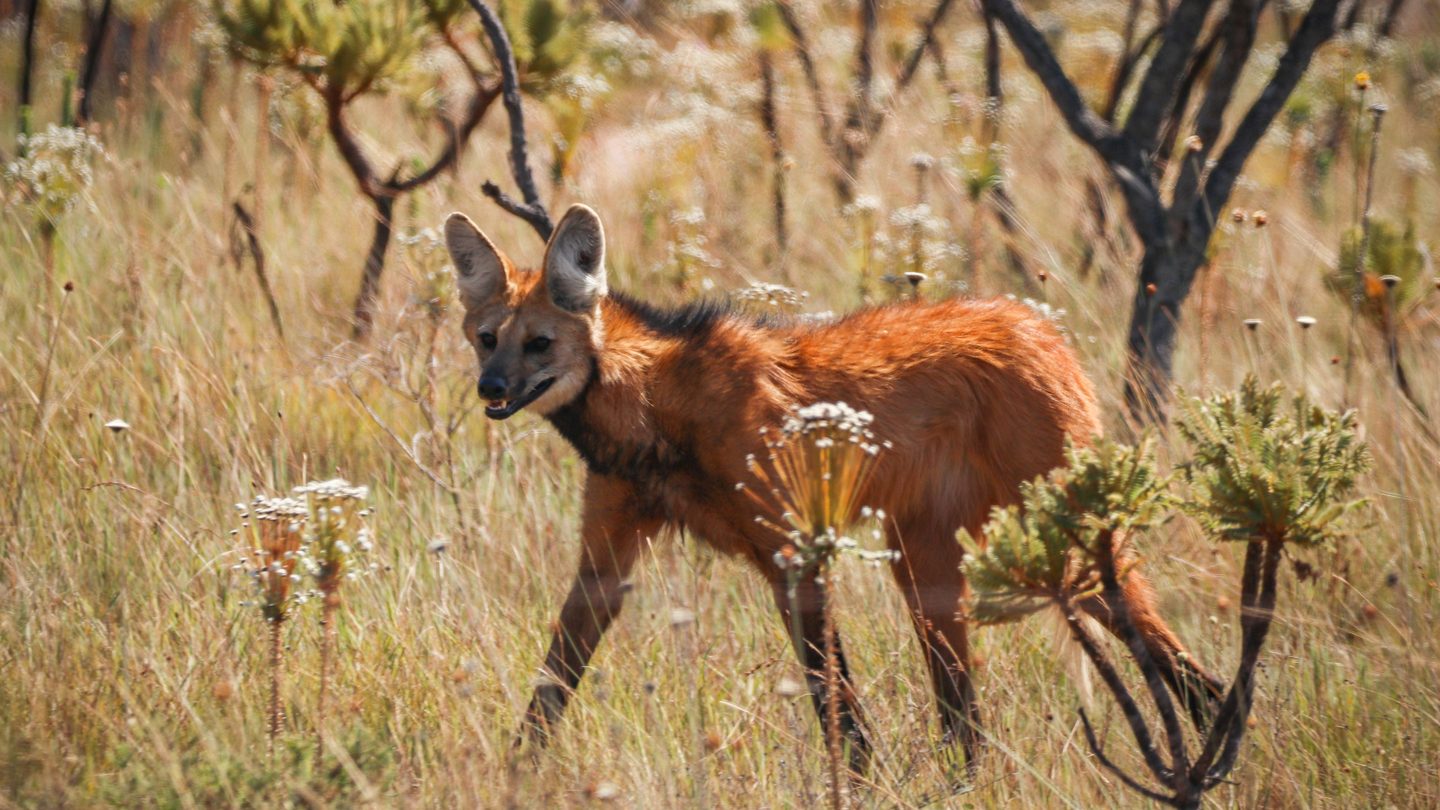
A maned wolf looks like someone stretched a fox's coloring over a deer's legs, and that impression isn't far off: it's the tallest wild canid, standing close to three feet at the shoulder on legs built to see over tall grass in the South American cerrado and Pantanal. But the name is misleading twice over. It isn't closely related to gray wolves, and despite the fox-like face and ears, it isn't a fox either. It's the sole living member of its own genus, Chrysocyon, which sits apart from both the wolf-and-dog genus Canis and the fox genus Vulpes on the canid family tree.
The more interesting part isn't the taxonomy trivia, though. This is a predator whose droppings are, by direct measurement, what lets its favorite fruit reproduce at any real rate, whose urine chemistry researchers are still trying to connect to how the species ovulates, and whose loud nighttime calls aren't the howls most people expect from something called a wolf.
Not a wolf, a fox, or a dog
"Maned wolf" is a translation of a name given by early European naturalists working mostly from physical resemblance, not ancestry. Genetic studies place Chrysocyon in a South American canid group called Cerdocyonina, and within that group its closest living relative is the bush dog (Speothos venaticus), a small, short-legged forest hunter that looks nothing like it. A 2013 study in Nature Communications, sequencing ancient DNA from museum specimens, went further and identified the maned wolf as the closest living relative of the Falkland Islands wolf (Dusicyon australis), a fox-like canid hunted to extinction by 1876. The two lineages split from a shared ancestor an estimated 7 million years ago, long before either took the specific shape it has today.
There's an older idea, based on anatomy alone, that the maned wolf sits closer to Canis, the genus holding wolves, coyotes, and domestic dogs. Molecular evidence collected since has moved away from that reading. The tall legs, upright ears, and reddish coat are a case of convergent evolution: a body plan that works well for a solitary hunter moving through waist-high grass, arrived at independently rather than inherited from a shared wolf or fox ancestor.
A predator whose diet is mostly plants
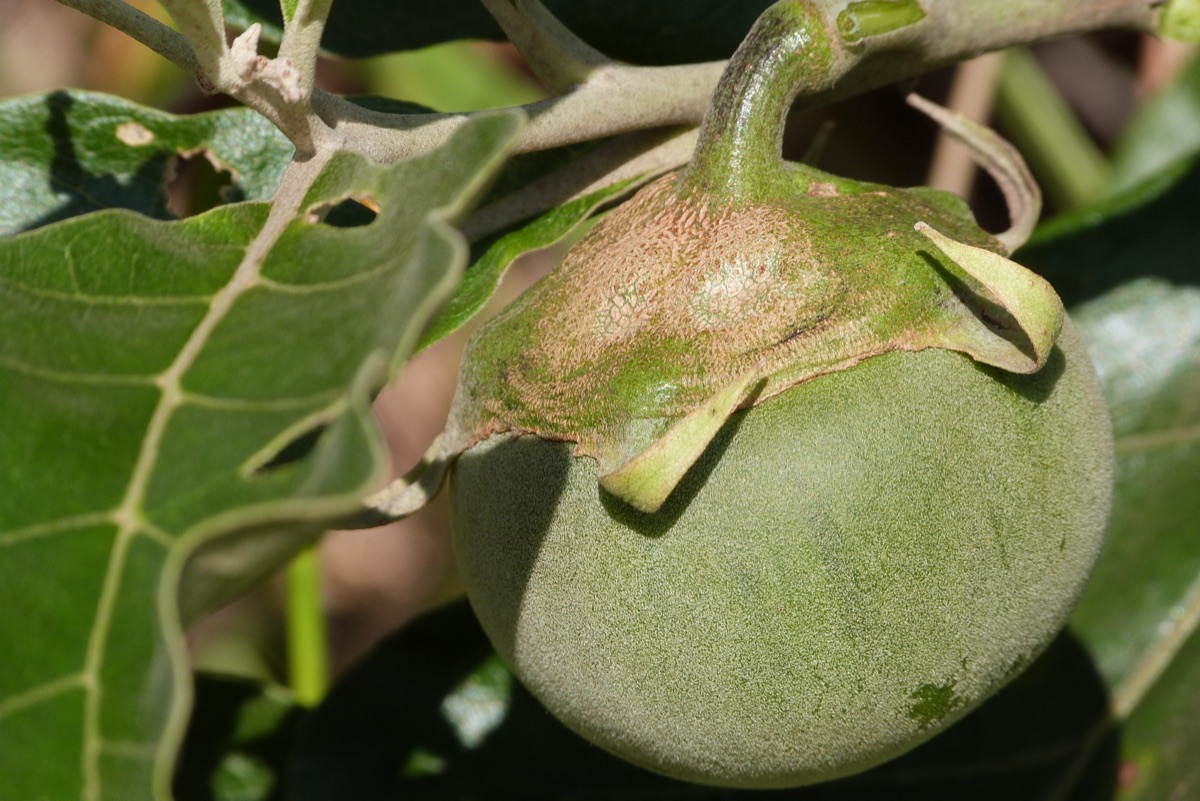
Wild canids are generally treated as carnivores by default, but the maned wolf breaks that pattern more than almost any of its relatives. A 2003 study in the Journal of Zoology, tracking the diet of maned wolves on a cattle ranch in Brazil, found that plant matter made up more than half of what the animals ate, with a single species, the lobeira or "wolf apple" (Solanum lycocarpum), accounting for close to 29% of total food biomass on its own. Lobeira is a shrub in the same family as the tomato and potato, and its round, pale green fruit is one of the wolf's most consistent food sources across the cerrado, the tropical savanna that covers much of central Brazil.
The fruit habit isn't a minor supplement to a mostly-meat diet. It's frequent and heavy enough that captive-management research treats it as a defining nutritional trait of the species: zoos have had to design specialized low-animal-protein diets specifically because feeding maned wolves like typical carnivorous canids caused real health problems, covered further down. In the wild, that same fruit-heavy habit turns the wolf into something more than a predator that happens to eat plants on the side.
Its droppings are what let the fruit reproduce
Research tracking Solanum lycocarpum seeds found a stark difference in germination depending on how the seed got there. Seeds collected directly from an intact lobeira fruit germinated at under 1%. Seeds recovered from maned wolf droppings, by contrast, germinated at 62.2% and 40.4% at two separate study sites, Ibitipoca State Park and Maripá de Minas. The mechanism is straightforward: passing through the wolf's digestive tract scarifies the seed's tough outer coat with stomach acid, the same kind of physical and chemical wear a seed would otherwise need years of weathering in soil to get through on its own.
There's a stranger twist documented at Emas National Park in central Brazil, where ecologist Orin Courtenay, then working with Oxford's Wildlife Conservation Research Unit, observed that essentially all of the cerrado's undisturbed lobeira plants were growing directly on the mounds of leafcutter ants in the genus Atta. The wolves use those same ant mounds as scent-marking posts and regularly defecate on them. The ants then drag the wolf's droppings into their nests to fertilize their underground fungus gardens, but discard roughly half the lobeira seeds onto refuse piles just outside, a nutrient-rich, disturbed patch of ground where those seeds germinate especially well. It's a three-way arrangement: the wolf gets fruit, the ants get fertilizer, and the plant gets carried to one of the few spots in the cerrado where its seeds reliably sprout.
.jpg)
The chemistry behind its skunky urine
Anyone who has walked past a maned wolf enclosure at a zoo has likely noticed a smell that visitors and keepers alike routinely describe as similar to cannabis smoke. The comparison isn't imagined. A 2021 study in PLoS ONE, led by researchers at the Smithsonian Conservation Biology Institute, collected 317 urine samples from 13 maned wolves (six intact males, one neutered male, and six females) over five months and used gas chromatography-mass spectrometry to identify the volatile compounds responsible. Two pyrazine compounds, 2,5-dimethyl pyrazine and 2-methyl-6-(1-propenyl)-pyrazine, showed up in every single sample. Pyrazines are the same broad chemical family behind the smell of roasted coffee and some vegetables, and at the concentrations maned wolves produce them, the effect reads to most human noses as distinctly skunky.
The more useful finding for researchers wasn't just that the smell exists, but that it varies in a specific way. Fifteen compounds differed significantly between intact males and females, and a much larger set, 62 compounds, differed between intact and neutered males. The maned wolf is what's called an induced ovulator, meaning females don't cycle on a fixed schedule the way many mammals do, and the mechanism that triggers ovulation is still unconfirmed. Researchers suspect it's a chemical signal carried in male urine, and the study's authors flagged several of the compounds that shifted after neutering as strong candidates for follow-up testing on exactly that question. The skunky smell, in other words, may be a side effect of a signaling system tied to reproduction, not a rejected byproduct.
It doesn't actually howl
Despite carrying "wolf" in its name, the maned wolf doesn't produce anything close to the long, rising howl associated with gray wolves. Its main long-distance vocalization is a loud, repeated "roar-bark," and a 2022 study in the journal Animals set out to figure out what that call is actually for. Researchers passively recorded audio in the species' natural habitat for more than 10 months, covering both the breeding season and the period of early parental care, and separately analyzed manual recordings of captive animals. Vocal exchanges between individuals happened more often during mating season and again during early cub-rearing, pointing to a role in keeping mated pairs in contact rather than warning off rivals.
Out of the full recording set, researchers could confidently attribute calls to specific individuals in 21 exchanges, and those calls differed measurably between the animals involved, including a consistent sex difference: male roar-barks ran about 0.124 seconds longer than female calls on average in the captive recordings. Nearly all of the multi-participant exchanges in captivity involved both a male and a female, reinforcing the idea that these are largely male-female pairs calling back and forth, not a chorus meant to intimidate outsiders. That distinction matters for how the species is often described: it's frequently, and inaccurately, lumped in with pack-hunting, group-vocalizing canids like the African wild dog or the whistle-calling dhole, when its actual social and vocal behavior points almost entirely the other way, toward a loosely bonded, mostly solitary pair rather than a coordinated group.
Why it doesn't make a good pet
Beyond the legal and conservation issues of keeping a wild species that the IUCN classifies as Near Threatened, with a global population estimated at roughly 17,000 mature individuals, more than 90% of them in Brazil, the maned wolf has a specific medical vulnerability that makes it a poor fit for anything resembling typical pet-dog care. Veterinary research on captive populations has found cystinuria, a metabolic condition in which the amino acid cystine isn't properly reabsorbed by the kidneys, in a majority of maned wolves tested, in both zoo populations and the wild. Left unmanaged, excess cystine can crystallize into painful, sometimes dangerous stones or blockages in the kidneys or bladder. The leading suspected cause is a mismatch between the species' naturally omnivorous, fruit-heavy diet and the high-animal-protein food historically fed to canids in captivity, which is exactly why fennec fox-style small-carnivore diets or standard dog food don't translate to this species. Zoos and sanctuaries now generally use a specially formulated low-animal-protein diet developed specifically to manage the condition, alongside close veterinary monitoring, an arrangement that only makes sense in a dedicated conservation facility. Even other unusual-looking wild canids kept in professional care, like the oversized-eared fennec fox, tend to have far more forgiving dietary needs than the maned wolf's cystinuria risk allows.