
The short answer, with the numbers
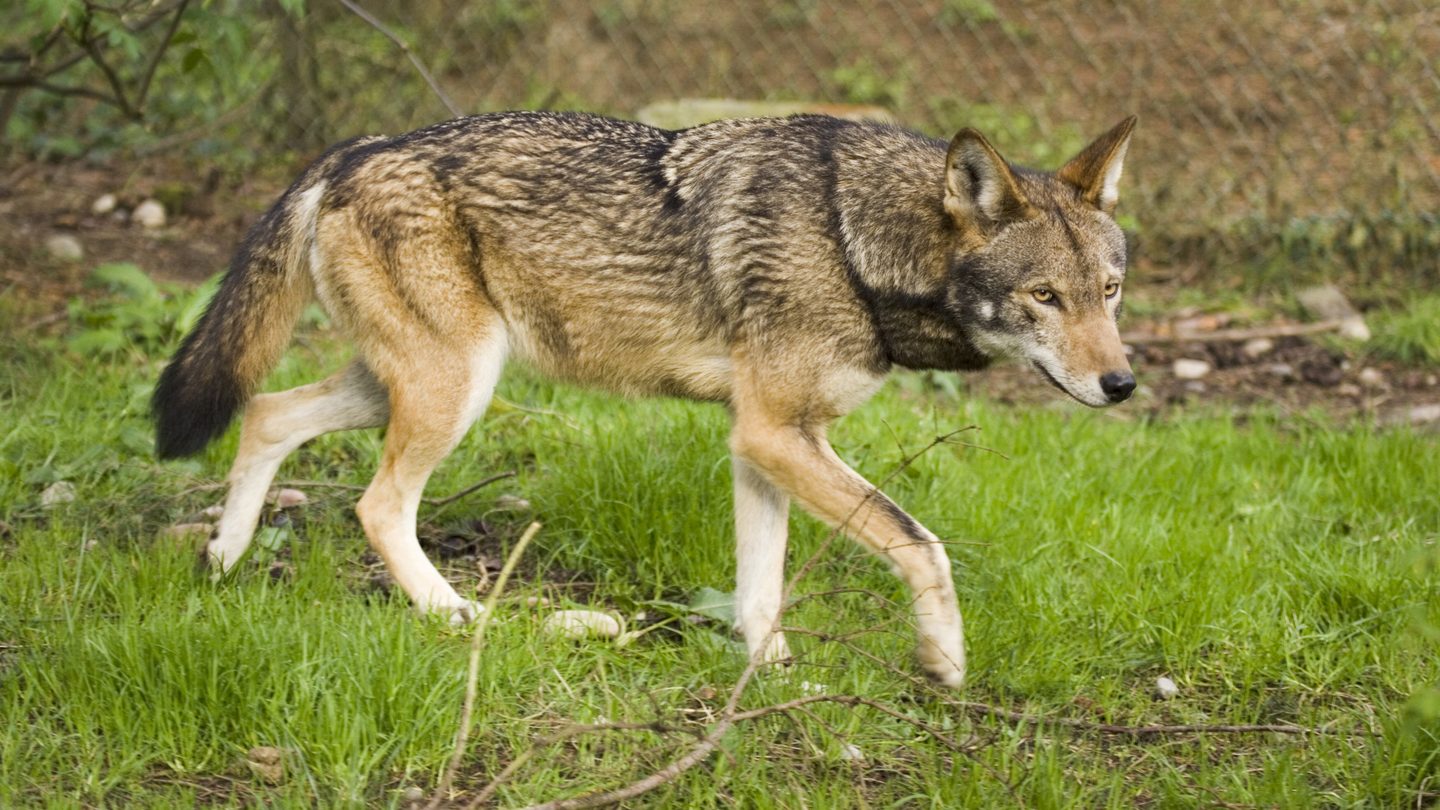
A red wolf is bigger, but the gap is smaller than people expect. The U.S. Fish and Wildlife Service's red wolf species profile lists adult red wolves at 45 to 80 pounds, standing about 26 inches at the shoulder, and running about 4 feet from nose to tail tip. National Geographic's coyote fact sheet puts adult coyotes at 20 to 50 pounds, with a head and body of 32 to 37 inches plus a 16-inch tail, and a shoulder height of roughly 20 to 22 inches by wildlife-agency identification guides such as Iowa DNR's canid ID sheet. Do the math and an 80-pound red wolf and 50-pound coyote aren't close, but a 45-pound red wolf and a 50-pound coyote overlap. Weight alone won't always settle it.
| Trait | Red wolf | Coyote | Source |
|---|---|---|---|
| Weight | 45 to 80 lb | 20 to 50 lb | FWS / National Geographic |
| Shoulder height | About 26 in | About 20 to 22 in | FWS / Iowa DNR canid ID guide |
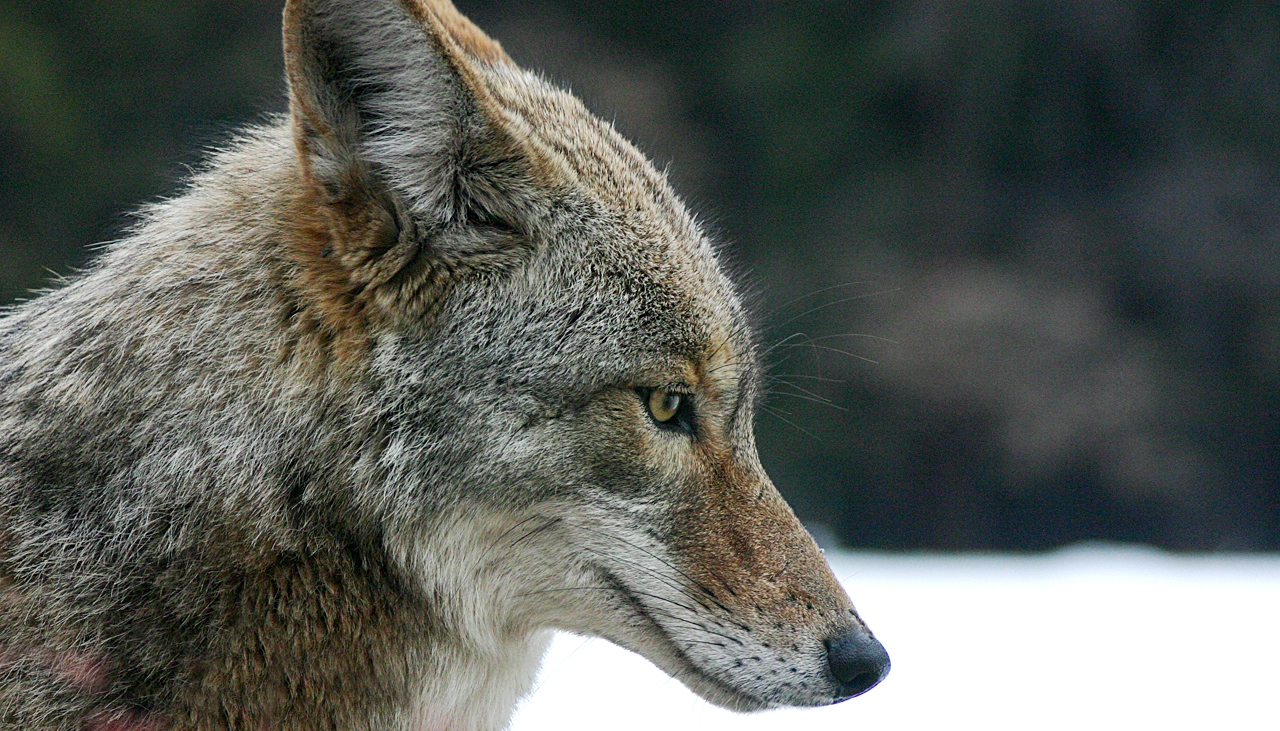
| Head and muzzle | Wide head, broad muzzle | Long, narrow snout | FWS / IFAW |
| Coat | Brown/buff with black along the back, reddish ears and legs | Greyish-brown with reddish patches, lighter underside | FWS / IFAW |
| US status | Endangered; ~21-23 known wild adults (Aug 2026) | IUCN Least Concern; population increasing | FWS / IUCN via National Geographic |
| Range | One wild population, 5 counties in eastern NC | 49 US states plus parts of Canada and Central America | FWS / National Geographic |
The muzzle is the real giveaway, not the size
Head shape holds up better than weight. FWS describes the red wolf as having "wide heads with broad muzzles, tall pointed ears and long, slender legs with large feet." IFAW's coyote profile describes the opposite build: "long, coarse, greyish-brown fur," a bushy tail, and "a long, slender snout." Side by side, the coyote's face tapers to a point; the red wolf's does not.
Ear shape turns out not to be a reliable tell between these two specifically, even though it's often cited as one for gray wolves versus coyotes. FWS's listing gives the red wolf "tall pointed ears," and IFAW describes the coyote's as "erect and pointed" too. Coat color also overlaps: both animals mix brown, buff, and reddish tones, and FWS notes red wolves often show "a reddish color on their ears, head and legs," which is exactly the kind of patch IFAW describes on coyotes. Color alone is not a safe field ID.
Where the two do reliably diverge is where they live and how they act around people. FWS describes red wolves as elusive, most active at dawn and dusk, and generally avoiding humans and human activity, all inside a single wild range in coastal North Carolina. Outside that recovery area, an animal is unlikely to be a wild red wolf. Geography alone does not distinguish a coyote from another canid, such as a dog or gray wolf.

What a "red wolf" even is, is still argued over
This isn't settled trivia. FWS's 2018 five-year status review of the red wolf lays out a genuine scientific dispute: genetic techniques applied since the 1990s produced "new hypotheses suggesting the red wolf evolved via hybridization between gray wolves and coyotes," with researchers disagreeing over whether that mixing happened in the Pleistocene, thousands of years ago, or as recently as 300 years ago with European settlement. Some geneticists conclude the red wolf is a distinct species; others conclude it's "merely a hybrid and not distinct from gray wolves and coyotes," per that review's summary of the literature.
FWS's position, and the one this guide uses, is that the red wolf is Canis rufus, its own listed endangered species, currently found nowhere in the wild except the reintroduced population in North Carolina. Whatever its deep ancestry, the modern population is real, small, and managed as a distinct conservation unit. The coyote, Canis latrans, carries none of that ambiguity: it's never been a candidate for endangered status, and the IUCN lists it as Least Concern with a growing population.
Why they keep interbreeding
The two species don't just look similar in places, they sound similar too. A 2016 University of Cambridge study led by Arik Kershenbaum analyzed howls from wolves and coyotes worldwide and found "significant overlap between the howling vocabulary of the red wolf and the coyote," with both favoring the same highly modulated, whining howl type. "The survival of red wolves in the wild is threatened by interbreeding with coyotes, and we found that the howling behaviour of the two species is very similar," Kershenbaum said. "This may be one reason why they are so likely to mate with each other." For how a dog's howl connects back to its wolf ancestry, the why do dogs howl guide covers a 2023 playback study in which wolf-howl responses depended on both breed ancestry and age.
FWS names hybridization, not habitat loss or hunting, as the single biggest threat to red wolf recovery. Red wolves actively defend territory against other canids, including other wolves, but when the wild population is this small, a red wolf that can't find a red wolf mate will pair with a coyote instead, and the pairing produces fertile offspring.
Biologists have spent decades fighting that math with a strategy nicknamed the "placeholder" program. Wildlife biologist Eric Gese explained it to The Wildlife Society: field teams sterilize coyotes in the recovery area rather than removing them outright, because "you can kill coyotes but you're just going to be mowing the lawn" as new coyotes move in to replace them. A sterilized coyote instead holds its territory, unable to produce hybrid pups, until a red wolf eventually displaces it. "We essentially found that 37 percent of the placeholders were displaced and it led to occupancy by a red wolf," Gese said, and displacement usually meant a female red wolf pushing out a smaller female coyote, or a male wolf displacing a male coyote. The tradeoff: the same research found coyotes had higher survival rates than red wolves in 12 of 14 years studied, so keeping them as placeholders rather than eliminating them was also the more sustainable option.
One population is collapsing, the other is everywhere
Their conservation status could not point in more opposite directions. FWS's red wolf recovery program page, updated for August 2026, puts the known/collared wild population at 21 animals, with a total estimate of 22 to 23 adults and subadults plus 14 to 15 pups. That's the entire wild population of red wolves on Earth, confined to Beaufort, Dare, Hyde, Tyrrell, and Washington counties on North Carolina's Albemarle Peninsula, the only place a 10(j) rule allows an experimental reintroduced population. A further 295 red wolves live in the captive-breeding SAFE program as a genetic backstop. The species was declared extinct in the wild in 1980, reintroduced starting in 1987, and has never recovered a second wild population.
Coyotes are the mirror image. National Geographic's range summary notes coyotes have expanded from their historical range in the prairies and deserts of Mexico and the central U.S. into an increasing number of American and Canadian cities, and are now established in all 49 continental U.S. states. The IUCN lists the coyote as Least Concern with a current population trend of increasing. One species can only be found by wildlife biologists tracking radio collars in a handful of North Carolina counties; the other is common enough to den under suburban decks.
Diet, territory, and family life
Both are pack animals, but the packs run differently. FWS describes red wolf packs as typically five to eight animals: a breeding pair that mates for life, pairing once a year in February, with pups born in April or May and older offspring often helping raise the litter before dispersing at one to two years old. Red wolves range over 20 to 80 square miles depending on prey, can travel 20 miles or more a day, and eat mostly white-tailed deer, raccoons, rabbits, rodents, and nutria, consuming 2 to 5 pounds of food daily as opportunistic feeders. Fewer than half of wild-born pups survive to adulthood, FWS notes, with disease, malnutrition, and predation the main causes.
Coyotes are more flexible generalists. Research summarized by the National Wildlife Federation puts roughly 90% of a coyote's diet as mammalian, mostly small prey like cottontail rabbits, ground squirrels, and mice, though coyotes also eat birds, fruit, and deer fawns, and can live on small habitat patches because their prey and energy needs run lower than a wolf's. Coyotes are also, per that research, the most vocal wild mammal in North America, using at least three distinct call types, including the yip-punctuated howl that Kershenbaum's study found overlapping with the red wolf's howl type. The dhole, a wild dog classified in its own genus rather than as a wolf species, has its own distinct two-pitch call; the dhole guide covers that bioacoustics finding. For another canid whose common name overpromises, the maned wolf guide covers a South American species that, despite the name, isn't a wolf, fox, or dog.