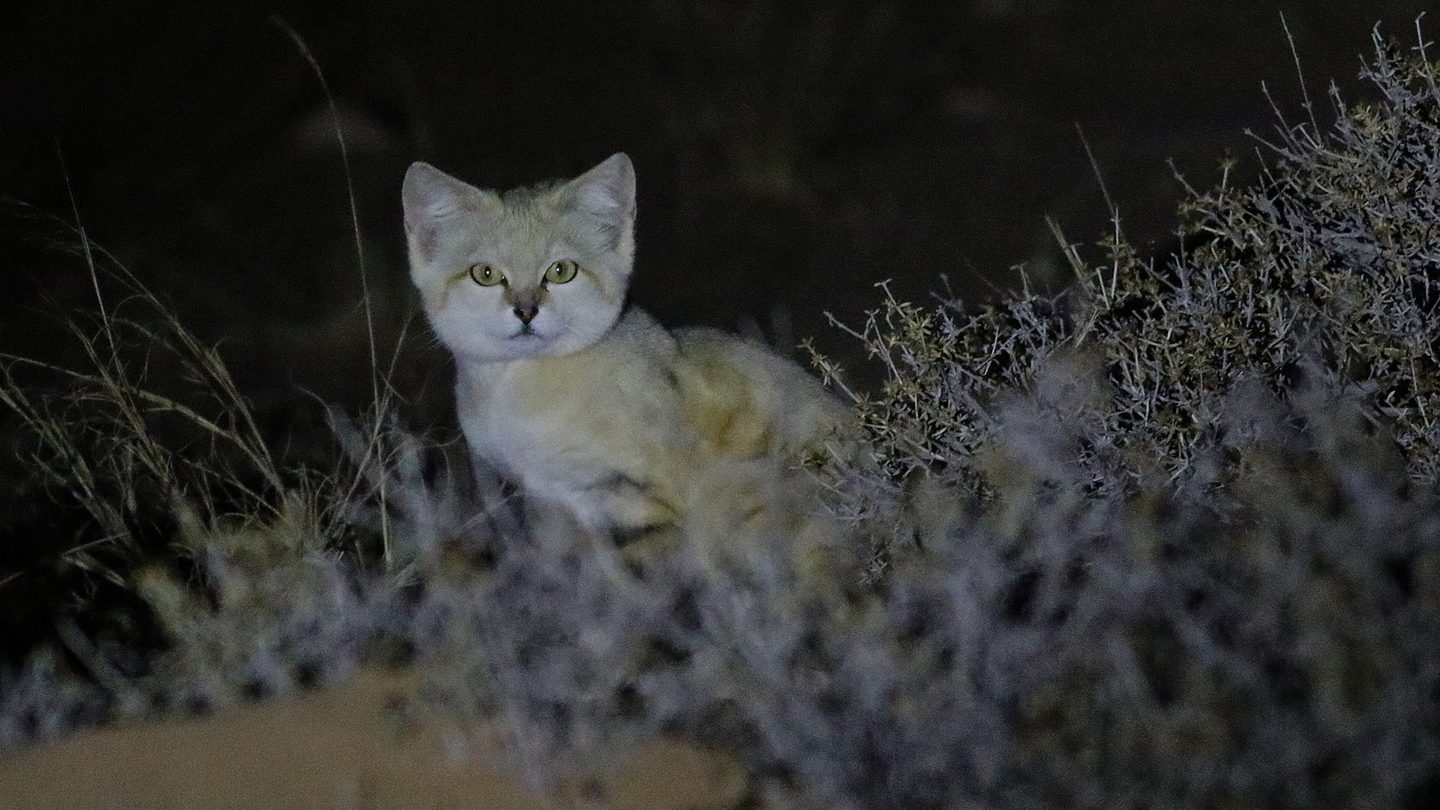

The short answer: no
A sand cat is smaller than the cat on your sofa. Adults weigh 1.5 to 3.4 kilograms, or about 3.3 to 7.5 pounds, on a head-and-body length of 39 to 52 centimetres with a 23 to 31 centimetre tail. That is a scaled-down house cat, not a miniature leopard, and at that size there is no plausible way for one to hurt a person. The Smithsonian's National Zoo says so outright in its sand cat Q&A; asked whether the cats are dangerous to humans, the zoo answers "not really," adding that they are unlikely to attack animals much bigger than they are and that meetings between people and sand cats are rare because the deserts the cats live in are so hostile to human life.
The behavior points the same way. Sand cats are solitary and nocturnal, and they are built to disappear. One field account describes a sand cat closing its eyes when a person approaches, holding still and leaning on camouflage, which is the opposite of an animal looking for a fight. Animal Diversity Web lists no negative impact of the sand cat on people, filling that section instead with the one real risk the species poses: it can carry diseases that affect domestic animals.
Why they get called deadly, and who that means
The reputation is deserved, it is just aimed elsewhere. The sand cat is the only cat found across true desert, and it survives there by catching almost anything it can overpower: gerbils, jirds, jerboas, spiny mice, young hares, small birds such as the desert lark, lizards, geckos, insects, and snakes. The IUCN SSC Cat Specialist Group's species account lists horned and sand vipers (Cerastes species) among their regular prey.
The equipment fits the work. A sand cat's ear canal is about twice the size of a domestic cat's, its hearing at low frequencies roughly 8 decibels sharper, and its ears sit low and wide on the skull, all adaptations for picking up prey that is moving underground. The Smithsonian notes that a sand cat eats about 10 percent of its body weight a day, which scaled to a person would mean 7 to 9 kilograms of food.
In the Ténéré, a desert region of south-central Sahara, researchers watched sand cats take Cerastes vipers and bury whatever they could not finish. A sand cat is a dangerous animal if you happen to be a viper.
The snake-venom immunity claim does not hold up
Popular write-ups about the sand cat often add a flourish: that it is immune to snake venom, so a viper bite simply does not land. The claim is absent from the IUCN species account and from the Smithsonian's page, and neither attributes the cat's success with snakes to venom resistance. The mechanism discussed in the literature is speed, the cat pinning a strike before it connects.
Real venom resistance would be a striking physiological result, the kind that puts a species in textbooks, and it would be easy to cite. What the sources describe instead is a small predator eating a dangerous meal and getting away with it, which is remarkable enough without the invented immunity.
Where the risk falls
For sand cats, people are the hazard. The animals are caught and sold. Animal Diversity Web lists the illegal pet trade among the human pressures on the species, and sand cats have been caught for the pet trade in the United Arab Emirates and Iraq, including two sold as pets in Baghdad in 2012 that were handed to a nursery and died within a week (Wikipedia, checked 2026-10-12).
A 2026 WWF Japan report on live wild animal imports puts numbers on that trade. Japan imported 94 sand cats between 2020 and 2024. Of the 73 that came through Thailand, 53 carried the source code "wild," meaning they were taken from Sudan, part of the species' native range. Pet-store advertisements priced sand cats at 2.2 to 4.95 million yen, about 13,843 to 31,146 US dollars, the highest of any carnivore the report tracked. The report's own description of the animal is blunt: a wild feline that is not suitable for a pet, and yet advertised for sale.
Why sand cats do badly in captivity
Sand cats are not domestic cats, and a house is close to the worst place for one. The species sits on CITES Appendix II, which regulates international trade, and the husbandry record is unforgiving. Captive sand cats are highly sensitive to respiratory disease, and feline viral rhinotracheitis is the leading cause of death in adults kept in captivity, which is why the animals have to be housed in enclosures with stable, arid air. The European Endangered Species Programme population descends from only 18 founders, almost all of them from the Arabian Peninsula, a narrow genetic base for a cat that does not breed readily.
The pet-insurance blog that currently ranks for this question reaches the same conclusion from the other direction, noting that people who have tried keeping sand cats find the animals develop respiratory infections once they are away from the desert.
So are sand cats endangered?
Not formally, and that is part of what makes the question confusing. The IUCN Red List's 2016 assessment moved the sand cat from Near Threatened to Least Concern, on an estimated global population of 27,264 mature individuals. That number rests on a single density estimate of 2.9 cats per 100 square kilometres from southern Israel, and the animal is so rarely recorded that its true numbers stay a guess.
Least Concern is not a clean bill of health. The IUCN account lists habitat loss, deliberate and accidental killing through poisoning, snares and fencing, prey depletion, disease, and the pet trade as live pressures, and records the species as locally extinct in Israel and possibly extinct in Pakistan. Legal protection is patchy: hunting is prohibited in Algeria, Iran, Israel, Kazakhstan, Mauritania, Niger, Pakistan and Tunisia, and there is no legal protection at all in Egypt, Mali, Morocco, Oman, Saudi Arabia and the United Arab Emirates.
A sand cat is not dangerous to you, and the way it is treated is dangerous to it. Related reading: the official count of wild cat species, the fishing cat, and which four big cats roar.