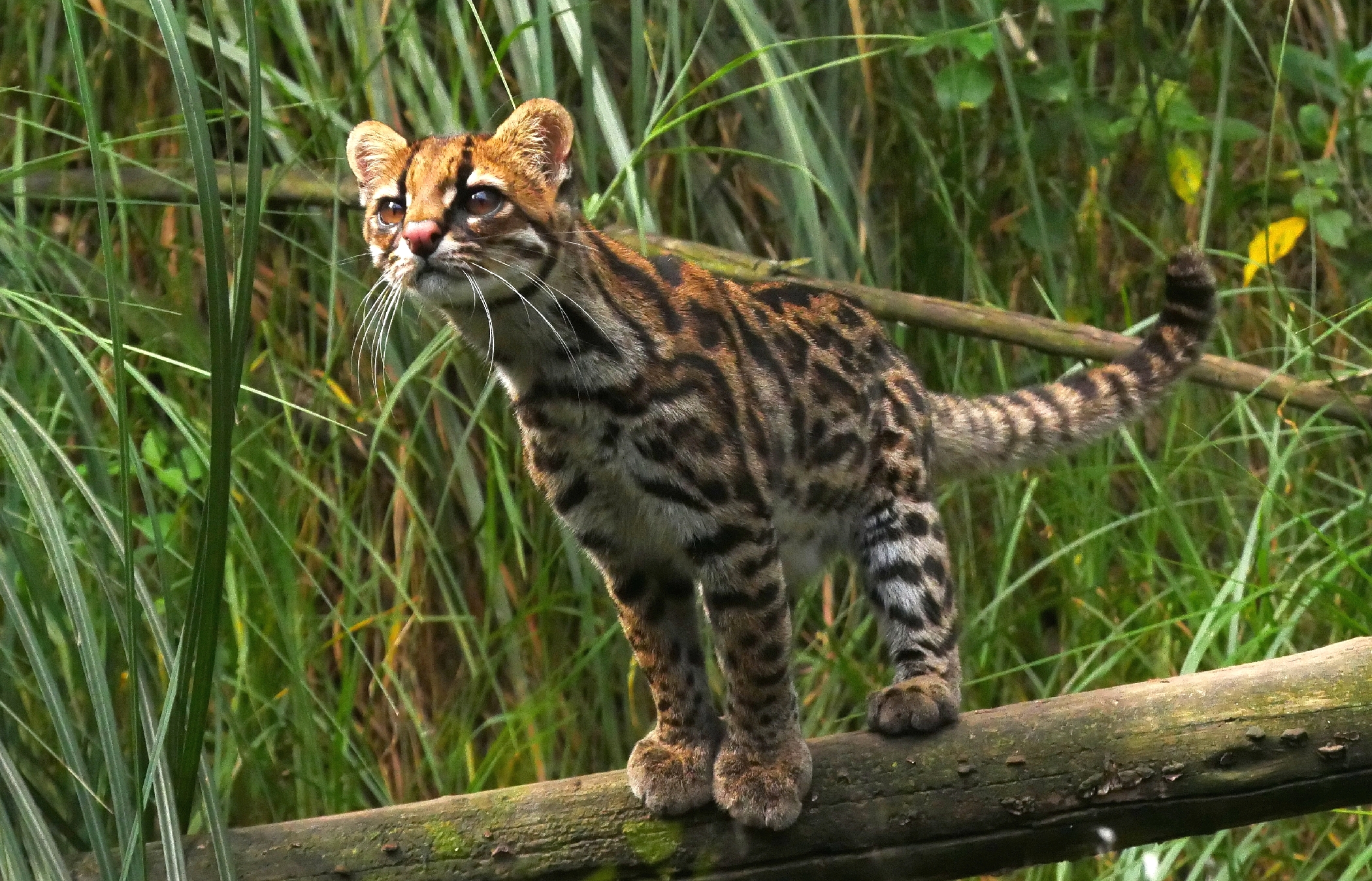

A 2006 genetic study drew the map before any committee voted on it
Before 2006, cat classification leaned heavily on skull shape, coat pattern, and body size, the same tools naturalists had used for a century. Johnson, Eizirik, and colleagues changed that with a genetic assessment published in Science, sequencing 22,789 base pairs of autosomal, X-linked, Y-linked, and mitochondrial DNA from nearly every living cat species and calibrating the results against 16 fossil dates. The analysis found that all 37 living felid species descend from a common ancestor in Asia less than 11 million years ago, radiating outward through at least 10 separate intercontinental migrations across land bridges that later disappeared, and separating into eight principal lineages: Panthera, bay cat, caracal, ocelot, lynx, puma, leopard cat, and domestic cat. A separate ghost-lineage analysis in the same paper estimated that the fossil record underestimates when those lineages actually first appeared by an average of 76 percent, meaning cats radiated into most of their modern diversity well before the physical evidence available to paleontologists.
That 2006 paper didn't rename a single species. What it did was hand taxonomists a dated family tree built from DNA sampled across nearly the entire cat family rather than skeletal traits alone, and every major reclassification since has worked within the eight lineages it defined.
Formal taxonomy caught up in 2017, and stamped a number on it: 40
Eleven years passed between that genetic framework and an organization willing to formally re-draw the family based on it. The IUCN/SSC Cat Specialist Group convened a Cat Classification Task Force of roughly 22 experts, chaired by Andrew Kitchener, and published its findings as an 80-page special issue of Cat News in 2017. The task force adopted a traffic-light certainty system, color-coding each proposed species by how strong the morphological, molecular, and biogeographic evidence behind it was, and landed on two subfamilies, the same eight genetic lineages Johnson's team had identified, 14 genera, 77 subspecies, and 41 species in total: 40 wild cats plus the domestic cat. That was a substantial departure from the previous standard reference, W. Chris Wozencraft's 2005 chapter in Mammal Species of the World, which had organized the family differently and recognized fewer distinct species.
That 40-wild-species figure is not a historical footnote. The Cat Specialist Group's own 2024-2025 report to the IUCN Species Survival Commission still describes its mission as conserving "the world's 40 wild living cat species," the same number set in 2017. For an organization built around Red List conservation assessments, a lower, well-vetted species count has a practical logic: each assessment takes years of population and range data, and re-splitting a widely studied species resets that clock.
Two later papers already outrun that number, and nobody has reconciled them
The 2017 baseline didn't freeze the underlying science. Jonas Feijó, Ji-Long Cheng, and Fabio Nascimento published an integrative taxonomic revision of the pampas cat complex in the Zoological Journal of the Linnean Society in 2021, combining the broadest morphological dataset assembled for the group with molecular sequencing and ecological niche modeling. What had been treated as a single species, Leopardus colocola, with a tangle of disputed subspecies, came out the other side as five separately diagnosable species: L. braccatus, L. colocola, L. garleppi, L. munoai, and L. pajeros, distinguished by skull and pelage traits, distinct climatic niches, and molecular species-delimitation tests. The revision didn't recognize any subspecies within the group at all, treating each of the five as a complete, self-contained species.
A second revision followed in January 2024. Nascimento and colleagues built species distribution models from more than 1,400 museum specimens and photographs covering the four subspecies previously lumped under the tiger cat complex, running ecological, biogeographic, and phenotypic analyses together instead of leaning on any single line of evidence. The result split the group into three distinct populations occupying different habitats: a savanna tiger cat across the Guiana Shield and central-northeastern Brazil, an Atlantic Forest tiger cat in Brazil's coastal lowland forests, and a newly elevated clouded tiger cat, Leopardus pardinoides, restricted to high-altitude cloud forest across Central America and the Andes. Mongabay's coverage of the paper noted that the new range maps also showed historic distributions shrinking by 50 to 68 percent, changes with direct consequences for how each population gets assessed and protected. Between the pampas cat and tiger cat revisions, published, peer-reviewed taxonomy has already proposed more distinct wild cat species than the Cat Specialist Group's 2017 count includes, and as of this writing neither organization has issued a joint reconciliation. A tracker site that follows every published paper on its own schedule, not any single institution's Red List calendar, Wild Cat Family, counted 45 species as of its November 2024 update, five more than the IUCN's own page states.
The fishing cat and the pallas cat belong to the broader Felidae family mapped by the 2006 study. Fishing cats hunt in wetlands; Pallas cats have been tracked across the Mongolian steppe. Those ecological differences are separate from the proposed species splits within Leopardus. The margay, a close South American relative of the newly split tiger cats, has kept its single-species status throughout both revisions, a reminder that taxonomic churn concentrates on genera with genuinely blurry boundaries rather than spreading evenly across the family.