_(CWPG).jpg)
Round pupils and 9,000 hairs per square centimeter
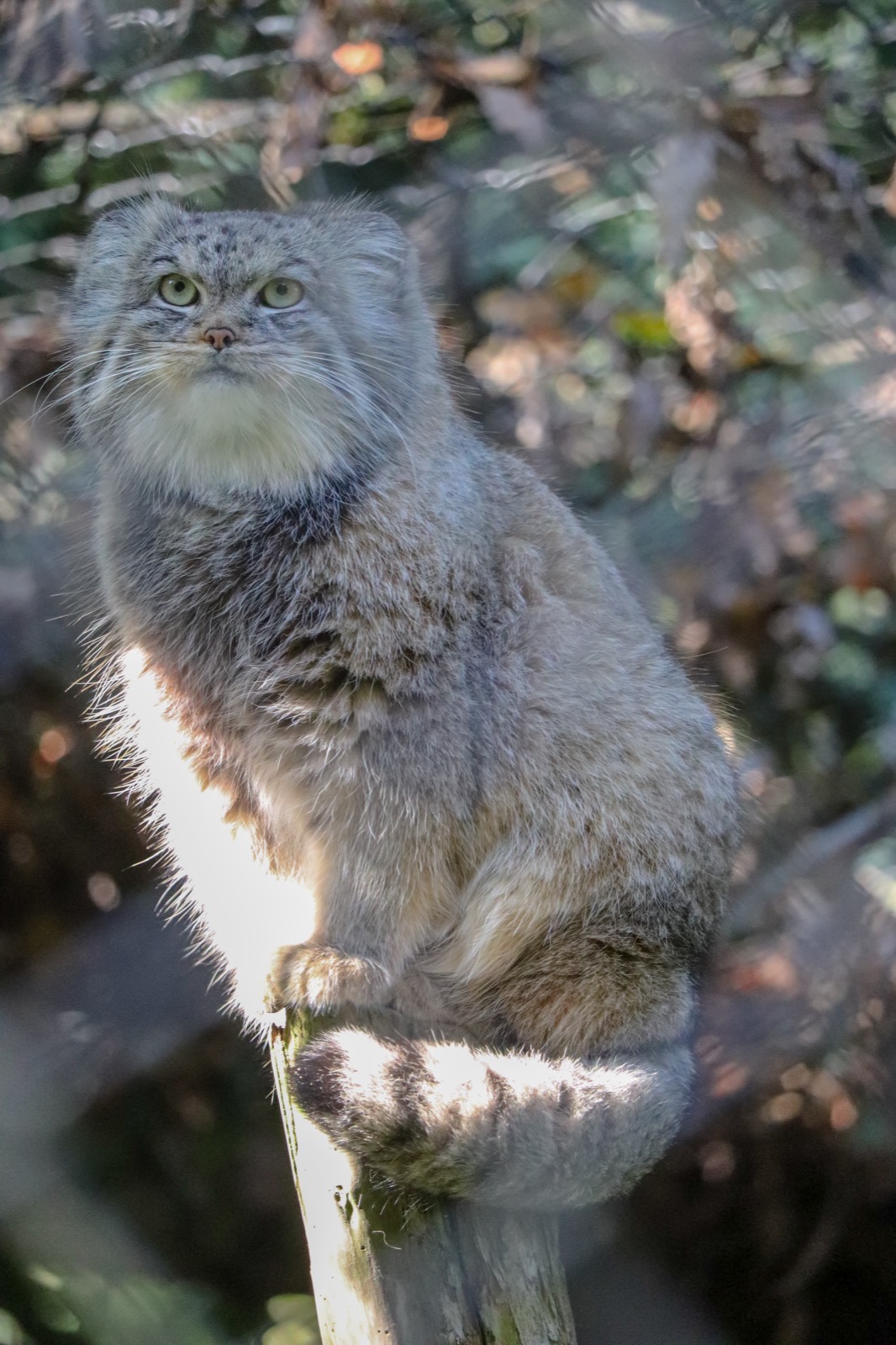
Per the IUCN Cat Specialist Group, Pallas's cats have a stocky, short-legged build with a head-and-body length of 46 to 65 centimeters and a bushy tail 21 to 31 centimeters long, and Smithsonian's National Zoo puts adult weight at roughly 4 to 11 pounds (about 1.8 to 5 kilograms). The build looks bigger than it is because of the coat: a figure widely cited by zoos and conservation groups, tracing to Sunquist and Sunquist's reference work Wild Cats of the World, puts fur density at around 9,000 hairs per square centimeter, among the densest of any cat species, with the hair on the underparts running nearly twice as long as on the back.
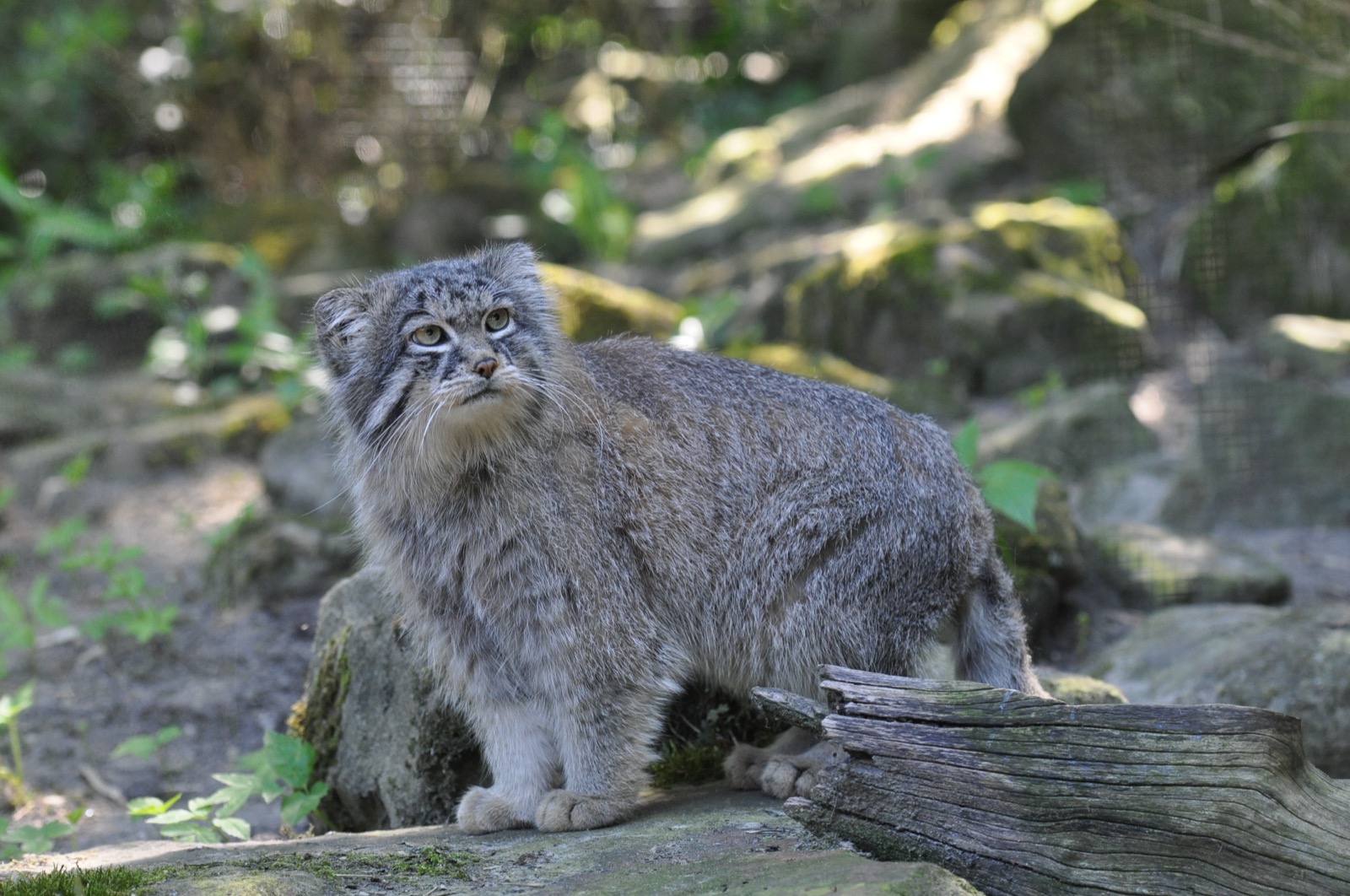
Two other traits set the species apart from most other small cats. Per the Smithsonian's National Zoo, Pallas's cats have round pupils rather than the vertical slits seen in most felids, a feature rare enough among cats that it stands out on sight, and researchers there describe the round shape as useful for judging distance. When threatened, the cat doesn't run; it flattens its body against the ground and freezes, letting its frosted grey-and-tan coat blend into the rock and scrub of its Central Asian range. Its body is too low and too stocky to outrun much of anything, so it doesn't try. A fishing cat uses stillness to hunt, crouching at a riverbank and luring a fish within striking range before it plunges in; the Pallas's cat uses the same tool for the opposite job, holding still to disappear rather than to strike.
.jpg)
A breeding pair, 24 kittens, and a 58 percent death rate
Wolfgang Basso and colleagues published the clearest early account of the problem in Parasitology in 2005: a single breeding pair at Vienna's Schönbrunn Zoo produced 24 kittens between 1998 and 2002, and 58 percent of them died between the second and fourteenth week of life, mostly from acute toxoplasmosis. That wasn't an isolated cluster. Simon Girling and colleagues, writing in the Journal of Zoo and Wildlife Medicine in 2020, reported that across European Association of Zoos and Aquaria institutions between 2006 and 2016, Pallas's cats died at a rate of 71.59 percent from all causes in their first year of life, with systemic toxoplasmosis, confirmed by postmortem examination and histopathology, the single largest infectious cause at 20.6 percent of deaths.
The species appears unusually vulnerable to a parasite, Toxoplasma gondii, that most cats and most mammals carry without incident. Christiane Ketz-Riley and colleagues, examining five neonatal Pallas's cats that died of toxoplasmosis with a concurrent herpesvirus infection at the Oklahoma City Zoo, reported in the Journal of Zoo and Wildlife Medicine in 2003 that blood work on the animals showed defective interleukin-12 gene expression in every cat tested and reduced lymphocyte responses in others, pointing to an immune dysfunction built into the species rather than an unusually harsh environment or exposure route. Fennec foxes carry a comparably fixed trait: as an earlier FactCrumbs piece on fennec fox kidneys covers, their concentrating kidneys can't be replicated by captivity no matter how the enclosure is designed. Pallas's cats' apparent vulnerability to Toxoplasma reads the same way, a trait a zoo has to work around, not one it created.
A prophylactic antibiotic, tested at two collections since 2014
Girling's 2020 paper describes what happened when two collections that had previously recorded 100 percent mortality from toxoplasmosis in kittens under a year old changed their protocol. Starting in 2014, kittens at those two collections received a prophylactic course of the antibiotic clindamycin covering the periods of highest Toxoplasma exposure risk, applied to a cohort of 17 kittens. Over the two years that followed, first-year mortality at those collections fell to 5.88 percent among treated animals, a 67.03 percent reduction the paper reports as statistically significant, with a 95 percent confidence interval of 41.76 to 78.61 percent on the size of the effect.
The paper doesn't claim the underlying immune vulnerability identified by Ketz-Riley's team has been explained or fixed; clindamycin works by suppressing the parasite during the window kittens are most exposed to it, not by correcting whatever makes Pallas's cats susceptible in the first place. What changed is that a specific, previously near-total cause of death in captive kittens now has a documented countermeasure that two real collections actually tried, not just a fix proposed on paper.
In Mongolia, male ranges run four to five times larger
Wild Pallas's cats face a different set of pressures than captive ones. Steven Ross, Bariushaa Munkhtsog, and Stephen Harris GPS-tracked 9 male and 16 female Pallas's cats across the central Mongolian steppe between 2005 and 2007, publishing their results in the Journal of Mammalogy in 2012. For the 13 females with enough location fixes to calculate a reliable estimate, 95-percent-kernel home ranges averaged 23.1 square kilometers; for the 9 males, the average was 98.8 square kilometers, with individual male ranges spanning as wide as 20.9 to 207.0 square kilometers. That's roughly a four- to fivefold gap between the sexes, and the study's authors found it held regardless of prey density or season, ruling out the simplest explanation that males just have to work harder to find food.
The IUCN reassessed the species from Near Threatened to Least Concern in 2020. The assessment itself credits better survey data for the change, not any measured increase in cat numbers on the ground, and the current listing estimates roughly 58,000 mature individuals with a population trend that may still be declining. Regional threats named in the assessment include direct poaching, secondary poisoning from rodent-control campaigns that target the pikas and ground squirrels the cats depend on for prey, and habitat fragmentation from mining and infrastructure development across its Central Asian range. A species can be reclassified as less at risk on paper, in other words, without a single one of the pressures documented on the ground having eased.