.jpg)
A force plate made of lasers and reflective glass beads
You can't strap a force plate to open water, so in a 2004 study published in the Proceedings of the National Academy of Sciences, Harvard researchers S. Tonia Hsieh and George Lauder measured basilisk water-running forces a different way: they seeded a water track with near-neutrally-buoyant, silver-coated glass spheres, lit a thin cross-section of the water with a laser sheet, and filmed five juvenile plumed basilisks (Basiliscus plumifrons, 11.4 to 20.0 grams) sprinting across it at 250 frames per second. As each foot moved, it dragged the glass beads with it; tracking that particle motion let the team calculate the actual forces the lizards were generating, a technique called digital particle image velocimetry.
The footage broke each stride into three phases: a slap, as the foot plunges straight down into the water and pushes a pocket of air down around it; a stroke, as the foot sweeps backward and medially while still inside that air pocket; and a recovery, as the foot exits before the pocket collapses and swings forward to slap again. For one representative 18-gram lizard, the slap took up just 13.9 percent of the total stride, the stroke 17.5 percent, and recovery the remaining 68.6 percent. The foot is extracted from the water before the air cavity around it has time to close, which is the part that keeps the lizard from simply sinking into the hole its own foot just made.
The force numbers explain why the slap matters most. Averaged across the five lizards, the vertical force generated during the slap reached 113 percent of body weight, nearly three times the 39 percent produced during the stroke, and the paper's authors describe this as "sufficient... to prevent the basilisk from sinking" on its own. Forward thrust, by contrast, came out roughly even between the two phases (63 percent of body weight during slap versus 47 percent during stroke), which surprised the researchers since the foot travels much farther during the stroke; they attribute it to the slap striking the water at a steep, toe-down angle and higher foot velocity. Sideways forces were large, too, and reversed direction mid-stride: pushing 79 percent of body weight medially during the slap, then switching to 37 percent laterally during the stroke, a pattern the authors hypothesize helps recenter the lizard's swaying body mass with every step, the same basic idea as a person widening their stance to keep balance. Physical models can test other aquatic locomotion hypotheses. A robotic plesiosaur experiment tested how four flippers interacted and found that a hind flipper could benefit from the front flipper's wake. That mechanism differs from the basilisk's foot striking the water.
Why you couldn't do this, even with fins
The physics doesn't scale up. In a classic 1996 study in the Journal of Experimental Biology, biomechanists James Glasheen and Thomas McMahon worked out what it would actually take for a much larger animal, like a human, to run across water the same way a basilisk does. Their answer: a person would need to slap the water at more than 30 meters per second, a speed they calculated would require roughly 15 times more muscle power than a human body can produce. A separate calculation, by John Bush and David Hu, found that even at a slap speed of 10 meters per second, a human's feet would each need on the order of 1 square meter of surface area to generate enough force. Writing in 2012, a research team led by Alberto Minetti put it plainly: "notwithstanding various internet hoaxes, humans are apparently incapable of walking or running on water" at Earth gravity, no matter how the feet are shaped. A separate internet myth involved a viral photo that made a desert arachnid appear much larger than its real size; that case concerned perspective and misleading captions, rather than water-running mechanics.
There is a loophole, though: gravity itself. Minetti's team built a body-weight-unloading harness over a wading pool to simulate reduced gravity, fitted volunteers with small rigid fins under their feet (well under a tenth of a square meter, far smaller than Bush and Hu's Earth-gravity estimate), and tested a range of simulated gravity levels. At roughly 20 percent of Earth's gravity, close to the Moon's, the human subjects were able to run in place on the water's surface, confirming the same hydrodynamic model that explains basilisks also predicts human capability once weight is reduced enough. Motion-capture data turned up something the researchers hadn't expected: the humans kept their head and trunk at a nearly constant height throughout, the identical postural strategy already documented in basilisk lizards and in the Western grebe, a 1.5-kilogram water bird capable of running about 20 meters across a lake's surface during courtship displays at roughly 7 strides per second. Three very different body plans, converging on the same trick to stay stable.
Green, brown, and bronze: telling the species apart
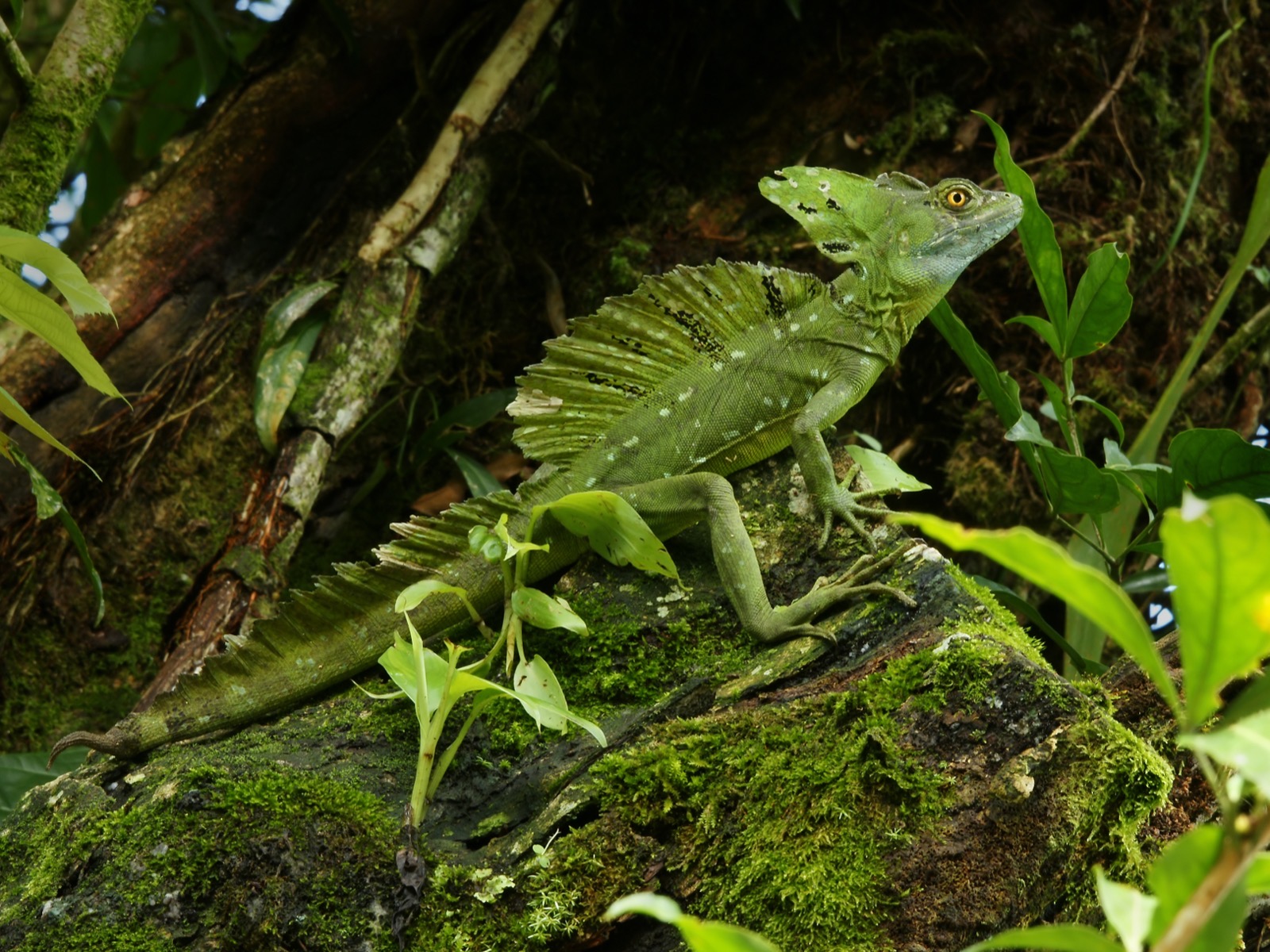
"Basilisk lizard" covers four species in the genus Basiliscus, and only one of them is actually green. The plumed or green basilisk (Basiliscus plumifrons), the species Hsieh and Lauder studied, grows to about 3 feet (90 centimeters) in total length, according to the Smithsonian's National Zoo, and is bright green with white, gray, or pale-blue markings; adult males carry four separate crests, one small one just behind the eyes, a larger one at the back of the head, plus a dorsal and a tail crest, while females and juveniles have only a greatly reduced head crest and a feeble tail crest. The Smithsonian also credits the species with sprint speeds over 7 miles per hour (11.3 km/h) on land immediately before it hits the water, a different measurement from Hsieh and Lauder's controlled water-track figures, since it captures the initial escape sprint rather than sustained mid-run velocity.
The common basilisk (Basiliscus basiliscus), the species Glasheen and McMahon used for their human-scale calculation, runs larger: Animal Diversity Web lists adult mass at 200 to 500 grams and total length (mostly tail, which makes up 70 to 75 percent of the body) from 430 to 800 millimeters, with color ranging from brown or olive to bright green or bronze depending on the individual, and males growing the same kind of sail-like head, dorsal, and tail crests as green basilisks. The species that has actually established itself outside its native range, though, is the plainest-colored and most modestly crested of the group: the brown or striped basilisk (Basiliscus vittatus), which University of Florida measurements put at 4.5 to 6.5 inches of body length and 11 to 27 inches including the tail. Its most distinct feature is a prominent head crest, largest in adult males and absent in small basilisks of both sexes; adult males sometimes add a smaller, fin-like crest along the back and tail, but it's a far less pronounced sail than the tall three-part crest carried by the green and common basilisk. It's brown or dark olive with a cream-to-yellow stripe running from the eye down the back, plus dark bars on the back and sides in juveniles and females.
An established Florida population that isn't officially 'invasive'
Brown basilisks are native to lowland coastal habitat from central Mexico south through Panama, and Florida's own wildlife agency has the arrival date on record: the Florida Fish and Wildlife Conservation Commission reports the species was introduced through the pet trade and first observed in the wild there in 1963. A 2022 peer-reviewed University of Florida IFAS Extension publication, co-authored by St. Lucie County extension agent Ken Gioeli, tallied 160 vouchered specimens in the Florida Museum of Natural History's herpetology database as of that February, most collected in coastal southeast Florida from Brevard County to Monroe County plus additional counties in the southwest. Combined with citizen-science sightings on iNaturalist and EDDMapS, the species is now regularly seen along the east coast from southern Brevard County through the Keys, on the west coast from Pinellas County to Collier County, and around the southern shore of Lake Okeechobee. Gioeli described his own first encounter with the species in St. Lucie County as "quick splashes of water followed by rustling in the nearby saw palmettos," lizards "somewhat akin to what you might see in a Jurassic Park movie and reminiscent of mini-velociraptors."
Despite that, the same publication is explicit that "invasive" is the wrong word for now. An invasive species, by the definition UF/IFAS uses, has to be shown to actually harm the ecology, economy, or quality of human life where it's been introduced. "Presently, brown basilisks do not fit this definition," the authors write, "but they have not been studied in enough detail to rule out their potential for being considered invasive." There are no documented economic impacts, and the lizards pose no direct threat to people or pets outside the remote chance of a bite if one is actually being handled.
The one indirect human-health link is real but narrower than a quick summary makes it sound. A 2022 study by Lawrence Reeves and Nathan Burkett-Cadena used DNA barcoding to identify the blood-meal sources of Culex mosquitoes, including Culex nigripalpus, a known vector for West Nile virus and St. Louis encephalitis virus, across several Florida counties. Exotic reptiles supplied 75 percent of all reptile-derived blood meals in the sample despite making up only 39 percent of the state's available reptile species, a statistically significant gap. But within that pattern, one species did almost all the work: the brown anole accounted for 64.6 percent (62 of 96) of all reptile blood meals. The brown basilisk was one of several other nonnative lizards the study detected as a host, with three or fewer blood meals attributed to it, confirmed as a real but minor contributor rather than a primary driver. It's a smaller-scale version of a pattern that shows up elsewhere in invasive-species research: an invasive ribbon worm has separately been linked to tetrodotoxin turning up in English oyster beds, a downstream risk from an introduced species that has nothing to do with the trait that made it notable in the first place.