
Webbed feet and claws that never fully retract
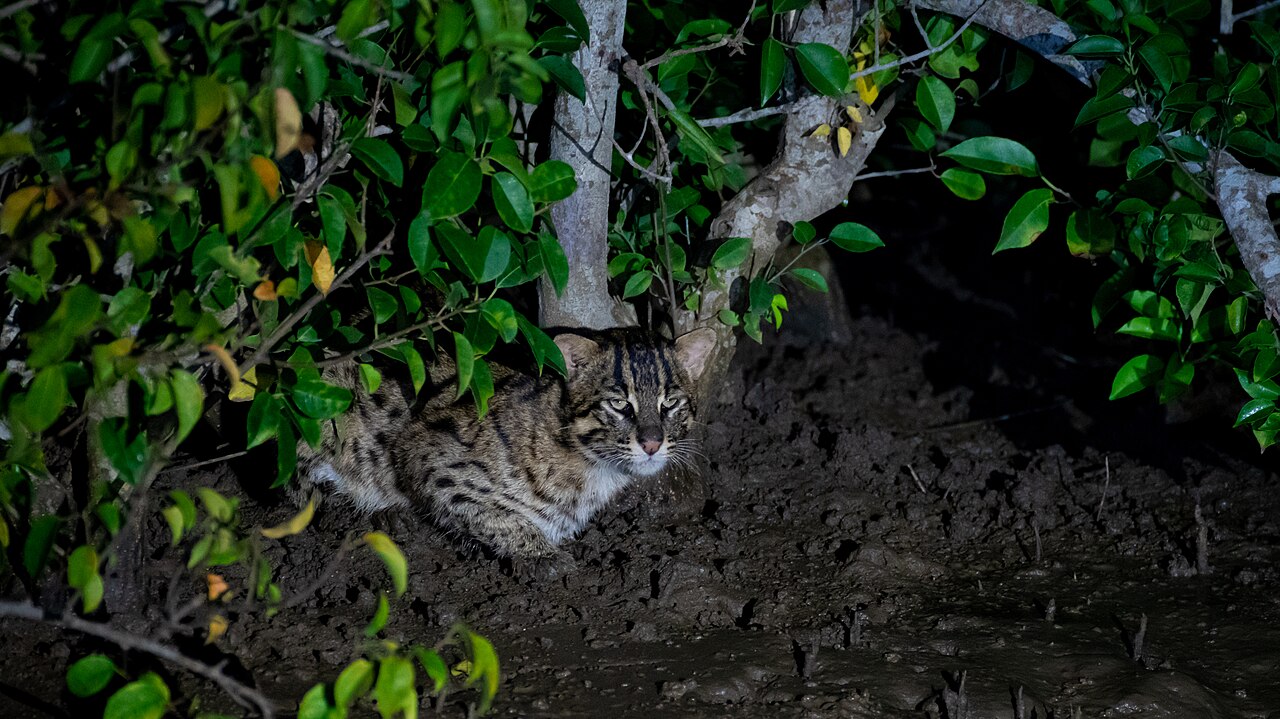
Per the Smithsonian's National Zoo and Conservation Biology Institute, adult male fishing cats weigh 8 to 14 kilograms (18 to 31 pounds) and females 5 to 9 kilograms (11 to 20 pounds), with a body length of 85 to 115 centimeters and a shoulder height just over 40 centimeters, making the species roughly twice the size of a housecat. What separates it from other small wild cats isn't the size, though. Its front paws carry partial webbing between the toes, and its claws, unlike a housecat's, don't fully retract into their sheaths, leaving the tips exposed even at rest, a grip aid on wet mud and slick riverbanks that a cat with fully sheathed claws doesn't get. A double-layered coat, a dense underlayer beneath coarser guard hairs, keeps the animal from soaking through on repeated trips into the water.
To hunt, a fishing cat crouches at the water's edge and taps the surface lightly with one paw, mimicking the ripple of a landing insect; when a fish rises to investigate, the cat plunges its head and forepaws in and pins it against the bank or bottom. According to the IUCN Cat Specialist Group, the species has a wide but fragmented distribution across South and Southeast Asia, from southern Pakistan in the west to Cambodia in the east, tied throughout to wetlands: rivers, marshes, oxbow lakes, and mangrove forests. Unlike a pinniped such as a sea lion, whose limbs have been reshaped into flippers for a life spent mostly in the water, a fishing cat's paws stay recognizably paws, just with webbing and looser claws added on top, letting it hunt from the bank as often as it swims.
Five collars in a capital city, and a 10.7-times gap
Anya Ratnayaka's team GPS-collared five fishing cats living inside Colombo's urban wetlands across two tracking windows, 2013 to 2015 and 2018 to 2019, publishing the results in Mammalian Biology. The cats, two resident females, one resident male, and two translocated males released into the city's wetland parks, were monitored for a combined 637 days, averaging 127 days each, and yielded 2,278 GPS fixes recorded at five-hour intervals, the first study of its kind to track fishing cats with automatic GPS collars inside a city rather than a protected reserve. The paper's own summary is blunt about the headline result: all five individuals used highly urbanized areas more than the researchers expected going in.
A later paper by Rama Mishra's team assembled a side-by-side table of every fishing cat home range study published to date, and it lists the Colombo numbers as an average of 12.49 square kilometers for males against 1.17 for females, calculated using a method called time local convex hull. That's a gap of roughly 10.7 times. Mishra's team, discussing why Colombo's ranges came out so much smaller than their own Nepal results, points to higher rodent prey density in Colombo's built-up core: a resident cat surrounded by concentrated food doesn't need to cover nearly as much ground to eat well.

Nepal's ranges are the biggest on record, and the reason isn't exotic
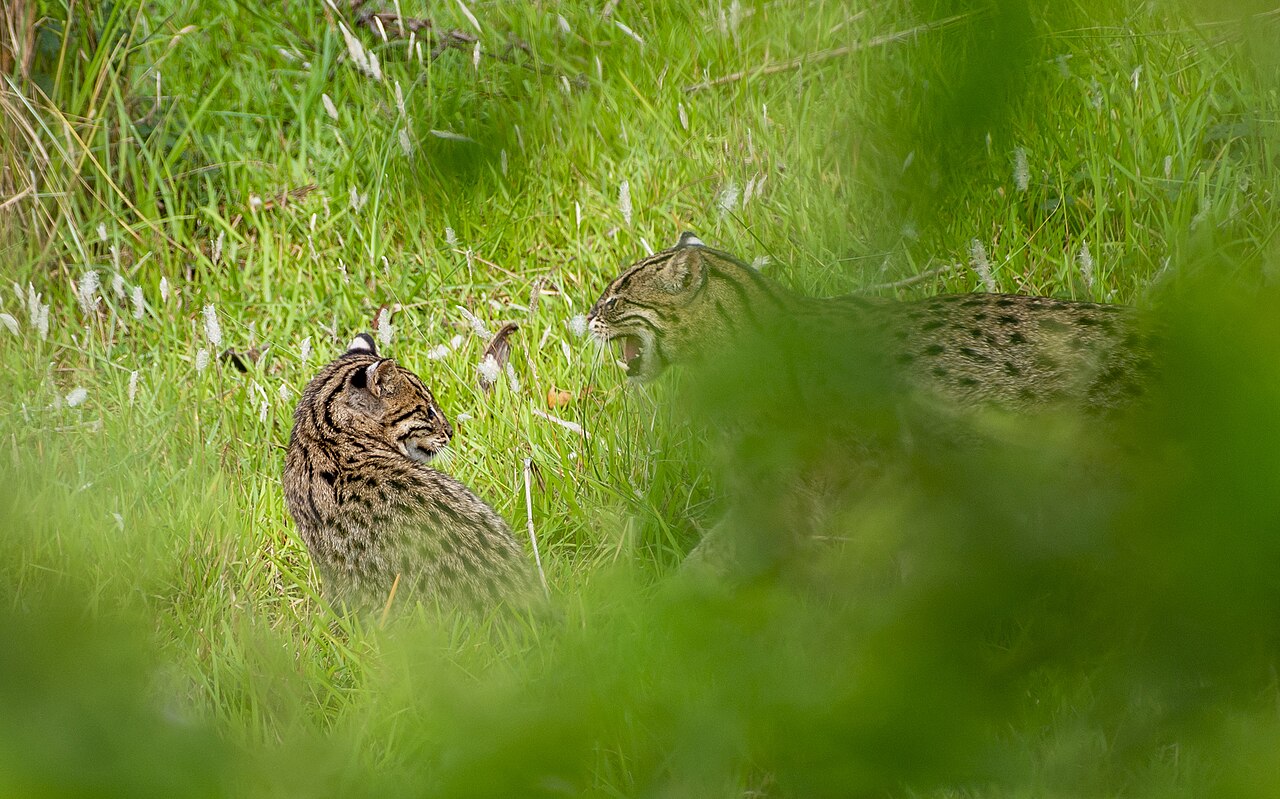
Rama Mishra, Babu Ram Lamichhane, and colleagues published a comparison table of five fishing cat home range studies, running from 1984 to their own 2021-2022 fieldwork, in their 2025 paper in the Journal of Mammalogy: a 1984 VHF-collar study in Chitwan National Park found males ranging 16 to 22 square kilometers, a 2009-2010 study in Thailand's Khao Sam Roy Yot National Park found 8.75 for males and 3.85 for females, and a 2011-2012 camera-trap study in India's Kishanpur Wildlife Sanctuary found a single male at 18.46. Their own 11-cat, GPS-collared study in and around Koshi Tappu Wildlife Reserve, publishing 2,303 locations gathered over the tracking period, came out far above all of them. Three cats had under three months of tracking and were excluded from the range estimate; among the remaining 8 (4 females, 4 males), home ranges averaged 29.12 square kilometers under a minimum-convex-polygon method and 39.88 under a more modern autocorrelation-corrected kernel method, with females averaging 21.72 and males 58.03, a statistically significant split (p < 0.001 in the paper's model).
The authors give two concrete reasons their numbers dwarf the older studies rather than treating the gap as a mystery. First, GPS collars record a location automatically on a fixed schedule, while the VHF radio-collars used in the older studies required a researcher with a directional antenna to physically locate the signal, a method that regularly failed to find cats that had moved out of range and mechanically undercounted how far they'd actually gone. Second, Koshi Tappu appears to have lower prey availability than the sites of the earlier studies, which would push cats to cover more ground to find enough food. Habitat-use tracking backed up the wetland link driving all of this: fishing cats there showed up most often in tall grassland and shrub (31.51% of locations) and wetland (27.36%), but statistical preference indices, which weigh use against how much of each habitat was actually available, still ranked wetland as the most selected-for habitat overall, with cats using wetlands and settlements more at night and tall grassland more by day. Male ranges also consistently overlapped several nonoverlapping female ranges rather than the reverse, the same land-tenure pattern documented in other solitary felids. Over a third of the average home range, though, fell inside human-dominated land, fish ponds, farms, and settlements, where the study's authors flag persecution, road kills, and dog attacks as documented causes of death.
Vulnerable since 2016, with no sign of a turnaround
The IUCN listed the fishing cat as Vulnerable in a 2016 Red List assessment led by Shomita Mukherjee and a team of co-authors that included Anya Ratnayaka, the same researcher who led the Colombo GPS study, estimating a roughly 30 percent decline in the global population across three generations between 2010 and 2015. Per the IUCN Cat Specialist Group, the classification stands today, and the species carries an Endangered listing on the national red lists of Bangladesh and Nepal specifically, a sharper local designation than its global one. Wetland destruction and direct killing by local people, retaliation for raiding fish ponds and poultry among them, are the threats the assessment names as driving the decline, the same conflict-with-farmers dynamic that shows up directly in the Koshi Tappu tracking data.
Another habitat-specialized animal is the fennec fox: it has physiological adaptations to desert life and is still trapped from the wild in North Africa. Those facts are distinct from the fishing cat's wetland dependence and conservation rating. The fishing cat's case has one advantage the leopard seal's doesn't: its Red List status has actually been reassessed since 2016, rather than resting on a circumpolar count that's now a quarter-century old, but reassessment alone hasn't been enough to move the number.