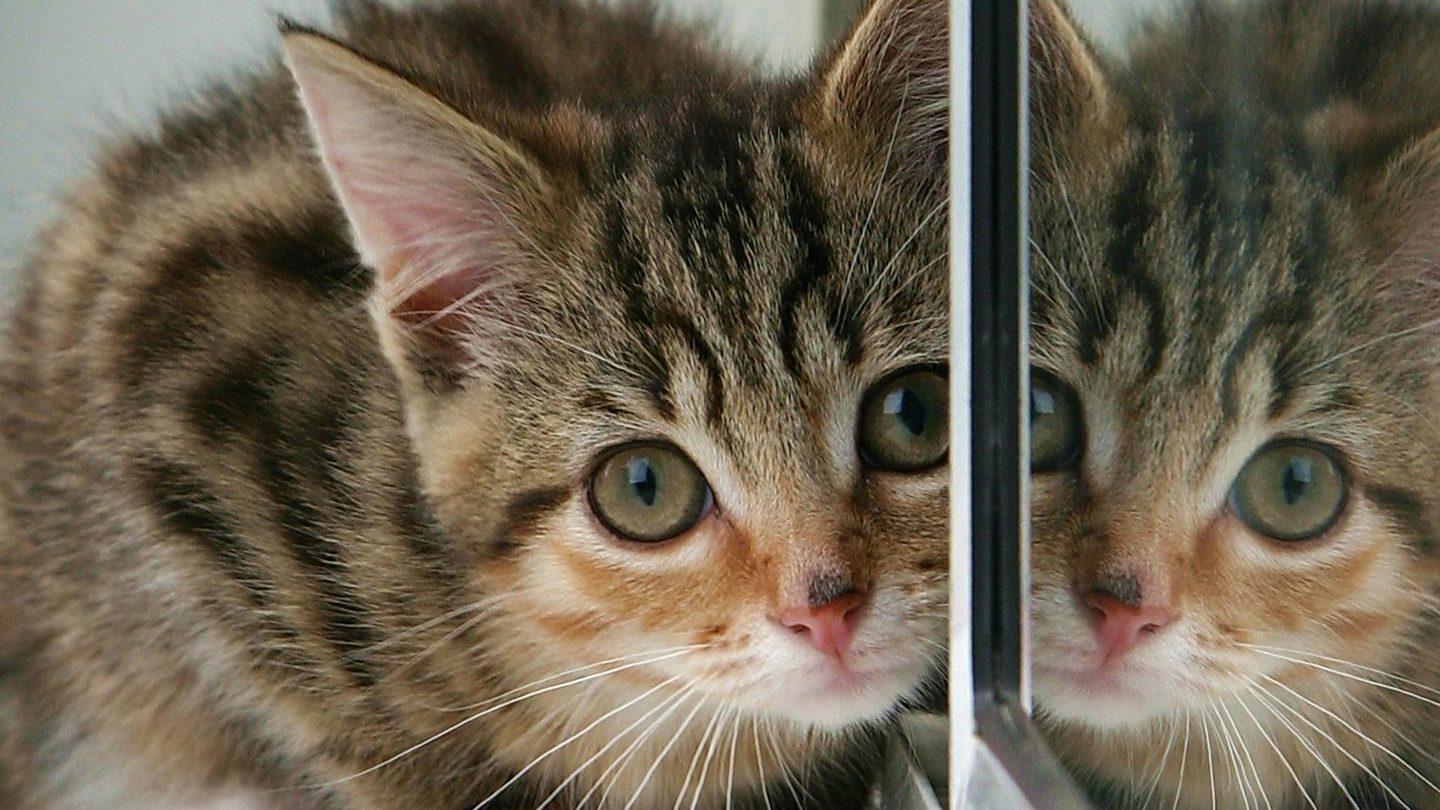

The answer everyone gives, and the test it comes from
Ask the internet whether cats recognize themselves in the mirror and the answer arrives instantly, in one word. No. The pet blogs, the vet sites and the social posts all agree, and they all give the same reason: a cat treats its reflection as a stranger, hisses at it or ignores it, and never works out that the face in the glass belongs to it.
That answer traces back to a specific experiment. In 1970 the psychologist Gordon Gallup Jr. published a short paper in Science describing what is now called the mark test, or the mirror self-recognition test. He put red dye on chimpanzees' faces in a spot they could only see in a mirror, gave them time to get used to the mirror first, and then watched. The chimpanzees touched the marks on their own faces. Monkeys, given the same setup, did not.
The logic fits in a sentence. An animal that reaches for a mark it can only see reflected is treating the reflection as its own body. An animal that treats the reflection as a rival is not. That single distinction has organized half a century of research on animal self-awareness, and it is the instrument almost everyone assumes has been pointed at cats.
The cat research that barely exists
Here the story turns. In 2025, Youngbean Kim and Philip Johns of Yale-NUS College published a paper in Animal Behavior and Cognition on how cats respond to reflective images, and they opened it with an admission that undercuts most of what you can read online. They were, they wrote, aware of little formal research related to visual self-recognition in domestic cats.
What they could find amounted to a single sentence, from a 1949 Dutch journal article by an author named Kraus. The sentence reads: “Dogs and cats, especially younger ones, have a brief interest in their reflection, in which they probably also think they see a congener. Dogs are often afraid of it, cats become curious and go look behind the mirror.” Kim and Johns then added four words of their own: “We know of no others.”
The plain version of the question, do cats recognize themselves in the mirror, has no controlled experiment behind its standard answer. So the confident no repeated across the pet internet is not the summary of a long series of failed experiments. It is closer to a reasonable guess, made by people who noticed that a cat does not behave the way a chimpanzee behaves in front of a mirror, and then repeated until it hardened into fact. The mark test itself, as far as the published record shows, has essentially never been run on a domestic cat.
What cats actually do in front of a mirror
With no controlled test to draw on, Kim and Johns went looking for cats meeting mirrors in the wild of the internet, and analysed two kinds of video.
The first were TikTok clips from a 2019 to 2020 trend in which owners held a phone up to a cat with an augmented-reality filter that turned the owner's face into a cat's face. The reasoning was straightforward: if cats understand reflective images, the altered face on the screen should pull their attention the way a painted dot pulls a chimpanzee's. Mostly it did not. Across 145 videos, cats did turn toward the phone screen, but only 2 of the 145, about 1.4%, showed the complete sequence in which the cat looked at the screen, registered that the face had changed, and then turned back to check the human. Kim and Johns are cautious about even that number, noting that some cats were probably reacting to the owner's touch or to cues happening off camera.
The second set was 57 YouTube videos in which a cat met a mirror with nobody else in the frame. A sequential analysis sorted the cats into five behavior clusters. Two were curious, covering 49.1% of the cats: they turned toward the reflection and either pawed the glass or tried to look behind the mirror, which is exactly the behavior Kraus described in 1949. Two were aggressive, covering 45.6%: charging, sidestepping, fur up along the spine. Together the clusters accounted for 47.1% of the variation in what the cats did.
Neither group showed self-recognition. The curious cats were investigating something interesting, not inspecting their own bodies. Kim and Johns put it plainly, writing that even the curious cats showed little evidence that they have the prerequisite conditions to be tested for mirror self-recognition. A cat that fails a test it was never given is not a cat that failed.
Which animals have actually passed
The roster of animals that have passed a version of the mark test is short, and seeing it whole shows what a positive result actually looks like.
Gallup's original chimpanzees passed in 1970, and the other great apes followed: bonobos and orangutans clear the bar, gorillas only sometimes. Bottlenose dolphins passed in 2001, in a study by Diana Reiss and Lori Marino in PNAS, the first non-primate to do so. Asian elephants passed in 2006, in work by Joshua Plotnik, Frans de Waal and Reiss, also in PNAS, with the mark painted on the forehead where only a mirror would reveal it. Eurasian magpies passed in 2008, in a PLoS Biology paper by Helmut Prior, Ariane Schwarz and Onur Güntürkün, the first bird and the first non-mammal on the list; that study also ran a sham mark, a black sticker on black feathers that felt the same but could not be seen, and the birds scratched at the visible one while ignoring the sham. Cleaner wrasse, a small reef fish, passed a version of the test in 2019, in work by Masanori Kohda and colleagues, with a 2022 follow-up paper answering criticism of the first study. The result is still argued over.
The newest entry is the beluga whale. In May 2026, Alexander Mildener and colleagues published a PLOS One study of four belugas at the New York Aquarium. Two of the four, a subadult female and her mother, showed a rich set of self-directed behaviors at the mirror, and the adult female showed mark-directed behavior and passed one of the initial mark tests. It is the first evidence for mirror self-recognition in belugas.
| Species | Test published | What was marked | Result |
|---|---|---|---|
| Chimpanzee | 1970 | Red dye on the face | Touched the mark; monkeys given the same setup did not |
| Bottlenose dolphin | 2001 | Mark applied where only the mirror showed it | Inspected the mark on its own body |
| Asian elephant | 2006 | Mark painted on the forehead | Touched the mark; only about half of tested elephants pass |
| Eurasian magpie | 2008 | Colored sticker on black throat feathers, plus a sham mark that could not be seen | Scratched at the visible sticker and left the sham alone |
| Cleaner wrasse | 2019 | Mark under the throat | Passed a version of the test; the result is still disputed |
| Beluga whale | 2026 | Mark tests after mirror exposure | One adult female showed mark-directed behaviour and passed one test |
| Domestic cat | Never run | Nothing | No published controlled test exists |
Two patterns run through that list. Passing is rare and it is individual: even among chimpanzees and elephants, only around half the animals tested pass. And the test is narrow. It measures one thing, whether an animal uses a mirror to inspect its own body, and it says nothing about how well an animal navigates its world by other means.
Why a mirror may be the wrong instrument for a cat
There is a real possibility that the mirror test cannot see what a cat is doing, because cats work out who is who by smell.
In August 2026, a team led by Masao Miyazaki at Iwate University, working with researchers in Germany and Spain, published a study in Current Biology that found the mechanism. They identified 13 branched-chain fatty acids in domestic cat urine, compounds not previously documented in mammalian urine. Every cat carries a distinct mix of them in distinct proportions, and the profile holds up over time: it stays stable across different collection days and is still detectable at least 24 hours after the urine is deposited at 25 degrees Celsius.
The behavior lined up with the chemistry. Cats spent less time sniffing a urine sample they had met before, and their interest revived when a different cat's sample appeared. They also performed the flehmen response, the open-mouthed grimace a cat makes when drawing a scent across the roof of its mouth, more often at unfamiliar urine than at their own.
The storage site resolves a puzzle veterinarians have been staring at for more than a century. Those fatty acids sit in the unusually large lipid droplets in the cat's kidney cortex, a feature of the cat kidney noted for over 100 years without a known purpose. Related compounds turned up in lions, tigers, leopards, jaguars, lynx and the Iriomote cat, part of the wild cat family whose official species count keeps shifting.
Put the two lines of work together and the picture shifts. Cats very likely do recognize individuals, and they have a chemical identity system built for it. What they may not have is any reason to use a mirror, which carries no scent at all.
How to watch your own cat around a mirror
A version of the observation can be run at home, though what it produces is a careful description of your cat, not a verdict on its inner life. Three ground rules first: put the mirror somewhere the cat already spends time instead of carrying it over, leave the cat a clear way to walk away, and never stick a mark, a sticker or paint on the animal. Marking is a research procedure done under review, not a game to play with a pet.
Start by leaving the mirror in place and watching from a distance over several days. Most cats begin in the phase the research describes as social: the reflection reads as another cat, so you get staring, ears flattening, sometimes a hiss, sometimes a slow approach.
Watch next for the look behind the mirror. That is the behavior Kraus recorded in 1949 and the one that dominates the YouTube sample, and it tells you the cat is testing whether the other animal has a body back there.
Then watch for the shift. Kim and Johns describe habituation as the point where the reflection stops being interesting. If the hissing fades and the cat eventually walks past the glass without a glance, it has reached the stage the research treats as the prerequisite for a self-recognition test.
Only at that point would a real test begin, and that is where the record on cats stops. A cat that ignores a mirror has not demonstrated anything about itself. It has done the same thing a chimpanzee does before the interesting part of the experiment starts.
Related reading: the purring mechanism, why cats avoid water, and how high a cat can jump.