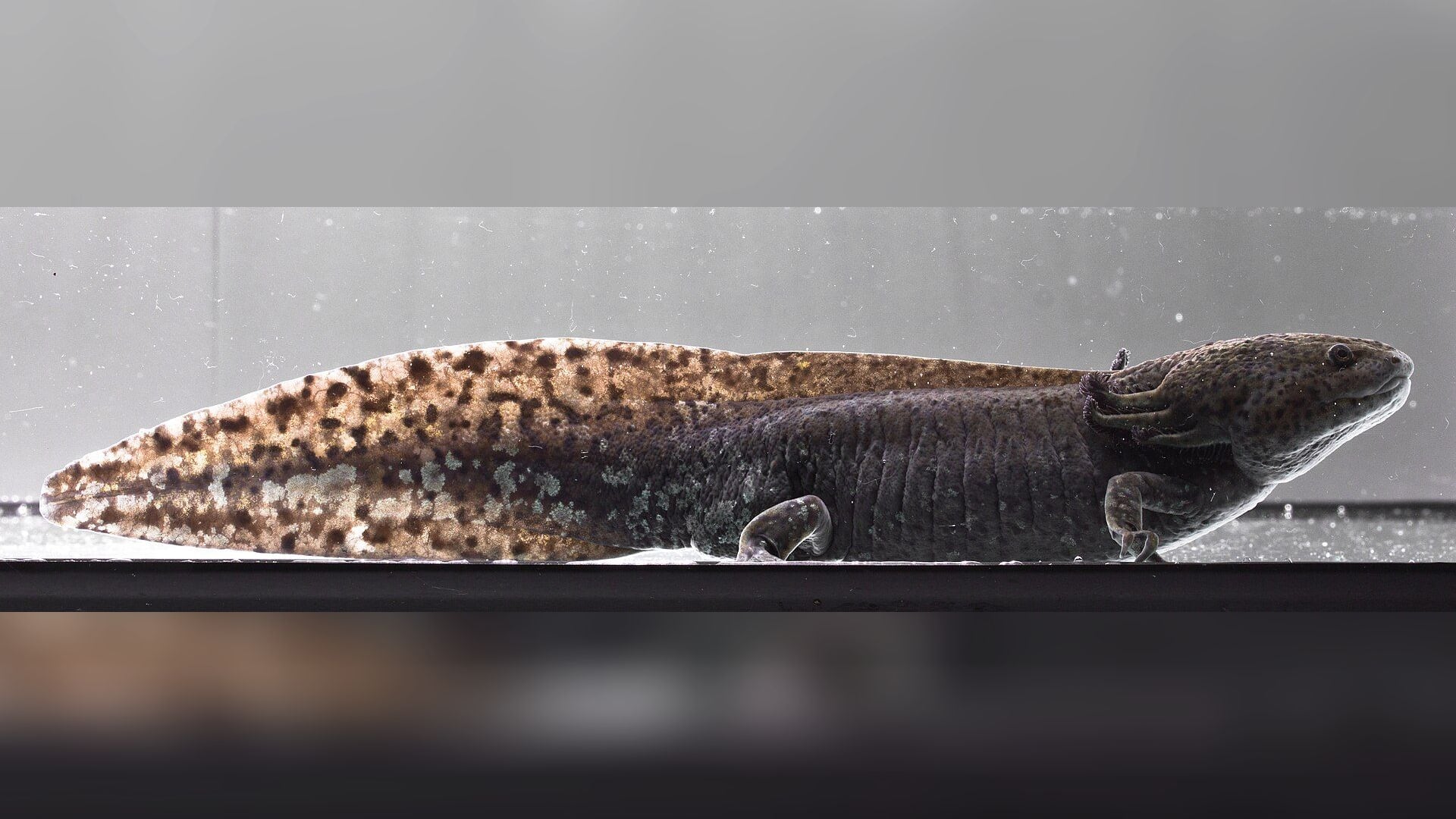

The laboratory axolotl is 5.8 per cent tiger salamander, and the paperwork says so
The albino axolotl is one of the standard laboratory strains, and it did not come from an axolotl. Woodcock and eleven colleagues set out the history in Scientific Reports in 2017, in a paper whose main business was mapping the genes behind two historic pigment mutants. Their finding on the albino line is stated flatly: the phenotype "did not arise within the axolotl lineage but was instead established by interspecific hybridization".
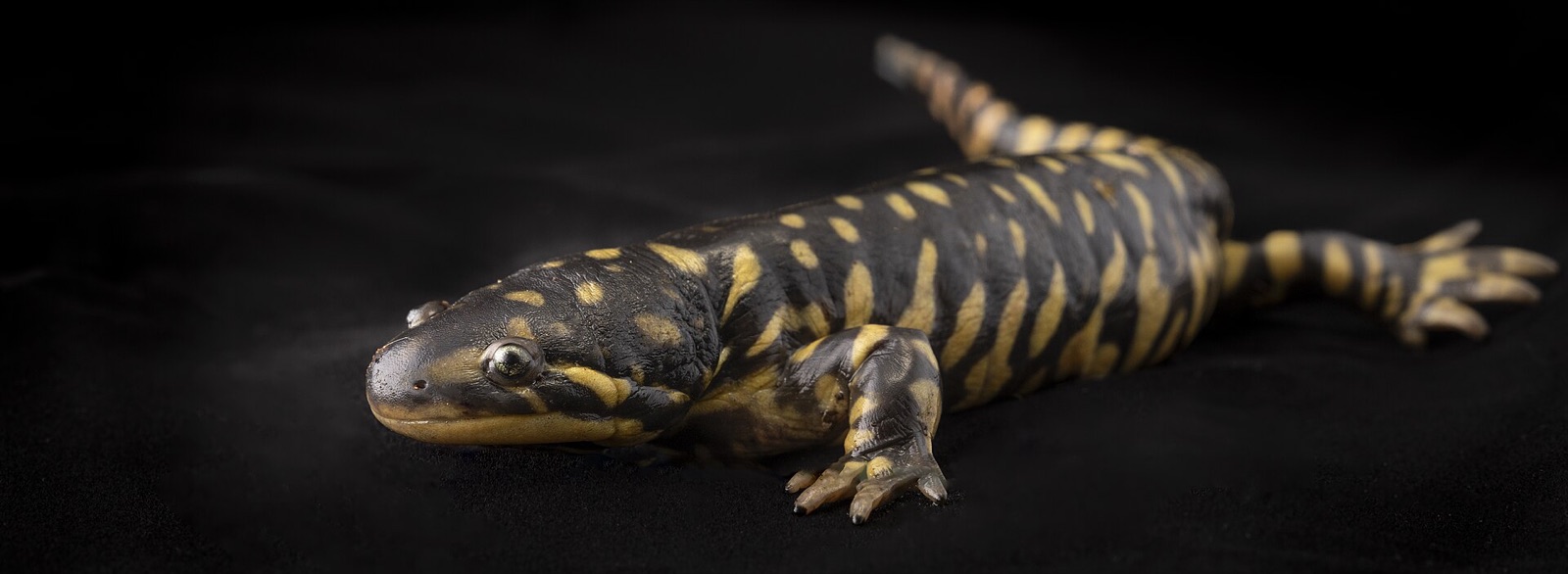
The founding animal has an address. "In 1962, a terrestrial tiger salamander (A. tigrinum) lacking melanin was collected near Foot Lake, Willmar Minnesota and after almost a year in captivity, it was gifted to Rufus Humphrey at Indiana University." Humphrey already knew a metamorphic tiger salamander could be crossed to a paedomorphic axolotl by in vitro fertilisation, but his embryos from that cross started dying. The workaround was to build the embryos by hand: Humphrey and colleagues "used cutting edge technologies for the time – somatic cell nuclear transfer and microsurgery – to create embryos that carried the albino gene".
The authors reconstructed what happened next from studbook records. From 1964 through 2013 the hybrid descendants were mated 29,945 times, and 4,884 of those spawns left descendants in the current collection. Removing donor DNA after a cross like this normally means backcrossing to the original species over and over. Only 4 per cent of the retained spawns, 196 of them, were backcrosses of hybrids to axolotls, and even those were spread across three separate founder lineages, not concentrated in one. Hybrid was bred to hybrid instead, and the arithmetic ran one way. "Over time, hybrid descendants were crossed to all existing axolotl strains, and by 2000, all axolotls in the collection traced their ancestry to the 1963 axolotl x tiger salamander hybridization cross."
"Pedigree analysis predicts that an average AGSC axolotl genome contains 5.8 ± 1.0% tiger salamander DNA." Genotyping backed it up from a second direction: on average each animal carried tiger salamander DNA at 12 of 158 expressed-sequence-tag markers, "suggesting that at least 7.6% of genes in the axolotl genome contain tiger salamander DNA". Fluorescence in situ hybridisation put the albino locus, tyrosinase, near the tip of the chromosome corresponding to linkage group 7, and 73 per cent of the 48 albino chromosomes examined still carried at least 7 centimorgans of tiger salamander sequence around it. The albino allele itself turned out to be a 142 base pair deletion.
The authors do not soften the conclusion. "AGSC axolotls should be considered a distinct, hybrid axolotl strain." They spell out the practical consequence for anyone designing an experiment: if an average animal has tiger salamander DNA at 7.6 per cent of loci, then more than a thousand genes are expected to be segregating foreign sequence, "with implications for design of molecular probes and primers, gene targeting vectors and other approaches".
Why the historical, non-hybrid lines vanished by 2000 is not settled. The paper offers two possibilities. One is timing: the Xochimilco population collapsed around then, which made importing fresh material from Mexico difficult or impossible. The other is that the hybrids were simply better at being laboratory animals, since "studies of naturally occurring hybrid ambystomatid salamanders suggest they are often more vigorous than the parental species from which they derive".
One caution about how far this figure travels. It was measured on the Ambystoma Genetic Stock Center collection at the University of Kentucky, not on pet-shop stock, and nobody has genotyped the pet trade systematically. The inference that pet animals carry the same ancestry rests on the fact that they descend from laboratory lines, and on the albino and other color morphs being products of exactly this history. That is a strong inference, and it is still an inference. Popular accounts of an animal have a way of hardening around whichever specimen was best documented, which is how the Brachiosaurus everyone pictures turned out to be a different genus.

Almost every domestic axolotl descends from 34 animals shipped to Paris in 1863
Randal Voss, Ryan Woodcock and Luis Zambrano laid out the two-population problem in BioScience in 2015 under the title "A Tale of Two Axolotls", and the framing is Dickensian on purpose. "Although axolotls appear to be thriving in domestication, the native axolotl population in Mexico is on the brink of extinction."
The domestication half starts with a single consignment. "The majority of domestic axolotls in the world today trace their ancestry to a shipment of 34 axolotls from Xochimilco that arrived in Paris in 1863." They bred readily, and the distribution that followed was narrower than the shipment size suggests: "From just five males and one female, the Jardin des Plantes distributed thousands of axolotls to scientists throughout Europe." The American line runs through the same bottleneck. Ross Harrison gave axolotls he had received from Krakow to Robert Hutchison at the Wistar Institute's Morris Biological Farm in 1935; five white offspring went to Rufus Humphrey, who founded a colony at the University of Buffalo, moved it to Indiana University in 1957, and saw it become a National Science Foundation stock centre. It moved again in 2005, on George Malacinski's retirement, to the University of Kentucky as the Ambystoma Genetic Stock Center.
Run the genetics on what that produced and the numbers are uncomfortable. The AGSC holds roughly 1,200 adults, which sounds like a healthy population and is not. "Captive populations with inbreeding coefficients above 12.5% are considered emergency management situations; the average inbreeding coefficient for axolotls in the AGSC is 35%." Current diversity works out to 5.82 founder genome equivalents, which the authors note "is similar to the Paris 1863 founder population". A century and a half of breeding has not widened the base at all.
They point out that this has already happened once. In 1880 the naturalist Hans Gadow recorded whole axolotl colonies dying out or turning sickly, with healthy breeding pairs hard to obtain, and attributed the deterioration to incessant inbreeding with no import of fresh material to Europe. The 2015 paper treats that as a forecast: "Past history predicts an ominous future for the AGSC population if genetic management strategies are not enacted. Moreover, if the Xochimilco axolotl population goes extinct, where will new sources of genetic variation come from?"
There is a route out, and it runs through management. Simulations with the pedigree tool PMx suggest 89 per cent of current genetic variation in the AGSC could be held for 100 years if breeding pairs are chosen by mean kinship, with the collection split into separately managed subpopulations. That preserves what exists. It does not manufacture anything new.
Wild axolotl numbers: from 6,000 per square kilometre to empty nets
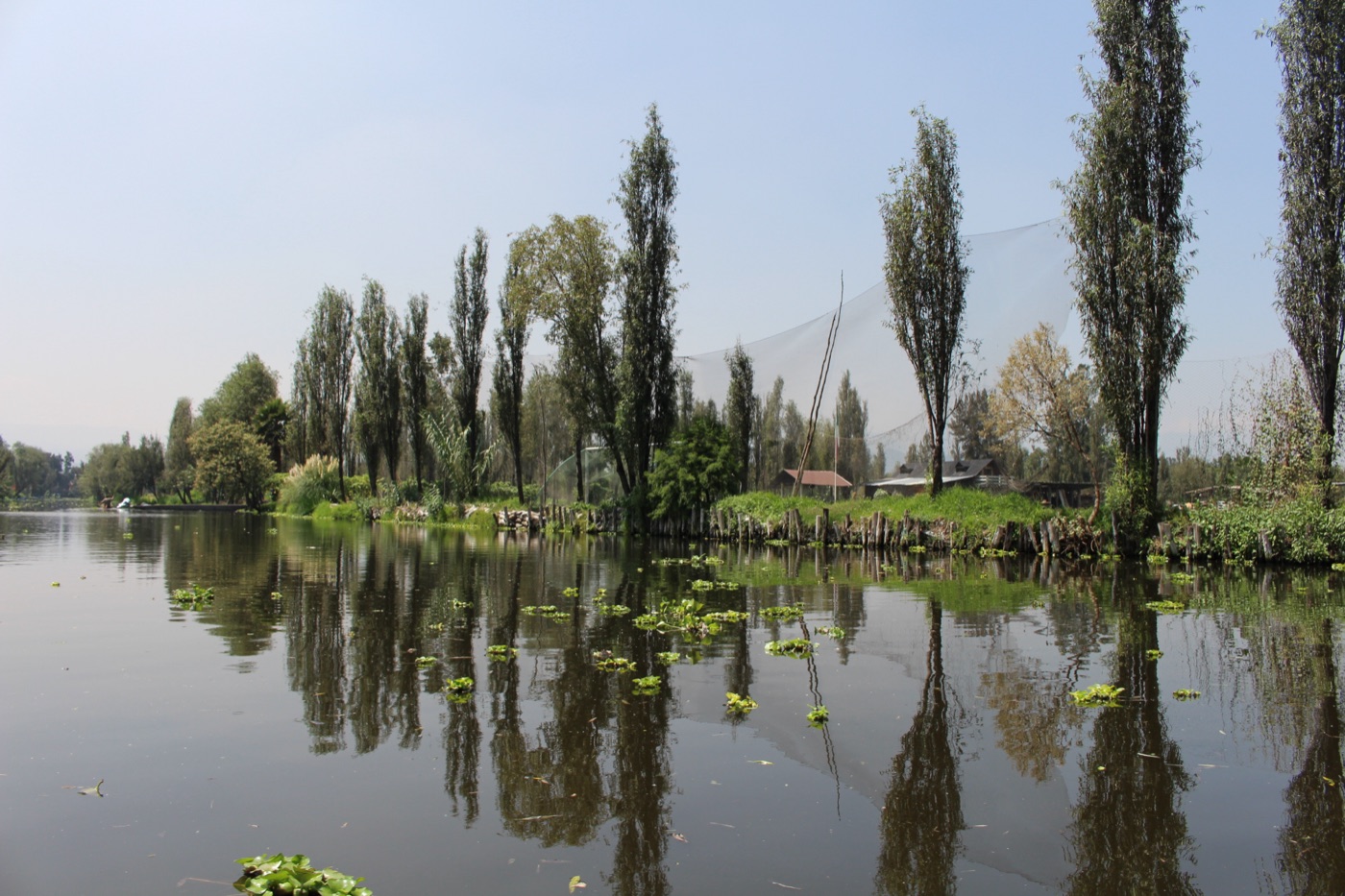
The species is endemic to one lake system and now effectively to one part of it. Xochimilco's canals are what remains of a wetland complex that the Aztecs engineered into an enormous length of shoreline, and that Mexico City then drained, sank and polluted. The city more than tripled in size between 1950 and 1975; by the early 1950s Xochimilco no longer received input from the springs and rivers that had fed it, and became an endorheic basin with alkaline, salty water. Land in Xochimilco is still subsiding, in places by 30 to 40 centimetres a year, which changes the shape of the basin and where the water goes. The replacement supply arrives through seven pipes from a single treatment plant at Cerro de la Estrella, and its quality swings through the year.
The monitoring record is short and steep. Researchers began systematic surveys in the 1990s, and the BioScience review summarizes the result in one line: "The density of axolotls decreased from 6000 per square kilometer in 1998 to 100 in 2008 [...] and recent data suggests that there are fewer than 35 axolotls per square kilometer." A population viability analysis published by Zambrano and colleagues in 2007 put extinction as a live possibility by 2017. Zambrano gave the same trajectory in blunter terms at the launch of the Adoptaxolotl campaign in November 2023: "In 1998, there were 6,000 axolotls per square kilometer. The last census was carried out in 2014 and there were only 36 [per square kilometer]."
Water quality and vanishing wetland are not the whole story. The declines track the build-up of introduced fish, and the review is specific about the mechanism: axolotl reductions "are also associated with the overpopulation of introduced fishes that predate on the most vulnerable axolotl life stages: eggs and juveniles". Carp and tilapia both eat axolotl young and compete with adults for food and cover.
Then came the first count in a decade, the one after the 2014 survey, run by UNAM's Ecological Restoration Laboratory with Conservation International-Mexico across 115 monitoring sites in the 2,500-hectare Xochimilco protected area. It used nets, as previous surveys had, and added environmental DNA, which detects genetic traces an animal leaves in the water without requiring the animal itself. The nets caught nothing. The eDNA came back positive, and Conservation International's account of the survey puts it plainly: although no axolotls were captured with the nets, the genetic testing "revealed that axolotls are still present in the canals". The only direct evidence the species is still in Xochimilco is now genetic material suspended in the water.
The IUCN assessment for Ambystoma mexicanum lists it as Critically Endangered, with an estimated 50 to 1,000 mature individuals remaining and a decreasing trend. That range is wide because counting an animal you cannot catch is hard. A survey that recovers no specimens is not the same as an extinction, but it is a long way from the 1998 baseline, and both numbers come from the same canals.

What happened when captive-bred axolotls were actually released
The obvious question, asked constantly and answered only recently, is whether captive animals put back into the water survive. Alejandra Ramos, Horacio Mena, David Schneider and Luis Zambrano published the trial in PLOS ONE on 30 April 2025, using VHF radio telemetry rather than inference.
Eighteen captive-bred axolotls went out in two batches. Eight, four males and four females, were released at La Cantera Oriente, an artificial pond, on 26 October 2017 and tracked to 7 December. Five male-female pairs went into a restored chinampa in Lake Xochimilco on 12 March 2018 and were tracked to 20 April. Tracking ran to a fixed weekly schedule rather than continuously: at La Cantera Oriente, two and occasionally three sessions a day on Mondays, Wednesdays and Fridays, while at Xochimilco volunteers camped at the chinampa and tracked on foot at roughly three-hour intervals.
The paper reports that no mortalities followed transmitter implantation and that all the animals survived the procedure and the monitoring period, and it summarizes the outcome as "Axolotls survived and foraged successfully in both sites". The weight evidence is thinner than the survival result. Only three of the eighteen were recaptured at all, one at La Cantera Oriente and two at Xochimilco, and one of those three has no recapture weight on record, so "Recaptured individuals gained weight, suggesting successful adaptation" rests on a very small number of animals that were caught twice. Home ranges differed sharply between the two habitats, averaging 2,747 square metres at the artificial pond, with a range of 548 to 4,404, against 382 square metres in the restored chinampa, ranging from 175 to 697. Movement peaked in a narrow thermal band, around 16 to 17 degrees Celsius at Xochimilco and 15.5 to 16.5 at La Cantera Oriente, and dropped away on either side. At La Cantera Oriente females covered noticeably more ground than males, averaging 86.75 metres a day against 54.33.
The result is genuinely encouraging and the paper does not oversell it. Two of the Xochimilco animals were lost to birds after the study period closed, and the authors' recommendations include predator-awareness training before release. Their broader point is that artificial wetlands such as La Cantera Oriente offer conditions stable enough to be worth counting as habitat, rather than being written off as not the real lake.
Two limits sit underneath the result. Eighteen animals over roughly six weeks each is a pilot, not a restocking programme. And the animals were captive-bred stock released under a research protocol, which is not the same proposition as releasing a pet.
Why releasing a pet axolotl is a bad idea, with a worked example
The reason has less to do with the individual animal than with what its genes can do to a neighbor, and North America has already run the experiment by accident.
Maureen Ryan, Jarrett Johnson and Benjamin Fitzpatrick reported the outcome in PNAS in 2009. "Hybridization between the threatened native California tiger salamander (NCTS) (Ambystoma californiense) and the introduced barred tiger salamander (IBTS) (Ambystoma tigrinum mavortium) began 60 years ago when bait dealers introduced thousands of IBTS larvae from Texas into ponds already inhabited by NCTS." Nobody planned an invasion; somebody was selling larvae to bass fishermen. Six decades on, "hybrid tiger salamanders now occupy ≈20% of the NCTS range, largely within the Salinas Valley", and the hybrids are not neutral tenants. In experimental ponds, "[m]ost classes of hybrid tiger salamander larvae dramatically reduced survival of 2 native community members, the Pacific Chorus Frog (Pseudacris regilla) and the California Newt (Taricha torosa)".
The axolotl sits inside the same species complex, and the Scientific Reports authors say why that is dangerous: "Reproductive barriers to hybridization have not evolved among closely related, sympatric species or surprisingly, geographically isolated and phylogenetically distinct species like A. mexicanum and A. tigrinum." The AGSC collection is the proof, several thousand fertile generations of it. California wrote that risk straight into its regulations. Title 14, section 671 of the California Code of Regulations makes it unlawful to import, transport or possess the listed animals without a departmental permit, and lists "Family Ambystomatidae--Mole Salamanders 1. Genus Ambystoma (nonnative tiger salamander group)" under code (D). The code is defined in the same section: species "listed because they pose a threat to native wildlife, the agriculture interests of the state or to public health or safety are termed 'detrimental animals'". The regulation never says axolotl, and never says mexicanum. It catches the animal because the axolotl sits inside the tiger salamander species complex, which the Scientific Reports authors state directly: "The axolotl is a member of the Tiger salamander complex, a widely distributed group of salamanders in North America". The same section of California code restricts an entirely different popular exotic pet for an entirely different reason: the fennec fox is listed there too, not for hybridization risk but under a category the regulation itself defines as covering wild-population depletion and animal welfare.
The failure mode is not hypothetical either. In November 2025 an axolotl turned up swimming in Walnut Creek near Lake Erie in Pennsylvania, thousands of kilometres from anywhere it belongs, and was taken to a local aquarium shop. It was treated for a fungal infection and died. The shop wrote afterwards that "No domesticated animal can be safely released outside — not even aquatic ones," adding: "They depend on proper water quality, temperature, and care to survive."
Axolotl keepers argue about all of this among themselves, and with some precision. A March 2025 thread in r/axolotls, "Very frustrating misconceptions about axolotls", opens with the flat claim that pet axolotls "aren't even the same as the ones in the wild because they're crossed with tiger salamanders". The top-scoring reply makes the charismatic-species case, that the pet trade helps by making people aware the animal exists at all. Further down, commenters get to exactly the caveat the literature has: the studies were done on laboratory colonies, pet-trade animals descend from those colonies, and one commenter lands on the honest version, that hybrid ancestry in pet stock is "more probable but not a dead cert". That is roughly where the published evidence actually stands, arrived at on a hobbyist forum. Popular claims about animals often outrun what anyone measured, which is how camel spiders acquired a running speed nobody ever clocked.
The axolotl genome is ten times ours and missing a gene it should have
Whatever else the axolotl is, it is a working model organism, and in 2018 Sergej Nowoshilow and colleagues published its genome in Nature. They report "the sequencing and assembly of the 32-gigabase-pair axolotl genome using an approach that combined long-read sequencing, optical mapping and development of a new genome assembler (MARVEL)", which at the time made it the largest genome anyone had assembled, roughly ten times the size of ours.
Most of that bulk is not extra genes. "We observed a size expansion of introns and intergenic regions, largely attributable to multiplication of long terminal repeat retroelements." Set against that, the paper finds intron size in developmental genes is under constraint, and that genes restricted to this lineage may contribute to limb regeneration, the trait the animal is famous for.
The oddity is a hole. "The axolotl genome assembly does not contain the essential developmental gene Pax3." Pax3 is not an optional accessory in vertebrates. The authors tested whether its paralogue had taken over the job: "mutation of the axolotl Pax3 paralogue Pax7 resulted in an axolotl phenotype that was similar to those seen in Pax3−/− and Pax7−/− mutant mice." The animal appears to run a developmental programme most vertebrates run with two genes using one.
A reference genome is only as clean as the animal it came from, and the animals it came from carry several per cent of a second species distributed across more than a thousand genes. That does not invalidate the work, and the Scientific Reports authors are explicit that mutants still segregate according to Mendelian predictions, so the introgression will not obstruct cloning other historic axolotl mutants. It does mean the reference for Ambystoma mexicanum was built partly on Ambystoma tigrinum, and that the only source of genuinely unmixed genetic material is a wild population currently detectable mainly as DNA suspended in canal water. This is not the only case in this group where the standard reference animal is a composite: Ankylosaurus is reconstructed largely from its relatives for want of complete material.