
How well is Ankylosaurus actually known?
Arbour and Mallon close their 2017 redescription of Ankylosaurus with a line that sits strangely under an animal this famous: "Despite being the namesake of its entire suborder, Ankylosaurus was far from a representative ankylosaur." The paper spends thirty pages establishing why, and the short version is that almost nothing about the animal matches the group it lends its name to.
Ankylosaurus lived in the late Maastrichtian, the last stage of the Cretaceous, which the Natural History Museum in London dates for this animal at roughly 68 to 66 million years ago. Its fossils include material from the Hell Creek Formation of Montana, the Lance and Ferris formations of Wyoming, and the Scollard Formation of Alberta; isolated osteoderms from the Frenchman Formation of Saskatchewan are also provisionally referred to the genus, so it shared its world with Triceratops, Edmontosaurus and Tyrannosaurus. The specimen AMNH 5214 was collected 45.4 meters below the boundary layer that marks the end of the period.
The fossil record behind the reputation is thin. The paper lists everything referable to the genus. AMNH 5895 is the holotype: a partial skull, two teeth, five neck vertebrae, eleven dorsals, three caudals, a right scapulocoracoid, ribs and armor. AMNH 5214 has the best preserved skull and the only well preserved tail club. CMN 8880 preserves a skull and left mandible, but no postcranial material. CCM V03 is a fragment of tail club handle. AMNH 5866 is a block of osteoderms, collected with the specimen Henry Fairfield Osborn described in 1905 as Dynamosaurus imperiosus, which was later recognized as the animal we now call Tyrannosaurus rex. Two isolated osteoderms from Saskatchewan and isolated teeth and armor from Lancian-aged formations add to those principal specimens.
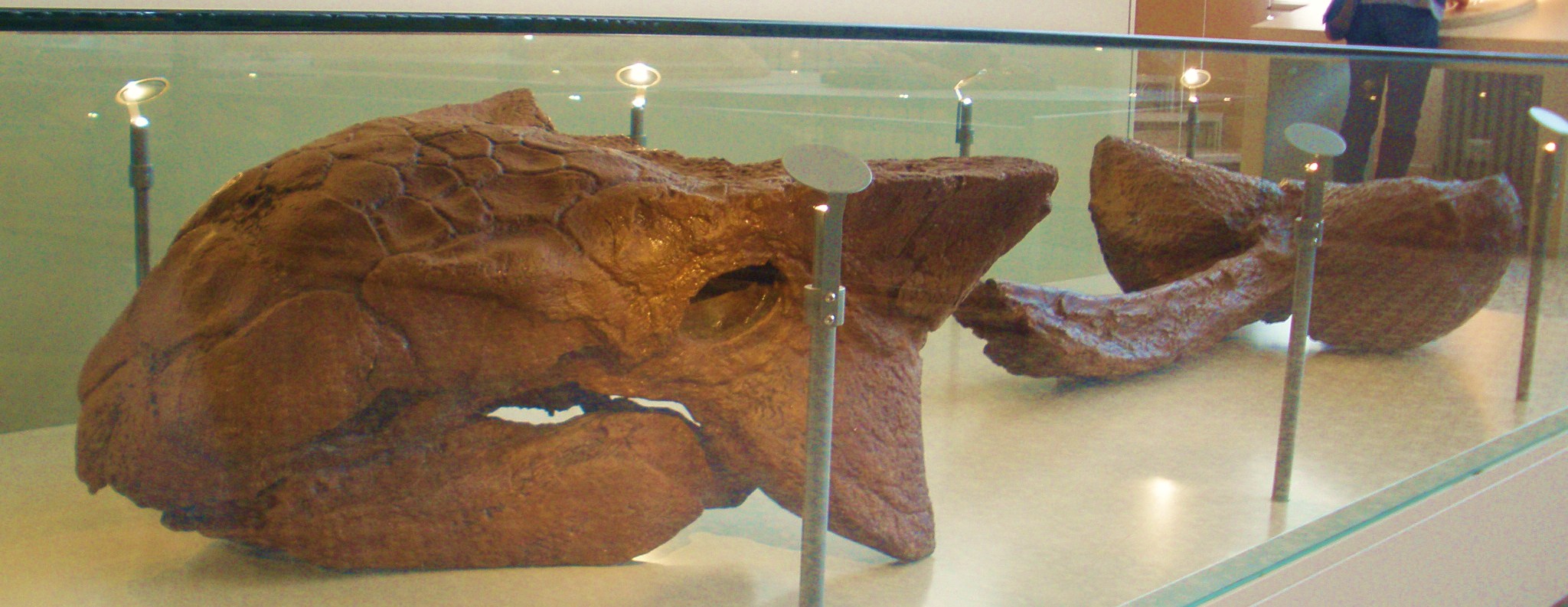
The five principal specimens, then, leave major gaps: no complete pelvis, foot, tail or skeleton. Pelvic material includes an ischium and newly identified fragments, leaving only a partial view of the pelvis. Everything else in a museum mount is inference drawn from relatives: Euoplocephalus, Anodontosaurus, Dyoplosaurus, Scolosaurus, Zuul, and the Mongolian genera Saichania and Pinacosaurus. The photograph at the top of this page makes the point by accident. It shows a cast of the AMNH 5214 skull displayed beside a tail, and the tail belongs to Anodontosaurus. Reference animals assembled partly out of other species are commoner than they look, and not only among fossils: the laboratory axolotl carries several per cent of a second salamander species.
Part of the reason for the thin record is that the animal was rare. Arbour and Mallon cite Lyson and Longrich's finding that Ankylosaurus accounts for under 0.05% of associated dinosaur specimens from the Hell Creek, Lance and equivalent formations, and Wilson's matching figure for isolated specimens at microvertebrate sites. Horner and colleagues, sampling differently, recovered none at all from the middle or upper third of the Hell Creek Formation and put it at 5% of the fauna in the lower third. Whether it was genuinely scarce or simply an infrequent visitor to the coastal plains where fossils form, the paper treats as open.
The first Ankylosaurus reconstruction had no tail club
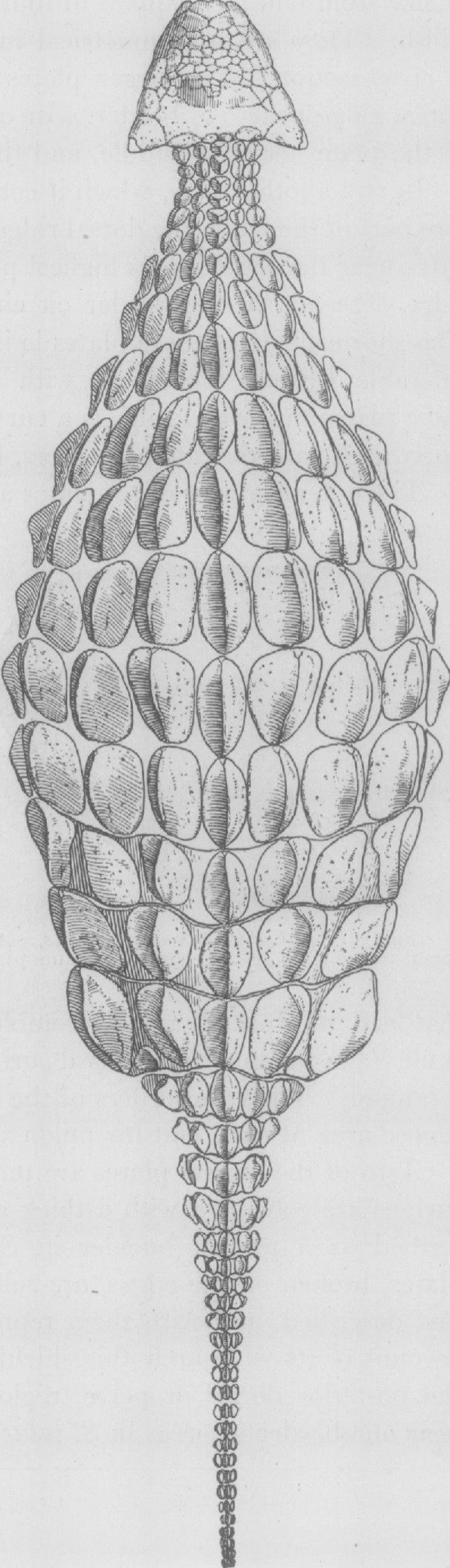
Barnum Brown named the animal in 1908 and published a restoration with it. That restoration has closely packed, fairly uniform body armor, reads the cervical half rings as belonging to the hips and tail (he was reasoning from glyptodonts, the extinct armadillo relatives with banded shells), and ends in a tapering flexible tail with nothing on the end of it. The single most recognizable feature of the animal was missing from its first published portrait.
The club arrived in 1910 with the discovery of AMNH 5214, and from there it worked its way into popular depictions, among them Rudolph Zallinger's 1947 Age of Reptiles mural at Yale. Later reconstructions kept revising the rest. Tracy Ford in 2003 spaced the osteoderms further apart and added a pelvic shield; Kenneth Carpenter in 2004 argued the neck armor formed quarter rings. Arbour and Mallon put the half rings back, rearranged the thoracic and pelvic osteoderms, and adjusted the body proportions again.
Reconstructions running ahead of their evidence is a habit in this corner of paleontology. Mosasaurus spent decades scaled up from a single outsized jaw beyond anything the rest of the material supported, and the inflated figure long outlived the correction. The famous long-necked Brachiosaurus is filled in from a different genus entirely, its type specimen preserving no skull and no neck vertebrae at all.

What did Ankylosaurus eat? The teeth are the wrong size
Arbour and Mallon's best reading is soft, energy-rich plant material rather than bulk foliage, with fruiting bodies and possibly invertebrates in the mix, and the reason they land there is that the teeth are far too small for an animal this size.
Ankylosaurus carried 34 to 36 maxillary teeth, more than Anodontosaurus or Euoplocephalus, and the revised diagnosis puts each crown at less than 2% of basal skull length. Arbour and Mallon plotted unworn crown height against basal skull length across ankylosaurs and found the teeth of Ankylosaurus sitting well below the trend. The jaws could hold more of them because each one was so small.
One detail in that dataset is genuinely difficult to explain. The teeth of CMN 8880, the largest skull known, are absolutely smaller than the teeth of AMNH 5214, the smallest. Not smaller in proportion to the skull. Smaller by direct measurement, in an animal roughly a quarter larger. The paper's closing list of open questions includes "Why are the teeth so variable in size?" with no answer attached.
The feeding arithmetic is odd too. Working from published energy requirements, Arbour and Mallon calculate that an ectothermic Ankylosaurus would have needed about 6 kilograms of dry ferns a day, roughly 2 metric tons a year, an intake Hummel and colleagues considered unrealistic for a herbivore that size. An endothermic one would have needed around 60 kilograms a day, about 20 metric tons a year, which is close to what a large elephant on dry vegetation gets through. The small cusp-like teeth and the selective beak shape suit energy-rich fruiting bodies better than bulk foliage, and the authors raise invertebrates as a possible supplement, pointing to a Liaoningosaurus skeleton found with fish preserved in its chest cavity and to the plate-like hyoglossia, the bones anchoring the tongue, in Saichania and Pinacosaurus that imply a muscular tongue.
Nostrils that do not face forward
In most ankylosaurines the external nares point forward or forward and slightly out. In Ankylosaurus they sit further back on the skull and open downward and outward, so the nostrils are not visible when you look at the animal head on. Arbour and Mallon call this an extreme transformation relative to its relatives from Laramidia, the western landmass North America was split into at the time. The opening is roofed by the loreal caputegulum, one of the bony tiles paving the skull, which is unique among ankylosaurids and forms part of the revised diagnosis for the genus.
What the arrangement was for is unsettled. Coombs suggested expansion of the nasals pushed the opening back, Maryańska blamed overgrowth of the cranial ornamentation, and Carpenter proposed the internal sinuses expanding. Arbour and Mallon list a shift in nasal function, a shift in olfactory ability, and a shift in diet as candidates, then say plainly that choosing between them is not currently possible.
There is at least a good model of what those passages did in related animals. Jason Bourke, Ruger Porter and Lawrence Witmer ran computational fluid dynamics on the looping nasal airways of Panoplosaurus and Euoplocephalus in 2018 and found them working as heat exchangers, recovering 65% and 84% of exhaled heat energy respectively and 69% and 79% of the water. Their reading is that animals this large with brains this small were under constant risk of the brain overheating, and the nasal labyrinth was a way of dumping that load. Neither species is Ankylosaurus, and its own nasal cavity has not been modeled the same way.
How hard could an Ankylosaurus tail club hit?
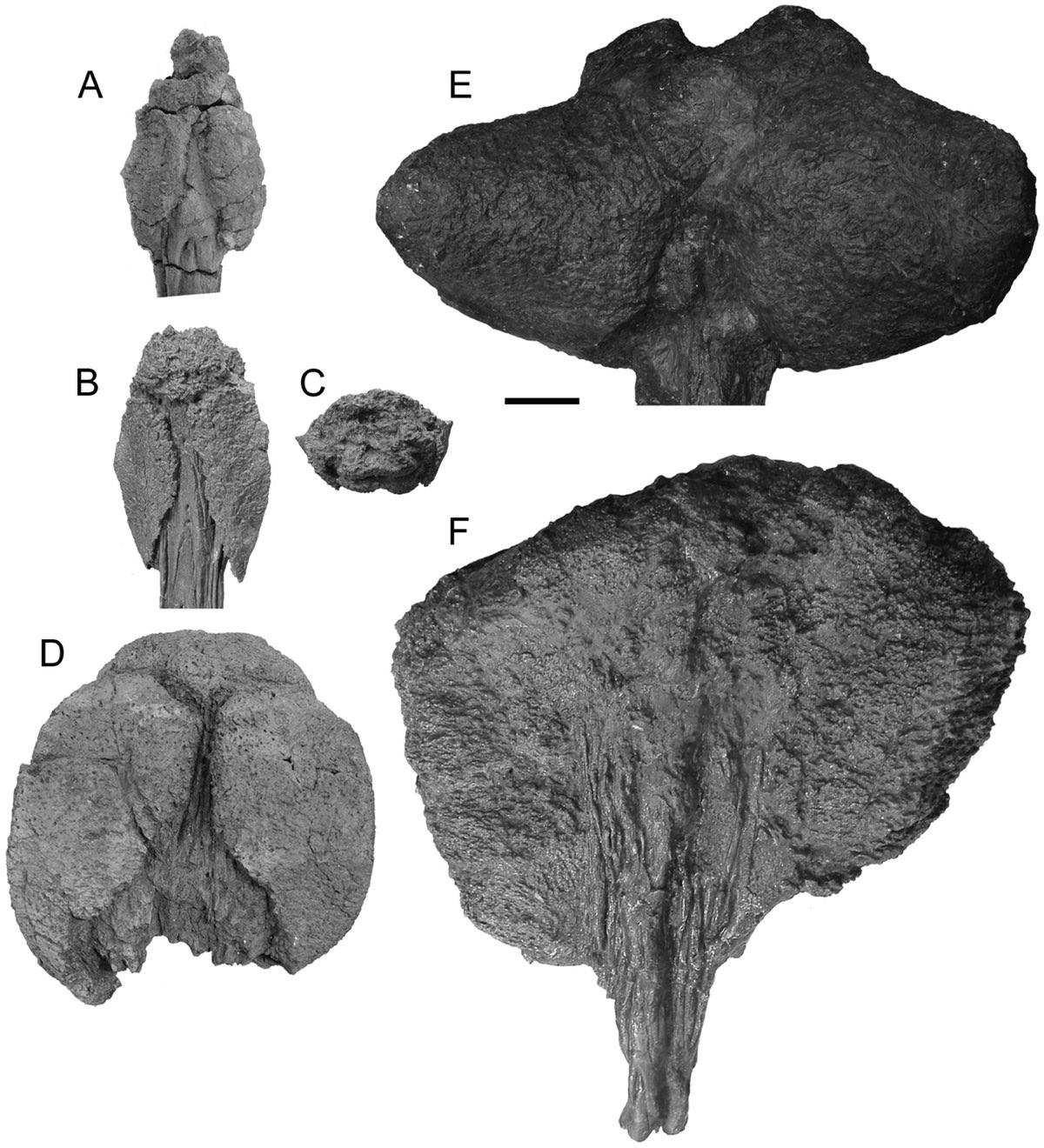
AMNH 5214 preserves the only good Ankylosaurus knob: 60 centimeters long, 49 wide, 19 high, semicircular seen from above. The handle is stranger. Its vertebrae are twice as wide as those of Anodontosaurus and Dyoplosaurus but no longer, which leaves two readings on the table. Either the tail was shorter relative to the body than in its relatives, or the tail had normal proportions and the club on the end of it was small for the animal. Arbour and Mallon's final list of unanswered questions includes what constrained the size of the club.
The force figures repeated in almost every article about this dinosaur come from Arbour's 2009 study in PLOS ONE, and they were not measured on Ankylosaurus. That work CT scanned clubs referred to Dyoplosaurus and Euoplocephalus. A tail with the proportions of the largest specimen in the sample, the composite AMNH 5245 and ROM 788, could deliver 7,281 to 14,360 newtons at an impact stress of 364 to 718 megapascals, and in the paper's words "would very likely break bone." An average knob managed 962 to 2,014 newtons. The smallest club in the study, ROM 784, produced 797 to 1,127 newtons, and while that is roughly twice the force published for a Stegosaurus tail spike, the paper notes the resulting impact stress lands in similar territory because of how the two weapons distribute their blow.
The abstract states the conclusion bluntly: large knobs could break bone and average and small ones could not. The discussion is more careful, noting the average-knob estimate rests on the most fragmentary specimen in the study and that average knobs may have been capable of it after all. The scans also turned up something useful, which is that the knob osteoderms are mostly cancellous inside. A hollow-cored club lowers the rotational inertia of the tail and makes the whole apparatus easier to swing. A companion finite element study by Arbour and Eric Snively the same year found that small and average clubs were unlikely to break during a forceful impact, while large ones risked fracturing just in front of the knob.

Could the tail club break a Tyrannosaurus leg?
The idea has a real source in the literature. Bruce Rothschild and Ralph Molnar catalogued tyrannosaur pathologies in 2008 and proposed that some healed fibula fractures might have come from ankylosaur club strikes. When Arbour returned to the question in her 2009 paper she set out the test that would settle it: model club strikes against ankylosaur ribs for intraspecific combat, and against theropod tibiae and metatarsals for defense.
Thirteen years later she answered it with Lindsay Zanno and David Evans, working from the holotype of Zuul crurivastator, an ankylosaur whose species name means destroyer of shins. The specimen carries osteoderms that were broken and healed while the animal was alive. Those injuries are not scattered at random. A chi-squared test of normal against pathological osteoderms on the back versus the flanks returned p = 0.0039, and the damage sits in a narrow, roughly symmetrical band over the rear of the trunk and the pelvis, exactly where a sideways swing from another Zuul would land. Ankylosaurid tails had limited up-and-down movement, so a club could not easily reach an opponent's back in the first place.
The paper's conclusion is that "sexual selection, rather than predation, appears to have been the primary mechanism" behind the evolution of the club. The authors found no significant correlation between ankylosaurid distal tail width and apex predator body mass. Knob widths do not grow through geological time. Large theropods were around for millions of years before any ankylosaur evolved a stiff tail or a knob, and the nodosaurids never evolved a club at all despite facing the same predators. Juvenile Pinacosaurus have no knob at around 68 centimeters from snout to hip and have one by around 170 centimeters, which is late for a defensive structure and normal for a display weapon. On the 2008 fibula fractures the authors are direct: those injuries could have come from many causes. They also note that ankylosaurids were rare enough in North American faunas that they were probably never a staple tyrannosaur prey item in the first place.
None of this says the club was useless against a predator. The paper is explicit that it could have been used in defense when needed. The claim it dismantles is the stronger one, that fending off theropods is what the club evolved for.
That distinction has not traveled far. The 2022 authors surveyed popular depictions themselves and reported that they overwhelmingly show ankylosaurids swinging their clubs at theropods. The pattern holds in enthusiast spaces: a widely upvoted r/Dinosaurs thread from April 2024, "You're a gigantic predator, what exactly are you supposed to do against an Ankylosaurus?", drew 94 comments framed entirely around the club as an anti-predator problem, with the top replies suggesting flipping the animal over, driving it into mud, or waiting for something bigger to do the work. A detailed Hell Creek illustration posted in March 2026 still describes deterring predators as a well known fact about the club, and gives the animal a length of 6 meters where Arbour and Mallon's estimate for the largest skull runs from 7.56 to 9.99 meters.
Some of it is getting through. An artist posting a Zuul illustration in March 2024 asked the subreddit directly whether the club was about in-group fighting rather than defense, and framed it as "Did Zuul shatter shins or hearts?" The gap between the animal in the ground and the animal in the culture is a familiar one anyway. Velociraptor was turkey-sized and covered in feathers for years of scientific consensus before the popular image began to shift.