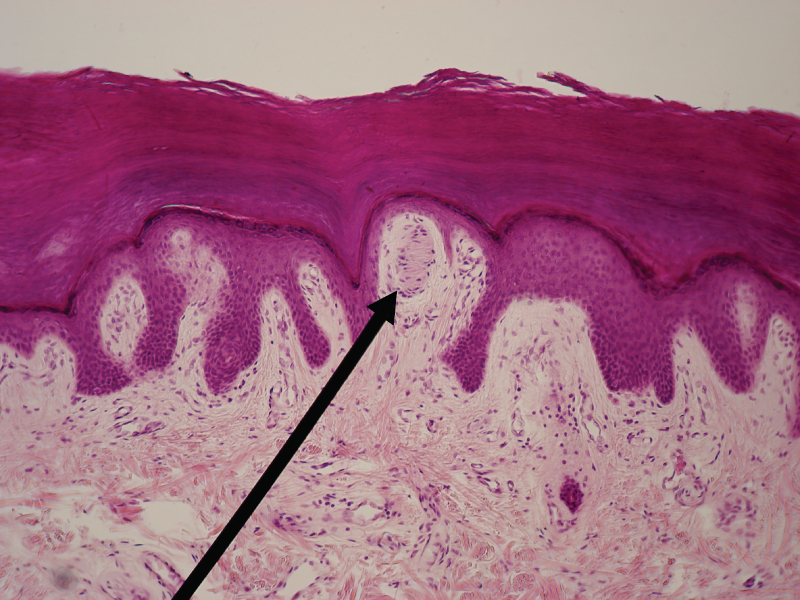

What they are and where they're built to work
Meissner's corpuscles sit inside the dermal papillae, the fingerlike ridges where the dermis pushes up into the epidermis, but only in glabrous skin, the smooth, hairless kind found on fingertips, palms, soles, and lips. According to the NCBI Bookshelf edition of Purves et al.'s Neuroscience textbook, each corpuscle is an elongated capsule built from several stacked layers of Schwann cells wrapped around one or more nerve endings, and the fibers feeding these corpuscles account for roughly 40 percent of the total sensory innervation of the human hand, more than any other single receptor type in the skin. Not every animal's most sensitive touch organ sits in the skin at all: a narwhal's tusk is itself a nerve-packed sensor with an estimated 10 million endings, reading water salinity and temperature, not surface texture.
The corpuscles are rapidly adapting, meaning they fire a burst of signal when the skin is first depressed and then go quiet even if the pressure holds steady, and they're most efficient at picking up relatively low-frequency vibration, in the 30 to 50 Hz range, the kind of signal produced when a textured object slides across a fingertip. Pacinian corpuscles, the other major rapidly adapting touch receptor, sit much deeper, in the subcutaneous tissue well below the epidermis, and their onion-like capsule of fluid-separated membrane layers acts as a mechanical filter tuned to a completely different band, 250 to 350 Hz, the higher-frequency buzz that travels up a tool or surface rather than direct skin contact. The two receptor types adapt at different speeds too: Pacinian corpuscles adapt even faster than Meissner's and have a lower response threshold, which is why they pick up vibration transmitted through something you're holding, while Meissner's corpuscles do the work when a fingertip reads a surface directly.
A discovery that ended a friendship
Georg Meissner and Rudolf Wagner worked together at the University of Göttingen, and in 1851 Meissner joined Wagner, along with future surgeon Theodor Billroth, on a research trip to Trieste to study the nerves of electric rays. Back in Göttingen, Meissner turned to the skin and identified the tactile corpuscles that would eventually carry his name. In February 1852, Wagner published their joint findings, describing peculiar bodies in the papillae of the fingers and palm and proposing the Latin name corpuscula tactus. Meissner dedicated his doctoral dissertation to Wagner and credited him for the collaboration, but within a few years the two men were each claiming sole credit for the discovery, a dispute serious enough that, per the biographical record on Meissner, it strained their relationship for years.
Meissner went on to a career that outlasted the argument: he held professorships at Basel, Freiburg, and eventually Göttingen again, described a second, unrelated structure now called Meissner's plexus (a nerve network in the gut wall that shares his name but not his skin discovery), and, per the historical record on Robert Koch, served as Koch's doctoral advisor at Göttingen. Koch would go on to identify the bacteria behind tuberculosis, cholera, and anthrax and win the 1905 Nobel Prize in Physiology or Medicine, a scientific lineage that started with a professor better known today for a sensor smaller than a grain of rice. Vibration and pressure sensing through touch turns up in stranger places than human skin, too: a trapdoor spider hunts entirely by feeling ground vibration through its legs, catching prey at a high rate even with its eyes painted over.
What a 2020 mouse study actually proved
For more than a century, everything known about what Meissner's corpuscles actually do came from indirect evidence: recordings from human nerve fibers, correlations between receptor density and touch sensitivity, and inference from the corpuscle's location and structure. That changed in 2020, when a team led by Harvard Medical School neuroscientist David Ginty bred mice genetically engineered to lack Meissner corpuscles and tested what the animals could and couldn't feel. Ginty later explained why the model mattered to Pain Research Forum: "We're excited to have a mouse model in which Meissner corpuscles are lacking, as well as new genetic tools to visualize and functionally manipulate Meissner corpuscle afferents, because this mechanosensory end organ was discovered in the 1850s, and its functions in tactile perception have remained unclear." The mice were measurably worse at detecting the gentlest forces applied to glabrous skin and showed impaired fine sensorimotor control, the first direct behavioral evidence tying the corpuscle's presence to a specific perceptual and motor function, not merely correlating with it.
The same study documented something about the corpuscle's internal wiring that hadn't been shown before: each individual Meissner corpuscle is innervated by two molecularly distinct, but physiologically similar, mechanosensory neuron types, with their nerve endings intertwined inside the same capsule. The two neuron subtypes are developmentally interdependent, meaning one doesn't fully form without the other, and their receptive fields on the skin surface tile in a pattern that's uniform and complete but offset and overlapping between the two types, rather than each neuron simply covering its own patch. The researchers proposed that the extent of lamellar wrapping around each nerve ending inside the corpuscle helps set that neuron's specific force threshold and response speed, giving one small structure two overlapping but distinct channels for reading the same patch of skin. The Perspective article Science ran alongside the study was co-written by Ardem Patapoutian, who the following year shared the 2021 Nobel Prize in Physiology or Medicine with David Julius for related discoveries about how the nervous system senses touch and temperature.
Why fingertips get less sensitive with age, but not evenly
A 2019 study in the Journal of Anatomy, led by researcher Jorge García-Piqueras, examined post-mortem finger skin from subjects across three age brackets, 20 to 39, 40 to 59, and 60 to 90 years old, using immunohistochemistry to count and measure Meissner corpuscles, Merkel cells, and Pacinian corpuscles in each sample. The number of Meissner corpuscles and Merkel cells fell sharply with age: the oldest group had roughly four to five times fewer than the youngest group, and the corpuscles that remained had changed shape, growing smaller and more rounded, sitting deeper in the dermis, with visible signs of denervation in the oldest subjects. A different animal illustrates nonvisual sensing underground: Eumillipes persephone has no eyes and unusually long antennae. Its anatomy does not establish a touch-over-sight tradeoff in aging humans.
Pacinian corpuscles, examined in the same tissue samples, told a different story. The study's own summary states that Pacinian corpuscles "generally showed no relevant age-related alterations," meaning the deep pressure-and-vibration receptor held up while the surface touch receptor declined. The researchers linked the Meissner and Merkel decline to reduced expression of Piezo2, a mechanically gated ion channel involved in light-touch sensing, and to falling levels of the BDNF-TrkB neurotrophic signaling system that helps maintain the corpuscles in the first place. A separate 2023 Journal of Physiology study modeling the same effect reached the same conclusion from a different angle: aging skin loses fine texture discrimination and light touch sensitivity through Meissner corpuscles faster and more severely than it loses deep pressure or vibration sensing through Pacinian corpuscles, a specific and uneven pattern rather than a uniform fade in the sense of touch.
Engineers are now copying the design
More than 170 years after Meissner and Wagner first described the corpuscles, their structure has become a literal blueprint for touch-sensing hardware. In a paper published in Science Advances in March 2025, a research team led by biomedical engineer Sriramana Sankar built a prosthetic hand whose outer sensor layer explicitly mimics two of the skin's four primary mechanoreceptor types: Merkel cells, which respond to light touch, and Meissner corpuscles, which respond to low-frequency vibration. Tested on everyday objects of varying texture, weight, and compliance, the hand's multilayered tactile sensing reached 99.69 percent average accuracy classifying different objects by feel and 98.38 percent average accuracy on a dedicated texture-discrimination task, according to the paper's own reported results, outperforming earlier soft robotic and rigid prosthetic fingers tested the same way.
A separate 2025 study took a narrower approach, building what its authors call a biomimetic roll-type tactile sensor, using a coiled electrode structure and a magnet-responsive fluid to reproduce the layered, elongated geometry of an actual Meissner corpuscle rather than just its general sensing role. The design showed high responsiveness across a range of dynamic motions, pressing, pinching, twisting, bending, and shearing, the same category of everyday moving contact that a fingertip's Meissner corpuscles are already tuned to read at 30 to 50 Hz. The corpuscle that Georg Meissner first drew under an 1850s microscope is now a design spec engineers are trying to fabricate directly.