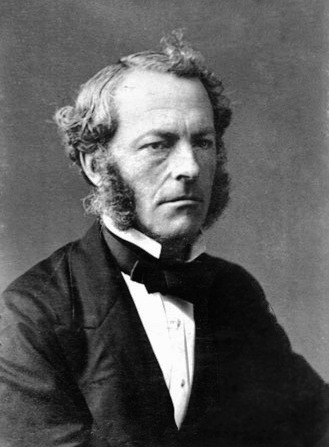

The pendulum problem Stokes was actually trying to solve
George Gabriel Stokes wasn't trying to explain how spheres fall through liquid when he worked out the formula that now carries his name. He was chasing a much narrower problem: in the mid-1800s, a swinging pendulum was one of the most precise instruments available for measuring g, the local acceleration due to gravity, and getting an accurate reading meant accounting for every force acting on the bob, including the drag of the surrounding air, which slows the swing and throws off the timing a clean gravitational calculation depends on. Stokes worked through the physics in a paper for the Transactions of the Cambridge Philosophical Society, "On the Effect of the Internal Friction of Fluids on the Motion of Pendulums," published in 1851, a decade into his career at Cambridge.
To correct for that drag, Stokes needed a general answer to a specific question: how much does a viscous fluid resist a small sphere moving slowly through it? He derived that the resisting force is proportional to the fluid's viscosity, the sphere's radius, and its velocity, a relationship now written as F = 6πηrv, where η stands for the fluid's viscosity, r for the sphere's radius, and v for its velocity. The formula answered Stokes' pendulum question, but it also turned out to describe something much broader than a swinging bob: how any small sphere settles through a viscous fluid under gravity, a fact that would matter far more to later physicists than the pendulum problem that produced it.
The formula, and what it actually predicts
Stokes' drag formula comes out of a simplified version of the Navier-Stokes equations for what fluid dynamicists call creeping flow, the regime in which a fluid's viscosity dominates the physics and the moving object's own inertia barely registers. Set that drag against the pull of gravity, minus the buoyant push from the fluid the sphere displaces, and the two balance out at a constant falling speed known as terminal velocity, v = d²gΔρ / (18η), where d is the sphere's diameter, g is gravitational acceleration, Δρ is the difference between the sphere's density and the fluid's, and η is the fluid's viscosity. Run in reverse, timing how fast a sphere of known size and density falls through a liquid whose viscosity is unknown, the same equation is still how a falling-ball viscometer measures viscosity directly, a piece of lab equipment built on 170-year-old physics.
Plugging in real numbers shows how slowly the formula predicts small things fall. A water droplet 40 micrometers across, roughly the width of a fine human hair and a realistic size for an individual droplet inside a cloud, has a density of about 1,000 kilograms per cubic meter settling through air, whose viscosity runs about 1.81 x 10^-5 pascal-seconds at 20°C. Working through Stokes' formula with those figures gives a terminal velocity of roughly 4.8 centimeters per second, slow enough that the droplet takes close to a minute to sink three meters, and slow enough that an ordinary updraft inside a cloud easily keeps it suspended rather than letting it fall. Shrinking precipitation can fall more slowly and drift farther with the wind, helping explain why a virga streak curves as it falls. The square-of-diameter rule applies only in creeping flow through a Newtonian fluid, not to every drop or ice particle in a trail.
Why the law breaks down for actual raindrops
That 4.8-centimeter-per-second droplet sits comfortably inside the regime where Stokes' formula holds. Fluid dynamicists express that regime using the Reynolds number, a ratio of inertial to viscous forces, and Stokes' law is considered reliable only below a Reynolds number of roughly 1, with error climbing above 2 percent once it passes about 0.1; the 40-micrometer droplet above works out to a Reynolds number around 0.13, safely inside that window. Solving Stokes' own formula for the diameter at which a falling water droplet in air first crosses a Reynolds number of 1 gives a value of about 80 micrometers, meaning the law's clean linear relationship between drag and velocity is only trustworthy for droplets smaller than roughly the width of a human hair.
Actual raindrops are ten to fifty times larger than that threshold, and they behave nothing like Stokes predicts. NASA's Global Precipitation Measurement mission describes drops smaller than about 1 millimeter as essentially spherical, held in shape by surface tension, but as a drop grows past that size and falls faster, the air pushing against its underside flattens the bottom while the top stays rounded, and once a drop reaches roughly 4 to 5 millimeters across it becomes unstable and splits apart entirely. None of that deformation exists in Stokes' math, which assumes a perfectly rigid, undistorted sphere. Once a falling drop is large enough to flatten under its own aerodynamic pressure, viscosity has stopped being the dominant force resisting its fall, and Stokes' 1851 formula no longer applies.
Real applications: measuring electron charge and grading soil
The most famous use of Stokes' law came a good six decades after Stokes published it, and it wasn't about pendulums or raindrops at all. Between 1909 and 1913, Robert Millikan and Harvey Fletcher sprayed a fine mist of oil droplets into a chamber, applied a voltage across it, and used Stokes' formula to work out each droplet's radius from how fast it fell under gravity alone, then measured how strong an electric field was needed to hold a charged droplet motionless against that same gravity, which let them isolate the electric charge sitting on the droplet. Millikan published his result in August 1913, reporting an elementary charge of 1.592 x 10^-19 coulombs and claiming an uncertainty of only 0.2 percent. The modern accepted value is 1.602 x 10^-19 coulombs, a difference of roughly half a percent, and physicists later traced the gap to the specific value Millikan used for the viscosity of air in his Stokes' law calculation, a figure a Swedish researcher named Kellström measured as noticeably higher a couple of decades afterward. Get the viscosity term wrong and Stokes' formula quietly carries that error straight into the answer.
The same formula, run on particles settling through water instead of oil droplets falling through air, still underlies a standard soil-science technique called the hydrometer method: stir a soil sample into water, let it settle, and read a floating hydrometer at set time intervals to see how much material remains suspended, since Stokes' equation converts each settling time directly into a particle diameter. Guelph University researchers who validated the technique found it holds across roughly the range 0.2 millimeters down to 0.0002 millimeters, the same Reynolds-number ceiling that rules out raindrops capping the upper end, while particles finer than about 0.0002 millimeters get jostled around by random Brownian motion faster than gravity can settle them, so the same law that once corrected a pendulum clock is still how a soil lab sorts a handful of dirt into sand, silt, and clay.