
What Newton actually wrote in 1687
Isaac Newton never wrote down an equation for viscosity. In Book II of the Principia, published in 1687, he stated a hypothesis in prose: the resistance arising from a fluid's "defectus lubricitatis," its lack of slipperiness, is proportional to the velocity at which its parts are pulled apart from one another. Later physicists turned that sentence into what's now called Newton's law of viscosity: shear stress is proportional to the rate at which adjacent fluid layers slide past each other, and the ratio between the two, viscosity, stays constant for a given fluid at a fixed temperature and pressure. A fluid that holds to that proportionality no matter how hard or gently it's stirred, poured, or sheared is called Newtonian.
That constancy is the whole definition. It doesn't mean a Newtonian fluid resists flow by some fixed amount; honey obviously resists more than water does. It means the resistance stays proportional to the stirring, whether the stirring is slow or violent, the same way the stiffness in Hooke's law doesn't change depending on how far a spring gets stretched. That constant ratio is also the starting assumption behind one of the oldest formulas for how fast a small sphere sinks through a fluid: Stokes derived that terminal-velocity formula in 1851 to correct pendulum clocks for air drag. Its derivation assumes a Newtonian fluid and slow, creeping flow around an isolated sphere; constant viscosity alone is not enough.
The ordinary fluids that follow the rule
Most fluids people handle daily happen to obey Newton's proportionality. Water sits at about 1 centipoise, roughly 1 millipascal-second, at 20 degrees Celsius, the reference point the whole viscosity scale is built around. Air, a gas and not a liquid, follows that same linear relationship at about 0.0181 millipascal-seconds at that temperature, some 55 times thinner than water. Honey runs far thicker, typically somewhere between 2,000 and 10,000 centipoise depending on its water content and the surrounding temperature, and most liquid honey stays Newtonian across that range. A 2021 rheology review published in the journal Foods found real exceptions, though: manuka, buckwheat, and several eucalyptus-sourced honeys, along with any honey that has started to crystallize, thin out under continued stirring, so the stress-to-flow ratio stops holding constant.
Air's status as a Newtonian fluid isn't a throwaway technicality. In the creeping-flow limit, a small spherical water droplet has a settling speed proportional to the square of its diameter. Shrinking drops can also fall more slowly within a virga trail, allowing wind to carry its lower part sideways. Larger drops and ice particles need drag models beyond the small-sphere approximation.
Where the rule breaks down
Plenty of familiar fluids ignore Newton's proportionality outright. Ketchup and blood are shear-thinning, or pseudoplastic: squeeze or shake them and their effective viscosity drops, which is why a full ketchup bottle needs a hard slap to get moving but then flows freely. Cornstarch stirred into water goes the other way, shear-thickening, or dilatant: stir it slowly and it behaves like a thick liquid, but hit it and the mixture locks up almost instantly, resisting the sudden force. Neither pattern fits Newton's 1687 hypothesis, because in both cases the ratio between stress and strain rate shifts with how hard the fluid gets pushed, rather than holding steady the way it does in water or honey.
For a Newtonian liquid, treating viscosity as constant simplifies a mathematical model of its motion. A stalagmite's growth models, for instance, can use a dimensionless value called the Damköhler number, the balance between how fast dissolved calcite precipitates out of drip water and how fast that water spreads across the growing tip. Modeling that balance cleanly depends on the drip water behaving in a predictable, Newtonian way as it flows. Water moving through pore spaces also carries material out of soil during eluviation that carves out a pale E horizon. The horizon description establishes that transport process; predicting its rate also requires soil permeability and other conditions.
What quicksand research actually found
Quicksand gets filed under the same non-Newtonian umbrella, but the mechanism turned out to be stranger than either shear-thinning or shear-thickening alone, and it took until 2005 for anyone to measure it directly. Asmae Khaldoun, Erika Eiser, Gerard Wegdam, and Daniel Bonn, working at the University of Amsterdam, brought natural quicksand into a laboratory rheometer and published their results in Nature. They found that quicksand, unlike sand or clay tested separately, does both things in sequence: applying stress first collapses its internal structure and drops its viscosity sharply, liquefying the mixture, and then, as sand and trapped water continue separating under ongoing disturbance, the viscosity climbs back up rather than staying low. That two-stage behavior, not a mythical suction dragging someone downward, is what the researchers pointed to as the real reason a person who starts thrashing in quicksand has such a hard time getting free.
The same study ran a simple calculation that undercuts a more dramatic part of the myth: full submersion. A human body is less dense than the saturated sand-and-water slurry that makes up quicksand, so buoyancy alone keeps a person from sinking completely under the surface, the same way a swimmer floats higher in denser saltwater than in a freshwater pool. What actually endangers someone stuck in quicksand tends to be external, an incoming tide, exposure, or a limb trapped too long before help arrives, rather than the ground swallowing them whole the way films tend to show it.

.jpg)
The other myth: does glass actually flow?
Old cathedral windows are often held up as proof that glass, loosely treated as an extremely viscous liquid rather than a true solid, slowly flows downward over centuries, leaving panes thicker at the bottom than at the top. Physicist Edgar Zanotto tested that claim directly in a 1998 paper in the American Journal of Physics, calculating the viscosity of representative medieval glass compositions extrapolated to room temperature and using it to estimate how long a pane would need to visibly sag under its own weight. His result: a relaxation time of at least 10^32 years, a number so far past the roughly 13.8-billion-year age of the universe that measurable flow at room temperature is, for practical purposes, physically impossible. The real explanation for uneven old window panes is far more mundane: hand-blown crown glass came out uneven to begin with, and glaziers commonly installed the thicker edge at the bottom for stability, a manufacturing habit mistaken centuries later for evidence of flow.
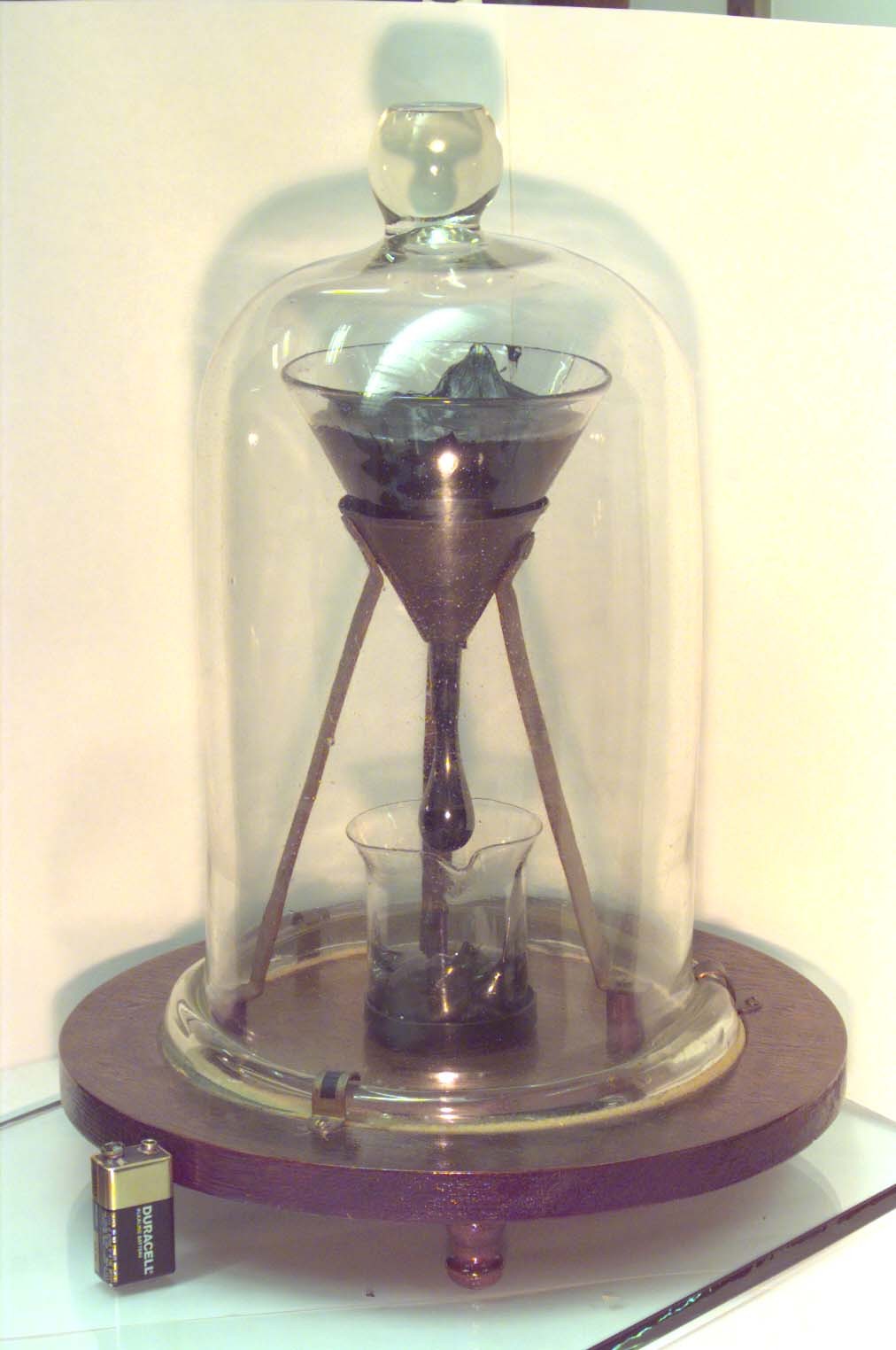
Pitch shows what a genuinely slow-flowing, essentially Newtonian fluid actually looks like. Thomas Parnell set up the University of Queensland's pitch drop experiment in 1927, pouring heated pitch into a sealed funnel and cutting its spout open three years later. Only nine drops have fallen since, with gaps between them running anywhere from about seven to fourteen years, and the ninth, in April 2014, was the first ever caught on camera after 87 years of nobody witnessing the moment. Physicists Robert Edgeworth, B.J. Dalton, and Thomas Parnell used the timing of the early drops to calculate the pitch's viscosity in a 1984 paper, treating it as an ordinary Newtonian fluid even though it's hard enough to shatter with a hammer, and arrived at roughly 2.3 x 10^8 pascal-seconds, on the order of 100 billion times more viscous than water. Pitch, unlike glass, really does flow measurably within a human lifetime; it's just thick enough that watching it happen takes more patience than most people have.