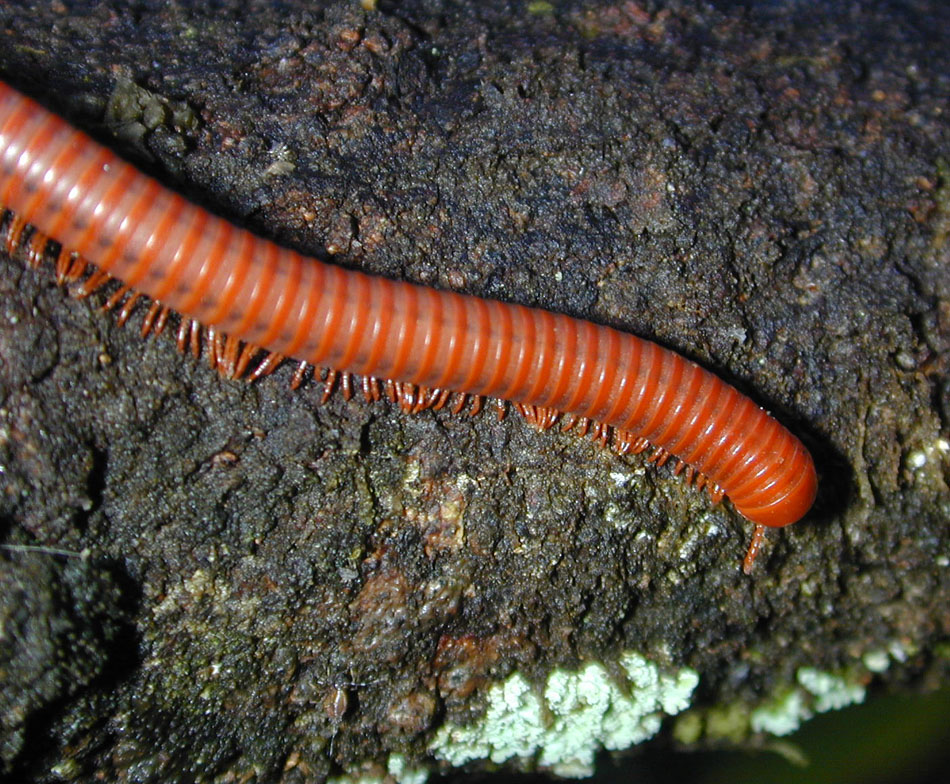

What actually makes something a millipede
The single feature that separates a millipede from every other myriapod is a fused body segment called a diplosegment, formed early in development when two originally separate segments merge, each one carrying two full pairs of legs, not just one. That's the whole distinction between millipedes (class Diplopoda) and centipedes (class Chilopoda): a centipede has one leg pair per segment and a modified front pair, called forcipules, that grip and inject venom into prey. A millipede has none of that: no venom claws, and nothing built for grabbing or biting prey. Almost every one of the roughly 12,000 formally described species, out of an estimated 145 families and 16 orders, is a detritivore, grinding through dead leaves, rotting wood and fungi with mouthparts built for chewing plant matter rather than piercing prey, according to the taxonomic overview in Brewer, Sierwald and Bond's 2012 survey published in PLOS ONE. Where a centipede is a fast, venomous predator, a millipede is a slow, armored decomposer. They belong to different myriapod classes and have different leg arrangements and feeding structures.
Leg count itself varies enormously and rarely gets anywhere near the number in the name. Common species most people encounter carry somewhere between 40 and 400 legs, and individuals keep adding segments (and therefore legs) throughout their lives as they molt, so the same species can show a range of counts depending on age. More than 260 years after Carl Linnaeus first classified millipede species, cataloging several Julus specimens in the 1758 edition of Systema Naturae, the literal thousand-foot threshold the group's common name promises had simply never been documented in any specimen, described or otherwise.
The 80,000-species figure that keeps getting repeated doesn't hold up
A number that circulates widely online claims roughly 80,000 millipede species exist worldwide, dwarfing the 12,000 that have actually been described and named. That figure traces back loosely to older, informal extrapolations rather than a rigorous count. When Michael Brewer, Petra Sierwald and Jason Bond set out in 2012 to actually test millipede diversity estimates empirically, publishing their results in PLOS ONE, two of their three species-richness estimation methods put the real total closer to 13,413 to 16,760 species, not 80,000. That's a meaningful undercount relative to what taxonomists have already found and described, roughly 25 to 40 percent more species than currently have names, but nowhere near a sevenfold gap.
The authors' broader point wasn't really about the number itself. They were flagging that millipede taxonomy is unevenly studied, concentrated in a handful of well-collected regions, with vast stretches of tropical soil and leaf litter never systematically surveyed, so any single global estimate carries wide uncertainty in either direction. The 80,000 figure keeps getting repeated in blog posts and pest-control sites specifically because it sounds more dramatic than a modest, well-reasoned correction, which is a pattern that shows up whenever a rounder, bigger number is more shareable than the number that actually came out of the study.
The specimen that finally lived up to the name
In December 2021, Paul Marek of Virginia Tech and six co-authors described a new species in Scientific Reports that finally closed a gap of more than 260 years between the name "millipede" and reality. Eumillipes persephone is a pale, eyeless, threadlike animal just under a millimeter wide and about 95.7 millimeters long, pulled from a mineral-exploration drill hole roughly 60 meters below the surface of the Eastern Goldfields region of Western Australia. It has 330 body segments and, the researchers counted, exactly 1,306 legs, more than any animal ever documented, millipede or otherwise. Before this specimen, the record for any millipede stood at 750 legs, held by Illacme plenipes of California, meaning no species anywhere had ever cleared even three-quarters of the number implied by "thousand feet." As Marek told NPR's All Things Considered when the discovery was announced, the name "millipede" itself is "actually an exaggeration," since "there are no millipedes until now that had more than 750 legs."
E. persephone shows the classic hallmarks of a troglomorphic animal, adapted to permanent life underground with no light: it has no eyes, no pigment, and an elongated, cone-shaped head with unusually long antennae and a beak-like mouth, likely adaptations for feeling and feeding its way through fungal threads in total darkness rather than seeing anything at all. That reliance on touch has a broad parallel in human skin: Meissner's corpuscles, packed into fingertips, respond to light contact and low-frequency vibration. The comparison concerns non-visual sensing, not evidence that millipede antennae and human corpuscles share the same mechanism. Its extreme leg count may itself be an underground adaptation, since a very long, thin, many-legged body can push through narrow, irregular soil channels more effectively than the shorter, thicker plan most surface millipedes carry.
A land animal older than trees, found by one man in Scotland
The oldest confirmed evidence of any animal breathing air on land isn't a full skeleton; it's a single centimeter-long fragment of fossilized millipede cuticle. Mike Newman, an amateur fossil collector, found it in 2001 in the Cowie Harbour Fish Bed near Stonehaven, Aberdeenshire, and Heather Wilson and Lyall Anderson formally described it in 2004 as Pneumodesmus newmani. What makes the fragment significant is a row of small openings along its body wall, interpreted as spiracles, the external openings of a tracheal breathing system that only functions in air, making P. newmani the earliest known animal with direct physical evidence of pulling oxygen straight from the air, not filtering it out of water.
The fossil's exact age was disputed for years, with estimates ranging from the mid-Silurian to the earliest Devonian depending on which rock layer and dating method researchers used. A comprehensive 2025 stratigraphic review by Michael Brookfield, Elizabeth Catlos and Hannah Garza that combined spore biostratigraphy, vertebrate fossil evidence and multiple rounds of uranium-lead zircon dating settled on an age of roughly 419 to 411 million years, spanning the Silurian-Devonian boundary. Even at the more conservative end of that range, the fossil predates the earliest known trees, which the fossil record places around 385 million years ago, by tens of millions of years: this myriapod was breathing air on land before anything resembling a forest existed for it to walk under.
A toxin strong enough that lemurs get high on it
When threatened, most millipedes don't run or fight; they curl into a tight coil, protecting the soft underside, and release a defensive fluid from paired glands, called ozopores, running down each side of the body. The exact chemical mix varies by species, but commonly includes benzoquinones, along with smaller amounts of hydrogen cyanide, phenols or hydrochloric acid, according to a StatPearls clinical review of millipede toxin exposure in humans. In people, contact typically causes only localized skin discoloration and mild irritation that clears up within days to weeks, though the same review notes eye contact is more serious, some larger species can spray the fluid several centimeters, and while permanent injury is rare, it does happen. That reputation outpaces the clinical evidence, a pattern FactCrumbs has tracked across other misunderstood animals.
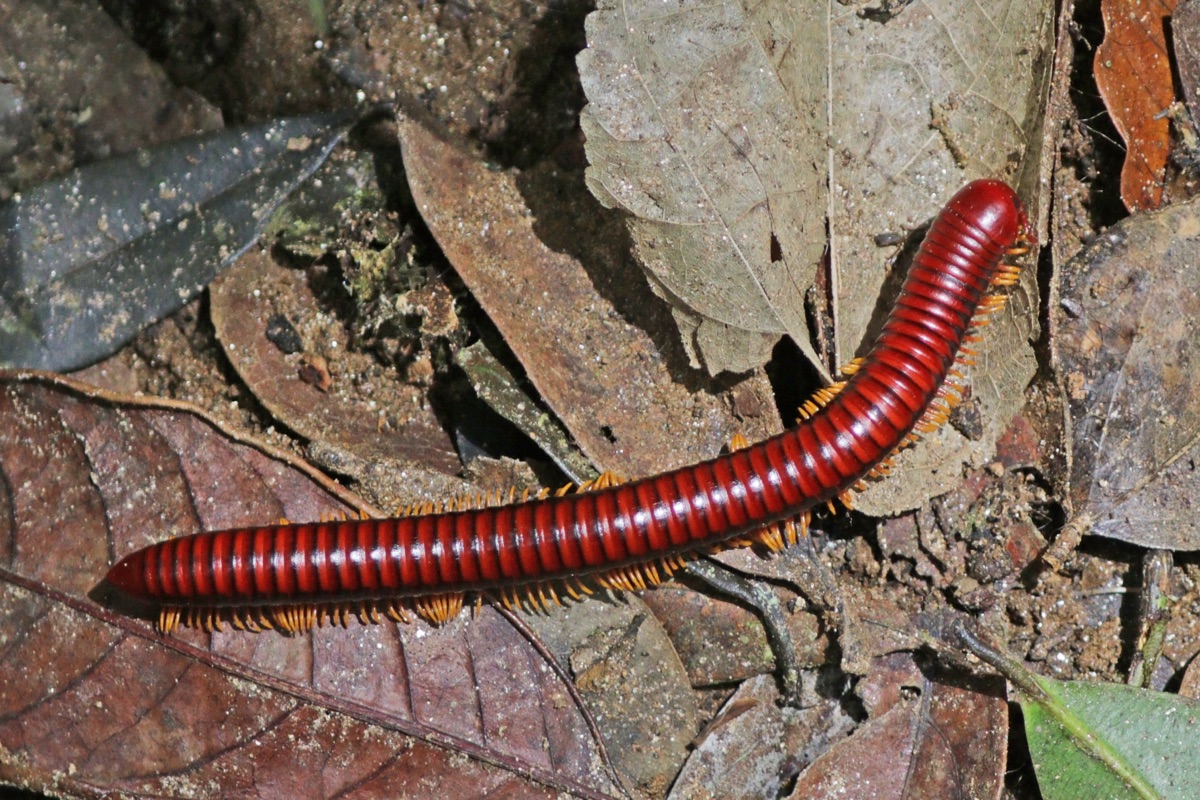
That same defensive chemistry gets deliberately exploited by at least one primate. In a 2018 study published in the journal Primates, Louise Peckre, Clara Defolie, Peter Kappeler and Claudia Fichtel observed wild red-fronted lemurs (Eulemur rufifrons) in Madagascar's Kirindy Forest repeatedly catching millipedes, chewing them at length, and rubbing the resulting toxic saliva into their perianal-genital fur and tails; several individuals also swallowed the chewed millipedes outright. The researchers propose the behavior functions as a form of self-medication, with the anointing and ingestion working together against gastrointestinal parasites, and multiple observers have described the lemurs entering a visibly altered, trancelike state during the process, consistent with mild intoxication from the same benzoquinone compounds that irritate human skin. Bright coloration in species like the Madagascar fire millipede pictured below functions as a warning signal for this same chemistry: a visual advertisement, to anything that might consider eating one, that a chemical deterrent is waiting underneath.
_Mantadia.jpg)